
Confused by the Past Tense of Swing? Get the Facts Here

Quick Answer
The past tense of swing is swung. “Swang” and “swinged” are not correct.
Every day: I swing the bat.
Yesterday: I swung the bat.
Many times: I have swung the bat before.
Swing, Swung, Swung — See the Pattern
Read these sentences. Look at how the verb changes:
- The children swing on the swings every day. (now — it happens regularly)
- She swung the door open yesterday. (past — it is finished)
- He has swung the bat many times this season. (past with “has”)
Did you see the pattern? There are two forms for the past:
| When? | Form | Example |
|---|---|---|
| Now / every day | swing | I swing the bat every morning. |
| In the past | swung | I swung the bat yesterday. |
| With have / has / had | swung | I have swung the bat before. |
Notice something nice? The past form and the “have” form are the same word — swung. That makes this verb easier than many others. You only need to remember one word for both.
When to Use Swing and When to Use Swung
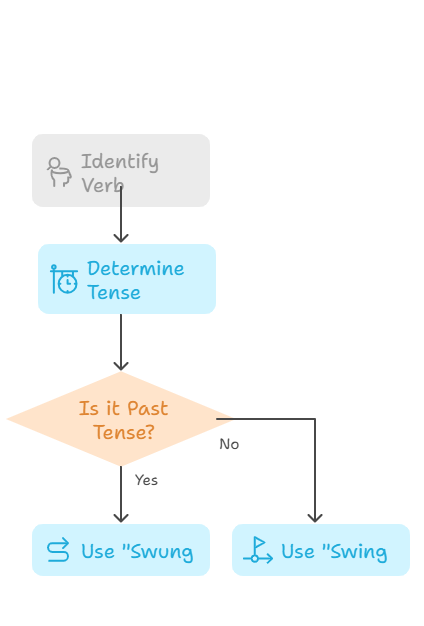
Here is the simple rule:
Use “swing” when you talk about now or something that happens regularly:
- I swing my bag over my shoulder every morning.
- The monkeys swing from tree to tree.
Use “swung” when you talk about the past — with or without a helping word:
- She swung the rope over the fence. (past — no helping word)
- He has swung by the shop on his way home. (with “has”)
- They had swung the door shut before I arrived. (with “had”)
Easy way to remember: If the action is finished or in the past, the answer is always swung. It does not matter if you use have, has, or had — it is still swung.
The Rule in One Line: Past tense? Always swung. Never “swang” or “swinged.”
How to Use Swung in Everyday English
Here are sentences you might use in real life:
- She swung the door open and walked in. (past — she pulled the door open)
- The monkey swung from branch to branch. (past — it moved through the trees)
- He swung by my house after work. (past — “swung by” means “visited quickly”)
- The vote has swung in her favour. (with “has” — opinions changed)
- The children had swung on the swings all afternoon. (with “had” — they played for a long time)
You are doing great. Now let’s look at the mistakes many learners make.
Two Mistakes to Avoid With Swing
Even native speakers sometimes say “swang” because it sounds like “rang” or “sang.” So if you have said it too, you are not alone.
Mistake 1: Saying “swang” instead of “swung”
✗ He swang the bat and missed.
✓ He swung the bat and missed.
Mistake 2: Adding “-ed” to make “swinged”
✗ She swinged the rope over the fence.
✓ She swung the rope over the fence.
How to remember: Think of the word “stung.” A bee stung you — not “stang” or “stinged.” Swing works the same way: swung, not swang.
Other verbs that follow the same pattern: sting → stung, cling → clung, fling → flung, wring → wrung.
Test Yourself: Swing, Swang, or Swung?
Choose an answer to see your feedback immediately. Your first answer counts towards your score.
1. He _______ the bat and hit the ball.
2. The monkey has _______ from tree to tree all morning.
3. The gate _______ open in the wind last night.
4. She had _______ the rope across the river before we arrived.
5. The children _______ on the swings all afternoon yesterday.
Keep Going — You Are Building Something
You just learned swing → swung. That is one more irregular verb you will never get wrong again.
But here is something interesting. You now know that swing only has one past form — swung. The verb ring sounds very similar, but it has two different past forms. Do you say “I rang the bell” or “I rung the bell”? And what about “I have rang” versus “I have rung” — which one is right?
Next lesson: Is It Rang or Rung? Understanding the Past Tense of Ring
Source
Harper, Douglas. “Etymology of swing.” Online Etymology Dictionary

I’m Khamis Maiouf. I’m studying Health and Social Care and have completed Functional Skills Level 2 in English and Level 3 Hairdressing. I have taught ESOL in my community and helped students with GCSE English. I run English Teacher Site to help people learn and practise English.