
Forget, Forgot, Forgotten Explained: Simple Examples for Learners

Quick Answer
The past tense of forget is forgot. With “have” or “has,” use forgotten.
Every day: I forget things.
Yesterday: I forgot my keys.
Many times: I have forgotten my keys before.
Forget, Forgot, Forgotten — See the Pattern
Read these sentences. Look at how the verb changes:
- I forget names all the time. (now — it happens often)
- She forgot her phone at home yesterday. (past — it is finished)
- We have forgotten the meeting time. (past with “have”)
Did you see the pattern? There are three forms:
| When? | Form | Example |
|---|---|---|
| Now / every day | forget | I forget things easily. |
| In the past | forgot | I forgot my keys yesterday. |
| With have / has / had | forgotten | I have forgotten her name. |
When to Use Forgot and When to Use Forgotten
This is the part that confuses many learners. Here is the simple rule:
Use “forgot” when you talk about the past — something that is finished:
- I forgot to call my mum yesterday.
- He forgot his wallet at the shop.
Use “forgotten” when there is a helping word before it — have, has, or had:
- I have forgotten my password again.
- She has forgotten where she put her bag.
- They had forgotten about the party until I reminded them.
Easy way to remember: If you see have, has, or had before it, use forgotten. If not, use forgot.
The Rule in One Line: have/has/had → forgotten. No have → forgot.
How to Use Forget, Forgot, and Forgotten in Everyday English
Here are examples you might use every day:
- I forgot to buy milk on the way home. (past — it is finished)
- She forgot her friend’s birthday last week. (past — it is finished)
- He has forgotten the answer to the question. (with “has” — use forgotten)
- We have forgotten how to play that game. (with “have” — use forgotten)
- I always forget where I park my car. (now — it happens often)
You are doing great. Now let’s look at the mistakes many learners make.
Three Mistakes to Avoid With Forget
These are the most common mistakes with “forget.” Even advanced learners mix up “forgot” and “forgotten” sometimes — so if you get confused, you are not alone.
Mistake 1: Using “forgot” with have/has/had
✗ I have forgot my book.
✓ I have forgotten my book.
Mistake 2: Using “forget” for the past
✗ I forget my phone yesterday.
✓ I forgot my phone yesterday.
Mistake 3: Using “forgotten” without have/has/had
✗ She forgotten the answer.
✓ She has forgotten the answer.
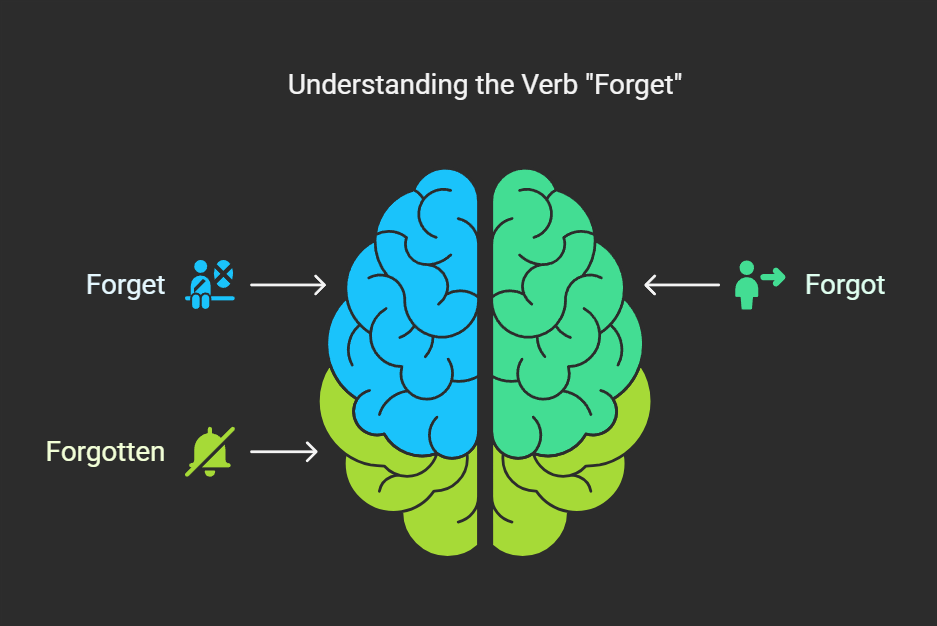
How to remember: Think of get, got, gotten. It follows the same pattern: forget, forgot, forgotten. The ending changes to -ot in the past and -otten with have/has/had.
Other verbs like this: get → got → gotten.
Test Yourself: Forget, Forgot, or Forgotten?
Choose an answer to see your feedback immediately. Your first answer counts towards your score.
1. Yesterday, I _______ to bring my umbrella.
2. She has _______ her password again.
3. I always _______ where I put my glasses.
4. We had _______ about the meeting until he called us.
5. He _______ his lunch at home this morning.
Practice: Forget, Forgot or Forgotten — Exercises
Ready for extra practice? Complete each sentence with forget, forgot or forgotten. Write your answers down, then check them below.
- Please don’t ___ your keys again.
- Yesterday I ___ my homework at home.
- She has ___ his name already.
- I never ___ a friendly face.
- We ___ to lock the door last night.
- Have you ___ our meeting this afternoon?
- Don’t ___ to call your mum tonight.
- By the time we arrived, he had ___ the tickets.
Show the answers
1. forget 2. forgot 3. forgotten 4. forget 5. forgot 6. forgotten 7. forget 8. forgotten
Want more practice with irregular past tenses? Try bend or bent, cut or cutted and the past tense of break.
Keep Going — You Are Building Something
You just learned forget, forgot, forgotten. That is one more irregular verb you will never get wrong again.
But did you know that break follows a similar pattern? Break, broke, broken — three different forms. Many learners use “broke” when they should use broken. Do you know when to use each one?
Next lesson: Broke or Broken — Which One is Correct?
Source
forget (v.) — Online Etymology Dictionary
Keep learning
Practise another short lesson from the same topic:

I’m Khamis Maiouf. I’m studying Health and Social Care and have completed Functional Skills Level 2 in English and Level 3 Hairdressing. I have taught ESOL in my community and helped students with GCSE English. I run English Teacher Site to help people learn and practise English.