
The Weigher of Words (C2 Reading Story)

C2 · PROFICIENCY Reading practice · ~3,300 words · 17-min read
This is an original folk tale for advanced readers. The narration shifts register — from a fireside storyteller’s voice to formal proclamation to earthy village banter — exactly as living folk tales do. Ten demanding words are glossed below and woven back into the story more than once. Read them first, then let the tale carry you.
Before you read — 10 key words
- reckoning — the moment when accounts are settled and everyone must answer for what they owe.
- renege — to go back on a promise or agreement you have made.
- beholden — owing something to someone; bound to them by a debt or favour.
- parsimonious — extremely unwilling to spend or give; stingy in a careful, calculating way.
- ledger — a book in which debts, payments, and accounts are formally recorded.
- windfall — a piece of unexpected good fortune, especially money that arrives without effort.
- gall — shameless boldness; the nerve to do something insulting or presumptuous.
- threadbare — worn so thin that the threads show; by extension, feeble from overuse (a threadbare excuse).
- recompense — payment or action given to make up for loss, harm, or effort.
- crumble — to break apart into small fragments; to fall gradually into pieces.
The story
1 · The village that weighed its words
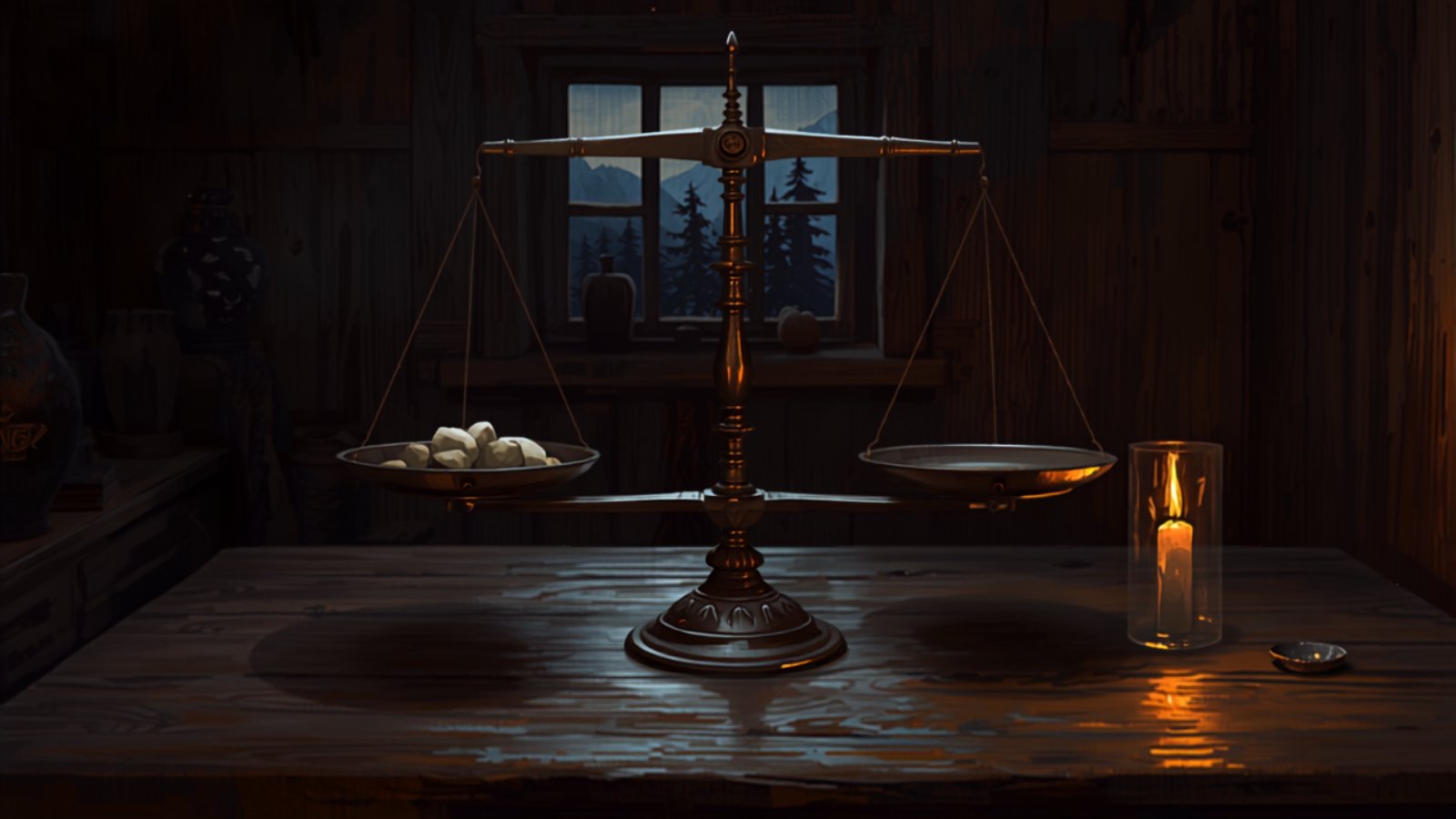
They will tell you, if you climb high enough into the Krevna mountains and buy the right old woman a glass of plum brandy, that there was once a village where words had weight. Not weight in the figurative sense that preachers and politicians intend when they clear their throats — actual, measurable, pocket-dragging weight. In Krevna, a promise spoken aloud did not evaporate into the air as promises do everywhere else. It condensed. By the following dawn, a small grey stone would be sitting on the promiser’s doorstep, smooth as a river pebble and faintly warm, with the words of the promise pressed into its surface in letters too small to read and too deep to erase.
Keep your promise, and the stone would quietly crumble into pale golden sand — sand the villagers swept up with something close to reverence, for reasons the young were never told and the old never explained. Break your promise, however, and the stone stayed. Worse: it grew. A broken promise the size of a walnut in spring would be the size of a fist by harvest, and a betrayal left to ripen for years could end up the size of a millstone, squatting on its owner’s roof beam and making the whole house groan in the night.
Presiding over all of this was the weighing-house, and presiding over the weighing-house was Old Marta. Nobody remembered appointing her, and nobody had the gall to suggest replacing her. She kept the great brass scales polished, kept the village ledger in handwriting like frost on a windowpane, and kept her opinions, for the most part, to herself. Once a year, on the first cold morning of autumn, the bell above the weighing-house rang for the Feast of the Reckoning, and every soul in Krevna — the blacksmith, the priest, the midwife, the children barely old enough to promise anything at all — carried their unbroken stones to Marta’s scales to be weighed before the whole village.
The ceremony had its own solemn music. Marta would set each person’s stones in the copper pan, watch the needle settle, and announce the figure without commentary. A light pan drew nods of respect. A heavy one drew silence — which, in a village that small, was the loudest sound there was.
“Words are seed corn,” Marta liked to say, on the rare occasions she said anything. “Spend them carelessly and you’ll starve on your own eloquence.”
Most of Krevna took the lesson to heart. Its people grew famously careful with language — not cold, but precise, the way a carpenter is precise with a chisel he respects. Betrothals in Krevna were short on poetry and long on particulars. Merchants from the lowlands found the villagers maddening to haggle with, since no one would say I’ll take it until they had genuinely decided to take it. And into this careful, quiet, precisely spoken village, as if the mountain itself had a taste for irony, was born Josik, the miller’s son — the most gloriously careless talker the Krevna valley had ever produced.
2 · The miller’s son
Understand this about Josik: he was not a liar, and he was not cruel. Had he been either, the village would have known how to deal with him, for Krevna had old and efficient remedies for liars. Josik’s affliction was rarer and more slippery. He was generous with words and parsimonious with everything else. Promises poured out of him the way water pours over the mill wheel — abundantly, musically, and without the slightest sense of where any of it was going.
“I’ll mend that fence for you on Saturday, Widow Hana — consider it done!” And Widow Hana’s fence would stand broken through Saturday, and the Saturday after, while a small grey stone appeared on the mill’s doorstep and began, patiently, to grow.
“Next market day, Tomas, the drinks are on me — every last one!” And next market day Josik would be somewhere else entirely, charming somebody else entirely, while another stone joined the first.
He meant every word at the moment he said it. That was the maddening thing. In the instant of promising, Josik genuinely saw himself mending the fence, buying the drinks, carrying the widow’s firewood up the hill all winter. The promise gave him such a warm glow of future virtue that actually performing the deed came to feel almost redundant — like paying twice for the same loaf.
His father, a decent man worn threadbare by embarrassment, tried everything. He reasoned, he pleaded, he docked Josik’s wages, and once he marched him to Widow Hana’s fence with a hammer and stood over him until the job was done — whereupon one stone on the doorstep obligingly crumbled to golden sand, and Josik, flushed with cheap triumph, promised the assembled onlookers that from that day forward he would be a changed man. The stone recording that promise turned out to be the biggest one yet.
By his twenty-third year, the pile behind the mill could no longer be politely ignored. It had outgrown the woodshed. Ravens perched on it. Small children were taken past it on educational walks, in the way lowland children are taken past prisons. And each autumn at the Reckoning, when Josik’s stones went into the copper pan — it took three trips now, and a wheelbarrow — the silence in the weighing-house acquired a texture you could have cut into slices and sold.
Old Marta announced the weight without commentary, as she always did. But that year, as Josik wheeled his shame back down the hill, she watched him from the doorway of the weighing-house for a long moment, and something in her expression was not contempt. It might, in a certain light, have been patience.
3 · The pedlar’s advice
It was in the spring following that worst of all Reckonings that the pedlar came up the mountain road — a narrow man with a narrow smile, whose cart was full of things that glittered and whose prices were full of things that didn’t. He took one look at the mountain of stones behind the mill, another at the young man sulking beside it, and drew his own swift conclusions, being a connoisseur of other people’s weaknesses.
“Heavy harvest,” he observed, settling himself on the wall with the air of a man in no hurry. “You’ll be the famous Josik, then. They talk about you three valleys away, you know. The boy who promises.”
“The stones aren’t fair,” Josik said, with the fluency of a grievance long rehearsed. “A man’s tongue runs ahead of him once or twice, and the mountain never lets him forget it. In the lowlands, I hear, a promise weighs nothing at all. A man can renege on his own wedding down there and the sky doesn’t so much as cloud over.”
“That he can,” said the pedlar comfortably. “I’ve reneged on three weddings myself, and look at me — light as a lark.” He leaned closer, and his voice dropped into the register of confidences and contraband. “But you needn’t move to the lowlands, my friend. You need only learn what every merchant learns in his first year of trade. Never promise. Imply.“
“Imply,” Josik repeated.
“Let them hear what they wish to hear, while your actual words commit you to nothing a court — or a mountain — could hold you to. Don’t say I’ll mend your fence on Saturday. Say that fence deserves attention, and Saturday is certainly a day on which fences have been known to be mended. The widow hears a promise. The mountain hears weather talk. And your doorstep, my boy, stays clean.”
Josik paid for this advice with his second-best coat, and considered it a windfall at the price.
And here is the strange and instructive thing: it worked. For a full year, not one new stone appeared on the mill’s doorstep. Josik implied his way through the seasons like a dancer. He was lavish with sympathy, rich in enthusiasm, forever certain that something ought to be done — and never once, in any sentence a scholar could parse, did he commit himself to doing it. He felt very clever. He felt, in fact, the same warm glow the promises used to give him, now wonderfully free of consequences.
What he failed to notice — what men of his temperament always fail to notice until the noticing is done for them — was the cooling. Widow Hana stopped asking him for anything at all. Tomas greeted him in the lane with the bare minimum of civility a man can offer while still technically nodding. Invitations thinned. Conversations closed like shutters at his approach. He had stopped disappointing people, true. But he had achieved this the way a miser stops losing money: by no longer letting anyone near his purse. The village, which had once been exasperated with him, was now merely finished with him, and of the two conditions the second is infinitely colder.
Had he understood what that coldness was costing him, he might have gone back on the pedlar’s bargain there and then. But understanding, like the mountain’s sand, tends to arrive only after something has crumbled.
4 · The Reckoning
Autumn came, and with it the bell. Josik walked up to the weighing-house that year with a light wheelbarrow and a lighter conscience — only the old stones, the historical record of his former self, and not a single new one to join them. He had, he felt, turned a corner. He was almost looking forward to the scales.
The weighing-house was full, as it always was: the blacksmith with his one small stone (a delivery promised and delayed by a lame horse — the village had already forgiven him, but the mountain kept stricter books), the priest with none, the children with their tiny pebbles of playground promises. Marta worked through them all in her frost-white handwriting silence, and then it was Josik’s turn, and then it was not.
For Marta stepped away from the scales. She unhooked the great village ledger from its chain, opened it to a page marked with a black ribbon, and read aloud — and her voice, which for thirty years had done nothing at these feasts but pronounce numbers, took on the full iron formality of proclamation:
“Be it entered in the record of this village, in the four-hundredth year of the weighing: that whereas the son of the miller has this year uttered no promise, made no pledge, and bound himself to no soul in Krevna by so much as a word — the scales find nothing in him to weigh. Let him therefore stand not among the keepers of promises, nor even among the breakers of them, but apart, in the third place, which the old tongue calls the place of the hollow. And let it be asked of him, before all assembled: young man, to whom are you beholden?”
The silence that followed made all previous silences seem like festivals.
“To no one,” Josik said at last, and even as he said it he heard, for the first time, what it actually meant. He had intended it all year as a boast. Spoken aloud in that room, before those faces, it landed as a confession — possibly the most complete confession of failure the weighing-house had ever recorded.
“To no one,” Marta agreed, closing the ledger with a sound like a trap. “The breakers of promises at least owed something. Debt is a rope, boy, and a rope has two uses: it can hang you, or it can hold you to the people on the other end of it. You have spent one year cutting every rope you had, and you stand before us now magnificently unhanged — and entirely unheld. Tell me. Has it made you happy, this weightlessness?”
Josik opened his mouth, located nothing in it worth saying — a novel experience — and closed it again.
“Then hear the sentence,” said Marta, and the iron came back into her voice. “Were it a matter of broken stones alone, I would leave you to your pile and your ravens. But a hollow man is a danger to a village in ways a debtor never is. Therefore: one promise a day, Josik, son of the miller. Made aloud, made to a named person, and kept before the sun sets on it. Every day, for a year and a day. Should you miss a single one, the record of the hollow stands against your name for good — and the record of the hollow, unlike stone, does not crumble.”
5 · What the sand was for
The first week nearly killed him — not the labour, but the smallness of it. A man who had once promised the whole village a bridge (the stone from that episode was the size of a sheepdog) now had to learn to say, and mean, sentences like: “Hana, I’ll bring your water up from the well this evening.” The words felt absurd in his mouth, beneath his gifts, an insult to his eloquence. He said them anyway, because the alternative was the record of the hollow, and he carried the water, and in the morning a stone the size of an acorn lay on his doorstep and crumbled into a spoonful of golden sand even as he watched.
He swept the sand up, as custom demanded, and took it to the weighing-house, and it was there — watching Marta pour his one small spoonful into the great oak bin behind the scales — that he finally asked the question no young person in Krevna ever thought to ask.
“What is it for? The sand. Why do we keep it?”
Marta looked at him for a long moment, and then, apparently deciding he had at last earned an answer, jerked her chin toward the window — toward the village below, its walls and wells and bridges, its bake-oven, its weighing-house, all of it built from the same pale golden mortar that no trader had ever been able to buy and no mason from the lowlands had ever been able to match.
“What do you think holds the stones of this village together, boy? Rain washes lowland mortar out in a generation. Ours has stood four hundred years, through floods that took whole towns off the map downriver.” She let the bin’s lid fall shut. “Every wall in Krevna is built with the sand of kept promises. That is not a figure of speech. That is masonry. Your grandfather’s word is in the bridge you cross every morning. Widow Hana’s marriage vows are in the oven that bakes your bread. And every promise you broke, all those years —” she nodded down the hill, toward the raven-haunted pile behind the mill, “— is mortar this village will now never have. You did not merely disappoint your neighbours, Josik. You withheld the recompense every soul owes the place that holds it up. You were eating bread baked in other people’s promises and paying for none of it.”
Josik stood very still. Outside, a cart rattled across the bridge — across his grandfather’s word — and the sound of it reached him differently than it had ever reached him before.
“The pile behind the mill,” he said slowly. “The broken ones. Is there no way —”
“There is one way,” said Marta, “and you have been doing it for a week. A broken promise is not a dead promise, boy. It is a debt in arrears. Keep it late — keep it years late, keep it to the person’s children if the person is gone — and the stone will still crumble. Slower. Grudgingly. But it crumbles.” The corner of her mouth moved, in what a generous witness might have called a smile. “Why do you think I set your sentence at a year and a day? A day for the promise. A year for the pile.”
6 · The last stone
They still talk, three valleys away, about the year the miller’s son worked through his pile. How he mended, twelve years late, a fence whose widow had almost forgotten it was ever whole. How he bought a market day’s drinks for Tomas — and for Tomas’s brothers, and their wives, by way of interest. How he built, with his own hands and two summers of his own money, the small footbridge over the mill race that he had once promised the village whole — and how, the morning after the last plank was nailed, the sheepdog-sized stone behind the mill sighed and fell into sand, and there was enough of it to mortar the bridge’s own railings, so that his broken promise ended up holding together the keeping of it, which Marta said was the mountain’s idea of a joke.
One by one the ravens lost interest. One by one the stones let go of their grudges and crumbled. The village, which had been finished with Josik, cautiously reopened its accounts — for people, unlike mountains, forgive faster than they claim they will, provided the recompense is real and the excuses are not threadbare. By the time his year and a day was done, the sentence had become simply the way he lived, and he no longer noticed himself keeping it, which is the only kind of virtue that lasts.
But one stone would not crumble.
It was the oldest of them all, and the smallest — no bigger than a thumbnail, worn smooth, sitting at the very bottom of the pile like a seed that had declined to grow. Josik carried it to the weighing-house in his closed fist, and for once Old Marta had to fetch her glass and study the tiny letters for a long while before she read them out.
“When I am big,” she read, “I will take you to see the sea.” She looked up. “There’s no name in it. Who was it made to?”
“My mother,” Josik said. “I was five. She used to say the sea was the one thing the mountains had cheated her of.” He turned the little stone over in his palm. “She died the winter I turned nine.”
The weighing-house was quiet for a while.
“Well,” said Marta at last, and her voice had put its iron away entirely, “you heard my lesson, boy. Keep it to the person’s children, if the person is gone.” She closed his fingers around the stone. “You are the person’s child.”
And that is why, if you climb high enough into the Krevna mountains and buy the right old woman a glass of plum brandy, she will end the tale by pointing you down the long western road — the one that leaves the valley and keeps going, past the lowlands, all the way to the coast. They say the miller’s son walked it in his fortieth year, with a thumbnail-sized stone in his breast pocket, and that he stood on the shore for a whole day, saying nothing, letting the sea do the talking. What became of the stone, the old woman will not tell you for any quantity of brandy. She will only smile, and say that somewhere on that beach there is a handful of sand that glitters more golden than the rest — and that if ever you find it, you should make a promise standing on it, and see what the morning brings.
Check your understanding
Read each question. Think about your answer. Then click “Show answer” to check.
Words to remember
Here are the key words again, in new sentences. Try producing one sentence of your own with each.
- reckoning — The auditors arrived in April, and for the finance department the day of reckoning had come.
- renege — The investors threatened to sue when the firm tried to renege on the agreed terms.
- beholden — She funded the campaign herself so as to be beholden to no donor.
- parsimonious — He was famously parsimonious with praise; a single “adequate” from him counted as a standing ovation.
- ledger — Every transaction, however trivial, was entered in the ledger in her meticulous hand.
- windfall — The inheritance was an unexpected windfall, and she resisted the urge to spend it all at once.
- gall — He had the gall to ask for a reference from the very manager he had publicly criticised.
- threadbare — By the third missed deadline, his excuses were looking distinctly threadbare.
- recompense — The court ordered the company to pay proper recompense for the damage to the farmland.
- crumble — Without maintenance, even the grandest wall will eventually crumble.
Grammar in this story: inverted conditionals
This tale uses inverted conditionals — a formal, literary structure in which if disappears and the auxiliary verb moves in front of the subject. It is exactly the register a storyteller or a proclamation reaches for. Look at three examples from the story:
Had he been either, the village would have known how to deal with him. (= If he had been…)
Were it a matter of broken stones alone, I would leave you to your pile. (= If it were…)
Should you miss a single one, the record of the hollow stands against your name. (= If you should miss…)
Notice how the inversion instantly raises the register: Marta’s sentence sounds like law precisely because of were it and should you. At C2, you should be able to deploy all three patterns — had + subject + past participle, were + subject, should + subject + bare infinitive — and to hear the difference in formality they create.
👉 Master all three patterns here: Inverted Conditionals: Had I Known, Were It Not For, Should You Need.
Talk about it · Write about it
Talk about it: Marta claims a “hollow man” — one who commits to nothing — is more dangerous to a community than someone who breaks his commitments. Is she right? Where do you see the pedlar’s “never promise, imply” strategy operating in modern life — in politics, advertising, or the workplace — and what does it cost?
Write about it: Write 250–300 words retelling one folk tale or moral story from your own culture in your own words — as this story does — for an audience who has never heard it. Include at least two inverted conditionals (had she known…, were it not for…, should you ever…) and one deliberate shift of register.
🎉 You have just read a 3,300-word literary folk tale in English — narration, proclamation, banter, and all. Notice how much of the ten-word gloss you no longer needed by the final chapter; that is the 98% rule doing its quiet work.
But one question is still open, and the old woman with the plum brandy refuses to answer it: what did become of the last stone on that beach? Write your own ending, using details from the story to explain your choice.
A coastal village depends on the wind. Read the folk tale and examine what happens when something shared is treated as a possession. Next story: The Man Who Bought the Wind (C2 Reading Story)
About this story: This is an original C2 graded reader (~3,300 words) — a folk tale invented for this site, not an adaptation of any existing book. It uses near-native vocabulary, idiom, deliberate register shifts, and full grammatical range including inverted conditionals. The ten most demanding words are glossed before the story and each reappears at least twice inside it, following the graded-reader principle that a reader should recognise about 98% of the running words.

I’m Khamis Maiouf. I’m studying Health and Social Care and have completed Functional Skills Level 2 in English and Level 3 Hairdressing. I have taught ESOL in my community and helped students with GCSE English. I run English Teacher Site to help people learn and practise English.