
The Man Who Bought the Wind (C2 Reading Story)

C2 · PROFICIENCY Reading practice · ~3,150 words · 16-min read
This is an original folk tale written for proficient readers. The prose is rich and idiomatic, the syntax varied, and the moral — as in all good folk tales — is left for you to weigh. Nine words that carry the story are glossed below; watch how each one returns, gathering meaning as it goes. A short quiz, a grammar focus, and discussion prompts follow the tale.
Before you read — 9 key words
- covet — to long, often enviously, to possess something that belongs to another.
- hoard — to amass and hide away far more of something than you could ever use.
- beguile — to charm or deceive someone, often so pleasantly that they scarcely notice.
- threshold — the strip at the base of a doorway; figuratively, the point at which something begins.
- hearth — the floor of a fireplace; by extension, the warm centre of a home.
- wither — to dry up, shrivel and fade, as a plant deprived of water does.
- threadbare — worn so thin that the fabric barely holds together; of excuses, feeble from overuse.
- reckoning — the settling of accounts; the moment when past actions must finally be paid for.
- recompense — payment or amends made for loss, effort, or wrongdoing.
The story: The Man Who Bought the Wind
1 · The village that lived on the wind
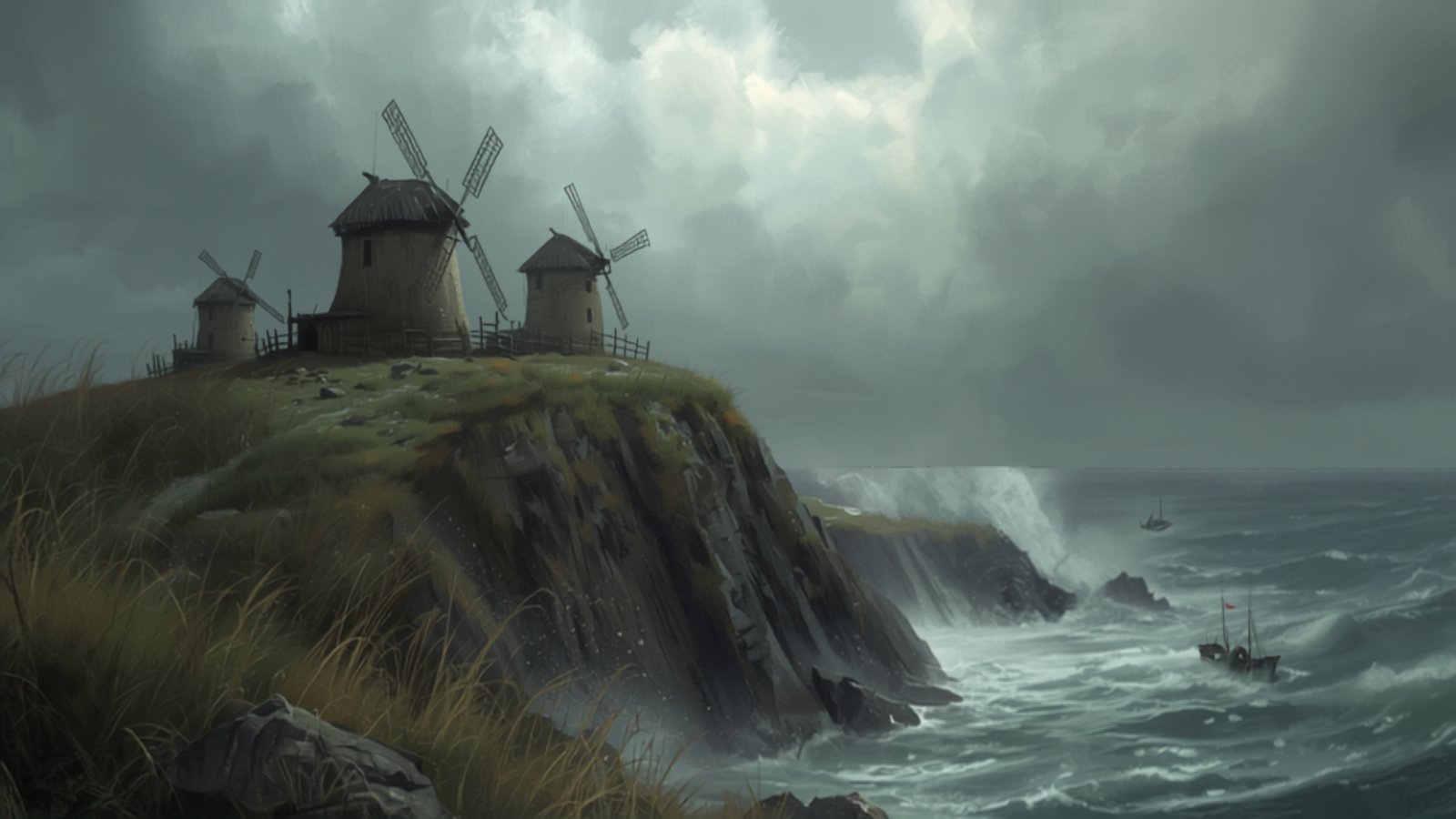
They say — and who am I to contradict them? — that the village of Harrowby-on-Sea was built not on rock, nor on sand, but on the wind itself. Everything the village had, the wind had given it. The wind drove the fishing boats out beyond the grey teeth of the headland and, more importantly, drove them home again. The wind turned the sails of the three mills on the ridge, grinding corn for every table on that coast. The wind dried the nets, scattered the seed, carried the gulls, and on washing days it filled a hundred shirts with invisible bodies and set them dancing on the lines. Nobody in Harrowby owned the wind, and for precisely that reason it belonged to everyone.
Nobody, that is, thought of owning it — except Silas Crane.
Silas Crane was the miller on the highest point of the ridge, and by common consent the richest man for forty miles. He had inherited one mill, bought the second from a widow at a price that still made honest men wince, and built the third himself, taller than the church tower — a detail he mentioned more often than was strictly necessary. He was not a wicked man, or at least he had never done anything the law could name. His fault was older and quieter than wickedness: he coveted things. Not merely wanted them — coveted them, with that particular ache that ruins a man’s sleep. When he saw a neighbour’s field, he saw only the fence that kept it from being his. When he heard that a fisherman had hauled in a remarkable catch, his first feeling was not admiration but a small, bitter arithmetic: that could have been mine.
And what tormented him most — what he coveted beyond fields and catches and church towers — was the one thing his money could not corner. His rivals’ mills turned on the same breeze as his own. The poorest fisherman’s patched sail filled with the same wind that filled the sails of the finest ship. The wind, infuriatingly, made no distinctions. It blew for everyone or for no one, and it never once asked Silas Crane for permission.
“A scandal,” he muttered to himself on the ridge one evening, watching all three of his mills turn alongside the humble mill of old Widow Prue in the valley. “I pay for my grain, my timber, my labour. Why should the power that turns my sails be given away free to every fool with a bedsheet on a pole?”
It was the wind itself, of course, that carried these words away over the rooftops. Perhaps that was his first mistake. In folk tales — and, one suspects, in life — the wind hears everything.
2 · The pedlar’s bargain
The pedlar arrived at the autumn fair, as pedlars do, from no particular direction. He was a narrow, weathered man with a cart, and on the cart stood row upon row of stoneware jars, each stoppered with wax and labelled in a fine, slanting hand: North-easterly, brisk. Sea breeze, morning, with gulls. Storm, half-grown. The wind that turns October leaves. The villagers gathered round to laugh, and the pedlar let them laugh, which is always the mark of a man who knows something you don’t.
“Winds of the world,” he announced mildly. “Bottled at the source. A penny a jar, and the jar returned when empty.”
A young fisherman, grinning to his friends, paid his penny, broke the wax — and staggered backwards as a fresh salt gust burst from the jar, knocked his cap into the crowd, and set every ribbon on the fairground streaming. The laughter stopped as though a door had been shut on it. By evening the pedlar had sold thirty jars, and word had climbed the ridge to the tall mill, where it found Silas Crane at his ledgers.
He came down at dusk, when the fair was folding itself away. He turned a jar in his hands, listened to the faint impatient whistling inside it, and asked the question that had been swelling in him all afternoon.
“If you can bottle a breeze,” he said slowly, “you can bottle it all. What would it cost me — the wind itself? All of it. Every breath that crosses this coast, sealed and delivered to my mill, and not one sigh of it left over for anybody else?”
The pedlar looked at him for a long moment, and something in his face was older than the evening. “It would cost you half of everything you have,” he said. “And I am obliged to tell you the terms, so listen well. The wind cannot be sold, because the wind cannot be owned. It can only be lent. Take it, hoard it, do as you please with it — but understand that you are borrowing, and every loan has its day of reckoning. When the wind is called in, it will settle its own account. Sign here.”
Half of everything was a fortune, but Silas had done the arithmetic already: the man who owns the only wind owns every sail, every mill, every harvest on the coast. What is half a fortune against all of them? He signed the pedlar’s ledger — an old book, its leather threadbare, its pages full of names he did not read and would not have recognised if he had. That night, forty carts rolled up the ridge to the tall mill, laden with great sealed jars, and by morning the pedlar was gone, from no particular direction, the way he had come.
And the wind was gone with him.
3 · The still year
It is difficult to describe a stillness to people who have never lived through one. The sea flattened to a sheet of dull metal. Smoke from the chimneys rose in perfectly straight grey columns, as though the sky had been ruled with a pencil. The gulls, finding nothing to ride, walked about the harbour with their wings folded, looking faintly embarrassed. Washing hung dead on the lines. The three mills of Silas Crane and the one small mill of Widow Prue stood motionless on the ridge like men waiting for news.
At first the village called it strange weather. Then they called it a cursed season. Only slowly, as autumn stiffened into winter, did the truth leak down from the ridge, where lamplight burned late in the tall mill and, once in a while, a single sail could be seen turning briskly while all the world around it held its breath. Silas Crane would carry one of his jars into the mill, crack the wax, and let a carefully measured wind spin his machinery for exactly as long as suited him. Then he would stopper what remained and lock it away. He had built a long cellar beneath the mill, and there the jars stood in their hundreds — a hoard of weather, shelved and labelled like preserves.
He was, that winter, the only miller on the coast who could grind corn, and he set his prices accordingly. Those prices climbed the way frost climbs a window pane — slowly, beautifully, and with complete indifference to what lay on the other side of the glass. The fishing fleet rowed where it had once sailed, and the men came home with aching backs and half-empty boats, or did not go out at all. The winter wheat, unstirred and unbreathed-upon, began to wither in the fields; without wind, it seemed, even the rain fell wrong, straight down like nails, missing everything it used to be blown to. And still the village paid Silas Crane, because there was no one else to pay.
It was the small losses, the ones nobody could have predicted, that hurt in the strangest way. No kites, the children discovered. No whistling in the chimney on a November night, which had frightened them once and which they now missed the way you miss an old quarrelsome friend. Church bells that rang flatly and died at the churchyard wall, their sound no longer carried across the valley to the outlying farms. Fires sulked in every hearth, for even a flame needs a draught to draw it upward, and the whole village that winter smelled faintly of smoke that had nowhere to go. A village without wind, the schoolmistress said, is a body without breath: it may lie there looking much the same, but nobody is home.
Up on the ridge, Silas Crane read his swelling ledgers by lamplight and told himself he was content. He was believed, by those who glimpsed him at his window, to be the happiest man on the coast. He was, in truth, sleeping worse than ever. The cellar beneath his mill whistled at night — hundreds of jars, each whispering against its wax seal — and though he had bought every wind on the coast, he could not have said, if you had asked him, what exactly he had bought them for.
4 · Three knocks at the door
Folk tales run in threes, and so did the knocks on the mill door that February.
The first came from old Meg Tarrow, a fisherman’s mother with hands like mooring rope, who stood on his threshold at first light and asked — not begged, asked, with the level dignity of the poor — for one jar. One small jar, mind, a morning breeze, enough to carry her son’s boat past the headland to the deep water where the winter shoals lay. “You’d have it back by evening,” she said. “Wind returns, Mr Crane. It’s the only wealth that does.”
“If I lend to one, I lend to all,” said Silas, and shut the door. Through the wood he heard her say, quite calmly, that a man who would not share the air would one day have to answer to it. He put the remark where he put all such remarks — in the mental drawer labelled envy — and went back to his accounts.
The second knock came a fortnight later from a child, Widow Prue’s granddaughter, seven years old and blue-lipped with cold, holding a paper kite nearly as big as herself. She did not want the wind for profit, she explained through the crack he allowed the door; she wanted it because her grandmother was sad, and her grandmother was sad because the mill was still, and she had thought that if she could just fly the kite past the old woman’s window — “Wind is not a toy,” said Silas Crane, and the excuse sounded threadbare even to him as he said it, worn thin from being used on every caller that winter. He shut the door all the same. It is one thing to refuse an old woman; a man who can refuse a child and her kite has crossed a threshold of another kind, and he knows it in the small hours even if he never says it aloud.
The third knock came on the last night of February, and it was the softest of the three.
On the step stood a traveller in a good grey coat — a collector, he said, of wonders and curiosities, come a long way on the strength of an extraordinary rumour. Was it truly the case that the celebrated Mr Crane had accomplished what emperors had only dreamed of? The whole wind of a coast, mastered by a single man of business? Silas, who had eaten alone every night that winter, found the door opening almost of its own accord.
The traveller admired everything. He admired the ledgers; he admired the machinery; he admired, above all, the cellar, walking the long shelves with his hands behind his back while the jars whistled and shivered around him. The man could beguile the pattern off wallpaper, and Silas — flattered for the first time in a friendless season — never noticed the hook inside the honey. “Magnificent,” the traveller murmured. “Though I confess I’ve heard sceptics in the towns say the jars are empty, and the still weather mere coincidence. There would be a way, of course, to silence them for ever.” He paused before the largest jar of all, a vessel the height of a man, in which something enormous turned over in its sleep. The label, in a fine slanting hand, read: Storm, full-grown. With interest.
“Surely,” said the traveller silkily, “the owner of the wind is not afraid of his own property?”
Pride is deaf in exactly the register where warnings are spoken. Silas Crane, who had refused a mother and a child with a locked face, could not endure being doubted by a stranger in a good coat. He broke the wax with his own thumb. Long afterwards, the villagers would say he had been beguiled as neatly as any man in any tale ever was; but the truth is less magical and more human — flattery only beguiles those who are starving for it, and Silas Crane had been starving all winter without knowing the name of his hunger.
5 · The reckoning
What came out of the jar was not a wind. It was the wind — a year of it, compounded, and it had not enjoyed its confinement.
It took the cellar door first, then the stairs, then the roof of the tall mill, peeling it back with a sound like the world clearing its throat. It burst every other jar on every shelf in a single joyful detonation, and all the hoarded weather of Harrowby came off its shelves at once. It emptied the strongbox through the window and sowed the whole ridge with banknotes; it stripped the ledgers page from page and dealt them out across three parishes; it snatched the sails off the mill and sent them cartwheeling over the fields like drunken giants. And through all of it — witnesses swore to this later, and were believed — the storm never touched a hair of the traveller in the grey coat, who stood in the doorway holding his hat, watching with the patient expression of a man observing the settlement of an account.
“You were told,” he said, and his voice was somehow perfectly audible inside the roar, “that it could only be lent. This is the reckoning, Silas Crane. The wind keeps its own books, and it has come to collect precisely what it is owed — everything it earned you, and not a penny more.”
And that, the old people insist, is exactly what it took. The winter’s monopoly profits: scattered to the four corners of the coast, so that farmers found banknotes in their hedgerows for years afterwards. The second mill, bought too cheaply from a widow long ago: unroofed, unwalled, undone. The tall mill itself, built taller than the church tower on money squeezed from still-weather prices: laid politely on its side in the meadow, almost intact, like a toy put away by a tidy child. But the first mill — the small one Silas had inherited, the one his father had worked honestly before him — the storm walked around it. Not a shingle lifted. The wind, it turned out, was a scrupulous accountant: it took what it was owed and would not touch a farthing of what it was not.
By dawn the air over Harrowby was moving again, easy and ordinary, smelling of salt and turned earth. The gulls remembered their business. The washing filled. Widow Prue’s little mill creaked, caught, and began to turn. And halfway down the ridge, in the wreckage of his fortune, sat Silas Crane in his nightshirt, watching a ten-shilling note dance away over the hedge with what remained of his signature on the pedlar’s contract wrapped around it. Of the traveller in the grey coat there was, naturally, no sign. Some said he and the pedlar were brothers. Most said something simpler: that they were the same size, the same silence, and had the same way of arriving from no particular direction.
6 · What the wind left behind
Here is the part of the story that gets left out when it is told badly.
The village did not gloat. Sea people are practical about ruin; they have all seen enough of it to know it is not a spectator sport. When Silas Crane came down the ridge that spring — thinner, quieter, his coat gone threadbare at the cuffs like any other man’s — it was Meg Tarrow, of all people, who stood aside from her doorway and let the silence ask the question for her. He mended nets that first year, badly, then less badly. Some debts, the old people are fond of saying, lie beyond all recompense; his, it turned out, did not — but it was paid in small coin, over years, and never once in words. The covetous ache that had driven him all his life seemed simply to have withered in the storm, blown out of him along with everything it had ever bought. He worked his father’s small mill and charged his father’s honest prices. He built kites — this is well attested — dozens of them, extravagant paper things, and every child in Harrowby got one, and if this was recompense he never called it that, and neither did anyone else, because naming it would have spoiled it. Amends of that kind are like the wind itself: everyone can feel exactly where they’re blowing from, and nobody needs it written down.
He never became rich again. By every account he became something rarer: a man you could borrow from. And on winter nights, when the wind came off the sea and rattled his door on its threshold, he would look up from the hearth, and nod to it, as one nods to a creditor with whom one has, at long last, squared the account. The wind, for its part, turned his one small sail for thirty more years, free of charge — the same wind for him as for everyone, which, as he had finally learned, was the entire point.
The children of Harrowby still say that when a gale shakes your windows at night, it is only the wind going over its ledger, checking who has been lending and who has been hoarding. It is what the wind gives that it writes in pencil, they say; it is what people refuse to share that it writes in ink.
As for the pedlar — he was seen once more on that coast, years later, at another autumn fair, with a cart of small stoppered bottles labelled in a fine slanting hand: Silence, assorted. But who bought those, and what on earth they wanted it for, is another story altogether.
Check your understanding
These questions go beyond plot recall — several ask you to read between the lines. Think about your answer, then click “Show answer” to compare.
Words to remember
The nine key words again, in fresh contexts. Notice the registers they tend to live in — several are literary or formal.
- covet — It was not the prize money he coveted so much as the standing that came with it.
- hoard — During the shortage, those who hoarded fuel were resented far more than those who simply went without.
- beguile — The brochure beguiled us with talk of “sea glimpses”; the sea, it transpired, was a forty-minute walk away.
- threshold — She hesitated on the threshold of resigning for months before the decision finally made itself.
- hearth — Long after central heating arrived, the hearth remained the room’s emotional centre of gravity.
- wither — Deprived of funding, the once-ambitious project simply withered on the vine.
- threadbare — By the third late arrival, his excuses were looking distinctly threadbare.
- reckoning — Every boom, the economist warned, carries its own day of reckoning folded inside it.
- recompense — A formal apology and a modest sum in recompense — it was less than she deserved and more than she expected.
Grammar in this story: cleft sentences
Storytellers split sentences to throw weight exactly where they want it. This tale does it repeatedly with cleft sentences — structures that divide one clause into two in order to spotlight a single element:
“It was the wind itself, of course, that carried these words away over the rooftops.”
“It was the small losses, the ones nobody could have predicted, that hurt in the strangest way.”
“What tormented him most… was the one thing his money could not corner.”
Compare the flat version — The small losses hurt in the strangest way — with the cleft. Same facts; entirely different emphasis and rhythm. The first two examples are it-clefts; the third is a wh-cleft (pseudo-cleft). At C2, the skill is not merely recognising them but choosing when the extra weight is worth the extra words.
👉 Master both types here: Cleft Sentences — How English Splits a Sentence for Emphasis.
Talk about it · Write about it
Talk about it: The tale argues that some things — air, language, perhaps knowledge — can only ever be borrowed, never owned. Do you agree? Where would you draw the line between legitimate ownership and hoarding what should be common? Can you think of a modern “Silas Crane” — a person, company, or country?
Write about it: Retell a folk tale from your own culture in 300–400 of your own words — original phrasing, no borrowed text — and then add a closing paragraph analysing what the tale rewards and what it punishes. Use at least one it-cleft and one wh-cleft, and at least four of the nine key words.
🎉 You’ve just read a 3,150-word literary folk tale at full native register — dense idiom, shifting registers, irony left for you to catch. That is C2 reading in the truest sense, and the nine key words are yours to keep.
But one thread is still loose. The pedlar came back, years later, selling little bottles of silence. Who in a village like Harrowby would pay for silence — and what were they trying not to hear? That tale is still to be told…
Choose Your Next Story
This is the last story in the land, language and ownership group. Choose another C2 story from the reading collection when you are ready.
Other Story in This Group: The Custodian of Kern Street Garden (C2 Reading Story)
About this story: This is an original C2 graded reader (~3,150 words) written for englishteachersite.com. At this level the vocabulary is near-native and the prose uses idiom, irony, and register shifts freely, following the graded-reader principle of comprehensible input at the edge of your level. The nine most demanding words are glossed before the story and each is deliberately reused within it. The plot is entirely original — a new folk tale in the old style, copied from nowhere.

I’m Khamis Maiouf. I’m studying Health and Social Care and have completed Functional Skills Level 2 in English and Level 3 Hairdressing. I have taught ESOL in my community and helped students with GCSE English. I run English Teacher Site to help people learn and practise English.