
The Cartographer of Clouds (C2 Reading Story)

C2 · PROFICIENCY Reading practice · ~3,000 words · 13-min read
An original C2 short story about an elderly scientist, a teenage boy, and a rare kind of cloud that lasts less than two minutes. The register shifts between reflective narration and dry, understated dialogue, so expect some idiom and some near-native lexis. Before you begin, skim the eight glossed terms below — most are technical, and each one is reused inside the story so the meaning settles in.
Before you read — 8 key words
- nephology (n.) — the scientific study of clouds. A nephologist is someone who studies them, usually by direct observation.
- taxonomy (n.) — an ordered system of classification, especially for natural forms (species, cloud types, dialects). Also, the act of building such a system.
- cirrus (n.) — the family of thin, wispy, high-altitude clouds made of ice crystals. Often the first sign of a weather front.
- Kelvin-Helmholtz waves (n.) — a rare cloud form that looks like a row of breaking ocean waves suspended in the sky, produced when two layers of air slide past each other at different speeds.
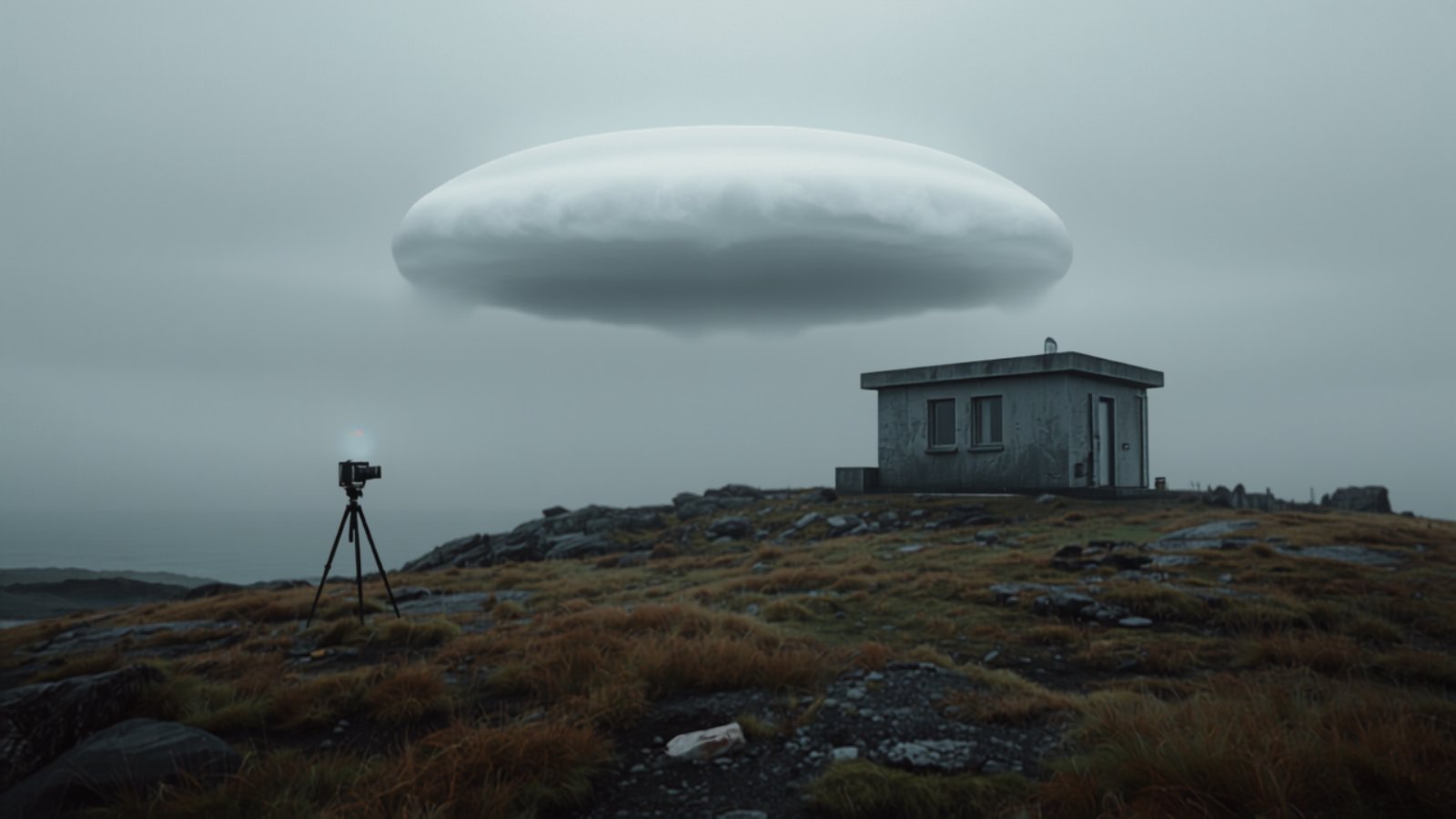
- lenticular (adj.) — describing a smooth, lens-shaped cloud that typically forms on the lee side of a mountain. Often mistaken, by the credulous, for a UFO.
- crepuscular (adj.) — of or belonging to twilight; the soft, low-angled light just before sunrise or just after sunset.
- barometric (adj.) — relating to atmospheric pressure, as measured on a barometer. A falling reading usually signals a change in the weather.
- valedictory (adj.) — serving as a farewell; often used of a final lecture, paper, or address given at the end of a career.
The story
1 · The last station
The road to Ardmhor ran out half a mile before the cliff. What remained was a rut of peat and stone, still holding, just, the tyre-marks of the previous tenant. Rowan Halloran parked the Land Rover at the cattle-grid, hoisted her tripod out of the passenger footwell, and walked the last stretch on foot.
The station itself was a squat concrete cube — a relic of the early 1960s, when the Air Ministry had scattered such buildings along the Hebridean seaboard to watch for weather fronts and, later, for aircraft that never came. It had been derelict for three decades before a well-meaning trust leased it out to visiting scientists at a peppercorn rent. Rowan had put in for the last available fortnight of the year, then quietly extended her stay to a month on the grounds that no one else had asked.
Inside, the electricity worked and the roof did not leak. That, in her long experience, was the difference between a good field posting and a bad one. She had once, in Iceland, spent a fortnight with neither, and still counted the resulting monograph among her best. Fieldwork of any kind, she had come to believe, was largely a matter of what one was prepared to put up with.
The interior was much as the trust’s website had promised: two rooms, a fold-down bed, a whiteboard still marked in the faint blue traces of some previous occupant’s calculations, and a single east-facing window whose sill she had already earmarked for the aneroid barometer. Someone — no obvious candidate — had left half a jar of instant coffee, an unopened packet of oatcakes, and a laminated card taped to the inside of the door with the local coastguard’s number in careful capital letters. This last struck her as the kindest thing she had encountered in a rental in years.
She unpacked in the order she had unpacked in for forty years: instruments first, notebook second, kettle last. The kettle went on the two-ring stove; the notebook opened at a blank page. She wrote the date, the barometric reading, and, in the wide margin she always left for herself, one line: Perhaps. Then, out of long habit, she ran through the seven-item checklist she had first taught herself as a graduate student — barometer, thermometer, anemometer, hygrometer, camera, tripod, notebook — touching each object in turn as she named it, the way a pilot walks a pre-flight inspection.
Rowan was a nephologist — a student of clouds. It was, she had long since accepted, one of those professions whose name people asked her to spell twice. In her earlier years she had softened the term for strangers, calling herself an atmospheric scientist, or a meteorological researcher, or, at parties where she had already drunk too much wine, simply a woman who watches the sky. Lately she had stopped softening anything. If people found the word difficult, that was, in her view, an invitation to look it up.
She was sixty-eight. Her sight, thank God, was still what it had been at forty. Her back, less so. She had come to the station to write what she privately called her valedictory paper — a final taxonomy of the rare mid-latitude cloud forms she had spent her working life cataloguing. It was not the paper that had made her name. Her name had been made, if made at all, by a monograph on cirrus fibratus published in 1994 and by three decades of quiet, meticulous teaching. This paper was, rather, the one she wanted to leave behind for other people to disagree with.
And she had come, though she would not have said so aloud, in the hope of finally seeing one particular thing.
2 · A life in cirrus
She had first fallen in love with the sky from the fifth-floor window of a Dublin flat, at the age of eleven, when it occurred to her that the sky was the only thing on earth to which everyone had an equal view. The rich did not get better clouds than the poor; the priest saw the same weather as the drunk. This struck her as, in a small way, a form of justice. She had been an argumentative child. She grew into an argumentative woman.
Her mother, a hospital cleaner who worked nights, had not understood the interest but had defended it, in the way of Irish mothers of her generation, with the phrase at least it’s not the boys yet. Her father, absent by the time she was thirteen, had left behind a small brass barometer that she still owned. It had, over the decades, migrated with her from bedsit to lecturer’s office to the shelf directly above the sink in her kitchen in Sligo, where it now sat, retired but consulted, alongside a photograph of her cat.
She had chosen nephology partly because her doctoral supervisor, a Yorkshirewoman called Dr Wetheral, had said one evening — over dry sherry in a common room in Bristol — that field observation of clouds was going to die with her generation, and that Rowan might, if she was quick, catch the last of it. Satellites were coming. Photogrammetry was coming. The trained eye, patient and cheap and slightly out of fashion, would soon be neither respectable nor funded.
Wetheral had, of course, been right about the funding, and wrong about the eye. There was, Rowan believed, no substitute for a person on a cliff, at three in the morning, watching what a satellite could not resolve. Not that anyone in the current climate would pay for it.
Over the course of a working life she had seen most of what there was to see. She had witnessed a lenticular cap sitting on Ben Nevis for eleven consecutive hours; she had photographed a rare noctilucent display over the Cairngorms in the summer of 1998; she had chased mother-of-pearl clouds across Antrim in a hired car with a broken clutch. She had, over the years, contributed nine new entries to the informal working taxonomy the field kept in a shared Google document, and one of them had, to her private delight, made it into the official 2017 revision of the International Cloud Atlas.
There was, nonetheless, one cloud form she had never, in forty years of watching, seen with her own eyes. She had seen a great many photographs of it, some taken by amateurs on their phones from the balconies of coastal hotels. That fact, she often reflected, was funnier than she would once have allowed. What she wanted to see, before she stopped watching, was a set of Kelvin-Helmholtz waves: those brief, curling, breaking cloud forms — like a row of Hokusai waves suspended in the air — that occurred when two layers of air, moving at different speeds, slid past each other and lost their nerve.
They lasted, when they came at all, for two or three minutes. Nothing more.
3 · The boy who could draw the wind
It was on her ninth morning at the station that a boy of about fifteen came up the track with a rod over one shoulder and a canvas satchel over the other. He stopped a polite distance from the door and waited. Rowan opened it because she saw no reason to pretend she was not in.
“You’re the cloud lady,” he said.
“I am.”
“My uncle says you have the kettle on.”
“Your uncle is well-informed.”
He was called Fionn, and he was, he said with the mild embarrassment of any boy of fifteen anywhere, on his way to a bit of the shore where he was not strictly supposed to fish. He was not, he added, going to catch anything. He simply liked the walk.
He came back the next morning, and the morning after that. Rowan, who had expected to spend the month in a state of professional solitude, found that she did not entirely mind. He was polite; he made his own tea; he did not, above all, want to talk about clouds.
What he wanted to talk about was whether school was, in his precise phrase, a load of pointless rubbish. He had, he said, given up on it. He was going to work on his uncle’s boat and be done with it. Rowan, who had heard variations of this speech many times over the decades, offered the usual mild rebuttal and then let it drop. It was not her place, she reminded herself, to argue him back into a chair he had already left.
What changed her mind was not anything he said. It was what she saw in the margin of the exercise book he had left on her kitchen table one morning, in the hurry of trying to eat toast before it went cold.
He had been drawing the horizon. Not casually — properly. He had it right: the difference between a low stratus deck and a bank of sea-fog, the subtle rippling that betrayed a shear layer above it, the way a lenticular cap seemed to sit at anchor even in a strong wind. He had drawn, without knowing what any of it was called, the very thing she had spent her career trying to teach graduate students to see.
“Fionn,” she said, when he came back for his book that evening, “who taught you to draw the sky?”
“Nobody.”
“How long have you been doing this?”
He shrugged. “Since I was small. It’s just what I look at.”
There is a species of teacher — Rowan had known one, thirty years earlier, and had gradually become another — who recognises, with a kind of grief, the moment at which a stranger’s talent has to be defended against its owner. She poured him another tea, drew a chair up to the table, and told him that if he could give her one hour a morning for the rest of the fortnight, she would teach him, in exchange, how to read weather.
He looked at her with the deeply suspicious face of a boy who has been offered a deal that sounds too much like homework, and then said, with a shrug the exact colour of the Atlantic behind him: “Fine.”
The first lesson was on cloud height. She took him fifty paces along the cliff, dropped a stone at his feet, then walked another fifty and dropped a second. “Parallax,” she said. “The trick is to know how far apart the two of us are, and to have a fixed reference on the horizon. The rest is trigonometry, and the trigonometry is on my phone.” She showed him the small app she had commissioned from a former student in 2011 and never quite finished paying for. He was, to her private amusement, more impressed by the app than by the underlying method. She let this pass. Most of teaching, she had long since concluded, was letting things pass.
The second lesson was on what she called reading the shear — spotting the almost imperceptible ripple in a lower cloud deck that betrayed a fast-moving layer of drier air above it. She made him watch the horizon for twenty minutes without speaking, then asked him what he had seen. He told her, with the mild belligerence of someone expecting to be corrected, that the ripple had moved from left to right at roughly the speed of a herring gull’s glide, and that it had picked up in the last five minutes. She said nothing for a moment. Then she said, “That’s better than most of my graduate students would have managed. Please don’t tell anyone I said that.”
The third lesson was, in the strictest sense, no lesson at all. She simply took him out at dawn and stood beside him and did not speak. He fidgeted for twenty minutes, then for another ten, and then, eventually, stopped fidgeting. When they came back inside for tea she said only, “Patience is nine-tenths of nephology. The other tenth is being able to write neatly when your hands are cold.” He wrote this down in the back of his exercise book, in handwriting that was, admittedly, not neat.
4 · The waves
They came on the twelfth morning.
Rowan had been awake since four. The barometer, over the course of the previous evening, had dropped just far enough to make her hopeful, and just slowly enough to make her cautious. She had, once, driven three hundred miles for a barometric signal that came to nothing. She had, on another occasion, been in the wrong bathroom for what turned out to be the finest lenticular formation of her career. Nephology, she often told her graduate students, was a discipline that specialised in humbling its practitioners.
At five past five, she stepped outside. The sky to the east was crepuscular, still the deep bruised violet of a full-moon night, but already softening at its lower edge. The wind was steady from the south-west, warm at ground level, colder aloft — she could feel the gradient on her cheek. She checked her instruments. She looked up. And she saw, forming along the ridge line above the sea, the first, faint, curling suggestion of what she had waited forty years to see.
She went back inside.
“Fionn,” she said, shaking his shoulder. “Get up.”
“What?”
“Get up now. Bring your phone.”
“I don’t want to —”
“Now.“
He came, muttering, in the socks he had slept in. She pointed. He looked up. He stopped muttering.
Along a thin ribbon of sky, perhaps three degrees above the horizon, a row of clouds was breaking — actually breaking, in slow motion, like a film of a wave curling onto a beach and stopping there, half-frozen, before curling again. There were seven of them. Rowan counted, because counting was what she had always done. Seven perfect Kelvin-Helmholtz waves, glowing softly in the first crepuscular light, holding for perhaps ninety seconds — no, less — while the wind that had made them slid on and dissolved them from the west.
She had her camera on the tripod. She did not lift it.
Fionn, without a word, held up his phone.
He kept it steady. He knew, from what she had taught him about long-exposure photography of stars, to press his elbows against his ribs and to breathe slowly. He filmed the whole thing — ninety seconds, more or less — while Rowan simply watched, her hands loose at her sides, and her face, she realised only afterwards, wet.
When it was over, and the sky was ordinary again, Fionn lowered the phone.
“Was that it?” he said.
“That was it.”
“That’s what you’ve been waiting for?”
“Forty years.”
He looked at her, then at the empty sky, then at the phone in his hand, as if trying to work out whether he had been paid too much or too little.
“You didn’t take a picture,” he said.
“No.”
“Why?”
Rowan considered the question. It seemed to her a question worth answering carefully.
“Because,” she said eventually, “I wanted to see it.”
They walked back to the station without speaking. She made toast; he cut cheese. It was, she thought, one of the more peculiar breakfasts of her working life. Halfway through it Fionn put down his knife and said, “Cloud lady. Is that going to happen again?” She said, honestly, that she did not know; that the whole of the working literature suggested it would happen somewhere in the world every few days, but that whether it would happen again here, in her lifetime, was a question no barometer could answer. He nodded slowly, as if the answer had been philosophical rather than practical, and returned to his cheese.
5 · The invitation
Fionn’s video, at his own casual insistence, went up that evening on a website Rowan had never heard of. By the following afternoon, it had, in his phrase, done something. She did not entirely understand what. She understood, however, that a woman in Reykjavik had written to say thank you, and that an atmospheric physicist at Manchester whom Rowan had once sharply reviewed in print had emailed her a single line — So you finally saw them. About time. — and that a university she had not visited in fifteen years had written on the third morning to ask whether she would consent to deliver, at their expense, what they were calling a valedictory lecture.
She read the letter twice, folded it in half, and left it on the kitchen table.
Fionn arrived, as usual, at eight.
“Cloud lady.”
“Fionn.”
“They want you to give a talk.”
“They do.”
“Are you going?”
Rowan poured him a cup of tea. She thought about the question for a while. She thought about Dr Wetheral, in the common room in Bristol forty years earlier, telling her that the trained eye was going out of fashion. She thought about the boy sitting in front of her, whose own eye — untrained, unpaid, unreviewed — had held the phone perfectly steady for ninety seconds without being asked twice. She thought, too, about the taxonomy she had been working on for the last three years, and how its ordering suddenly seemed, if not wrong, then only half the point.
“I’ll go,” she said, “on one condition.”
“What?”
“You present the video. It’s your film. You stand up in front of the lecture theatre and show it. I’ll do the boring bit about the physics afterwards.”
He stared at her. He laughed, once, in disbelief. Then he said the same word he had said when she had first offered to teach him: “Fine.”
She smiled. She did not tell him, because she was not yet sure herself, what she was going to say when her turn came. There was a paper on the table she had not yet written the last page of; there was a young man sitting in front of her whom, this morning, she was not entirely sure she had taught or been taught by; and there was, somewhere in her satchel, a plane ticket she was going to have to book. Whatever she said in the lecture theatre, she thought, she would begin with the seven waves.
She would work out the rest on the way.
Check your understanding
Read each question and think through your answer before clicking “Show answer”. Some questions ask you to interpret rather than to remember — there is more than one defensible reading.
Words to remember
The eight glossed terms, this time reused in fresh contexts. Read each sentence aloud; note the collocations (the words that naturally travel with each headword).
- nephology — Once a niche within meteorology, nephology now attracts a small but international community of amateur observers coordinated through social media.
- taxonomy — The revised taxonomy of urban dialects proposed in her dissertation was later adopted, with minor amendments, by two university presses.
- cirrus — A thickening layer of cirrus the previous evening had warned the harbour master that the weather would turn before dawn.
- Kelvin-Helmholtz waves — Kelvin-Helmholtz waves are hard to photograph well: by the time the amateur observer has retrieved the camera, the atmosphere has already smoothed them out.
- lenticular — Sightings of lenticular clouds over Mount Fuji have, on more than one occasion, been misreported as sightings of unidentified aircraft.
- crepuscular — The photographer preferred to work in crepuscular light, when the low sun exaggerated the texture of everything it touched.
- barometric — Migraine sufferers frequently report a correlation between the onset of a headache and a sudden barometric drop.
- valedictory — Her valedictory address, though gently delivered, contained a pointed critique of the department’s new funding priorities.
Grammar in this story: nominalisation
Nominalisation is the C2-typical move of turning a verb or an adjective into a noun (observe → observation; taxonomic → taxonomy; arrive → arrival). Academic and scientific prose leans on it heavily because it lets a writer pack a whole idea into a noun phrase and then do something with that phrase — modify it, negate it, quantify it, subject it to another verb.
Look at how the narrator’s voice uses it in this story:
• “…a final taxonomy of the rare mid-latitude cloud forms she had spent her working life cataloguing.” (verb → noun: classify → taxonomy; verb kept as gerund → cataloguing.)
• “There was, Rowan believed, no substitute for a person on a cliff, at three in the morning, watching what a satellite could not resolve.” (substitute nominalises replace.)
• “…the transmission of wonder — teaching a stranger to see — is at least as valuable as the ordered list.” (transmit → transmission.)
• “…field observation of clouds was going to die with her generation.” (observe → observation.)
Nominalisation compresses information and raises formality, but it can also drain a sentence of its human agent. Skilled C2 writers alternate: they nominalise for density, then release into a plainer verb when they want the reader to feel something. Notice how Rowan’s most emotional line — Because I wanted to see it — deliberately avoids any nominalisation at all.
👉 Learn the full rule, its uses and its dangers, here: Nominalisation (C2 Grammar).
Talk about it · Write about it
Talk about it: Rowan chooses to watch the waves rather than photograph them, arguing that recording a thing puts you at a slight distance from it. Do you agree? Think of a recent occasion when you took a photograph and one when you deliberately did not. Which did you remember more vividly a week later, and why?
Write about it: In roughly 250–300 words, describe a natural phenomenon you have witnessed only once — a storm, an eclipse, a rare bird, a particular quality of light. Use at least three nominalisations to lift the register (observation, transmission, formation, disappearance, recognition, arrival) and at least one deliberately plain sentence at the emotional centre of the piece, on the model of Rowan’s final line.
🎉 That was a full C2 short story — roughly three thousand words of narrative prose with sustained register control, embedded technical vocabulary, and quiet emotional payoff. If you followed the whole thing without a dictionary, your reading is genuinely near-native. If you needed the glossary, that’s exactly what it’s for.
But there is a scene we don’t get to watch. Fionn is going to stand in front of a lecture theatre full of atmospheric physicists and press play on his ninety-second video. What does he say by way of introduction? And when Rowan takes over the microphone afterwards, what does she actually tell them she has learned in forty years of looking up? Write your own ending, using details from the story to explain your choice.
A field scientist notices an unexpected change in bat calls. Compare what she hears with what she is prepared to conclude. Next story: Voices in the Dark (C2 Reading Story)
About this story: An original C2 graded reader (~3,000 words) written for advanced learners approaching or already at near-native reading proficiency. The lexis and syntax follow the Oxford Bookworms method adapted for the web: a near-native headword range, register shifts between reflective narration and dry dialogue, and a small controlled set of technical terms glossed up front and reused inside the story so meaning consolidates through context. The featured grammar focus is nominalisation, the C2-typical device that lets a writer compress an idea into a noun phrase and manipulate it.

I’m Khamis Maiouf. I’m studying Health and Social Care and have completed Functional Skills Level 2 in English and Level 3 Hairdressing. I have taught ESOL in my community and helped students with GCSE English. I run English Teacher Site to help people learn and practise English.