
The Custodian of Kern Street Garden (C2 Reading Story)

C2 · PROFICIENCY Reading practice · ~3,200 words · 16-min read
This is an original C2 short story about the fine textures of city life — a retired teacher, a scrap of unclaimed ground between two tower blocks, and the moral awkwardness of what happens when small, careful goodness meets a developer’s brochure. Ten demanding words are glossed below and reused throughout the story so that the meanings settle without you needing to look them up again.
Before you read — 10 key words
- precarious — insecurely held; likely to fail or fall at any moment, and dependent on things you cannot control.
- anodyne — deliberately bland and inoffensive; the sort of language designed to soothe listeners without committing the speaker to anything.
- redoubtable — commanding respect through strength of character or ability; formidable in a way people quietly admire.
- munificent — extremely, showily generous; often used with a hint of irony when the generosity is calculated.
- threadbare — worn so thin the threads show; used figuratively for an argument or excuse that has been reused until nothing convincing is left in it.
- glib — smoothly fluent in a way that sounds pleasing but communicates very little; charming and slightly untrustworthy.
- beleaguered — beset with difficulties from every side; under sustained pressure and struggling to hold ground.
- quixotic — impractically idealistic; pursuing a course of action that is romantic, brave and probably doomed.
- incumbent — the person currently occupying a post or role (noun); also, in formal English, morally necessary as a duty (adjective).
- palimpsest — a page (originally a piece of parchment) that has been written on, scraped, and written on again, so that the older text still shows through beneath the new; used figuratively for anything layered with faint traces of its earlier lives.
The story
1 · The triangle between the towers
The triangle of ground between Ridley Heights and Marchmont House had, for most of its existence, been an accident. When the two towers were flung up in the late 1960s, the planners drew the concrete slabs at slightly wrong angles, and this triangle — perhaps two hundred square metres, no more — was what remained when the paths and bin stores had swallowed everything else. For thirty years it belonged to nobody in particular. Fridges appeared there. So did shopping trolleys and, once, a full-sized mattress bearing what looked like the wreckage of somebody’s wedding cake.
Ada Okoye moved into Ridley Heights in the autumn of 2004, four months after her husband Kelechi died. She was fifty-four, newly widowed, and disinclined toward the sort of grief that expresses itself in redecoration. What she wanted was air. From her twelfth-floor kitchen window she could look down onto the triangle and see, on any given morning, three or four gulls picking over whatever had appeared overnight. It was, she often said afterwards, the ugliest view in the borough, and she loved it because it required nothing of her.
The garden was not her idea. It was, if anyone remembered honestly, the idea of a Turkish neighbour called Sibel, who in the summer of 2006 tipped a bag of tomato seeds into the triangle out of pure irritation with the fridges. Ada watched from her window as, over the following weeks, a modest tangle of yellow blossom rose out of the rubbish. Something in her — a schoolteacher’s dislike of waste, a widow’s need for a project — was quietly convulsed. She went downstairs and asked Sibel whether they might, together, tidy the corner a little.
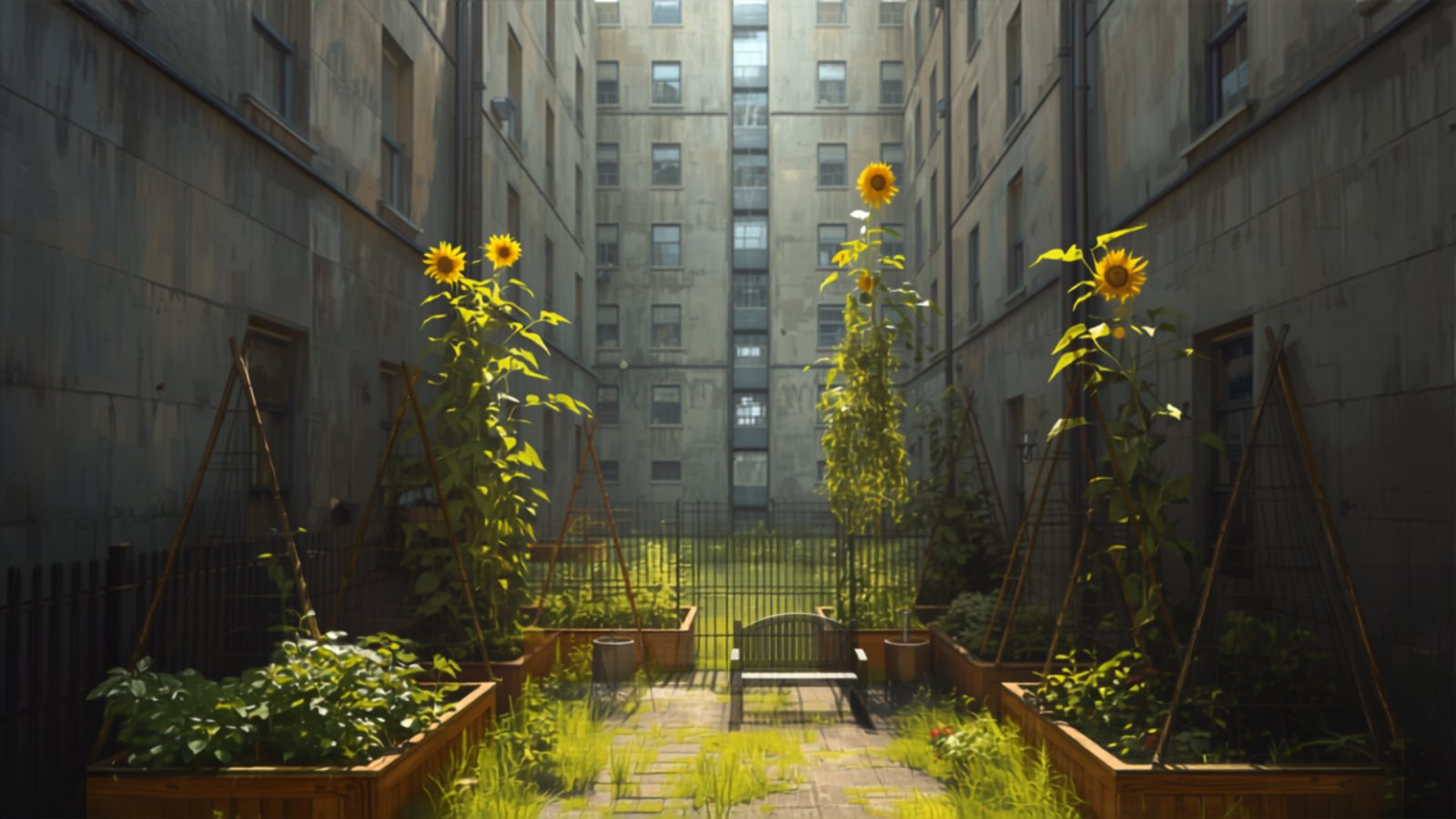
Two decades later, Kern Street Garden had raised beds edged with reclaimed scaffolding boards, three apple trees pruned to precisely the shape of Ada’s palm when she taught them, a chess table donated by a Polish tenant of Marchmont, and a shed containing tools, a kettle, a first-aid kit, and — because a garden of that size attracts every stray thing a city can offer — a rescue cat called Cornel who was, by any reasonable measure, not really anyone’s cat.
Its position was precarious. That was the word Ada always used, even before there was any reason to. A precarious thing is one that could fail at any moment, held up by nothing very solid. The triangle had no formal lease. The council had never quite registered its own indifference. What existed was an arrangement, in which everybody agreed not to ask questions, and Ada — with the redoubtable persistence of a woman who had taught inner-city eleven-year-olds for thirty-one years — made sure that no question was asked. She noted every visiting officer, every reshuffle, every consultation. Rarely did a councillor visit the ward without her sending, within the fortnight, a small thank-you card mentioning, almost incidentally, the garden by name. She had, by long attrition rather than by any election, become the incumbent guardian of the triangle — not because anyone had appointed her, but because everybody else had, over time, chosen not to be.
The teenagers came, at first, for the chess table. Then they came because Ada let them charge their phones in the shed. Then because she did not ask them, in the tone their teachers used, what they intended to do with their lives. Ellie, Yusuf, Mishra and a boy who insisted on being called Tag were, by their fifteenth summer, permanent fixtures. Not once did Ada complain about the smell of vape smoke drifting from behind the shed, and not once did they leave a bottle behind them. It was an unspoken treaty, and it held.
2 · The letter
The letter arrived on a Tuesday in April. Ada was, at the time, deadheading a bed of tulips whose colour — a marbled cream and pink — she had specifically chosen because it matched the paint on the front door of the flat she and Kelechi had rented in their first year in the city, forty years before. Sentiment, she liked to say, is a form of memory that nobody accuses you of.
The envelope was heavy, cream-coloured, franked by the borough’s regeneration team. Its contents were exactly what she had feared for two decades. The triangle, described in the letter as “Site Reference KRN/07,” had been included in a mixed-use redevelopment scheme. A local partnership had been identified. A public consultation would open in six weeks. All feedback would, of course, be considered.
“All feedback will be considered.” Ada read the sentence aloud, in the kitchen, to nobody, and laughed once, mirthlessly. She had been on the sending end of that phrase herself, in staff meetings, and she knew precisely what weight it carried. It was, she thought, the most anodyne sentence in all of municipal English — anodyne meaning bland and inoffensive, designed to soothe rather than to promise. She placed the letter on the table, made tea, and sat with it for a long time.
Her first instinct was the correct one, the professional one, the one she would have advised anyone else to take. She wrote a letter of her own. It was two pages long, polite, factually dense, and unemotional. It set out the garden’s history, its documented uses, the biodiversity survey done by a local university two summers earlier, and the fact that its removal would leave nine hundred and eighty-three flats without a scrap of shared green ground within walking distance. She posted it on Thursday.
The reply came on Wednesday of the following week, and Ada could tell from the envelope that it would be the anodyne version of the anodyne. Never had she read a letter that promised so much and committed to so little. The council thanked her for her “contribution.” Her comments would be “included in the consultation dossier.” The redevelopment aimed to “preserve and celebrate the character of the local community.” A tenant liaison officer named Yasmin would be “delighted” to arrange a site visit at a mutually convenient time. The reply itself, Ada thought, was a palimpsest — every phrase had been drafted and redrafted by twenty predecessors, scraped and overwritten so many times that nothing convincing remained beneath, only the faint outline of a promise nobody now remembered making.
That word — mutually — caught in her throat. The council had never once, in twenty years, treated the garden as anything requiring mutual consideration. Now that they wanted to sell it, they were suddenly generous with pronouns. It was, she reflected, the standard sequence: for two decades the garden had been ignored because it was precarious, and now it was to be extinguished because it was inconvenient.
She rang her son in Manchester that evening. He listened, and told her, gently, not to fight it alone. “Mum, please. This is what those lot do. They pick off the ones who go quiet.” He said he would come down at the weekend. She said she was perfectly capable of handling it herself, thank you. He said he knew, and that was rather the problem. They laughed, and did not argue.
3 · What the young ones did
She did not tell the teenagers immediately. She wanted, first, to have a plan she could present with the calm assurance she had brought to every classroom crisis for three decades. What she had not accounted for was Ellie, who — while charging her phone in the shed on the following Saturday — noticed the letter on the workbench and read it upside down.
By that evening a fifteen-second video was circulating on TikTok. It showed the triangle from above, filmed by drone (whose drone, Ada never established), the letter blurred but legible enough, and Yusuf’s voice, unaccredited and furious, saying, “This is our garden. They think we won’t notice.” A caption read: SAVE KERN STREET. By Monday morning the video had eleven thousand shares. By Tuesday it had four hundred thousand, and a national newspaper had rung the council press office for comment.
Ada was, to her considerable surprise, appalled. She had not authorised the video. She had not authorised the language. And on Wednesday, when Ellie posted a follow-up naming the ward councillor’s twenty-two-year-old daughter — who worked, entirely coincidentally, at the very developer’s PR agency — as proof of a conspiracy, Ada telephoned the four of them and asked them, in the tone she reserved for genuine anger, to come to the shed at six.
They came. They stood in a row like conscripts. Ada looked at them and thought, for the first time in twenty years, that she had misjudged something fundamental.
“You have,” she said, “just accused an entirely innocent young woman of corruption.”
“She works there,” said Tag.
“So do about six hundred other people. That is not evidence, it is coincidence.”
“But it’s brought attention, Miss.”
“Attention on the wrong thing. You have handed the council its excuse. They can now say the whole campaign is a mob.”
Yusuf, whose ordinary diffidence hid a redoubtable moral clarity, said, “But nothing else was working.” Ada opened her mouth to reply and, to her own irritation, closed it again. Because he was right. Her two-page letter had earned her a form reply and a mutually convenient site visit. Their crude, defamatory, brilliantly framed video had put the story into the national press. She had spent twenty years cultivating precisely the discipline that had produced nothing, while they had spent forty-eight hours doing something munificent — extravagantly, showily generous, wildly overspilling the boundaries of propriety — and had, in raw effect, made more progress than she had managed in a lifetime of good manners.
She did not concede this out loud. What she said was, “You will take down the post naming her daughter. Tonight. And in return, I will teach you how to run a campaign that the council cannot dismiss.” The four looked at one another. Ellie, who was going to be the difficult one, said, “And if we don’t?” Ada looked at her steadily. “Then you will still take it down, because it is the right thing to do. But there will be no lessons.” The post came down at midnight.
4 · A quieter kind of war
The weeks that followed were, for Ada, the strangest of her retirement. She found herself teaching again, but the subject was neither reading nor mathematics. She taught the four of them how to log a public records request, how to draft a press quote in fewer than forty words, how to identify the two councillors most likely to break ranks, and how to arrive at a public meeting five minutes early and choose the second-row seat rather than the front, “because the front looks needy and the back looks disengaged.”
Ellie, whose grasp of what she called “social” was decades beyond Ada’s, taught her in return. She showed her how to caption a photograph in a way that made a viewer stop scrolling, and how to reply to trolls without validating them. Ada, who had always considered social media a form of civic vandalism, was obliged to revise her position — not to embrace it, but to concede that a tool she disliked was, in the hands of the beleaguered, a defence.
Beleaguered was her word for the four of them, and it was accurate. Ellie’s mother worked three cleaning jobs. Yusuf’s family had been in a temporary flat for eleven years. Mishra’s father was awaiting a decision on an asylum application that had, so far, been reviewed for one thousand three hundred days. Tag lived alone at seventeen in a supported flat above a launderette. The council that was preparing to sell their garden had never, in any tangible sense, offered them anything else. Only now, when the loss of a single triangle threatened to become a public embarrassment, did the borough discover the vocabulary of consultation.
At the third open meeting, held in the community centre on a wet Thursday in June, the tenant liaison officer Yasmin — who was, Ada had by then decided, a genuinely decent person trapped in a bad institution — took her to one side. Would Ada, she asked, consider a private conversation with a representative of the developer? Off the record. Nothing binding. “It’s just,” Yasmin said, “that they’ve read your submission and they are, actually, quite impressed. They want to talk about how to preserve what you’ve built.”
Ada thought about it for a full three seconds. Preservation, in the mouth of a developer, was rarely what a gardener meant by preservation. But refusing to talk was the sort of gesture that satisfied the ego and lost the argument. “Yes,” she said. “Bring me the meeting.”
The meeting was scheduled for the following Tuesday, in a glass-walled room on the eighteenth floor of a building whose lifts smelt of orange peel. Ada wore her navy suit, the one she had worn to Kelechi’s memorial and to every meeting of any consequence since. It occurred to her, riding up in the lift, that she had never in her life been in a room that expensive without also carrying a mop.
5 · The offer on the table
There were three of them: a man called Julian, a woman called Priya, and a younger man taking notes whose name Ada immediately forgot. Julian did most of the talking, which Ada noted as a tactical error on their part, because Priya was clearly the sharper of the two.
Julian was fluent. Fluent, Ada thought, in the specifically glib sense — smooth, quick, pleasing to the ear, and communicating nothing anyone could later hold him to. He was “genuinely inspired” by the garden. He had “walked the site” (three times, apparently). The proposed development would include a “green heart” at ground level — a paved courtyard with “generous planting” and “flexible seating” — and, and this was the point he arrived at with the manner of a magician producing a rabbit, they proposed to name it, in perpetuity, Kern Street Green.
Ada waited. She had, over three decades of teaching, developed an almost occupational instinct for the moment in a pupil’s excuse when the excuse became threadbare — worn so thin that the threads showed through. Julian’s proposal was threadbare. The word “green” was doing a great deal of work. The word “flexible” was doing more.
“How much soil?” she asked.
Julian paused. “I’m sorry?”
“In your green heart. How much actual soil, in cubic metres, will be available to a resident who wanted, for example, to grow tomatoes?”
Julian looked at the note-taker. The note-taker looked at his laptop. Priya, to her credit, met Ada’s eye. “The planting scheme is on raised planter beds,” she said. “Structural reasons. Total soil volume is around eleven cubic metres.”
“And the current garden?”
Priya hesitated. “Ninety-four.”
“And your courtyard is proposed to serve how many flats?”
“Ninety-two new units, plus the retained blocks.”
Ada let the arithmetic sit between them. Nobody in the room needed her to do it out loud. Eleven cubic metres of soil, distributed across a courtyard that would be shared by more than a thousand people, was not a garden. It was a photograph of a garden.
Julian recovered. He spoke about the wider public benefit, about the housing crisis, about the funding that would be released for community initiatives elsewhere in the ward — a munificent-sounding sum of £180,000, ring-fenced for “green space projects” and shrinking to almost nothing the moment one spread it across a ward of thirty thousand residents. He offered, in what he clearly imagined to be his masterstroke, a place on the panel that would decide how the money was spent. Not the garden. The panel.
She was tempted. Not by the money — the money was crumbs — but by the specific, precise flattery of being made the incumbent, the safe pair of hands, the community elder who could be trusted to distribute other people’s compromises. It would have been an enormously comfortable retirement. She would have circumvented the ugly parts of the fight and preserved something, even if not the thing itself.
“Thank you,” she said. “I would like to think about it.” Julian smiled. It was, Ada noted, the smile of a man who had heard “yes” and did not yet know that he hadn’t. Priya, who had heard something rather different, did not smile at all.
6 · The walk back at dusk
Ada took the lift down alone. Julian’s parting handshake had carried the same glib warmth as his opening one, and something about the identical temperature of the two gestures unsettled her more than any single sentence he had said. She walked out into a summer evening that was already softening toward dusk, the towers of the city catching the last of the sun on their upper storeys. She could have taken the bus. She walked instead.
It was a long way. Past the offices of a bank that had, thirty years earlier, been a fish market. Past a mosque that had, forty years earlier, been a Baptist chapel. Past the tube station where a busker was playing a Bach piece badly, and near it a woman on a folding stool was selling, from a suitcase, second-hand children’s books. The city, in its palimpsest of uses, was itself a kind of Kern Street Garden — layer upon layer of accident, held together by the refusal of any single layer to fully disappear.
Not once during the walk did Ada rehearse an argument. She had done that all week. Instead, she thought about the young woman she had once been in the year they moved into Ridley Heights, and about the reasons that a widow of fifty-four had once found the ugliest view in the borough beautiful. It had been beautiful, she saw now, because it required nothing of her, and because the requirement had been what she was, then, unable to bear. Twenty years later, requirement was all she wanted. What Julian was offering was a comfortable exit from requirement.
By the time she reached the triangle, the streetlamps were on. The four teenagers were sitting on the chess table in a rough circle, Ellie’s laptop open in the middle. Cornel the not-quite-cat was, with characteristic diplomatic instinct, sitting on Yusuf’s foot. They looked up as Ada approached, and their faces — she registered this with a small internal shock — carried a tension that was, for them, unusual. They wanted to know what had happened in the room on the eighteenth floor.
Ada stopped just outside their circle. She had not, until that moment, decided what she was going to do. She had a courteous compromise in her jacket pocket, and she had a harder, unruly, imperfect fight ahead of her — a fight that would involve tactics she disliked, publics she did not trust, and outcomes she could not guarantee. To accept the compromise was quixotic in a soft, tempting way: it was idealistic about the goodwill of institutions that had never earned her goodwill. To refuse it was quixotic in the older, stranger sense — impractical, romantic, insufficiently prudent, and possibly the only honest thing left to do.
Ellie shut the laptop and stood up. Mishra shifted along the bench to make room. Cornel did not move. Ada took a slow breath, opened her mouth, and began to speak.
What she said to them, and whether it would be enough, was another story.
Check your understanding
Read each question and think about your answer before you click “Show answer”. Some questions test detail; others ask you to read between the lines.
Words to remember
Here are the ten key words again, this time in fresh sentences that push slightly beyond how they were used in the story. Read each one aloud and notice the register — several of these belong to formal or literary English rather than everyday speech.
- precarious — The whole peace agreement rested on a precarious understanding between two governments that did not, in truth, trust each other.
- anodyne — The chief executive’s statement was so anodyne that even the journalists who wrote it up struggled to find a headline in it.
- redoubtable — The prosecution’s key witness turned out to be a redoubtable retired accountant who had kept every receipt for fourteen years.
- munificent — The bank made a munificent donation to the arts centre and then, over the following decade, quietly attached its logo to everything the centre produced.
- threadbare — By the third rewrite, the minister’s defence of the policy had become so threadbare that even her own advisers stopped trying to shore it up.
- glib — There is a difference between being articulate and being glib: one earns trust over time, the other spends it in a single meeting.
- beleaguered — The beleaguered head teacher had, by the end of the term, learnt to distinguish between complaints she could act on and complaints she could only survive.
- quixotic — Opening an independent bookshop in a small town in 2026 was, by any commercial reckoning, a quixotic enterprise; that did not necessarily make it a mistake.
- incumbent — In our tradition, it is incumbent on the oldest guest to make the first toast — and the incumbent mayor was, unfortunately, also the oldest guest.
- palimpsest — The novel reads like a palimpsest of the writer’s earlier drafts, with older scenes half-erased beneath the new ones and occasionally showing through in unexpected places.
Grammar in this story: inversion after negative and restrictive adverbials
Look at these sentences from the story:
• Rarely did a councillor visit the ward without her sending a small thank-you card.
• Not once did Ada complain about the smell of vape smoke.
• Never had she read a letter that promised so much and committed to so little.
• Only now, when the loss of a single triangle threatened to become a public embarrassment, did the borough discover the vocabulary of consultation.
• Not once during the walk did Ada rehearse an argument.
Notice what has happened: the subject and the auxiliary verb have swapped places, so we say did a councillor visit, not a councillor visited. This is called inversion, and it is triggered whenever a sentence opens with a negative or restrictive adverbial: never, rarely, seldom, hardly, not once, no sooner, only when, only now, only after, and a handful of others. The word order signals to the reader that a formal, emphatic register is in play — which is why inversion is common in literary and journalistic English but rare in casual conversation.
👉 Learn the full rule, including the traps and the C1/C2 exam patterns: Inversion with negative adverbials — never, rarely, seldom (and why you flip the verb).
Talk about it · Write about it
Talk about it: Ada is offered a seat on a panel that would give her genuine, if limited, influence — in exchange for legitimising something she believes is wrong. Have you ever been offered something similar (in work, family, or public life)? What did you do, and would you decide the same way now?
Write about it: Write 250–350 words continuing the story from the final line. What does Ada say to the four teenagers? Try to use at least three inversions after negative or restrictive adverbials (never, rarely, not once, only when…), and at least four of the ten key words. Aim to match the register of the original — measured, precise, unafraid of a long sentence when the thought needs one.
🎉 Well read. Anything above three thousand words at C2 is a real piece of prose, not a graded exercise, and you have just read one. Notice, too, how quickly the ten difficult words have stopped feeling difficult — that is the point of glossing them once and then reusing them until they belong to you.
But we have left Ada in mid-breath, in front of four teenagers who trust her, holding a compromise in her pocket and a harder choice in her mouth. What she says next will decide whether Kern Street Garden survives, and — perhaps more interestingly — what kind of elder she becomes. That, as the last line promised, is another story…
Enter a folk tale where words have literal weight. Compare the narrator’s voice with the formal and informal speech of the villagers. Next story: The Weigher of Words (C2 Reading Story)
About this story: This is an original C2 (Proficiency) graded reader of roughly 3,200 words, written to the Oxford Bookworms method adapted for the web. The vocabulary sits near native, but the ten most demanding words are glossed up front and reused throughout so a proficient learner can read the story at speed and still absorb the harder lexis. The featured grammar point — inversion after negative and restrictive adverbials — is threaded through the narration rather than drilled, on the principle that C2 grammar is best learnt by noticing it in the wild.

I’m Khamis Maiouf. I’m studying Health and Social Care and have completed Functional Skills Level 2 in English and Level 3 Hairdressing. I have taught ESOL in my community and helped students with GCSE English. I run English Teacher Site to help people learn and practise English.