
The Bora and the Poet (C2 Reading Story)

C2 · PROFICIENCY Reading practice · ~3,200 words · 16-min read
This is a literary short story for advanced learners at C2. The register shifts between narrative reflection and clipped dialogue; you will meet controlled use of idiom, inversion for emphasis, and a scattering of borderland vocabulary. Skim the ten key words first — one or two are pre-taught precisely because they are load-bearing later. Then read for pleasure. There is a comprehension quiz at the end.
Before you read — 10 key words
- karst — a landscape of pale, porous limestone; here, the plateau above the Adriatic city of Trieste.
- bora — a fierce, dry north-easterly wind that funnels down from that plateau in violent gusts.
- borderland — a region where two cultures, languages, or histories overlap and blur, rather than meet cleanly.
- valediction — a formal act of saying goodbye; a leave-taking, especially at the end of a life or a letter.
- laconic — using very few words; economical in speech, often to the point of dryness.
- unassuming — modest in appearance; not drawing attention to itself.
- precipice — the vertical edge of a cliff; often used figuratively for a moment of moral or emotional risk.
- threshold — the flat stone or piece of wood in a doorway; also, figuratively, the point of entering something new — including, in some traditions, the passage of the newly dead.
- undeflectable — impossible to turn aside; unshakeable in intention or manner.
- derelict — abandoned; here, in the sense of “professionally derelict” — having failed in one’s duty.
The story
1 · The Bora Line
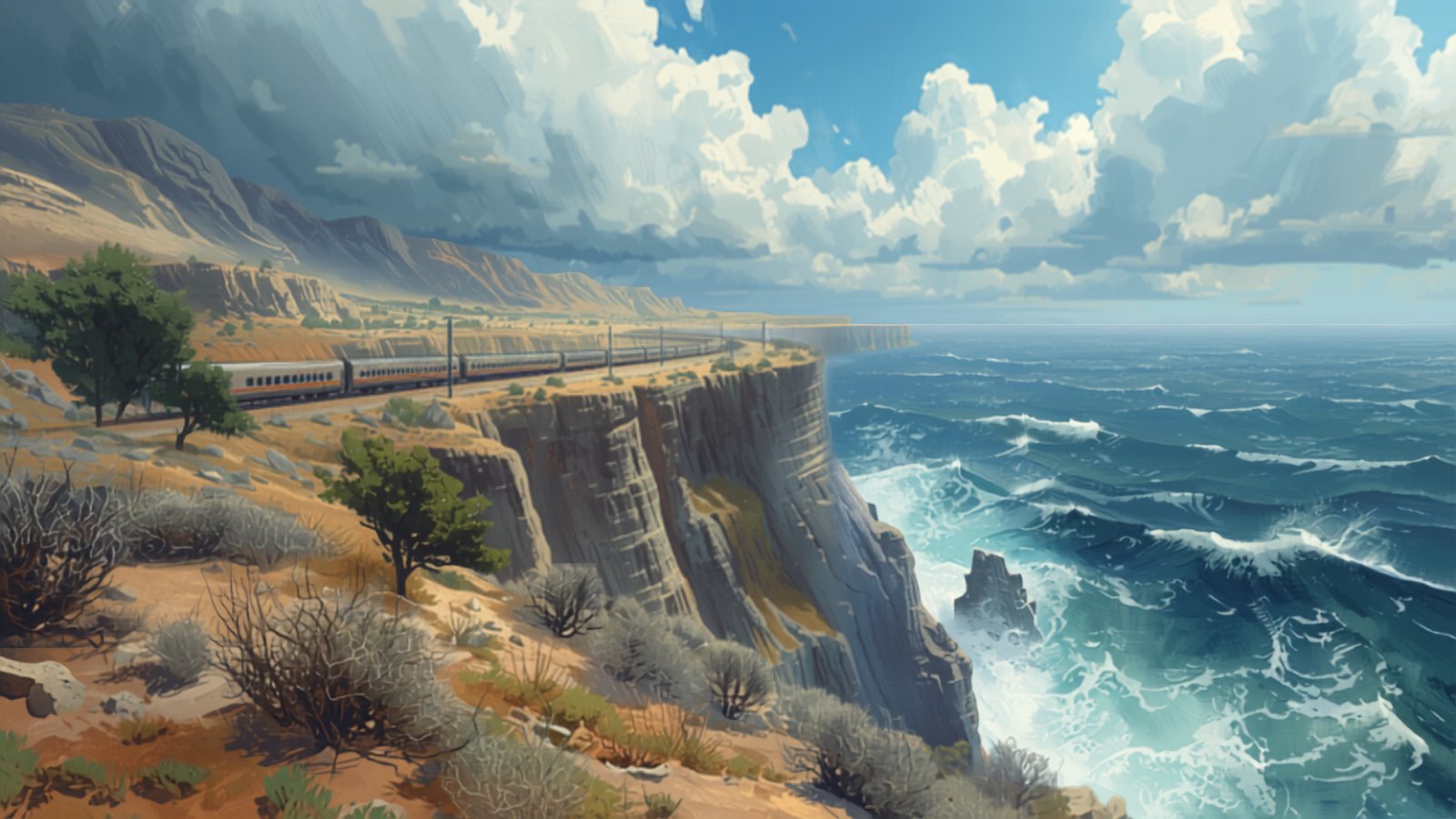
The train from Ljubljana to Trieste is known, unofficially, as the Bora Line, after the fierce north-easterly wind that occasionally comes tearing down from the karst plateau with enough force to overturn lorries on the coastal road. Marta had ridden it once before — nine years earlier, on a summer that no longer felt as though it had belonged to her — but she remembered next to nothing beyond a smudge of pine forest and the sudden, dizzying descent towards the Adriatic. This time she was travelling in November, and the carriage was very nearly empty. Two young men in coats too thin for the season were leaning against a window at the far end, sharing what appeared to be a single pair of earphones between them. A woman with silver hair sat opposite Marta and read, unhurriedly, a paperback whose spine had long since ceased to hold together.
Marta had accepted the assignment in what she now recognised, if she was honest with herself, as a moment of professional vanity. The poet was Andrej Kalin — Slovenian, ninety-one, and, if the reviews were to be believed, one of the last living voices in a lyric tradition that had once mattered enormously and now, like most things that had once mattered enormously, mattered only to the few who knew what they had lost. He had requested her by name. Her name — the name at the bottom of a small volume of border poetry she had translated a decade earlier and largely forgotten — had, according to his agent, been the reason he was willing to be translated into English at all. Whether this was flattery, fate, or, most probably, the persistent belief of the very old that they were owed one last debt from the world, Marta could not have said. She had said yes without deliberating. Only afterwards, boarding the plane at Gatwick under a rain like discouragement, had she wondered why.
Outside, the pine forest thickened. She thought of her mother, who had died in the spring — briskly, matter-of-factly, without granting any of them a proper valediction. She thought of the flat in Highbury which, in her absence, would remain undisturbed, the kettle cold, the plants sensibly watered by a neighbour to whom, Marta admitted, she owed at least a bottle of decent Chianti when she got back. She thought, in the long undignified way that thoughts arrive when there is nothing to do but sit, of every small failure of intimacy that had brought her to this carriage, on this line, at forty-seven years of age.
Then the train tilted, and the sea appeared.
If you have never come down into Trieste from the plateau, it is difficult to convey the effect. One is travelling, quite ordinarily, through pale grass and stone; and then, without warning, the whole horizon is water — the Gulf of Trieste opening like a hinged page — and the town lies below, tightly packed against the coast, its terracotta rooftops slanting towards a harbour full of nothing much. It is the last true frontier of the Latin world. Beyond the far breakwater, everything is Slav; and beyond the Slav, in a manner of speaking, everything is memory. Marta had once written a footnote to that effect, in a critical journal read chiefly by other translators, and had been quietly proud of it for a week.
The train drew, at length, into the station. A porter — genuinely, an actual porter, of the sort Marta had believed extinct outside period drama — offered to carry her case. She thanked him, in Italian; then, hearing herself, added a word in Slovenian, because she was in a town that had spoken both for centuries, and to slip only one language across a threshold was, in this place, a small kind of rudeness. He inclined his head. He said nothing, in either language, but he smiled — a slow, tired smile — as if she had passed the first, easiest test of the day.
She walked out into the sea light. The bora, at that hour, was doing nothing more spectacular than lift a paper cup along the pavement in a series of small, embarrassed hops. Beneath the awning of a caffè that had been in operation, according to a modest brass plate by its door, since 1904, an old man in a suit of impeccable, if unfashionable, cut was reading a newspaper printed in a script Marta could not, at that distance, identify. She envied him. She could not have said what precisely for.
2 · The Poet’s Threshold
Andrej Kalin lived in a top-floor flat on Via del Monte, in what the locals still called the Ghetto — a designation as much affectionate as historical, since the Jewish families who had given the district its name had, for the most part, been carried away in the war and never returned. The building was unassuming: pale ochre, three storeys, a heavy wooden door with a brass letter-slot corroded to green. Marta pressed the bell for KALIN — the initial K a small, defiant reminder that this was, or had been, a household of the borderland, not of Rome. A voice, thinly amplified by an intercom that had probably outlived several tenants, invited her up. There was no lift, and she counted, out of sheer nervousness, seventy-two steps.
The door of the flat had been left ajar. She pushed it open into a small, low-ceilinged corridor that smelled of paper, of old wool, and of the sort of coffee — burnt, unrepentant, insistent — that no barista in London would knowingly serve to a paying customer. A woman of about Marta’s own age stepped out from a further room and introduced herself, in unexpectedly Californian English, as Kalin’s granddaughter, visiting from Palo Alto. She had, Marta noticed at once, an air of practical competence that seemed at pointed odds with the rest of the flat, in which practical competence had clearly been rationed for decades.
“He’s been up since six,” she said. “He’s, um, luminously nervous. I can’t tell you what today means to him.”
“Nor to me, actually,” said Marta, and, hearing herself, was surprised to find she meant it rather more than she had prepared to.
The poet was seated at a small round table by the window, wrapped in a shawl the colour of moss. He was smaller than she had imagined — one always imagines poets to be tall, God knows why — and his hands, resting quietly on the tablecloth, were spotted, elegantly veined, and stiller than any hands she had seen for a long time. He did not stand. He inclined his head, with the sort of measured courtesy that used to be taught in schools that no longer exist.
“Signora,” he said. He looked at her for a long moment, and Marta had the odd, disorienting sensation of being read, as if she herself were a poem — one, at that, with a difficult prosody. “You are late.”
“By nine years, perhaps,” she said. “I am sorry.”
He laughed once, a short, dry cough of a laugh, and gestured her towards the chair opposite his. Behind him, through the tall window, the harbour lay in a thin, indifferent November light. A container ship, painted a violent red, was being nudged into place by two ill-matched tugs. Somewhere further down the street a scooter refused, at length and with several exclamations, to start.
She glanced, as one does when acclimatising to a stranger’s air, at the room behind him. Two walls, floor to ceiling, in books — chiefly poetry, in half a dozen alphabets, the Slovenian and the Serbo-Croat and the Italian mixed without any of the anxious segregation that librarians further west feel obliged to enforce. On a third wall, above a battered upright piano that nobody had played, presumably, for a decade, hung three photographs in identical dark frames: a young man in a uniform Marta could not identify; a woman on a beach, laughing at something outside the frame; and, curiously, an aerial shot of a village so small that its entire population must have fitted into the school hall. On the piano stood a single, half-empty jar of honey. Nothing else. Nothing, she thought, that a lesser man would have wanted a visitor to see first.
Marta had prepared a list of questions. She had, in her notebook, a careful ordering of them — biographical first, poetic second, the more delicate matters of politics and exile relegated, cautiously, to the end. Kalin looked at the notebook when she opened it, and said, without unkindness, “Put that away, please. If we are going to speak, we speak.”
She put it away, with the odd, dislocated feeling of having passed some minor but not unimportant examination without ever having been told what the subject was.
3 · Translations
They spoke for the better part of four hours. They spoke of his childhood in a village that had, over the course of eighty years, belonged to four different countries without so much as moving one metre in either direction. They spoke of the poetry he had written in his twenties, in a bureau in Ljubljana, with a censor’s blue pencil forever hovering above every noun. They spoke of the wife he had lost in 1998 — laconically, on his part, and with a delicacy that Marta was almost embarrassed to find in herself. They spoke, at last, of the book she was to translate, which contained forty-three poems and was called, in its original tongue, Odslovilo — literally, “the taking of leave”, though no English word quite carried the same weight.
“Valediction,” she offered.
“Too formal.”
“Farewell.”
“Too soft.”
“Send-off, then?”
“Now you are being ridiculous.”
He watched her puzzling over it in real time, and his eyes creased, not unkindly, with something that might have been anticipation. “You see,” he said at last, “this is why I asked for you. You will not settle.”
She almost said: Poetry is not always the failure of translation — sometimes it is precisely what translation makes possible. But she did not. It was the sort of thing one thought without saying, if one had any sense at all — the sort of remark that, offered aloud, curdles instantly into pretension.
Instead, she asked him about the final poem in the book, which she had read three times on the plane and could not, in all honesty, decide whether she understood. It was five lines long. It described a man walking, at dusk, along the edge of a limestone precipice — which, in the karst above Trieste, is quite a real place, marked on the maps and, on the day she had last been there, marked also by a single, rusted warning sign in three languages — with a coat draped over his arm and the wind rising. There was no verb of feeling anywhere in it. It ended with the word for threshold, which in Kalin’s language was also the word for the stone slab across the doorway of a house, and, by extension, for the passing of the newly dead across it.
“What is it about?” she asked; and then, hearing herself, added at once: “Forgive me. That is a stupid question.”
“It is not stupid,” he said. “But it is a question that a translator cannot afford to ask.”
“Why not?”
“Because if I answer, you will translate my answer. And then no reader in English will ever hear the poem. They will only hear what the old poet said the poem was about. Do you see the difference?”
She did. And she did not entirely welcome seeing it. Rarely, in her professional life, had she felt so deftly cornered by a courteous man.
“So,” he said, quite gently. “Don’t ask. Translate.”
He reached, without looking, for a slim green volume on the low shelf behind him and, opening it at a page apparently chosen at random, began to read. His voice, thinned by age, nevertheless held a musculature that startled her — the vowels long, the consonants only barely there, the caesura falling always a syllable later than a listener trained in English would expect. She did not follow every word. She caught, however, the shape of one line — tam, kjer se konča jezik — which he repeated twice, as if he wanted to be sure the phrase had landed. Later, in her hotel room, she would spend an unreasonable half-hour on it. There, where language ends. No — there, where the tongue itself gives out. No. Perhaps only: where words have nowhere further to go. She would settle on none of them. Kalin, she suspected, had known she would settle on none of them, and had chosen the line precisely for that reason.
She looked out at the harbour. The container ship had, in the twenty minutes since she had last noticed it, made almost no progress at all. A gull crossed the window at an angle that seemed, briefly, to defy some principle of physics she could not quite recall. Below, in the courtyard, a child was calling — persistently, in a language that might have been Serbian, or might have been something older — for someone named Tanja.
Only then did she realise that she had not written a single word down. In nine years of interviewing writers, she had never once conducted a conversation without a notebook. She should, she supposed, have felt professionally derelict. Instead she felt — and she suspected the feeling was not one she would find easy to name later — attended to.
“You are frowning, signora,” said Kalin. “May I ask why?”
“I was thinking,” she said, choosing her words with the care of a person walking on unfamiliar ice, “that I have not, in all my working life, sat with a writer and not taken notes.”
“And?”
“And I am not sure what that means.”
“It means, perhaps,” he said, “that today you are not a translator.” He waited, watching her; then, with the smallest inclination of his head, delivered his verdict. “You are only a reader. That is the older profession.”
4 · The Last Coffee
The wind rose in the afternoon. Not the bora — the true bora comes in gusts one can lean against, and takes the chimney pots as souvenirs — but a lesser cousin, sharp enough to make the shutters knock and to send an old newspaper cartwheeling, brief and doomed, across the tiles of a neighbouring roof. The granddaughter brought coffee: thick, unfiltered, poured from a small, dented pot that must have been in the family for as long as anyone could bear to remember. Marta drank hers black. Kalin insisted on his with a dissolving sugar cube, and stirred it with an air of undeflectable ceremony, as though the stirring itself were an obligation whose neglect might tip the world quietly out of balance.
He asked her, apropos of nothing, about her mother. Marta had not mentioned her mother. Whether he had guessed from the way she held her mouth, or whether — as she was increasingly inclined to suspect — the very old have their own methods of intelligence, methods that require neither microphone nor questionnaire, she did not know. She told him, more slowly than she would have expected herself capable of, about the illness, the surprise, the tidy, unfinished quality of the last months, the way her mother had refused, on principle, to make any pronouncement she could not later revise. He listened without offering the small consolations that people offer.
“You did not say goodbye,” he said, at last.
“No.”
He nodded, as though something in the atmosphere had merely been confirmed.
“Nor did she,” Marta added, and was startled by the small note of complaint that had, without her permission, crept into her voice.
“Ah,” said Kalin. “That is a different matter.”
Then he pushed a slim envelope across the table towards her.
“An advance copy,” he said. “The Slovenian edition. Yours before anyone else’s, in point of fact — though I would rather you did not tell my agent.”
She thanked him. She turned the book over in her hands. On the cover was a single word — Odslovilo — set in the plainest of typefaces; and, beneath it, a small pencil drawing of a stone step, worn concave, as by generations of feet.
She let her thumb rest on the drawing. She thought, quite involuntarily, of her mother’s front porch in Devon: the stone worn similarly, by nothing so grand as generations — only by one determined woman’s habit of standing on it at six each morning to see what sort of light the day had brought her. She had, in the last months, hardly ever been on that porch. It was an unremarkable regret, one of the hundreds she had come to Trieste carrying — and yet, in this room, at this table, in the presence of this particular unfamiliar book, it was somehow the one that surfaced. She said nothing about it. Kalin, one had to assume, could tell.
“You will translate it,” he said. “You will not settle. And you will not, I hope, ask me what any of it is about.”
“No,” she said. “I won’t.”
They sat for a while. The wind knocked the shutters again. Outside, the harbour lay unchanged, the red container ship at last docked, the tugs departing in a slow, purposeful convoy. The granddaughter, out of sight in the further room, was humming, quite tunelessly, a song Marta did not recognise and rather hoped she would never come to. Nothing happened, in the way that the important things in life so rarely do. But when Marta at last stood to leave, she found herself unable to speak the small, ordinary sentence she had prepared; and it was Kalin who spoke instead, in a voice that was neither weary nor especially kind, but simply, unmistakably, final:
“Go well, signora. And when next you are by a threshold — pause on it a moment. That is all any of us can ever do.”
She descended the seventy-two steps in the failing light. At the bottom, she stopped, one hand on the corroded green letter-slot, and did what she had been told. She did not cry. She was not, perhaps, a person who cried easily. But she stood, for the length of a breath, on the low stone step of a stranger’s threshold in a town she barely knew, and she felt — for the first time since the spring, since the flat in Highbury, since the plane and the pine forest and the sudden, hinged opening of the sea — that some small, unfinished piece of her had at last been laid, quietly and irrevocably, down.
Three weeks later, the first draft of the translation lay on her desk in Highbury. She had left the last poem for last. She read it, in the original, at a little after midnight, with the rain against the window and a tumbler of something amber and unnecessary at her elbow. Then she began to translate. She did not settle. And when she reached the final word — threshold — she paused, obedient at last to the poet’s instruction, and did not cross it for a very long time.
Check your understanding
Read each question, form a considered answer in your own words, then click “Show answer” to compare. Questions 6 and 7 are interpretive — there is no single “correct” reading.
Words to remember
Here are the ten key words again, redeployed in fresh contexts. Read each sentence aloud; note the register shift where it happens.
- karst — Slovenia’s karst region gives us the very word “karst” in geology; underneath the pale limestone runs an astonishing network of caves.
- bora — Ferries are cancelled whenever the bora gusts above force ten, and locals stop the moment their coat collars start snapping like flags.
- borderland — Growing up in a borderland, she had learned to switch languages the way other children switched cardigans.
- valediction — His retirement speech was less a valediction than a mild, ironic warning to whoever was foolish enough to take over.
- laconic — Ask the harbour master for a weather forecast and you will get a laconic “wind rising”, nothing more.
- unassuming — Behind the unassuming façade — chipped paint, one flickering lamp — was one of the finest private libraries in the city.
- precipice — The negotiation had been dragging on for months, and both sides now stood on the precipice of walking out.
- threshold — The moment you cross the threshold of a house in that region, you are handed slippers, coffee and, whether you want it or not, an opinion.
- undeflectable — She dealt with the customs officer’s questions in her habitual undeflectable tone, and he waved her through in the end out of sheer exhaustion.
- derelict — Any editor who lets a fact-check slide is derelict; the readers can always tell.
Grammar in this story: inversion for emphasis
At C2, one hallmark of confident, literary English is the inversion of subject and auxiliary verb after a fronted negative or restrictive adverbial. It sounds formal — and, when overused, self-conscious — but placed carefully it lends real weight to a sentence. Look at the passages below and note what has been moved to the front of the clause, and what has been inverted as a consequence:
“Only afterwards, boarding the plane at Gatwick under a rain like discouragement, had she wondered why.”
“Only then did she realise that she had not written a single word down.”
“Rarely, in her professional life, had she felt so deftly cornered by a courteous man.”
“Nor did she,” Marta added.
The uninverted alternatives (“She had only wondered why afterwards”; “She only then realised…”) are perfectly grammatical, but flatter. Inversion pulls the emphasis forward and gives the sentence a slight, deliberate solemnity — very useful in reflective, retrospective narration; disastrous in a lively email to a friend. Register matters.
👉 Master the full pattern — the triggers, the auxiliaries, the traps — here: Inversion for Emphasis (C2 Grammar).
Talk about it · Write about it
Talk about it: Kalin insists that a translator “should not settle” for a near-enough word. Do you agree that some words in your first language are genuinely untranslatable? Choose one and try to explain — in English — what surrounds it. What does the surrounding air feel like?
Write about it: Write 300–400 words about a small farewell you were denied — a person, a place, a former version of yourself. Use at least two examples of inversion for emphasis, and one image drawn from a specific landscape (weather, light, an object in the room). Aim for the story’s restrained register: understatement carries more weight than exclamation.
Well done — you have read a genuinely literary short story in English, complete with borderland vocabulary, register shifts, and a handful of inversions that would trip up a merely competent reader. At C2, that is exactly the level you should be able to sustain.
But we never see Marta finish the translation. What did she do with that final word — threshold — after her long, obedient pause? And what does it mean that the poet, dying, asked to be translated by someone who had already, in her own life, failed to say goodbye? The next story crosses a different threshold entirely…
Frances thinks she already knows the story she will write. Follow the last crossing and notice where experience challenges that certainty. Next story: The Last Crossing (C2 Reading Story)
About this story: This is an original C2 graded reader (~3,200 words) written for advanced learners. Vocabulary is unrestricted but the ten headwords most likely to obstruct a fluent reading have been pre-taught and reused inside the narrative. Grammar is deliberately full-range: inversion for emphasis, complex subordination, register shifts between narrative reflection and clipped dialogue. The plot is entirely original and adapts no copyrighted source.

I’m Khamis Maiouf. I’m studying Health and Social Care and have completed Functional Skills Level 2 in English and Level 3 Hairdressing. I have taught ESOL in my community and helped students with GCSE English. I run English Teacher Site to help people learn and practise English.