
The Last Crossing (C2 Reading Story)

C2 · PROFICIENCY Reading practice · ~3,200 words · 16-min read
This is an original story for proficient readers. It is written in near-native English, with idiom, irony, and shifts of register — the narrator’s polished magazine prose sits alongside the blunt speech of the people she meets. Ten less common words are glossed below; each one reappears in the story. Read them first, then let the story carry you.
Before you read — 10 key words
- elegy — a piece of writing that mourns something (or someone) that is gone.
- valedictory — expressing farewell; marking an ending.
- jaded — tired and cynical because you have had too much of something.
- threadbare — worn thin from overuse; (of ideas or phrases) stale.
- inured — so accustomed to something unpleasant that it no longer affects you.
- gall — rude boldness; the nerve to do something insulting.
- purchase — (here, a noun) a firm grip or hold on a surface.
- obsolescence — the process of becoming outdated and falling out of use.
- curmudgeon — a bad-tempered, difficult person, often old, often secretly kind.
- platitude — a flat, overused remark that sounds wise but says nothing.
The story: The Last Crossing
1 · The assignment
Frances Hale had written the piece before she boarded the train north. Not literally — the file on her laptop held nothing but a headline and a date — but in every way that mattered, the article already existed. Twenty-two years of travel writing will do that to you. Give her a dying ferry route, a remote Scottish island, a final sailing scheduled for a grey Friday in October, and the prose assembled itself while she slept: the mist would be rolling in off the Sound, the old boat would be creaking with memory, some weather-beaten islander would deliver, on cue, a line about the end of an era. She had written that article a hundred times, about a hundred places. Only the nouns changed.
It had not always been this way. There had been a decade — her first — when every ferry timetable read like a promissory note, and she would cross a continent on the rumour of a good story. She had filed copy from a monastery guesthouse by candlelight, from the cab of a logging truck in British Columbia, once from a customs shed while two officials argued over whether her typewriter counted as taxable goods. The hunger had been real then, and so, therefore, had the writing. What she could not establish — and she had gone looking, on certain bad nights — was the exact point at which the hunger had been replaced by technique.
Her editor’s email had been brisk. Last sailing of the Corra ferry, 24th. Sixty years of service, being replaced by some modern thing. Want 2,000 words, elegiac, you know the drill. Frances, this one writes itself.
That was precisely what troubled her, though she’d never have admitted it to him. An elegy is meant to mourn something; hers had long since stopped mourning anything at all. Somewhere along the way — she couldn’t have named the year — the genre had gone threadbare in her hands. The same fabric, rubbed thin by repetition, holding its shape out of habit. Vanishing railways in the Carpathians. The last lighthouse keeper in Brittany. A closing tea house in Kyoto that turned out, on closer inspection, to be relocating to a shopping centre. Obsolescence was her beat, and business was booming.
She was, she supposed, jaded — a word she disliked for its accuracy. Jaded, and inured to her own tricks. She could no longer read the phrase timeless charm without hearing the till ring. Other writers burned out loudly, with resignation letters and memoirs. Frances had simply gone quiet inside, filing polished copy on schedule, each piece a small valedictory performance for a world she no longer felt anything about. The platitudes arrived unbidden now, fully formed. That was the frightening part. Not that she reached for them — that they reached for her.
Still. Work was work. She changed trains at Glasgow, watched the hills lean in around the line, and by the time she reached the coast at Duncraig the light was already failing. Across the water, low and dark as a sleeping animal, lay the island of Corra. Population one hundred and forty. One shop, one church, one pier. And, for one more day, one ferry.
2 · The pier at Duncraig
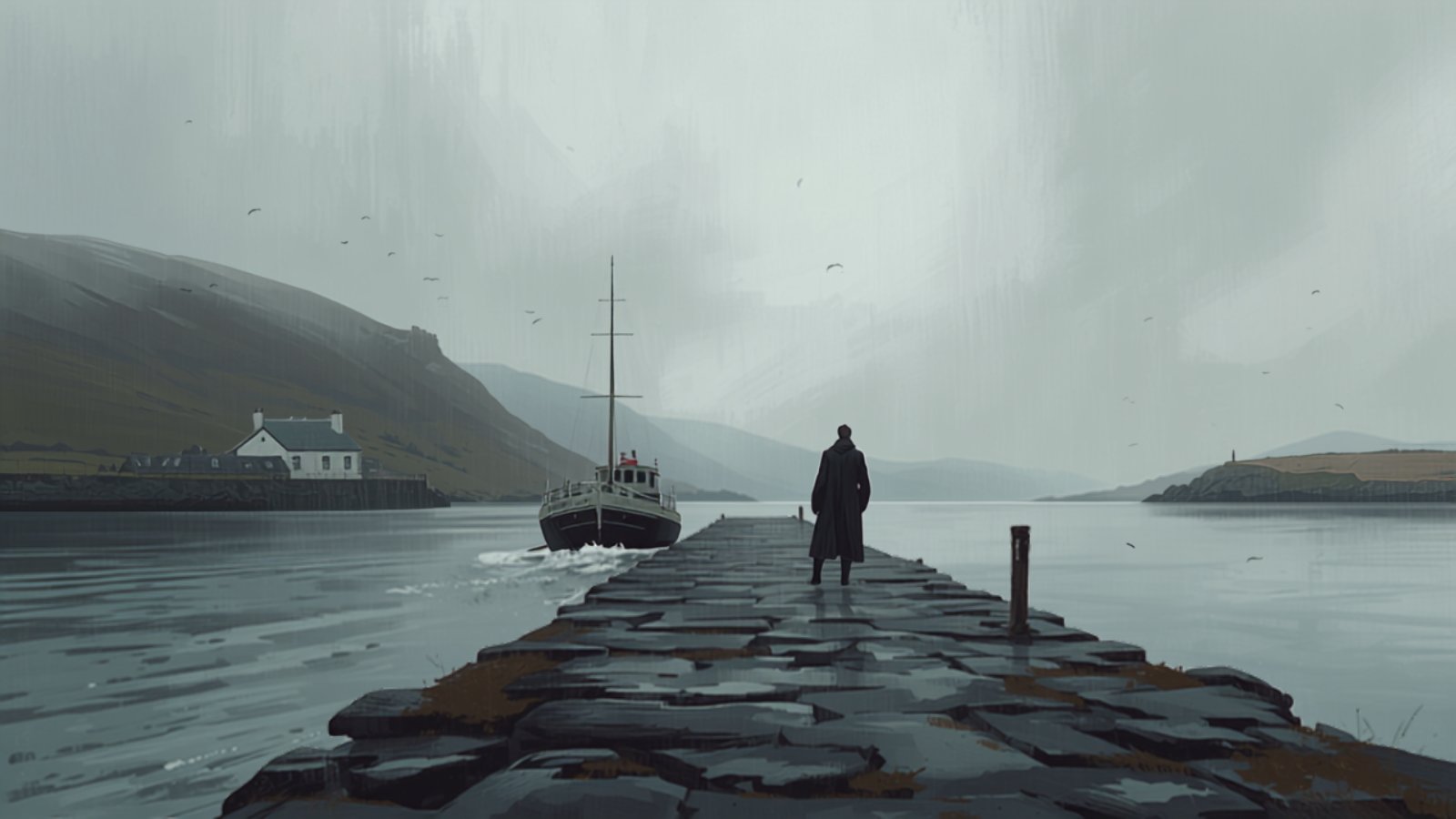
The Maid of Corra was smaller than her photographs — they always are — a stubby black-and-white vessel with a car deck that held six vehicles at a squeeze and a passenger lounge that smelled of diesel and wet wool. Frances arrived at the pier expecting, if not a crowd, then at least a gathering. Camera crews. Wreaths. Somebody with bagpipes. The occasion seemed to demand it.
What she found was a queue of two cars, a builder’s van, and eleven passengers with supermarket bags. A man in a high-visibility jacket was waving the van aboard with the enthusiasm of someone loading a dishwasher. Nobody was weeping. Nobody, as far as she could tell, was even pausing for a last look.
Duncraig itself was one street deep: a hotel with its lights on against the afternoon, a chandlery, a bus shelter papered with notices for a ceilidh that had happened in September. Above the pier a new linkspan waited for Monday’s vessel — an enormous, freshly painted grey ramp that everyone walked past without comment, the way you walk past a wrapped present the day before a birthday. Frances photographed it without quite knowing why. It would be days before she understood that the picture she’d taken absent-mindedly was the story, and the boat she’d come to photograph was the footnote.
The skipper took her ticket at the top of the gangway. Ewan MacAskill — she’d found his name in the press release — was perhaps fifty, built like the pier itself, with the professionally unimpressed expression of a man who had answered the same journalist’s questions four times that week.
“You’ll be the writer,” he said. It was not a question.
“Frances Hale. I’m covering the last crossing for —”
“Aye, I know what you’re covering.” He handed back her ticket stub. “Lounge is for’ard. Tea’s a pound. The heartbroken locals are a wee bit thin on the ground today, so you may have to make do with Effie.”
“You’re the fifth this week,” he added, relenting slightly. “Had a fellow on Tuesday flying one of those drones. Wanted me to sound the horn for him at sunset. I told him the horn’s for fog.” He considered the memory without pleasure. “He’s put it in his film anyway, the horn. Got the sound off the internet.”
Effie turned out to be the elderly woman settling herself by the lounge window with a cardboard box on her knees — small, upright, wrapped in a coat the colour of heather, with the sort of face that had spent eighty years disagreeing with the weather. A curmudgeon, Frances decided within the first minute, and an excellent one: the woman looked at Frances’s notebook the way most people look at a wasp.
“You can sit,” Effie said, “if you’re not going to be writing down everything I say.”
“I could put the notebook away.”
“You could. You won’t. Your kind never do.” But she moved her shopping off the seat all the same, which on certain islands is practically an embrace.
3 · The crossing
The Maid of Corra pushed out into the Sound at four o’clock precisely, and the mainland began its slow retreat. Frances went up on deck for form’s sake, boots fighting for purchase on the wet iron plates, and made her notes: the gulls hanging motionless in the wind, the water the colour of old pewter, the island growing ahead. Good material. Usable. She could feel the familiar machinery turning — the little ferry beats on against the tide, carrying the last of an old world — and she noted, with something between relief and despair, that the machinery still worked perfectly.
She tried the other passengers first, for due diligence. The builder gave her four serviceable sentences about the new boat cutting his materials bill in half and returned to his invoices. The teenagers, asked what the old ferry meant to them, exchanged the briefest of glances and said, with devastating courtesy, that it meant an hour each way to the swimming pool in Duncraig, and that the new one would do it in forty minutes. There is a particular vertigo, for a professional romantic, in discovering that nobody else in the room has read the script. Frances rode it out at the rail, watching the wake unspool behind them like a sentence being deleted.
It was the silence in the lounge that finally unsettled her. Not a mournful silence — a Tuesday silence. Two teenagers were watching something on a shared phone. The builder was doing his invoices. If sixty years of history were ending around these people, they had clearly decided to let it end without supervision.
She went back to Effie and tried the standard opening. “It must be an emotional day. The last crossing, after all these years.”
Effie looked at her for a long moment. “You’ve come a long way,” she said at last, “to tell us what we’re feeling.”
“I’m asking, not telling.”
“You’re asking the way a man holds a door open for you — because the answer’s already walking through it.” The old woman turned her gaze out the window. “Do you know what we call your lot on Corra? The funeral guests. Every year or two, one of you turns up with a notebook to bury something for us. The school. The post office. Now the boat. You write your wee elegy, and the readers in London have a good sigh about the vanishing islands, and not one of you ever asks why the boat’s going.”
“Last year,” Effie went on, warming to her theme, “one of your colleagues wrote that our children ‘grow up with the sea in their blood and loss in their bones.’ Loss in their bones. My granddaughter read it out at the dinner table in a voice like a minister, and we laughed until the tea went cold. She’s at university now, doing marine engineering. She’s coming home next year to work on the new boat’s engines. Put that in your bones.”
Frances, who had interviewed presidents and once shared a raft with a documentary crew and an uncooperative crocodile, found she had nothing to say. She was inured to hostility — journalists grow a hide early or leave the trade — but this wasn’t hostility. It was accuracy, which is worse.
“All right,” she said, and closed the notebook. “Why is the boat going?”
“Because we won,” said Effie.
4 · What Frances hadn’t asked
The story Effie told, as the light went copper over the Sound, was not the story in the press release, and it was certainly not the story sitting half-born on Frances’s laptop.
The Maid of Corra was sixty years old, and for at least twenty of those years she had been quietly failing the island she was supposed to serve. Her car deck couldn’t take a modern ambulance. In a westerly gale she couldn’t sail at all, and Corra could be cut off for four, five, six days at a stretch — which is a romantic inconvenience in a travel article and a rather different matter when you are eighty-one and your husband is having a heart attack on the kitchen floor.
“Nineteen years ago, that was,” Effie said, in the tone of someone reporting the price of eggs. “Donald John. My husband. The boat couldn’t sail, and the helicopter took three hours in that wind. He lived, since you’re wondering — lived another sixteen years, complaining the whole time — but that was the day this island stopped being sentimental about boats.”
It had taken the islanders twenty years of campaigning. Petitions. Meetings in Edinburgh with men who called Corra “economically marginal” to their faces. Effie herself had gone down twice, in her heather-coloured coat, and sat in a government waiting room with a folder of photographs of the ferry queue in January. “The second time, they kept us waiting two hours. There was a man there — young enough that I could have taught him at the school, and I probably did — and he told me the numbers didn’t support a new vessel. So I put my folder on his desk, and I opened it at the photograph of a coffin on the pier, waiting on the weather, and I said: put a number on that for me, son, and I’ll away home.” She smoothed her coat. “We got the letter eleven months later. I’ve it framed in the kitchen, where Donald John’s mother used to keep the Queen.” What the island had demanded — and finally, astonishingly, been granted — was the new vessel that would begin service on Monday: bigger, faster, built to sail in weather that would keep the old Maid tied to the pier. Room for an ambulance. Room, Effie noted drily, for a hearse, “so a body can leave this island with some dignity instead of waiting on the weather like the shopping.”
“So you see,” she finished, “this isn’t a funeral you’ve come to. It’s a graduation. And every one of you funeral guests will write the same threadbare piece anyway, about the end of an era, because the truth — that a hundred and forty stubborn people beat a government — doesn’t photograph as well as a sad old boat.”
Frances thought of her editor’s email. Elegiac, you know the drill. She thought of the phrase the end of an era, which she had typed so many times that her fingers could do it without her. A platitude, she understood with sudden clarity, is not just a stale sentence. It is a decision not to look. Obsolescence had been her subject for two decades, and here was the one question she had never once thought to ask about a vanishing thing: whether the people it was vanishing from might be glad to see it go.
“The gall of us,” she said quietly. “Coming up here to grieve on your behalf.”
“Aye, well.” Effie almost smiled. “At least you’ve the manners to notice.”
5 · The cardboard box
They were twenty minutes from Corra when Frances finally asked about the box. She asked carefully, notebook still shut, half expecting to be told to mind her own business — which, Effie’s expression suggested, was exactly what the question deserved.
But the old woman untied the string.
Inside, wrapped in a tea towel, was a ship’s log — cloth-bound, salt-stained, its corners soft with handling — and beneath it a brass pocket compass with a cracked glass. “Donald John was skipper of this boat for thirty-one years,” Effie said. “Before Ewan’s time. These were his. He kept the log the whole while — every crossing, every gale, every soul carried. When he died I couldn’t look at them, so they went under the bed, the way grief does.” She laid one flat hand on the logbook, a gesture so brief Frances nearly missed it. “It’s Ewan’s boat that’s ending today. Seemed right the log should be aboard for the last of it, and then it’s his to keep. He was Donald John’s boy in every way that counts.”
Frances looked at the box and felt the whole article she had planned collapse gently, like a tent with the poles pulled out. Here it was — the human moment, the detail every editor dreams of, the widow and the logbook on the final crossing. Her jaded professional self was already composing the paragraph. It would be moving. It would be a lie of a particular, polished kind: true in every fact and false in its music, because it would play as an elegy the very thing Effie had spent an hour teaching her was not one.
“I’d ask you to leave that out of your piece,” Effie said, retying the string. “It’s not for readers. It’s for Ewan.”
“Then it’s out,” Frances said, and was surprised to find she meant it — surprised the way you are when a muscle you’d assumed had wasted turns out to still hold. Somewhere below them the engines changed their note. The pier lights of Corra came swinging slowly into the window, and the teenagers stood up, and the builder gathered his invoices, and the last crossing of the Maid of Corra ended the way it had run for sixty years: on time, unremarked, useful to the end.
6 · What she wrote instead
Frances stayed three days on Corra, which was two and a half days longer than the assignment required. She watched Effie hand the box to Ewan MacAskill on the pier — watched the big man go still, then bend and kiss the old woman’s cheek — and she kept it out of her notebook, as promised. She drank tea in the one shop and let herself be corrected about sheep prices by a man of ninety. On Monday morning she stood in a crowd of a hundred and forty — now there was a crowd, now there were bagpipes — and watched the new vessel come in for the first time, huge and white and unlovely, and heard the cheer go up, and understood that she was present at the opposite of an ending.
The three days gave her more than the ceremony. She walked the island’s single road end to end and counted what Corra had instead of scenery: a doctor’s surgery with a helipad marked out in weathered paint, a school with seven pupils and a banner in the window reading WELCOME TO OUR NEW BOAT in seven kinds of handwriting, a shop whose noticeboard advertised a knitting circle, a second-hand boat engine, and — already — a protest about the new vessel’s timetable. It charmed her, that protest. A community mourning its ferry would have been a story she had read a hundred times; a community lodging complaints about the replacement before it had even arrived was something better. It was alive.
The piece she eventually filed was not valedictory, and it was not 2,000 words, and it did not contain the phrase the end of an era. What it was, was true. It was the islanders’ war she wrote — the petitions, the waiting rooms, the twenty years of stubbornness — and the old boat appeared only in the final paragraph, heading out on her last run with no one weeping, because the islanders had already given her the only tribute a working boat understands: they had used her, right up until the moment they had built something better.
She wrote it in the hotel at Duncraig with the window open to the Sound, and for the first time in years the sentences came slowly — not because they wouldn’t come, but because she was checking each one against something. The old test, recovered from wherever she had left it: not does this sound right, but is this true — and would Effie let it stand? Half her trade’s favourite phrases failed it. She filed at midnight, eight hundred words over length, and slept like a woman who has finally paid off a debt.
Her editor’s reply arrived within the hour. Frances looked at the subject line for a long time — long enough for her tea to go cold, long enough to lose her purchase on the calm she’d carried down from the island — and then she poured another cup and read it. What he proposed would take her somewhere she had sworn, publicly and in print, that she would never go again — and he had had the gall to sign off with her own words: this one writes itself. And the curmudgeon in her — for she had decided, on mature reflection, to become one — was already reaching for the train timetable.
Check your understanding
Some of these questions test facts; others test inference — what the story implies but never states. Think first, then click “Show answer”.
Words to remember
The ten key words again, in fresh contexts. Try writing your own sentence for each before reading these.
- elegy — The novel reads less like a plot than an extended elegy for the author’s lost hometown.
- valedictory — There was a valedictory note in her speech, as though she knew she wouldn’t be back.
- jaded — Even the most jaded commuter looked up when the aurora appeared over the station.
- threadbare — His excuse was threadbare from overuse; nobody in the office believed it any more.
- inured — Years on the night shift had left her inured to the sound of sirens.
- gall — He had the gall to criticise the dinner he hadn’t lifted a finger to cook.
- purchase — The climber’s boots could find no purchase on the ice-glazed rock.
- obsolescence — The phone was designed with built-in obsolescence: irreplaceable battery, sealed case.
- curmudgeon — Beneath the scowl, the old curmudgeon had been quietly paying for the children’s books for years.
- platitude — The minister offered platitudes about “lessons learned”, and the room grew colder with each platitude.
Grammar in this story: cleft sentences
This story leans on cleft sentences — structures that split a sentence in two to throw weight onto one element. Native writers use them constantly for emphasis and rhythm. Look:
“It was the silence in the lounge that finally unsettled her.” — an it-cleft. The plain version (“The silence unsettled her”) states a fact; the cleft insists on which thing, out of everything on that boat, did the unsettling.
“What she found was a queue of two cars…” and “What it was, was true.” — wh-clefts, which delay the key information to the end of the sentence, exactly where English likes its surprises.
👉 Master both types here: Cleft Sentences — How English Splits a Sentence for Emphasis.
Talk about it · Write about it
Talk about it: Effie accuses travel writers of “grieving on the islanders’ behalf”. Can outsiders ever write honestly about a place they are only visiting? Where is the line between observing a community and appropriating its story?
Write about it: Write 250–300 words describing a change in a place you know well — a closed shop, a demolished building, a modernised street — twice: first as an outsider’s elegy, then as an insider who welcomed the change. Use at least two cleft sentences, and notice how the same facts produce two different truths.
🎉 You’ve just read 3,200 words of unsimplified, native-level English — irony, idiom, register shifts and all. If the ten key words felt natural by the final chapter, that’s the graded-reader method doing its quiet work.
But one thread is still loose: what was in that editor’s email — and where had Frances sworn, publicly and in print, never to go again? Her next assignment is another story…
A parcel brings Gwen letters that were never sent. Read for the difference between an imagined conversation and words finally encountered. Next story: The Unsent Letters (C2 Reading Story)
About this story: This is an original C2 graded reader (~3,200 words). At this level, vocabulary is near-native and the grammar unrestricted — the challenge lies in idiom, irony, and shifts of register rather than rare words. The ten less common words are glossed before the story and each is reused within it, following the graded-reader principle that new language must be met more than once to stick.

I’m Khamis Maiouf. I’m studying Health and Social Care and have completed Functional Skills Level 2 in English and Level 3 Hairdressing. I have taught ESOL in my community and helped students with GCSE English. I run English Teacher Site to help people learn and practise English.