
The Unsent Letters (C2 Reading Story)

C2 · PROFICIENCY Reading practice · ~3,200 words · 16-min read
This is an original short story for proficiency-level readers. The language is unrestrained — literary narration, colloquial dialogue, formal letters, and a fair amount of idiom. Ten expressions that do particular work in the story are glossed below; each one reappears at least twice, so you will meet it again in context. At the end there are comprehension questions that ask you to read between the lines, not merely to retrieve facts.
Before you read — 10 key expressions
- estrangement — the state of no longer being close to someone you once loved; the distance itself, as a condition.
- executor — the person legally responsible for carrying out the instructions in a dead person’s will.
- verbatim — in exactly the same words; word for word.
- unconscionable — so wrong that no argument can excuse it.
- magnanimity — generosity of spirit, especially towards someone who has wronged you.
- equivocate — to speak in a deliberately vague way in order to avoid committing yourself to the truth.
- threadbare — worn thin from use; of an excuse or argument, weakened by repetition.
- eulogy — a formal speech in praise of someone, usually delivered at a funeral or memorial.
- rapprochement — the re-establishment of friendly relations after a long period of hostility.
- paper over the cracks — (idiom) to conceal a disagreement or flaw rather than genuinely repair it.
The story
1 · The parcel
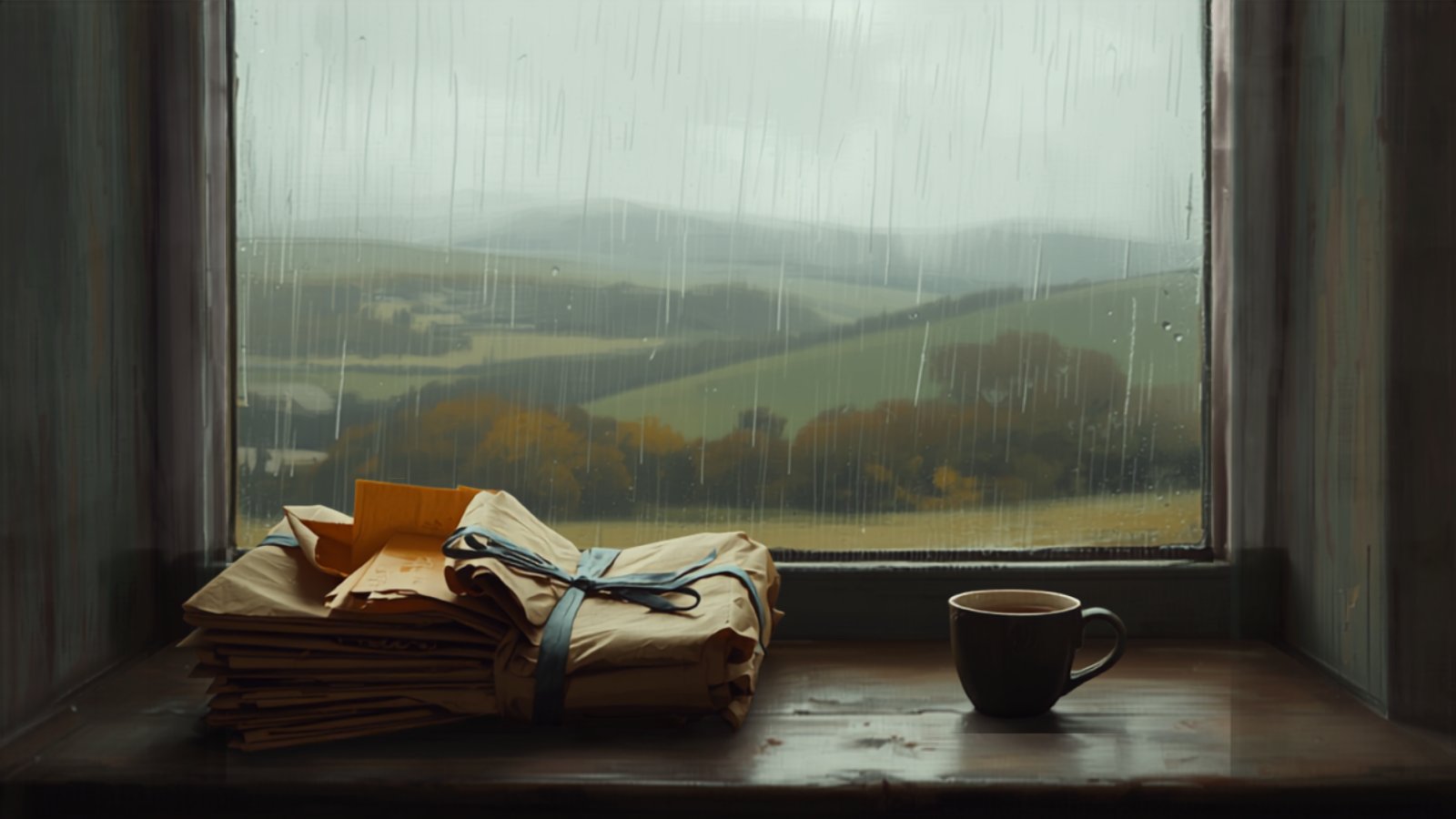
The parcel arrived on a Tuesday, which Gwen Fairfax would later think fitting, since nothing of consequence is ever supposed to happen on a Tuesday. It was raining in that half-hearted Welsh way that never quite commits to a downpour, and she was standing at the kitchen window in her threadbare dressing gown — the grey one, decades past decent, which she refused to replace on the grounds that it had outlasted two prime ministers and one marriage — when the postman’s van pulled up at the gate.
The parcel was book-shaped, though heavier than a book, and the covering letter was from a firm of solicitors in London. She read it twice before the words consented to mean anything.
Dear Ms Fairfax, I write in my capacity as executor of the estate of the late Constance Aldous. Among my instructions is the delivery of the enclosed materials to you, and to you alone. Ms Aldous further expressed the hope — she was insistent that I use the word “hope” rather than “request” — that you might consider delivering the eulogy at her memorial service on the 14th of next month. Should you decline, no offence will be taken and no explanation required.
So Connie was dead. Gwen sat down at the kitchen table, not because she felt faint but because standing suddenly seemed like an affectation, a performance for an audience of none. Constance Aldous — novelist, national treasure, the woman whose face had adorned festival posters and whose sentences were quoted at weddings by people who had never read the books they came from — was dead, and her executor had sent Gwen a parcel.
They had not spoken in thirty-six years.
It occurred to Gwen, with the particular cruelty of arithmetic, that their estrangement had now lasted longer than their friendship. She had known Connie for nineteen years and refused to know her for thirty-six. The silence had won on points.
She did not open the parcel that day. She put it on the dresser, between the fruit bowl and the photograph of her brother Daniel, and she made a pot of tea she did not drink, and she watched the rain fail to fall properly, and she thought: you unconscionable woman. Even now you want the last word.
2 · Cambridge, 1970
They had met over a stolen bicycle — or rather, over the accusation of one. Gwen, eighteen, up at Cambridge on a scholarship and acutely conscious of her accent, had wheeled what she sincerely believed to be her bicycle out of the rack outside the library, only to be confronted by a tall girl in a man’s overcoat who said, with magnificent calm, “That’s mine, actually. Yours is the one with the tragic basket.”
It was. The baskets were the only distinguishing feature between two otherwise identical bicycles, and Gwen’s basket was, there was no denying it, tragic. She began to apologise; the tall girl waved it away and said the bicycle wasn’t hers either, she’d simply always wanted to say something like that with total conviction, and had Gwen ever noticed that if you assert a thing calmly enough, people will hand you their own property? “That,” said Constance Aldous, “is essentially all that fiction is. Come and have tea.”
What followed was the sort of friendship that reorganises a life. They were unalike in every measurable way — Connie was expensively educated, careless with money, incapable of arriving anywhere on time; Gwen was punctual, frugal, and privately convinced that she had been admitted to the university through some clerical oversight — and yet they fitted together like the two halves of an argument. Connie had the nerve; Gwen had the ear. Connie would write forty pages in a weekend, of which thirty were dreadful, and Gwen would tell her, precisely and without mercy, which thirty. Nobody else dared. That, Connie said, was the whole of Gwen’s value and the whole of her charm: she was the only person in England who was never, ever polite to her.
The friendship survived things that routinely kill friendships. It survived Connie borrowing money and forgetting, with perfect sincerity, that she had borrowed it. It survived Gwen’s wedding, at which Connie gave a speech so funny and so faintly seditious that Gwen’s new mother-in-law did not speak to her for a month. It survived, more remarkably, success — for when Connie’s second novel made her suddenly famous, and half of literary London began agreeing with everything she said, it was to Pembrokeshire that she fled twice a year, to sit in Gwen’s kitchen and be told, over strong tea, precisely which of her new opinions were nonsense. “Everyone else applauds me,” she said once, marvelling. “You audit me.” She meant it as the highest compliment she knew, and Gwen received it as one.
After Cambridge their lives diverged in the usual way — Connie to London and the beginnings of a reputation, Gwen home to Pembrokeshire and a teaching post — but the friendship held, sustained by letters. Letters were their true medium. On paper Connie was funnier and Gwen was braver, and between them they built an archive of two lives: Connie’s disastrous love affairs and savaged first novel, Gwen’s classroom, her marriage, her brother Daniel and his boat.
Daniel. It always comes back to Daniel.
3 · The Salt House
Daniel Fairfax drowned in September 1979, three miles off the Pembrokeshire coast, in weather the inquest described as “unremarkable”. He was twenty-six. He had gone out alone, as he often did, in the small white boat he kept at the harbour, and the sea, which had tolerated him all his life, simply changed its mind.
Gwen did not weep at the funeral, a fact the village noted and misread. Her weeping went into the letters. For two years she wrote to Connie almost weekly — long, unguarded, midnight letters about grief and salt and the obscenity of ordinary mornings; about her mother setting a third place at the table and then quietly removing it; about the dream in which Daniel stood dripping in the kitchen doorway asking why the light was off. She wrote to Connie because Connie was the one person with whom she had never in her life been careful. Those letters were the rawest things she ever made. She never kept copies. It did not occur to her that anyone would.
Ten years later, Constance Aldous published The Salt House.
It was, the critics agreed, her masterpiece: a novel about a Welsh schoolteacher mourning a brother lost at sea, written with an intimacy that seemed — one reviewer’s phrase became famous — “less like invention than like eavesdropping on a soul”. It won the year’s biggest prize. It was translated into thirty languages. And on page after page, in scene after scene, Gwen found her own sentences looking back at her. The third place at the table. The dripping doorway dream, rendered almost verbatim. Whole paragraphs of her midnight letters, lightly combed and set into fiction — her grief, verbatim, wearing a stranger’s name and winning prizes for someone else.
The worst of it was the praise. The novel was not merely successful; it was beloved, and it was beloved for exactly the passages that were hers. Reviewers singled out the third place at the table as “an image of devastating economy”. A Sunday broadsheet printed the doorway dream in full, under the headline “The Paragraph of the Decade”. Strangers on television grew moist-eyed quoting her own midnight sentences back into the air, attributing to Constance Aldous a capacity for grief that Constance Aldous had bought second-hand. Even in the village it reached her: the librarian, meaning only kindness, pressed the book on Gwen with the words, “It’s about a schoolteacher who loses her brother to the sea — you of all people will feel it.”
She telephoned London. She had rehearsed a speech, and it deserted her, and what came out instead was simple: “You had no right.”
And Connie — this was the wound within the wound — equivocated. She, who prided herself on never dodging a question, dodged. She talked about transformation, about how all novelists are magpies, about grief belonging to everyone and no one; she said “you have to understand how books get made”, which was not an answer but an anaesthetic; she offered everything except the one sentence Gwen needed, which was I did something unconscionable, and I am sorry. On the radio the following month, asked where the novel had come from, she equivocated again — “from everywhere; from the air” — and Gwen, listening in her kitchen, three hundred miles away, understood that the air in question was her own breath.
“Don’t call me again,” Gwen said, the last time they spoke. “You may keep the prize. It’s an honest fault you’ve turned into a career: you can’t tell the difference between loving people and using them.”
Thirty-six years of silence began with the click of a receiver.
4 · The unsent letters
It took Gwen four days to open the parcel. She would like to have claimed indifference; the truth is that she circled it the way one circles a wasp in a room, pretending to read, pretending to garden, while the thing on the dresser hummed.
Inside, beneath a layer of tissue paper, were two bundles. The first was a manuscript — she set it aside. The second was a stack of envelopes, several dozen of them, tied with string. Every envelope was addressed to her, in Connie’s unmistakable extravagant hand, at this house. Every one carried a stamp. Not one had been posted.
The dates ran from 1990 to last winter. One letter a year, every year, written on the fourteenth of September — Daniel’s date. Thirty-six letters. Their whole estrangement, annotated from the other side.
She read them in order, at the kitchen table, over the course of one long evening, and watched a woman she had known better than anyone argue with herself for three and a half decades.
The early letters were dreadful — brittle, defensive, shot through with self-justification. You will say I stole from you, ran one from 1991, but a novelist is a kind of tide: things wash into her and she cannot always say from which shore. Gwen snorted aloud at that, alone in her kitchen, exactly as she would have snorted at twenty. The tide defence. Threadbare even then, and Connie had known it was threadbare, because the same letter ended: I have read this back and it is the letter of a coward. I will write you a braver one next year.
The braver ones came, though they took years. The register changed slowly, like a season: less performance, more plainness. The letter of 1999 said: I have stopped pretending this is a quarrel between equals. You confided; I harvested. There is no theory of art that launders that, and I have grown to despise the sound of my own equivocating. The letter of 2004 said simply: What I did was unconscionable. I knew it while I was doing it. I would type a passage of yours and feel the wrongness in my fingers, and I would tell myself I’d ask your blessing afterwards — as if permission were a thing that could be applied retroactively, like varnish.
The letter of 1996 dealt with the prize. They have given the book another award, it said, a lifetime-achievement affair, and I stood at the podium in borrowed diamonds and thanked my publisher, my editor, and “the landscape of west Wales”, and the audience found the last of these charming. I looked out at them applauding a theft and I understood, with great clarity, that there is no one left in my life to tell me the truth at volume. You were my auditor, Gwen. Without you the accounts have been wrong for years, and everyone is too polite to say so.
And the letter of 2011, which Gwen read three times:
Had I asked, you would have refused — and the book would have gone unwritten, and I have to live with the fact that, offered that same bargain again, knowingly, I cannot swear I would choose differently. That is the truth about me, and it is an ugly one, and you were the only person who ever saw it clearly and stayed anyway. For nineteen years your friendship was the one honest mirror in my house. Were it not for you, I should never have written a word worth keeping; because of what I did to you, I never again wrote a word I was proud of. There is a symmetry there that would be elegant if it did not hurt so much.
I do not send these letters because sending them would ask something of you — forgiveness, or at least reply — and I have taken enough. A rapprochement conducted for the comfort of the thief is just theft by other means. But I find I cannot stop writing them. Consider it my one enduring discipline: once a year, on Daniel’s day, I sit down and refuse to paper over the cracks.
Gwen sat for a long time when she had finished. The rain had finally committed itself; it drummed on the kitchen window with an enthusiasm the day had earlier lacked. She was surprised to find that what she felt was not vindication — though every letter conceded her the argument — nor quite grief, but something more disorderly: the specific loneliness of winning a war after the other army has gone home.
She had spent thirty-six years being right. It had cost her the only person who was never, ever polite to her.
5 · The dedication
She turned at last to the manuscript. It was the original typescript of The Salt House, the working draft, coffee-ringed and cigarette-scented, older than some of her former pupils. Clipped to the front was a note in the solicitor’s neutral hand: Ms Aldous instructed that this be given to you rather than to the university archive, which has requested it repeatedly. Gwen permitted herself a small, disloyal smile at that. Connie denying an archive something it wanted was Connie saying I love you in her native language.
She almost missed the dedication page. In the published book, the dedication had read, with what Gwen had always considered breathtaking nerve, “For the coast of Pembrokeshire”. But here, on the typescript, that line was crossed out, and beneath it, in ink, was the dedication that had never been printed:
For Gwen, who wrote the truest pages of this book without knowing it, and who will never forgive me — for G.F., verbatim, with shame and with love. Withdrawn by the author, who lacked the courage to print an honest sentence.
Underneath, in pencil, fainter, later: Should you ever read this, Gwennie — and I suppose if you are reading it, I am dead, which is the only condition under which I’d dare — know that I did try, once, to do the magnanimous thing and confess publicly. 1997, the South Bank interview. I got as far as “the novel owes a debt I have never properly acknowledged” and then I watched the interviewer lean forward, scenting a headline, and I lost my nerve and gave him equivocation instead. Magnanimity, it turns out, is a muscle: neglect it for a decade and it will not lift the weight when you finally ask it to. Learn from me. Yours — still, absurdly, after everything — Connie.
Gwen remembered that interview. She had watched it, arms folded, waiting for the confession that never came, and had taken its absence as the final proof of the case. It had not occurred to her that Connie had walked to the edge of it and stood there, unable. It did not excuse anything. It was not meant to. But there is a difference — she felt the difference move in her chest like a key in a stiff lock — between a friend who never regretted the wound and a friend who spent thirty-six Septembers refusing to paper over the cracks, in private, where it earned her nothing.
The estrangement had been just. She still believed that. But justice, she thought, putting the kettle on out of pure ceremony, is a doorway, not a house. Nobody is meant to live in it for thirty-six years.
6 · The fourteenth
The memorial was held in London, in a church full of publishing people wearing the sober expressions of an industry burying its best asset. Gwen sat at the back until she was called, and then walked to the front in her good coat, carrying a single sheet of paper, aware of a rustle of curiosity — who is she? — passing along the pews like wind through barley.
The executor found her beforehand, in the porch — a dry, precise man of about her own age who shook her hand and held it a moment longer than the profession requires. “She spoke of you often, at the end,” he said. “I ought to tell you that she dictated the letter about the eulogy from the hospice, and made me read it back four times until the word ‘hope’ sat exactly where she wanted it. She said you would understand the difference between a hope and a request, and that she had spent thirty-six years learning it.” He hesitated, then added, in the tone of a man exceeding his instructions and deciding it was worth it: “She also said that if you did come, it would be the bravest rapprochement in the history of a cowardly art.”
The eulogy she had written was serviceable. It was accurate, affectionate within limits, and dishonest in the way that all safe eulogies are dishonest: it papered over every crack that had made the friendship real. She had laboured at it for a week, and it had come out embalmed.
She reached the lectern. She looked out at the rows of strangers who thought they had known Constance Aldous because they had read her, and she thought of a tall girl in a man’s overcoat asserting ownership of a bicycle she had never seen before, on the theory that conviction is all that fiction is.
Gwen folded her serviceable page in half, and set it down, and did not look at it again.
“Constance Aldous,” she began, “stole from me. She knew it, I knew it, and for thirty-six years we conducted our friendship in the only register left to us, which was silence. I have recently learned that silence can be written in. I am here to read you what she never sent — and then, if you’ll allow it, I am going to tell you about the bicycle.”
The church went very quiet. In the third pew, the executor closed his eyes, as a man does at the first note of music he has waited a long time to hear. Gwen took the 2011 letter from her coat pocket, unfolded it, and — with the whole of her fifty years’ training in reading aloud to a room — gave her friend, at last, an honest audience.
What she read, and what the room did, and what she found tucked inside the final envelope, the one dated last winter — that is another story.
Check your understanding
These questions go beyond fact-retrieval — several ask you to interpret motive, tone, or implication. Think about your answer, then click “Show answer” to compare.
Words to remember
The ten key expressions again, in fresh sentences. Try producing your own sentence for each before reading on.
- estrangement — After years of estrangement, the brothers found they no longer remembered what the original quarrel had been about.
- executor — As executor of her aunt’s will, she spent months distributing paintings to people she had never met.
- verbatim — The minister’s aide had copied the report almost verbatim into the speech, footnotes and all.
- unconscionable — Charging bereaved families a fee to retrieve their own photographs struck the court as unconscionable.
- magnanimity — With unexpected magnanimity, the defeated candidate offered to campaign for her rival.
- equivocate — Asked directly whether the funds were missing, the treasurer began to equivocate, and everyone understood.
- threadbare — His excuse about the trains was threadbare by the third use, and frankly transparent by the fifth.
- eulogy — The best eulogy she ever heard mentioned the dead man’s faults with as much tenderness as his virtues.
- rapprochement — The two firms’ rapprochement surprised an industry that had enjoyed their feud for a decade.
- paper over the cracks — A pay rise may paper over the cracks, but it will not repair a culture people are desperate to leave.
Grammar in this story: inverted conditionals
Connie’s letters use inverted conditionals — formal conditionals where if disappears and the auxiliary verb moves in front of the subject. Look at three examples from the story:
Had I asked, you would have refused. (= If I had asked…)
Were it not for you, I should never have written a word worth keeping. (= If it were not for you…)
Should you ever read this, know that I did try. (= If you ever read this…)
The inversion raises the register: it makes the letters sound formal, deliberate, almost confessional — exactly right for a woman choosing every word of an apology. Notice also how the solicitor uses it (“Should you decline, no offence will be taken”), because legal English loves this structure.
👉 Master all three patterns here: Inverted Conditionals: Had I Known, Were It Not For, Should You Need.
Talk about it · Write about it
Talk about it: Connie never posted her letters because a rapprochement “conducted for the comfort of the thief is just theft by other means.” Was she right to stay silent, or was withholding the letters itself a form of cowardice dressed up as principle? Where is the line between respecting someone’s distance and abandoning them to it?
Write about it: Write the letter Gwen finds in the final envelope, dated last winter — Connie’s thirty-sixth and last. Aim for 250–300 words, and use at least two inverted conditionals (Had I…, Were it not for…, Should you…) and three expressions from the key vocabulary. Match Connie’s register: formal, self-aware, unsparing.
🎉 You have just read 3,200 words of unrestrained literary English — narration, idiom, shifting registers, and a moral question the story politely declines to answer for you. That is exactly what reading at C2 is.
But the final envelope is still sealed. What did Connie write last winter, knowing it would be her last fourteenth of September? And what did the room do when Gwen finished reading? Some silences, as you now know, can be written in…
Choose Your Next Story
This is the last story in the lives and remembered words group. Choose another C2 story from the reading collection when you are ready.
Other Story in This Group: The Unhurried Life of Isolde Kerner (C2 Reading Story)
About this story: This is an original C2 graded reader (~3,200 words) following the graded-reader method at proficiency level: near-native vocabulary, idiom, and register shifts (literary narration, colloquial dialogue, formal letters), with ten demanding expressions glossed before the story and each reused at least twice inside it. The plot is entirely original.

I’m Khamis Maiouf. I’m studying Health and Social Care and have completed Functional Skills Level 2 in English and Level 3 Hairdressing. I have taught ESOL in my community and helped students with GCSE English. I run English Teacher Site to help people learn and practise English.