
Who vs Whom: The Ultimate Guide You Need to Know

Quick Answer
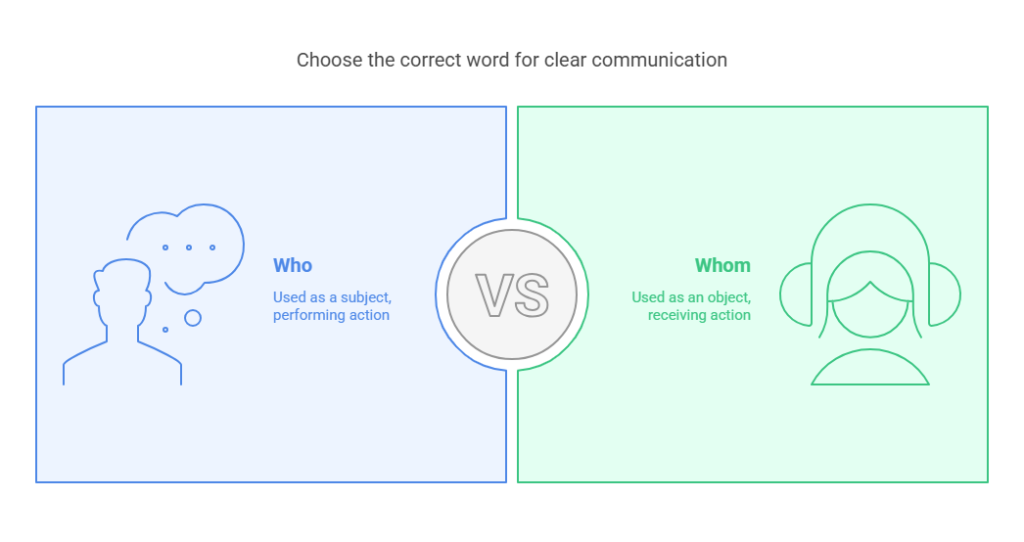
Use who when the person is doing the action (like “he” or “she”). Use whom when the action is done to the person (like “him” or “her”). Quick trick: if you can swap in “him,” use whom. If “he” fits, use who.
Who and Whom — See the Difference
Look at these sentences. Can you see when we use who and when we use whom?
- Who called you? (He called you.)
- Whom did you call? (You called him.)
- Who is that woman? (She is that woman.)
- To whom did you write the letter? (You wrote it to her.)
Did you see the pattern? When the person is doing the action, we use who. When the action is done to the person, we use whom.
Here is the pattern:
| Word | Replaces | Example |
|---|---|---|
| who | he / she | Who is coming? (He is coming.) |
| whom | him / her | Whom did you see? (You saw him.) |
When to Use Who and When to Use Whom
The trick is simple. Try replacing the word with he or him.
Use who when “he” fits:
- Who wants coffee? (He wants coffee. “He” works, so use who.)
- Who broke the window? (He broke the window.)
- She is the one who helped me. (She helped me.)
Use whom when “him” fits:
- Whom did you invite? (You invited him. “Him” works, so use whom.)
- To whom should I speak? (I should speak to him.)
- The man whom I met was kind. (I met him.)
Easy way to remember: WhoM = hiM. Both end in M. If the answer to your question ends in M (him, her, them), use whoM.
The Rule in One Line: Who = he does it. Whom = done to him.
How to Use Who and Whom in Everyday English
- Who wants to go for lunch? (He wants to go — use who.)
- The teacher whom I like best is Mrs. Brown. (I like her — use whom.)
- Who left the door open? (He left it open — use who.)
- Whom should I ask about the homework? (I should ask him — use whom.)
- She is someone who always helps others. (She always helps — use who.)
You are doing great. Now let us look at the mistakes many learners make.
Two Mistakes to Avoid With Who and Whom
Even native speakers use “who” when they should say “whom.” So if this feels confusing, you are not alone. Here are the two most common mistakes.
Mistake 1: Using “who” after a word like “to”, “for”, or “with”
Words like “to,” “for,” “with,” and “from” are followed by whom, not who. The person after these words is always receiving the action.
✗ The man who I spoke to was very kind.
✓ The man whom I spoke to was very kind.
✗ For who is this present?
✓ For whom is this present?
How to remember: Check with “him.” “I spoke to him” — yes, “him” works, so it is whom. “The present is for him” — yes, so whom.
Mistake 2: Using “whom” when the person is doing the action
Some learners try to sound formal by using “whom” everywhere. But if the person is doing the action, you must use who.
✗ Whom is going to the shops?
✓ Who is going to the shops?
✗ Whom told you that?
✓ Who told you that?
How to remember: Try “he” — “He is going to the shops.” That works, so it is who. “He told you that.” That works too — who.
Test Yourself: Who or Whom?
Choose an answer to see your feedback immediately. Your first answer counts towards your score.
1. _______ is knocking on the door?
2. _______ did you meet at the party last night?
3. She is the friend _______ helped me move house.
4. To _______ should I address this letter?
5. _______ do you think will win the prize?
Keep Going — You Are Building Something
You just learned the difference between who and whom. That is one more grammar rule you will never get wrong again.
But here is something tricky. What about who’s and whose? “Who’s coming?” and “Whose bag is this?” look almost the same — but they mean very different things. Do you know when to use each one?
Next lesson: Who’s vs Whose: Understanding Usage with Clear Examples
Sources

I’m Khamis Maiouf. I’m studying Health and Social Care and have completed Functional Skills Level 2 in English and Level 3 Hairdressing. I have taught ESOL in my community and helped students with GCSE English. I run English Teacher Site to help people learn and practise English.