
Alright vs All Right: Which One Should You Write?

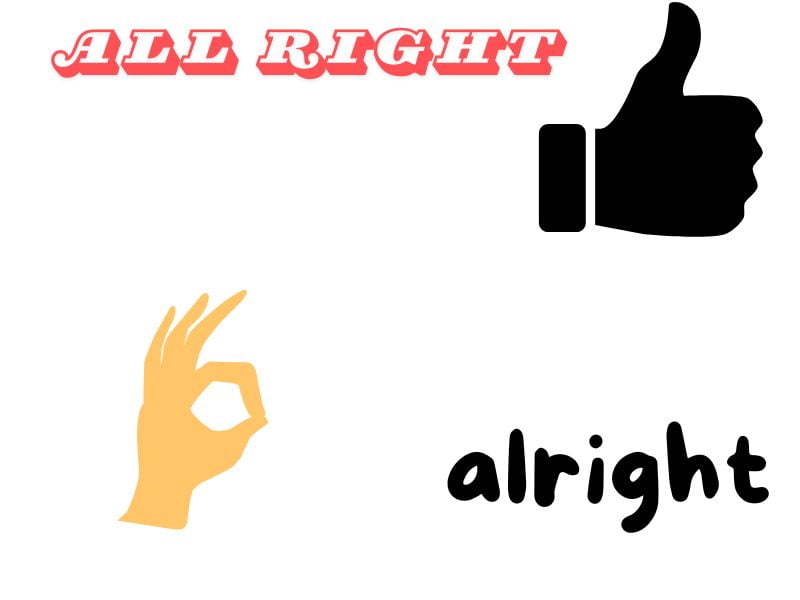
Quick Answer
All right (two words) is the standard form — safe in every situation. Alright (one word) is informal: fine in texts and chat, but many teachers and editors do not accept it. In exams and formal writing, always choose all right.
All Right and Alright — See the Difference
Both forms sound the same. The difference is where you are allowed to use them.
- “Are you all right?” she asked. (Standard — correct everywhere.)
- “Don’t worry, I’m alright 👍” (Informal — fine in a text message.)
- My answers were all right. (Can also mean: every answer was correct.)
- The film was all right, but the book was better. (Standard writing.)
Did you see the pattern? All right works in every sentence. Alright only feels at home in casual messages.
| Form | Status | Where to use it |
|---|---|---|
| all right | standard English | everywhere — essays, exams, emails, books |
| alright | informal | texts, chats, song lyrics — not formal writing |
When to Use All Right and When Alright Is OK
Ask yourself one question: who will read this?
- A teacher, an employer, an examiner? Write all right. Nobody will ever mark it wrong.
- A friend in a chat? Alright is fine — it is very common in informal English.
- Need the meaning “all correct”? You must use two words: “My answers were all right” = every answer was correct.
Easy way to remember: if in doubt, write it out — two words are always all right.
The Rule in One Line: All right is always right. Alright is only for casual writing.
How to Use All Right in Everyday English
- “Is everything all right with your meal?” (A waiter asking politely.)
- “I checked the numbers — they are all right.” (All correct.)
- “It’s all right to make mistakes when you learn.” (Acceptable, OK.)
- “The interview went all right, I think.” (Reasonably well.)
- “Alright, let’s start!” (Casual speech — you will hear this a lot.)
You are doing great. Now let’s look at the mistakes many learners make.
The Most Common Mistake With Alright
Alright appears so often in songs and chats that it feels standard — even native speakers are surprised it is not. If you thought alright was always fine, you are not alone.
✗ Using alright in a job application: “I am alright with weekend shifts.”
✓ “I am all right with weekend shifts.” (formal reader → two words)
✗ “My answers were alright” when you mean every answer was correct.
✓ “My answers were all right.” (= all correct — only the two-word form can mean this)
How to remember: picture your reader. Teacher or boss → all right. Best friend on WhatsApp → alright is fine.
Test Yourself: Alright or All Right?
Choose an answer to see your feedback immediately. Your first answer counts towards your score.
1. In a job application: “I am _______ with working weekends.”
2. In your English exam, the safe choice is always _______.
3. “I got 10 out of 10 — my answers were _______ .” (= all correct)
4. Which form do dictionaries label as informal?
5. Your teacher asks you to correct this sentence: “The film was alright.” What should you write?
Keep Going — You Are Building Something
You just learned when alright is acceptable and when only all right will do. That is one more writing trap you will never fall into again.
Here is the next one-word-or-two puzzle: altogether and all together. One means “completely”, the other means “everyone at once” — and mixing them changes your sentence completely. Can you tell them apart?
Next lesson: Altogether vs All Together: What’s the Difference?

I’m Khamis Maiouf. I’m studying Health and Social Care and have completed Functional Skills Level 2 in English and Level 3 Hairdressing. I have taught ESOL in my community and helped students with GCSE English. I run English Teacher Site to help people learn and practise English.