
Unlocking the Past Tense of Shake You Need to Know

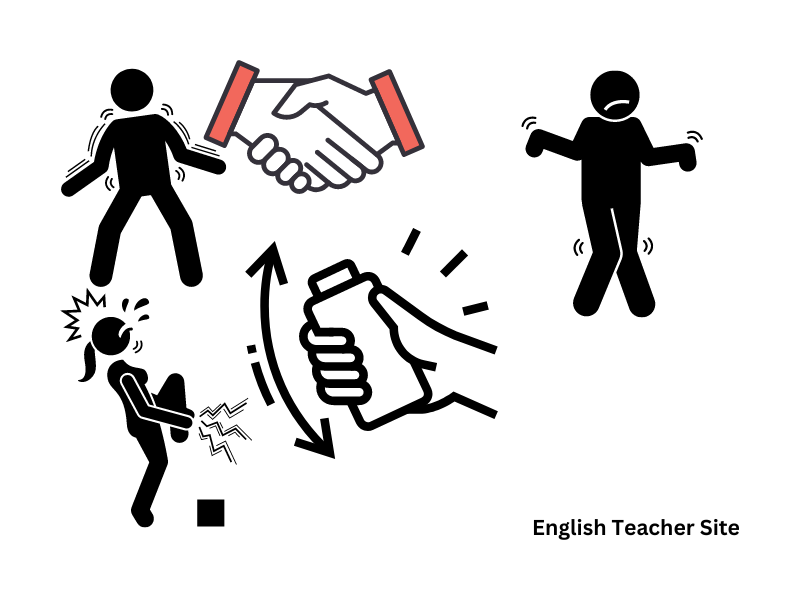
Quick Answer
The past tense of shake is shook. With “have” or “has,” use shaken.
Every day: I shake the bottle.
Yesterday: I shook the bottle.
Many times: I have shaken the bottle before.
Shake, Shook, Shaken — See the Pattern
Read these sentences. Look at how the verb changes:
- I shake my head when I mean “no.” (now — it happens often)
- She shook his hand at the meeting yesterday. (past — it is finished)
- The ground has shaken three times this year. (past with “has”)
Did you see the pattern? There are three forms:
| When? | Form | Example |
|---|---|---|
| Now / every day | shake | I shake the juice before drinking. |
| In the past | shook | He shook the tree yesterday. |
| With have / has / had | shaken | I have shaken the bottle already. |
When to Use Shook and When to Use Shaken
This is the part that confuses many learners. Here is the simple rule:
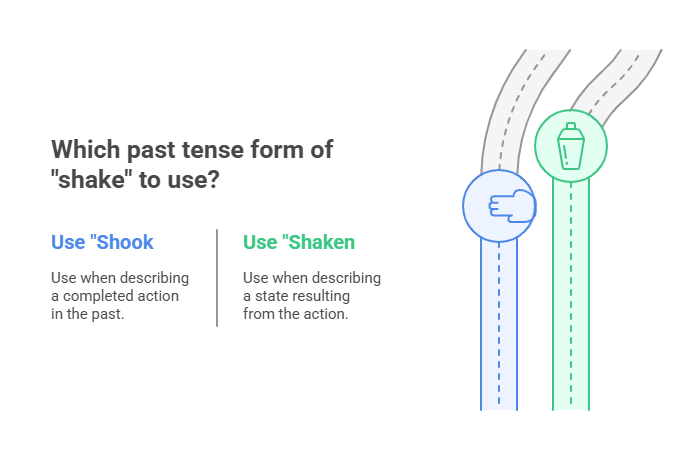
Use “shook” when you talk about the past — something that is finished:
- I shook his hand and said hello.
- The dog shook its body after the rain.
Use “shaken” in two situations:
1. When there is a helping word before it — have, has, or had:
- I have shaken the bottle, but nothing came out.
- She has shaken hands with many famous people.
- They had shaken the tree before we arrived.
2. When it describes something — like a describing word:
- He was shaken by the bad news.
- She felt shaken after the car accident.
Easy way to remember: If you see have, has, or had before it, use shaken. If it describes how someone feels (shaken up), use shaken. For everything else in the past, use shook.
The Rule in One Line: have/has/had or describing a feeling → shaken. Past action alone → shook.
How to Use Shake in Everyday English
Here are examples you might use every day:
- I shook the orange juice before pouring it. (past — it is finished)
- She has shaken the baby’s bottle to mix the milk. (with “has” — use shaken)
- The earthquake shook the whole building last night. (past — it is finished)
- Have you ever shaken hands with a famous person? (with “have” — use shaken)
- He was badly shaken after the accident. (describing how he felt — use shaken)
You are doing great. Now let’s look at the mistakes many learners make.
Three Mistakes to Avoid With Shake
Even advanced learners mix up “shook” and “shaken” sometimes — so if you get confused, you are not alone. Even native speakers’ children say “shaked” when they are learning to talk.
Mistake 1: Adding “-ed” to make the past tense
✗ She shaked the bottle.
✓ She shook the bottle.
Mistake 2: Using “shook” with have/has/had
✗ I have shook his hand before.
✓ I have shaken his hand before.
Mistake 3: Using “shaken” without a helping word
✗ He shaken the tree yesterday.
✓ He shook the tree yesterday.
How to remember: Think of take, took, taken. It follows the same pattern: shake, shook, shaken. The middle changes to -ook in the past and -aken with have/has/had.
Other verbs like this: take → took → taken, mistake → mistook → mistaken, forsake → forsook → forsaken.
Test Yourself: Shook or Shaken?
Choose an answer to see your feedback immediately. Your first answer counts towards your score.
1. She _______ his hand at the meeting yesterday.
2. The building has been _______ by the earthquake.
3. He _______ the bottle before opening it last night.
4. Have you ever _______ hands with a famous person?
5. The bad news _______ everyone in the office last week.
Keep Going — You Are Building Something
You just learned shake, shook, shaken. That is one more irregular verb you will never get wrong again.
Use the examples above to practise this pattern. When you are ready, choose your next topic below.
Choose Your Next Topic
This path ends here. Choose another B1 lesson from the collection when you are ready for a new topic.
Related Lesson for Review: Is It Mistook or Mistaken? The Past Tense of Mistake
Source
Definition of shake from the Collins English Dictionary

I’m Khamis Maiouf. I’m studying Health and Social Care and have completed Functional Skills Level 2 in English and Level 3 Hairdressing. I have taught ESOL in my community and helped students with GCSE English. I run English Teacher Site to help people learn and practise English.