
No One vs. Noone: Understanding the Correct Usage

Quick Answer
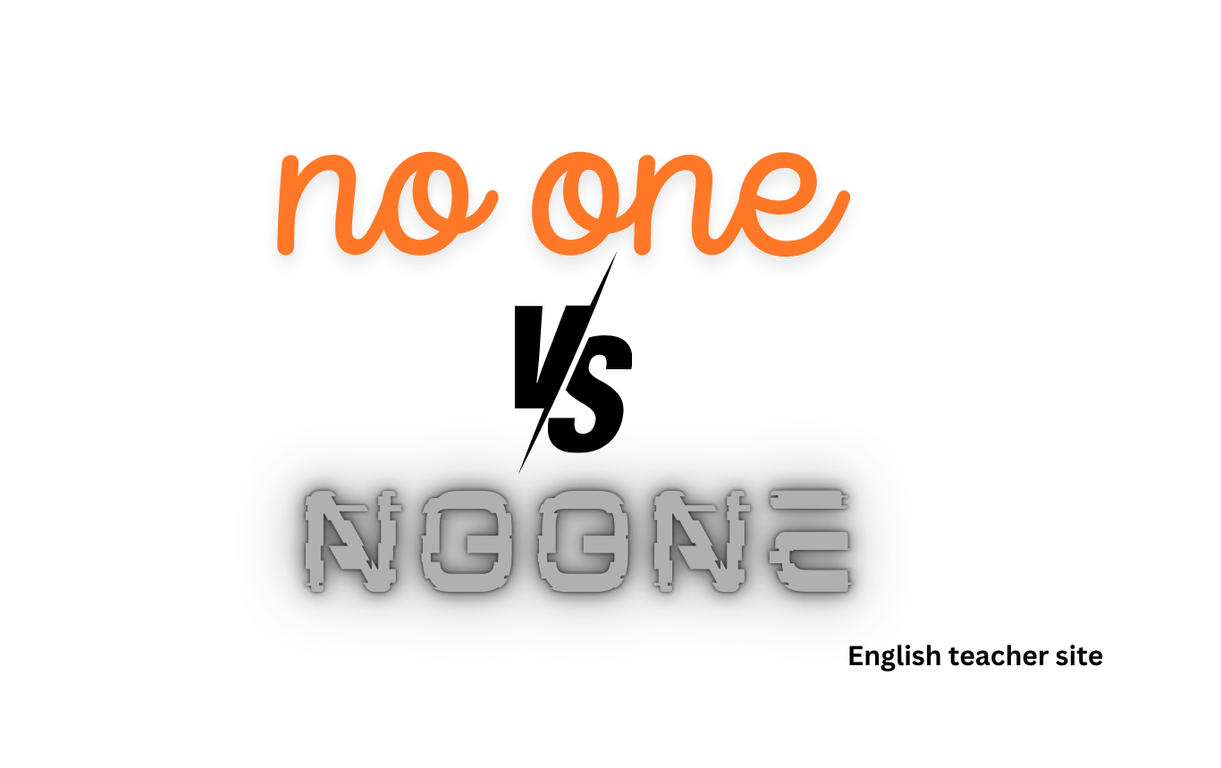
The correct spelling is no one (two words). Writing it as “noone” is a spelling mistake.
✓ No one was home when I called.
✗ Noone was home when I called.
No One — Always Two Words
Look at these sentences. What do you notice?
- No one knows where the keys are.
- She looked around, but no one was there.
- No one told me about the meeting.
- I called three times, but no one answered.
Did you see the pattern? It is always no one — two separate words. It means “not a single person” or “nobody.”
Why You Should Never Write “Noone”
This is what makes it confusing. Many similar words ARE one word:
- someone (one word)
- everyone (one word)
- anyone (one word)
So you might think “noone” follows the same pattern. But it does not. English keeps “no one” as two words. There is a simple reason — if you write “noone,” it looks like “noon” with an extra “e.” That is confusing to read.
| One word | Two words |
|---|---|
| someone | no one |
| everyone | |
| anyone |
There are two more things to remember:
- Singular verb: “No one” always uses a singular verb — no one knows (not “no one know”), no one was (not “no one were”).
- No double negatives: Never use “not” or “don’t” after “no one.” Say no one liked it (not “no one didn’t like it”).
Easy way to remember: “No one” means “nobody.” If you can replace it with “nobody” and the sentence still works, you have it right.
The Rule in One Line: Always write no one as two words — never “noone.”
How to Use No One in Everyday English
Here are sentences you might say or hear in daily life:
- No one came to the party early. (= not a single person came early)
- I knocked on the door, but no one opened it. (= nobody was there)
- No one wants to work on a Sunday. (= not a single person wants to)
- She asked for help, but no one offered. (= nobody offered)
- No one is perfect. (= everybody makes mistakes)
You are doing great. Now let’s look at the mistakes many learners make.
Three Mistakes to Avoid With No One
Even advanced learners write “noone” sometimes — so if you have made this mistake, you are not alone. Words like “someone” and “everyone” make your brain want to join “no” and “one” together. It is a very natural mistake.
Mistake 1: Writing it as one word
✗ Noone answered the phone.
✓ No one answered the phone.
Mistake 2: Adding a hyphen
✗ No-one told me about it.
✓ No one told me about it.
Mistake 3: Using a double negative
✗ No one didn’t come to the party.
✓ No one came to the party.
How to remember: Think of “no” and “one” as two separate ideas. “No” = zero. “One” = person. Zero persons. Two words, always.
Other words that mean the same thing: nobody, not anyone, not a single person.
Test Yourself: No One or Noone?
Choose an answer to see your feedback immediately. Your first answer counts towards your score.
1. _______ was home when I called.
2. No one _______ the answer to the question.
3. She looked everywhere, but _______ could help.
4. No one _______ the cake.
5. _______ told me about the meeting.
Keep Going — You Are Building Something
You just learned that “no one” is always two words. That is one spelling mistake you will never make again.
But here is something interesting. You know that weather is rain, sun, and snow. But what about whether? These two words sound exactly the same, but they mean completely different things. Do you know when to use each one?
Next lesson: Whether vs Weather — What Is the Difference?
Source
noone – Wiktionary, the free dictionary

I’m Khamis Maiouf. I’m studying Health and Social Care and have completed Functional Skills Level 2 in English and Level 3 Hairdressing. I have taught ESOL in my community and helped students with GCSE English. I run English Teacher Site to help people learn and practise English.