
Past Tense of Let Explained: What You Need to Know

Quick Answer
The past tense of let is let. The word does not change. “Letted” is not a real English word.
✓ Today: Please let me help you.
✓ Yesterday: She let me help her.
Let, Let, Let — The Word Never Changes
Look at these four sentences. Two talk about now. Two talk about the past. Watch the word in blue:
- They let their children play outside every day. (now)
- She let me use her phone yesterday. (past)
- We always let the dog sleep on the sofa. (now)
- The boss let everyone go home early last Friday. (past)
Did you see the pattern? The verb let looks exactly the same in every sentence. The only way to know if it is past or present is from the other words — “yesterday”, “last Friday”, “every day”.
| Time | Verb | Example |
|---|---|---|
| Now / every day | let | I let him sit here. |
| Yesterday / last week | let | I let him sit here yesterday. |
| With have / has / had | let | I have let him sit here many times. |
Why Does Let Stay the Same?
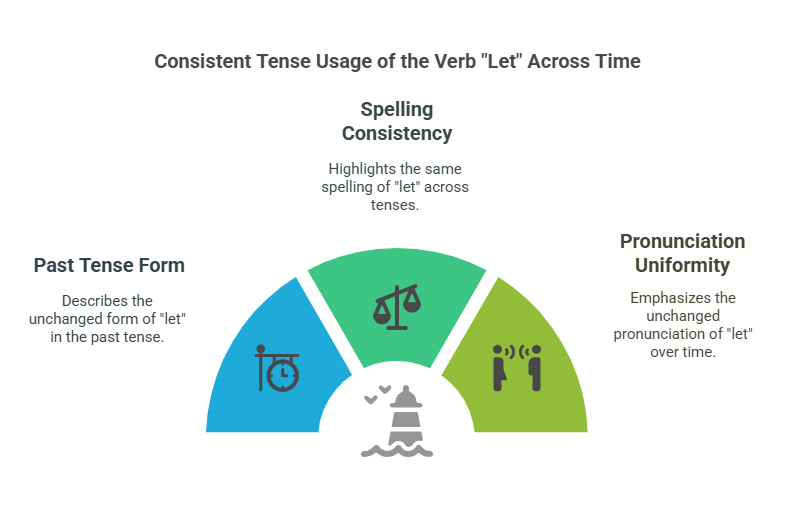
Most English verbs add -ed for the past tense. For example: play → played, walk → walked. But “let” is different. It belongs to a small group of verbs that never change — not for the past, and not with “have”, “has”, or “had”.
Here are the most common ones:
- let → let → let
- put → put → put
- cut → cut → cut
- shut → shut → shut
- hit → hit → hit
- set → set → set
Do you see what they share? They are all short words that end in -t. These verbs never add -ed. So “letted” is not real English. Many learners write it because they expect every verb to follow the -ed rule. Do not worry — this is very normal.
Easy way to remember: Short verb + ends in -t = it probably stays the same. Think: let, put, cut, hit, shut, set.
The Rule in One Line: Let stays let in every tense — “letted” is not a word.
How to Use Let in Everyday English
Here are sentences you might hear or say in daily life. All of them are about the past:
- “My dad let me drive his car last weekend.” (He gave me permission.)
- “The teacher let us leave class early on Friday.” (She allowed us to go.)
- “I let the cat out before I went to bed.” (I opened the door for the cat.)
- “They let me borrow their ladder yesterday.” (They said yes when I asked.)
- “Mom never let me eat chocolate before dinner when I was young.” (She did not allow it.)
You are doing great. Now let us look at the mistakes many learners make.
Three Mistakes to Avoid With Let
Even advanced learners write “letted” sometimes — so if you have made this mistake before, you are not alone. Your brain expects every verb to add -ed. That is actually a sign that you understand how most English verbs work. Now you just need to remember the exceptions.
✗ She letted me use her phone.
✓ She let me use her phone. (“Letted” does not exist in English.)
✗ I have letted the dog out already.
✓ I have let the dog out already. (With “have / has / had”, it is still just “let”.)
✗ He was let me borrow his bike.
✓ He let me borrow his bike. (Do not add “was” before “let” in the past tense.)
How to remember: Before you write the past tense, ask yourself: “Does this verb end in -t and is it short?” If the answer is yes (let, put, cut, hit, shut, set), do not add anything. The word is already correct.
One more thing about “letting”. You can say “I am letting the cat in right now.” That is the -ing form for actions happening now. But it is not the past tense. For the past, you still say: “I let the cat in.”
Test Yourself: Let or Letted?
Choose an answer to see your feedback immediately. Your first answer counts towards your score.
1. The teacher _______ us go home early last Friday.
2. My sister has never _______ me borrow her laptop.
3. Which sentence is correct?
4. My neighbour _______ me park in her space yesterday.
5. Look! She is _______ the bird out of the cage right now.
Keep Going — You Are Building Something
You just learned that “let” never changes — not for the past, and not with “have”. That is one more verb you will never get wrong again.
Now here is something to think about. You know that “let” stays the same in every tense. But what about the word put? If you put a glass on the table right now, that is easy. But what about yesterday — did you say “I putted the glass on the table”? Or does put follow the same rule as let?
Next lesson: The Surprising Past Tense of Put and How to Use It
Source
Harper, Douglas. “Etymology of let.” Online Etymology Dictionary

I’m Khamis Maiouf. I’m studying Health and Social Care and have completed Functional Skills Level 2 in English and Level 3 Hairdressing. I have taught ESOL in my community and helped students with GCSE English. I run English Teacher Site to help people learn and practise English.