Mastering the Past Tense of the Wear in 3 Simple Steps

Quick Answer
The past tense of wear is wore. With “have” or “has,” use worn.
Every day: I wear my blue jacket.
Yesterday: I wore my blue jacket.
Many times: I have worn my blue jacket.
Wear, Wore, Worn — See the Pattern
Read these sentences. Look at how the verb changes:
- She wears a red dress to work every day. (now — every day)
- She wore a red dress to work yesterday. (past — it is finished)
- She has worn that red dress many times. (past with “has”)
Did you see the pattern? There are three forms:
| When? | Form | Example |
|---|---|---|
| Now / every day | wear | I wear glasses. |
| In the past | wore | I wore glasses. |
| With have / has / had | worn | I have worn glasses since I was ten. |
When to Use Wore and When to Use Worn
This is the part that confuses many learners. Here is the simple rule:
Use “wore” when you talk about the past — something that is finished:
- He wore a suit to the meeting yesterday.
- They wore warm coats because it was cold.
Use “worn” when there is a helping word before it — have, has, or had:
- He has worn that suit to every meeting this year.
- She had worn the same shoes for three years before she got new ones.
- I have never worn a tie.
Easy way to remember: If you see have, has, or had before it, use worn. If not, use wore.
The Rule in One Line: have/has/had → worn. No have → wore.
How to Use Wear in Everyday English
Here are examples you might use every day:
- I wore jeans and a T-shirt to the party. (past — it is finished)
- She wore her new shoes to school today. (past — it is finished)
- He has worn the same watch for twenty years. (with “has” — use worn)
- We have worn these uniforms since September. (with “have” — use worn)
- They wore matching hats at the football game. (past — no “have”)
You are doing great. Now let’s look at the mistakes many learners make.
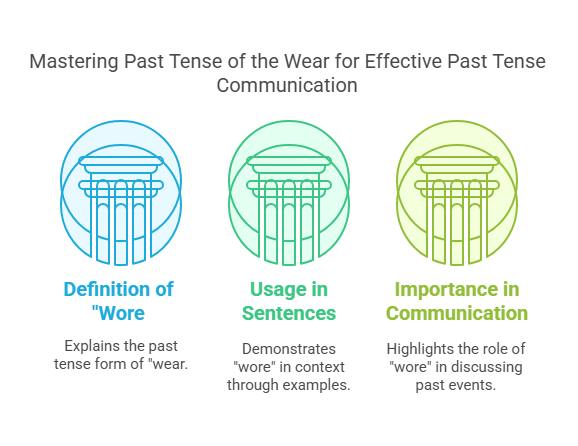
Three Mistakes to Avoid With Wear
These are the most common mistakes with “wear.” Even native speakers’ children say “weared” when they are learning to talk — so if you get confused, you are not alone.
Mistake 1: Saying “weared”
✗ She weared a long dress to the wedding.
✓ She wore a long dress to the wedding.
Mistake 2: Using “wore” with have/has/had
✗ I have wore this jacket before.
✓ I have worn this jacket before.
Mistake 3: Using “worn” without have/has/had
✗ He worn a hat yesterday.
✓ He wore a hat yesterday.
How to remember: “Wore” stands on its own. “Worn” always needs a friend — have, has, or had. Other verbs work the same way: break, broke, broken and tear, tore, torn.
Test Yourself: Wore or Worn?
Choose the correct answer for each sentence. Click Check to see if you are right.
1. She _______ a beautiful dress to the party last night.
2. He has _______ the same watch since he was eighteen.
3. The children _______ their new uniforms on the first day of school.
4. I have never _______ a tie to work before.
5. My grandmother _______ glasses her whole life.
Keep Going — You Are Building Something
You just learned wear, wore, worn. That is one more irregular verb you will never get wrong again.
But did you know that break follows the same pattern? Break, broke, broken — the third form always needs a helping word, just like “worn.” But many learners mix up broke and broken. Do you know which one to use?
Next lesson: Broke or Broken — Which One is Correct?
Source
Harper, Douglas. “Etymology of wear.” Online Etymology Dictionary.

My name is Khamis Maiouf. I am the creator of the English Teacher Site, dedicated to providing valuable resources and insights for students around the world. With a passion for education and a commitment to helping students enhance their skills, I aim to make English teaching more effective and enjoyable for both educators and students.