
What’s the Plural of Oasis: Understanding Singular and Plural Nouns

Quick Answer
The plural of oasis is oases. You change the -is ending to -es. For example: “The travellers found two oases in the desert.”
Oasis and Oases — See the Pattern
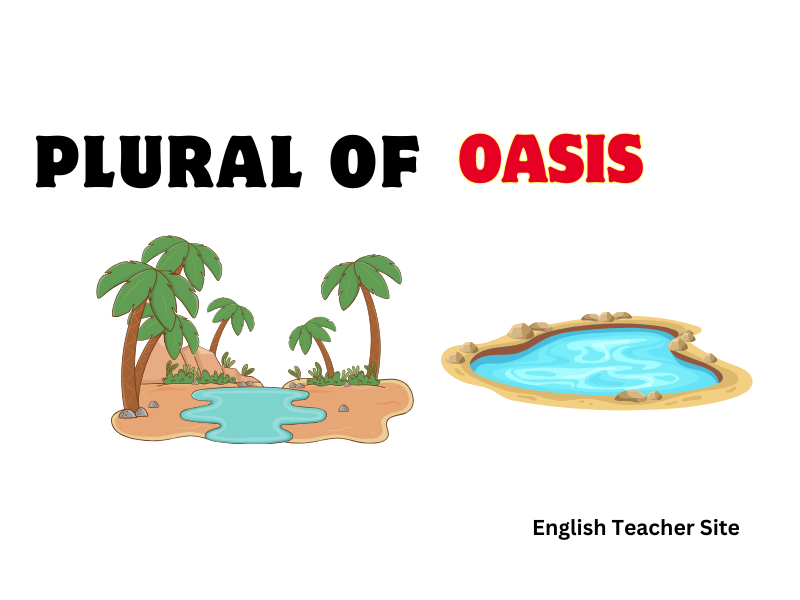
The word oasis means a green area in a desert where there is water. People also use it to describe any calm, peaceful place. Look at these examples:
- The travellers stopped at a beautiful oasis. (one place)
- The map showed five oases in the Sahara Desert. (five places)
- This is the only oasis for hundreds of kilometres. (one place)
- Ancient cities were often built near oases. (many places)
Did you see the pattern? When there is one, you say oasis. When there are two or more, you change the ending from -is to -es and say oases.
| Singular | Plural |
|---|---|
| oasis | oases |
How to Change Oasis to Oases
Oasis comes from Greek. That is why it does not just add an S like most English words. Instead, you follow a simple rule:
- Find the -is at the end of the word
- Change -is to -es
- Oasis becomes oases
Many English words that end in -sis or -is follow this same rule:
| Singular | Plural |
|---|---|
| crisis | crises |
| thesis | theses |
| basis | bases |
| analysis | analyses |
Easy way to remember: Find the -is at the end. Cross it out. Write -es. Oas-is becomes oas-es. Done.
The Rule in One Line: One oasis, two or more oases — change -is to -es.
How to Use Oasis and Oases in Everyday English
- The children read about a desert oasis in their geography book. (one place in a book)
- There are many oases across North Africa and the Middle East. (many places across a region)
- Our garden is an oasis of calm in the busy city. (one peaceful place — used as a word picture)
- The guide showed us where the oases were on the map. (more than one on a map)
- After a long week, the coffee shop felt like an oasis. (one peaceful spot — used as a word picture)
You are doing great. Now let us look at the mistakes many learners make.
Two Mistakes to Avoid With the Plural of Oasis
Even advanced learners sometimes add the wrong ending or try to add an S. If you have done this, you are not alone — English is full of tricky plurals from other languages.
Mistake 1: Adding -es to the full word to make “oasises”
✗ The desert has many oasises.
✓ The desert has many oases.
How to remember: You do not add -es to the end. You replace the -is with -es. Oasis does not become oasis-es. It becomes oas-es.
Mistake 2: Using “oasis” when you need the plural
✗ We visited several oasis on our trip.
✓ We visited several oases on our trip.
How to remember: If there is a word like several, many, two, or all before it, you need the plural: oases.
Other words that follow this same -is to -es pattern: crisis → crises, thesis → theses, basis → bases, nemesis → nemeses.
Test Yourself: Oasis or Oases?
Choose an answer to see your feedback immediately. Your first answer counts towards your score.
1. The Sahara Desert has many _______ where people live.
2. We stopped at a small _______ to get water.
3. The book describes five different _______ in North Africa.
4. This park is a green _______ in the middle of the city.
5. Ancient traders knew where all the _______ were along the route.
Practice: Oasis or Oases — Exercises
Time to practise! Complete each sentence with oasis or oases. Write your answers down, then check them below.
- The desert has one small ___.
- We visited three ___ on our trip.
- Each ___ has fresh water and shade.
- Many ___ have tall palm trees.
- An ___ is a green place in the desert.
- The old map shows several ___.
- This quiet park is an ___ of calm in the city.
- Travellers rest at ___ on long desert journeys.
Show the answers
1. oasis 2. oases 3. oasis 4. oases 5. oasis 6. oases 7. oasis 8. oases
Want more practice with tricky plurals? Try the plural of codex, the plural of wolf and our guide to irregular plural nouns.
Keep Going — You Are Building Something
You just learned the plural of oasis. That is one more tricky plural you will never get wrong again.
Oasis becomes oases because it follows the -is to -es rule. The word nemesis follows the exact same pattern — but do you know what the plural is? Is it nemesises, nemeses, or something else? And where does this unusual word even come from?
Next lesson: What’s the Plural of Nemesis?
Sources

I’m Khamis Maiouf. I’m studying Health and Social Care and have completed Functional Skills Level 2 in English and Level 3 Hairdressing. I have taught ESOL in my community and helped students with GCSE English. I run English Teacher Site to help people learn and practise English.