
Confused About the Past Tense of Hurt? Get the Facts

Quick Answer
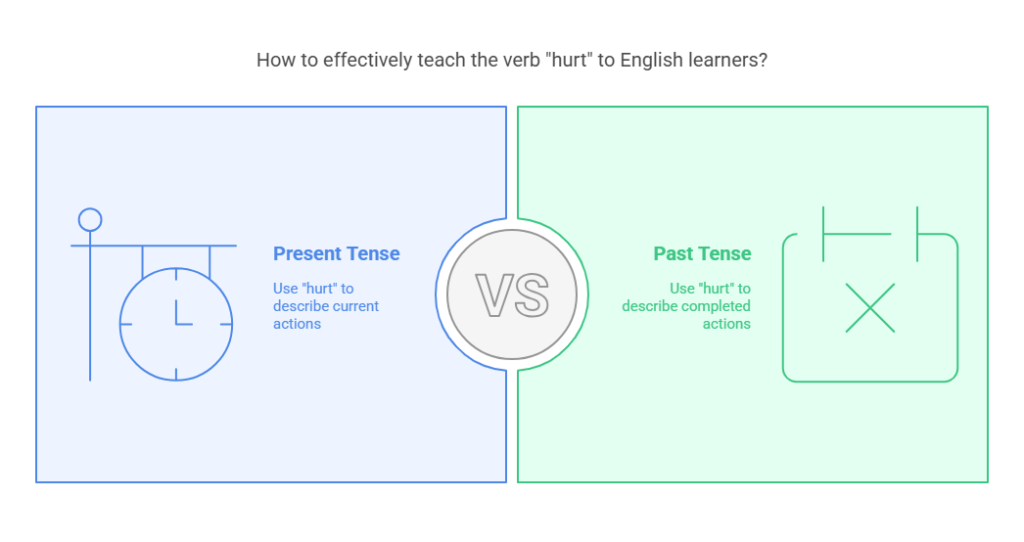
The past tense of hurt is hurt. It does not change. “Hurted” is not a real English word.
Example: I hurt my knee yesterday.
Hurt, Hurt, Hurt — See the Pattern
Look at these sentences. Can you see the pattern?
- I hurt my arm yesterday. (past)
- She has hurt her back before. (with has)
- He is hurting right now. (happening now)
- It hurts when I move. (present — he/she/it)
Did you see the pattern? Hurt stays the same in the past and with have/has/had. Only two forms change: hurts (with he/she/it) and hurting (with -ing).
| Form | Example |
|---|---|
| Now (base form) | I hurt my arm every time I play. |
| Past (simple past) | I hurt my arm yesterday. |
| With have/has/had | I have hurt my arm before. |
| Now (-ing form) | I am hurting right now. |
| He/She/It (present) | It hurts a lot. |
Why Does Hurt Stay the Same?
Most English verbs add -ed in the past:
- walk → walked
- play → played
But hurt is different. It is an irregular verb. The past tense is still hurt:
- ✅ I hurt my leg yesterday.
- ❌ I hurted my leg yesterday.
It also stays the same with have, has, or had:
- I have hurt my back before.
- She had hurt her foot before the race.
Easy way to remember: Hurt never changes in the past — only add -s (hurts) or -ing (hurting).
The Rule in One Line: Hurt is always hurt — past, present, and with have/has/had.
How to Use Hurt in Everyday English
Here are some sentences you might say in real life:
- I hurt my back when I picked up the box. (past — it happened before)
- She hurt his feelings when she said that. (past — emotional pain)
- My tooth has hurt all day. (with “has” — started before and still going)
- He hurt his ankle playing football yesterday. (past — physical pain)
- We hurt ourselves when we fell off the bike. (past — with “ourselves”)
You are doing great. Now let us look at the mistakes many learners make.
The Most Common Mistake With Hurt
Many learners add -ed to hurt because that is the normal rule in English. Even children who speak English at home say “hurted” when they are young — so if you make this mistake, you are not alone.
✗ I hurted my arm.
✓ I hurt my arm.
✗ She has hurted herself.
✓ She has hurt herself.
✗ He hurted his leg yesterday.
✓ He hurt his leg yesterday.
How to remember: Think of “hurt” like “cut” and “put.” These verbs never change in the past.
Other verbs like this: cut, put, shut, let, set, hit
Test Yourself: Hurt or Hurted?
Choose an answer to see your feedback immediately. Your first answer counts towards your score.
1. She _______ her knee when she fell down.
2. My head always _______ in the morning.
3. He has _______ his back before.
4. Those words really _______ me yesterday.
5. Be careful — that _______ a lot!
Keep Going — You Are Building Something
You just learned the past tense of hurt. That is one more irregular verb you will never get wrong again.
Did you know that cut follows the exact same rule? The past tense of cut is not “cutted” — it is still just cut. But do you know which other common verbs work this way? The answer might surprise you.
Next lesson: Past Tense of Cut: Is It Cut or Cutted?
Source
Dictionary, https://www.etymonline.com/word/hurt.

I’m Khamis Maiouf. I’m studying Health and Social Care and have completed Functional Skills Level 2 in English and Level 3 Hairdressing. I have taught ESOL in my community and helped students with GCSE English. I run English Teacher Site to help people learn and practise English.