
The Mapmaker of Aster Island (B1 Reading Story)

B1 · INTERMEDIATE Reading practice · ~3,000 words · 20-min read
This is the life story of Elena Voss — a fisherman’s daughter who changed the way people see her island. She is not a real person, but her story could be true. First, study the ten key words. Then read the six short chapters. At the end, there are questions to check how much you have understood.
Before you read — 10 key words
- chart — a map of the sea that shows the water, the rocks, and how deep it is.
- harbour — a safe place on the coast where boats can stay.
- tide — the movement of the sea, which rises and falls twice a day.
- fog — a thick, low cloud over the land or sea that makes it hard to see.
- accurate — correct in every small detail.
- measure — to find the exact size, length, or depth of something.
- sight — the ability to see.
- thread — a very thin line of cotton, used for sewing clothes.
- proud — feeling happy about something good that you or another person has done.
- career — the work a person does for a long part of their life.
The story
1 · The girl who asked questions
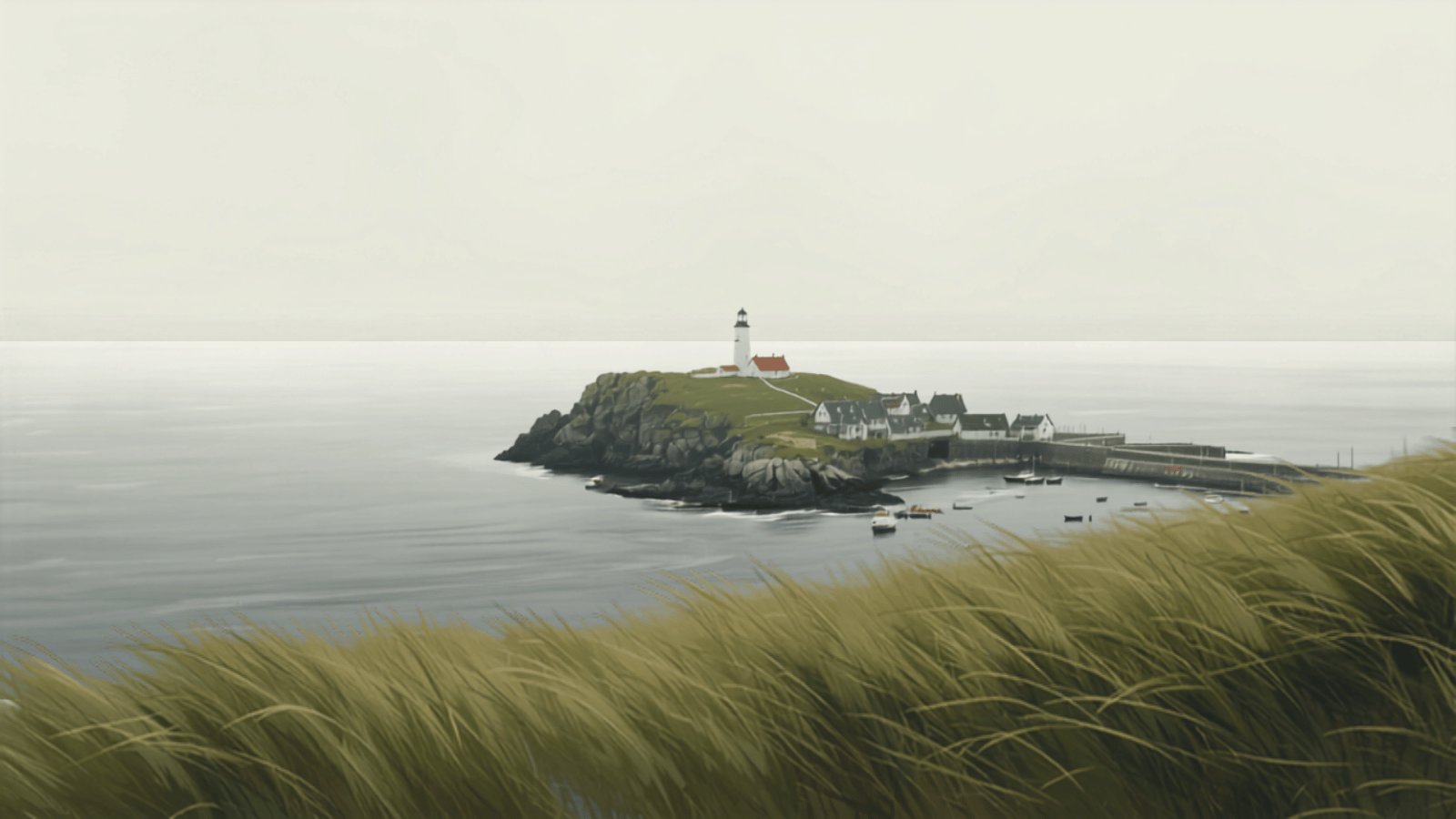
Elena Voss was born in 1931 on Aster Island, a small piece of rock and grass in the cold northern sea. If you look for Aster Island on a modern map, you will find it easily. In 1931, that was not true — and this is the story of the woman who changed it.
The island had one shop, one school, one lighthouse, and a little harbour where twelve fishing boats slept every night. Elena’s father, Piet, was a fisherman who had worked on the sea since he was fourteen. Her mother, Karin, repaired the nets and sold fish at the harbour on Saturdays. The family was not rich, but there was always food on the table and a fire in the kitchen.
From the beginning, Elena was different from other children. She asked questions all day long. Why does the tide come in and go out? Where does the fog come from? Why does the water change colour over the sand? Her mother often laughed and said, “Elena, you have asked me a hundred questions today, and it is not even lunchtime.”
Her teacher, Miss Abel, was the first person who took the questions seriously. One winter afternoon, she gave Elena an old book full of maps. Elena opened it and did not close it until it was dark. Rivers, coasts, mountains, cities — the whole world was inside that book, drawn in careful lines.
On the last page, there was a map of the northern islands. Elena found Aster Island on it. She looked at it for a long time, and then she frowned.
“Miss Abel,” she said, “this map is wrong.”
“Wrong? Elena, that map was made by clever men in the capital.”
“But the shape isn’t right,” Elena said. “I climb the hill behind our house every week. From the top, you can see the whole island. The north coast bends like a cat’s back. On this map, it is straight. And Black Point is missing — the long rocks that only show at low tide.”
Miss Abel looked at the map, and then at the girl who was eleven years old. “Perhaps the men who made it have never walked here,” she said slowly.
Elena never forgot those words. Many years later, she wrote in her notebook: “That was the day I understood something important. A map is only a story that someone tells about a place. If the person has never been there, the story is full of mistakes.”
2 · The night the Grey Gull was lost
When Elena was sixteen, something happened that decided the direction of her whole life.
It was a night in October 1947. A thick fog came down over the sea — the worst fog in years, the old men said later. A fishing boat called the Grey Gull was coming home late with two men on board: Elena’s uncle Marten and his young helper, Jon.
Marten was a careful sailor. He could not see the coast, so he did what careful sailors do: he followed the official chart. The chart showed deep, safe water all the way to the harbour. Marten trusted it.
The chart was wrong.
Just before midnight, the Grey Gull hit the long rocks at Black Point — the same rocks that Elena had noticed were missing from the map in Miss Abel’s book. The boat broke like an egg. Marten and Jon held on to a piece of wood in the freezing water and shouted into the dark.
They were lucky. The lighthouse keeper heard them, and a rescue boat found them before the cold did. But the Grey Gull, which Marten had paid for with fifteen years of work, lay at the bottom of the sea.
The next morning, the whole island stood at the harbour and talked about the accident. Elena listened to her father.
“The chart is forty years old,” Piet said. “The sea moves. The sand moves. The rocks stay, but nobody has ever put them on paper. Every captain here knows the truth in his head, but a stranger who follows that chart is in danger.”
“Then why has nobody made a new one?” Elena asked.
Her father shrugged. “Who would do it? The map office is five hundred kilometres away. We are a small island. To them, we are three lines on a page.”
Elena looked at the grey water where her uncle’s boat had disappeared. She was sixteen, she had no money and no training, and she made one of the biggest decisions of her life as easily as other people choose their breakfast.
“If nobody else will make an accurate chart of this island,” she said quietly, “I will make it myself.”
3 · Ten thousand steps
It is easy to say “I will make a map”. It is very hard to do it. Elena needed years to learn how hard.
She worked in the fish house every morning to earn money. With her first pay, she bought three things: a strong notebook, a long rope with a knot tied every metre, and a second-hand compass from a retired captain. These simple tools became her laboratory.
Every free afternoon, in sun, wind, and rain, Elena walked the coast of Aster Island. She learned to measure distance in two ways: with the rope for short distances, and with her own steps for long ones. She had measured her step exactly — sixty-two centimetres — and she counted every single one. Along the beaches, over the rocks, around the bays: step, step, step, and a number in the notebook.
“How far today?” her mother would ask in the evening.
“Ten thousand steps,” Elena would answer, eating her soup with cold red hands. “Tomorrow, ten thousand more.”
The sea was more difficult than the land. To measure the depth of the water, Elena borrowed a small rowing boat. She tied a heavy stone to her rope, dropped it over the side, and counted the knots until the stone touched the bottom. She did this hundreds of times, in hundreds of places, and slowly the invisible world under the water appeared in her notebook.
She also studied the tide. For one full year, she recorded the height of the water at the harbour wall, morning and evening, every single day. When her friends went dancing on Saturday nights, Elena was often on the beach with a lamp, watching the black water rise.
The work was often dangerous, and twice it nearly ended before it was finished. One January, a winter storm flooded the fish house where Elena kept her notes, and a whole season of measurements turned into soft blue paper soup. She sat on the wet floor, twenty years old, and cried for exactly ten minutes — she timed it, she said later, because ten minutes was all the crying she could afford. Then she started again. Another time, her rowing boat was caught by a strong current near Black Point, the same rocks that had broken the Grey Gull, and it carried her half a kilometre out to sea before she fought her way back. She never told her mother about that day. But she wrote it in the notebook, of course — with the exact strength and direction of the current.
Of course, people laughed. On the island she became “the map girl”. Young men joked that if you invited Elena for a walk, she would count the steps. Elena did not care. She wrote in her notebook: “Let them laugh. The sea does not laugh, and the sea is my real teacher.”
Five years passed like this. Then, one spring evening in 1953, at the kitchen table, twenty-two-year-old Elena drew the last line, put down her pen, and looked at what she had made: the first truly accurate chart of Aster Island in history. Every rock was on it. Every sandbank. Every safe passage. And at the north coast, drawn carefully in dark ink, lay the long teeth of Black Point.
The fishermen did not accept it immediately — sailors are careful people. It was old Captain Bram, the most respected man in the harbour, who tested it first. He followed Elena’s chart in bad weather for a whole month. When he came back, he put the chart on the table of the harbour office and said five words that changed Elena’s life:
“The girl’s chart is right.”
Within a year, every boat on Aster Island carried a copy, and Elena had drawn each one by hand. Her father hung one on the kitchen wall, next to the window that looked at the sea, and Elena had never seen him look so proud.
4 · A woman in a world of men
News travels, even from small islands. In 1955, Elena posted a copy of her chart to the national map office in the capital, with a polite letter that explained her methods. She waited for months. Finally an answer arrived. It was three sentences long. The office thanked her for her “interesting hobby” and explained that official charts were made by trained men, not by island girls.
Many people would have stopped there. Elena read the letter twice, put it in a drawer, and started writing. Over the next two years she sent the office her tide tables, her depth measurements, and a list of eleven mistakes in their official chart — each one with the exact position and the proof.
In the end, the office sent an inspector to the island. His name was Mr Holm, and he arrived, as Elena said later, “with the face of a man who has come to correct a child”. He asked Elena to walk the north coast with him and show him her work.
They walked for three days. Mr Holm carried modern instruments; Elena carried her notebook. At every point where the two charts disagreed, they measured together — and at every point, it was the official chart that was wrong, not Elena’s.
On the boat back to the capital, Mr Holm wrote his report. One sentence from it is now famous, because it later appeared in newspapers: “The chart of Aster Island made by Miss E. Voss is the most accurate coastal work I have inspected in twenty years of service.”
The map office offered her a job. And so, at twenty-six, the fisherman’s daughter who had measured her island with a rope and a stone began an official career as a chartmaker — the first woman in the history of that office. Over the next twenty-five years, she checked and corrected the charts of more than forty islands. Captains who had never met her trusted their lives to her lines every night.
It was not always easy. Some of the older men at the office refused to speak to her in her first year. Others checked her work again and again, hoping to find a mistake — and Elena, who understood exactly what they were doing, made sure they never found one. “If they want to test me every day,” she told her mother in a letter, “then every day I will pass the test.” Slowly, respect grew where doubt had been. Ten years later, when new chartmakers joined the office, it was Elena who trained them, and the first rule she taught was her own: walk the coast before you draw it.
She never moved to the capital permanently. Every spring she returned to Aster Island, to the house with the chart on the kitchen wall, and walked the coast again — partly to check the sandbanks, which never stop moving, and partly, she admitted, because the island was the only place where her mind was quiet. She never married. When people asked her about it, she smiled and said that she had promised her life to the sea before anyone else could ask.
When a journalist asked her what makes a good mapmaker, Elena gave the answer that students of geography still learn today: “A good map tells the truth, even when the truth is difficult to reach. If you have not walked the coast, do not draw it.”
5 · The fog comes in
Life, like the sea, does not stay calm forever.
In 1984, when Elena was fifty-three, she noticed that the fine lines of her charts were becoming soft and grey, as if she were looking at them through water. The doctors in the capital examined her eyes and gave her the hardest news of her life: she had an illness that they could not stop. Year by year, her sight would get worse. One day, it would be gone.
“How long?” Elena asked.
“Perhaps ten years of useful sight,” the doctor said. “I am sorry. In your profession…” He did not finish the sentence.
Elena went home to Aster Island. Those who knew her say that the next two years were the darkest of her life. The woman who had never stopped moving now sat still. Her notebooks stayed closed. In her diary she wrote: “All my life I have fought against fog on the sea. Now the fog is inside my own eyes, and no lighthouse can help me.”
The person who pulled her out of the dark was a child.
Tomas was the nine-year-old son of her neighbour, a bright, curious boy who had been blind since birth. One afternoon he sat in Elena’s kitchen while his mother borrowed some flour, and he asked her a question that nobody had ever asked her before.
“Elena, you know the island better than anyone. What does it look like?”
Elena opened her mouth to answer — and stopped. Every answer she had was a picture: lines, colours, shapes on paper. For Tomas, a picture meant nothing. She had spent forty years making maps, and she had never once made a map for someone like him.
That night, Elena could not sleep. She kept hearing the boy’s question. At three o’clock in the morning she got up, went to her work table, and took out a piece of wood, a pot of glue, and her mother’s old box of sewing thread.
If a map could not be seen, she thought, perhaps it could be touched.
6 · Maps you can touch
Elena’s first touch-map took her three weeks. She glued thick thread along the coastline of Aster Island, so that a finger could follow the shape of the land. She built the hills from thin layers of wood, one on top of another, like steps. She used rough sand for dangerous rocks and smooth paper for safe water. The harbour was a small hollow that a fingertip could rest in.
When it was finished, she invited Tomas to her kitchen and put his hands on the board.
The boy’s fingers moved slowly along the thread of the coast. They climbed the wooden hill behind Elena’s house. They found the rough sand at Black Point, and the little hollow of the harbour where the boats slept. Tomas was silent for a long time. Then he said, “So that’s it. That’s my island. It bends like a cat’s back.”
Elena had to turn away to the window, and she was glad, for once, that her eyes were too weak to be seen clearly.
It became her second career. She spent the rest of her life on this work. A teacher from a school for blind children visited the island, saw the map, and asked for another. Then a second school wrote, and a third. Elena developed a whole system: thread for coasts, wood for high ground, sand for danger, small metal dots for towns. As her own sight faded, her fingers learned to check every line, and in her last years she worked almost completely by touch — a blind mapmaker making maps for people who could not see.
Letters began to arrive on the island, addressed simply to “Elena Voss, the mapmaker”. One came from a blind teenager in a big city who had learned the shape of her own country for the first time. One came from a teacher who wrote that his students, who had never been able to imagine a coastline, now argued about which bay was the most beautiful. Elena kept every letter in a wooden box, and when her sight was completely gone, Tomas — now a grown man with children of his own — came to her kitchen once a week and read the new ones aloud.
“Do you ever feel sad,” he asked her once, “that you can’t see your own maps any more?”
Elena thought about it. “I spent half my life teaching people to trust their eyes,” she said, “and the other half learning that eyes are not the only way to see. If I had kept my sight, I would probably have made another forty charts. Because I lost it, I made something better. It is a strange trade, but I do not think I would change it.”
Elena Voss died in 2011, at the age of eighty, in the house where she was born. Since then, her touch-maps have travelled to schools in more than thirty countries, and sailors have trusted her charts for over half a century. The island that once laughed at “the map girl” is now deeply proud of her: the old lighthouse has become a small museum of her life. Visitors can see her first notebook, the rope with a knot at every metre, and the letter that called her work an “interesting hobby”.
But in the last room of the museum, there is a drawer that most visitors miss. Inside it lies an unfinished chart — the one Elena was working on the week she died. It shows a small island, far out in the northern sea, that appears on no other map in the world. Nobody knows if she found it, imagined it, or left it there as a question.
Under the chart, in careful raised letters that you can read with your fingers, Elena left four words: “Go and look yourself.”
Check your understanding
Read each question. Think about your answer. Then click “Show answer” to check.
Words to remember
Here are the ten key words again, in new sentences. Say each one out loud, then try to make your own sentence with it.
- chart — The captain checked the chart before sailing into the narrow bay.
- harbour — The storm was coming, so all the boats returned to the harbour.
- tide — You can only walk to the little island at low tide.
- fog — The airport closed for two hours because of thick fog.
- accurate — Her report was so accurate that nobody could find a single mistake.
- measure — We need to measure the room before we buy the carpet.
- sight — My grandfather’s sight is weak now, so he listens to audiobooks.
- thread — She sewed the button back on with a needle and thread.
- proud — I felt really proud when I finished my first book in English.
- career — He started his career as a teacher and ended it as a school director.
Grammar in this story: the present perfect
A biography connects the past to now, and English does that with the present perfect (have/has + past participle). Look at these lines from the story:
“Perhaps the men who made it have never walked here.” · “You have asked me a hundred questions today.” · “Her touch-maps have travelled to schools in more than thirty countries, and sailors have trusted her charts for over half a century.”
Notice the pattern: the action started in the past, but it still matters now — or the time period (today, half a century) has not finished. That is exactly when English chooses the present perfect instead of the past simple.
👉 Learn the full rule here: The Present Perfect Tense — Usage and Examples.
Talk about it · Write about it
Talk about it: Elena’s neighbours laughed at “the map girl” for years — and then they trusted her with their lives. Do you know anyone (famous or not) who kept working at something when nobody believed in them? What happened in the end?
Write about it: Write a short biography (8–10 sentences) of a person you admire — a family member, a friend, or someone famous. Use the past simple for finished events (she was born, he moved, they opened) and at least two present perfect sentences for things that still matter now (she has helped many people, his ideas have changed…).
🎉 Excellent work — you have just read a complete 3,000-word biography in English. A few years ago, that might have felt impossible. Today you did it, and you picked up ten useful words on the way.
But one question stays open, doesn’t it? Somewhere in the northern sea, there may be a small island that appears on only one chart in the world — an unfinished one, in a quiet museum drawer. “Go and look yourself,” Elena wrote. Maybe someone will…
Next story: Read another B1 story →
About this story: This is an original B1 graded reader (~3,000 words). The vocabulary is controlled to intermediate level, so you should understand about 98% of the words without a dictionary. The grammar uses past simple narrative with perfect tenses, relative clauses, and conditionals — the core B1 range. Any harder word is explained before the story and repeated inside it. Elena Voss and Aster Island are fictional.

I’m Khamis Maiouf. I’m studying Health and Social Care and have completed Functional Skills Level 2 in English and Level 3 Hairdressing. I have taught ESOL in my community and helped students with GCSE English. I run English Teacher Site to help people learn and practise English.