
The Woman Who Mended Clocks — The Life of Ines Vale (B1 Reading Story)

B1 · INTERMEDIATE Reading practice · ~3,050 words · 15-min read
This is a B1 biography — the life story of an ordinary Portuguese woman who did one small thing very well for almost seventy years. The English is intermediate, with perfect tenses, relative clauses (“the town where she was born…”) and simple past narrative. Learn the ten key words first. Then read the story. At the end, there is a short quiz to check your understanding.
Before you read — 10 key words
- workshop — a room or small building where somebody makes or repairs things by hand.
- mechanism — the moving parts inside a machine that make it work.
- pendulum — the long metal rod inside a tall clock that swings from side to side to keep the time.
- apprentice — a young person who learns a job by working every day with an expert.
- patience — the quality of being able to wait or work calmly, even when something is slow or difficult.
- inherit — to receive something from a person after they have died, especially money, a house, or a business.
- restore — to bring something old back to good condition, so that it works or looks like new again.
- precise — exact and correct in every small detail.
- tribute — something you say, write, or do to show respect for a person, often after they have died.
- legacy — the things (ideas, work, or skills) that somebody leaves behind after they die.
The story
1 · The shop above the river
Ines Vale was born in 1932 in Ourélia, a small town in the north of Portugal that stood on the edge of a slow, brown river. Her mother worked in the town bakery. Her father, whom Ines hardly remembered, had left for Lisbon when she was three years old. He never came back. So Ines grew up with only her mother — and, more importantly for this story, with her grandfather Silvio.
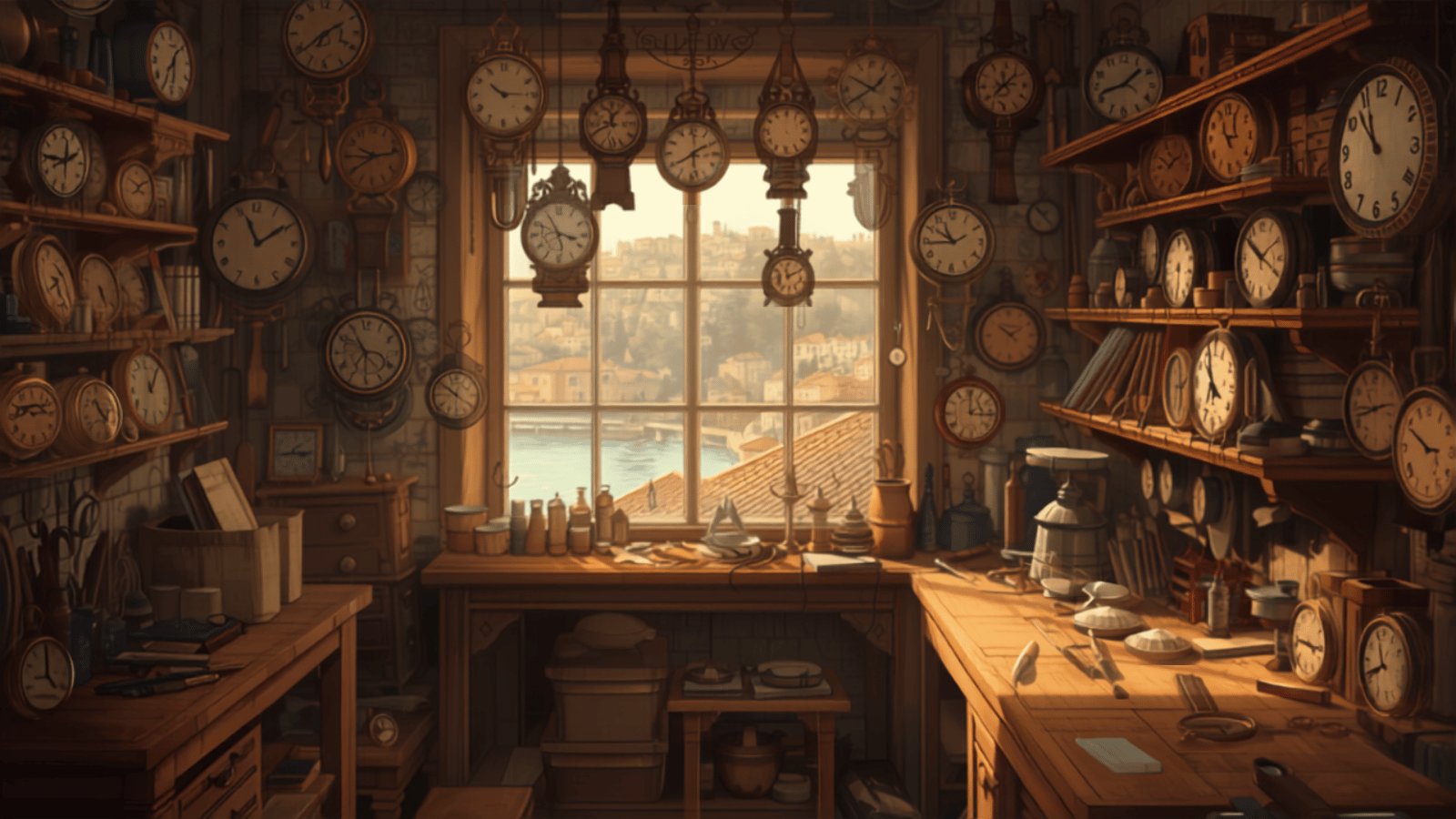
Silvio Vale owned a small clock shop above the river. The shop, which had a wooden sign shaped like a half-moon, had been in the family for almost a hundred years. Silvio’s own grandfather had opened it in the 1830s. Silvio’s father had run it after that. Now Silvio ran it alone, in a quiet room that smelt of oil, wood, and time.
Ines started visiting the shop when she was five. In the beginning, she went there only to escape the summer heat, because the shop was cool and quiet, and because her grandfather always had a bowl of fresh pears on the table by the window. But soon she started to watch him work.
Silvio spent his days repairing clocks that people from all over the north of Portugal sent to him. Farmers brought old kitchen clocks that had belonged to their mothers and their grandmothers. Priests sent him church clocks that had stopped ringing. Rich families in the cities, who had inherited grand grandfather clocks from ancestors they had never met, wrote him careful letters, asking if he could travel to their houses. Silvio worked in a small back room — his workshop, which is a room where somebody makes or repairs things by hand. There were tools on every shelf, and clocks in every corner, ticking softly to each other like a room full of small hearts.
“A clock,” Silvio told her one afternoon, when she was seven and had asked him what he was doing, “is a small heart. If you listen carefully, you can hear it — tick, tick, tick — and you can also hear when it is sick.” He held out a small silver watch that had stopped working. “This one has a broken spring. It is dying. But we can save it.”
Ines listened to the watch. At first, she heard nothing. Then, when she was very still, she heard the tiniest click, like a wooden bird trying to sing.
“I can hear it,” she whispered.
“Good,” said Silvio. He smiled. “That is the first lesson. You cannot mend anything if you cannot first listen to it.”
Every Saturday after that, Ines sat on the tall wooden stool by her grandfather’s workbench. She watched him take clocks apart and put them back together. She learnt the names of the parts — the wheels, the springs, the little hands, and the great long pendulum of a grandfather clock, which is the metal rod that swings slowly from side to side to keep the time. By the time she was ten, she had cleaned her first watch by herself. By the time she was twelve, she had repaired a small kitchen clock for the baker who lived next door. The baker paid her in bread.
Her mother laughed when she heard. “You will not marry a rich man in this town,” she said. “But you will always eat.”
Ines did not care about rich men. She cared about the sound of a good, clean tick, and about the smell of oil on old brass, and about the moment when a clock which had been silent for many years began to move again.
2 · The apprentice
When Ines was fourteen, she left school and started to work in her grandfather’s shop full time. In those days, in a small Portuguese town, it was normal for a girl to leave school early. Nobody was surprised. But most of the girls she had known at school went to work in the bakery, or the sewing shop, or on their families’ farms. Only Ines went to the workshop above the river.
Silvio, who was already seventy-two years old, was very pleased.
“I always hoped,” he said, “that one of my grandchildren would come. I have waited a long time. You are the one.”
He gave her a small wooden box, the top of which was carved with the family name. Inside the box were his own tools — the tiny screwdrivers, the small brushes, the delicate hooks — all of them worn smooth by the hands that had used them before her. “These belonged to my father,” he said. “Now they belong to you. Look after them, and one day, give them to your own apprentice — the young person who will learn from you.”
For the next four years, Ines was Silvio’s apprentice. An apprentice is a young person who learns a job by working every day with an expert. She spent every day at his side. She watched him. She copied him. She made mistakes, and he corrected her, always patiently. Patience was the first quality that Silvio demanded of her. Patience means the ability to wait or work calmly, even when something is very slow or very difficult. “A clockmaker who is not patient,” he liked to say, “is like a doctor who cannot wait for a fever to break. Both will kill their patients.”
Some days, they worked in complete silence for hours. Some days, Silvio told her stories — about the great town clock that had stood in the main square for two hundred years, about clocks he had repaired for a bishop who had once travelled from Rome, about the small mantel clock that a young woman had brought in weeping, because it had belonged to her son who had drowned in the river.
“Every clock has a story,” he told her. “When you mend the clock, you also mend a small piece of the story. Never forget that.”
Ines listened. She had a quiet, careful nature, and she remembered everything Silvio taught her. By the time she was seventeen, she could repair almost any mechanism that came into the shop. The mechanism is the moving parts inside a machine that make it work. She could listen to a broken clock for one minute and tell what was wrong with it. She could take a pendulum apart, clean it, oil it, and put it back together in a single afternoon.
One winter morning, when Ines was eighteen, Silvio did not come down to the shop. She waited an hour, and then she went upstairs to look for him. She found him sitting in his chair by the window, his hands cold, a silver pocket watch open on his knee. He had died quietly in the night, in the middle of a repair.
Ines mourned him for many months. She wore black clothes for a whole year, as was the tradition in her town at that time. And she inherited the shop. To inherit means to receive something from a person after they have died. The workshop above the river, and everything inside it, was now hers.
She was eighteen years old, and she was the only clock repairer in Ourélia.
3 · The Lisbon years
For three years, Ines ran the shop alone. She was good — perhaps as good as her grandfather already, although she would never have said so. The customers who had trusted Silvio began to trust her too. Farmers brought her their kitchen clocks. Priests sent her their church clocks. Even the rich families, who at first had refused to believe that a young woman could do the work, wrote her polite letters after they had heard about her from friends.
But Ines was restless. She was young, and she wanted to see more than Ourélia. She wanted to walk on wide city streets. She wanted to see the great clocks of the world — the ones she had only read about in her grandfather’s dusty old books.
In 1953, when she was twenty-one, she made a decision that surprised everybody in the town. She closed the shop. She packed a small suitcase. And she moved to Lisbon.
In Lisbon, she found a job in a large jeweller’s on the Avenida da Liberdade. The owner was a stern old man named Senhor Camarada, who at first laughed when a country girl told him she could repair clocks. But when he saw her work — the precise way she held a tiny screwdriver, the patient way she took apart a Swiss mechanism — he stopped laughing. Precise means exact and correct in every small detail. Within a month, he had given her the most difficult repairs in the shop.
Ines lived in Lisbon for twelve years. She learnt a great deal. She saw famous clocks in museums. She met other clockmakers from Switzerland, from Germany, and from England, and she learnt something from every one of them. She also met a young engineer named Paulo, who had kind eyes and made her laugh. They married in 1958.
The marriage was not a happy one. Paulo, who had grown up in the city, hated the countryside. Ines, who had grown up in the countryside, hated the noise of the city. He wanted her to give up clocks and become a housewife. She refused. They argued often. In 1963, without any children between them, they separated quietly. Paulo went to work in Brazil. Ines stayed in Lisbon for two more years, but her heart, which had always belonged to the shop above the river, was pulling her home.
In the spring of 1965, her mother wrote her a short letter. “The town clock is broken,” she wrote. “It has been silent for three months. Nobody in Ourélia can fix it. The council has written to a company in Porto, but the company wants a great deal of money that the town cannot pay. Everybody is asking about you.”
Ines read the letter twice. Then she went to Senhor Camarada, whom she loved like a second grandfather, and she gave him a month’s notice.
“I am going home,” she told him.
Senhor Camarada nodded slowly. “I always knew you would,” he said. “The clocks of Lisbon are fine, but they are not yours. The clock of Ourélia — that one has been waiting for you for a very long time.”
She returned to Ourélia in the summer of 1965. She was thirty-three years old. Her workshop above the river, which she had closed twelve years before, was still there. She opened the door, walked in, and stood for a long time in the middle of the quiet room where her grandfather’s tools were waiting for her, exactly where she had left them.
4 · The great town clock
The town clock of Ourélia was a great, beautiful thing. It stood in a stone tower in the main square. It had been built in 1791, and for almost two hundred years it had told the time to everyone in the town. Farmers ploughed their fields by it. Mothers cooked lunch by it. Children ran home from school when it struck five. When it fell silent, in April 1965, the whole town felt a strange, empty ache.
Nobody could remember a time before the clock had worked. Nobody knew what the town would do without it.
Two weeks after Ines returned, the mayor, whose grandfather had once bought a pocket watch from Silvio, came to the shop.
“Ines,” he said, “we have all been talking. Can you save the town clock?”
Ines went with him to the tower that afternoon. She climbed the narrow stone stairs. At the top, in the dusty little room behind the great white clock face, she found the mechanism.
It was ruined.
A storm the winter before had let rain into the tower. Water had poured over the wheels for weeks. The great pendulum, which had swung faithfully for two centuries, was now covered in thick orange rust. Several of the wheels had broken teeth. Some of the small springs were entirely missing.
Ines said nothing for a long time. She just looked, and she listened. She listened even though the clock was silent, because a good clockmaker listens with all the senses — with her eyes, with her fingers, with her memory of every good clock she has ever seen.
“Can you save it?” the mayor asked again.
“I can try,” Ines said. “But it will take a year. Maybe longer. And I will need to make some parts by hand, because there are no shops any more that sell parts for a clock as old as this one.”
“Do what you need to do,” the mayor said. “The town will pay whatever we can.”
The restoration of the town clock — to restore means to bring something old back to good condition, so that it works or looks like new again — took Ines fourteen months. She worked on it every single day. She climbed up to the tower with her tools in a basket. She took out the mechanism piece by piece and carried each piece down to the shop, where she cleaned it, or repaired it, or, when it was too damaged to save, made a new one from scratch.
She spent three months making a single spring. She spent five weeks polishing the great pendulum, whose old brass she rescued from beneath thick, orange rust.
The town watched, patient and quiet. Everybody in Ourélia knew that Ines was up in the tower, or down in her workshop, doing something that only she could do.
On the morning of the 12th of June, 1966, at exactly eleven o’clock, the great clock of Ourélia struck for the first time in over a year. The sound was deep, and warm, and true. In the square below, people stopped in the street. Some of them, who had missed the clock more than they had realised, began to cry.
Ines was up in the tower alone. She had chosen to be alone. She had wanted to hear the first strike by herself, so that she could listen properly to the great heart she had brought back to life. When the bell rang out over the roofs of the town, she smiled — a small, quiet smile — and she whispered, “Grandfather, we did it.”
5 · The last apprentice
After the restoration of the town clock, everybody in Portugal knew who Ines Vale was.
Newspapers wrote about her. Television reporters travelled from Lisbon to interview the clockmaker of Ourélia, who had saved the great tower clock nobody else had known how to save. Other towns started writing to her, asking her to come and look at their old, dying clocks. She travelled all over the country in the years that followed. She restored a fifteenth-century clock in a cathedral in Braga. She rebuilt a broken clock tower in a mountain village that had not worked for eighty years.
But she always came home to the workshop above the river. Ourélia was where she belonged.
The years passed. Ines never married again. She never had children. But she was not lonely. She had her work. She had the sound of the river outside her window. She had her friends in the town — the baker’s daughter, who was now the baker herself; the mayor’s son, who was now the mayor; the priest, who was younger than she was and who came to her house for tea every Wednesday afternoon.
When she was seventy, in the summer of 2002, she decided it was time to take an apprentice of her own. She had put it off for many years. But she could feel her hands slowing down. She could no longer see the very smallest parts as clearly as before. And she knew that the workshop above the river must not die when she died.
She chose a shy, quiet girl of fifteen, named Beatriz Moutinho, whose grandmother she had known well. Beatriz had once brought in a broken kitchen clock, one which her mother had already thrown into the rubbish, and Beatriz had asked Ines to save it. Something in the way the child had watched her work that afternoon had reminded Ines of herself at the same age.
She taught Beatriz everything her grandfather had once taught her. She taught her to listen first. She taught her to be patient. She taught her that every clock had a story, and that the story mattered as much as the mechanism. She gave Beatriz the small wooden box of tools that she had inherited from Silvio, and she told her the same words Silvio had told her all those years before: “One day, give these to your own apprentice.”
The lessons were slow and steady. Sometimes Ines would sit for a whole afternoon and say nothing, just watching Beatriz try, and try again, and try a third time to loosen a small brass wheel without damaging it. When Beatriz grew frustrated, Ines simply reminded her, “The paper is patient. The clock is patient. You must be patient too.”
Beatriz became a fine clockmaker. She still runs the workshop above the river today.
Ines Vale died peacefully in the winter of 2019, at the age of eighty-seven. On the day of her funeral, at exactly eleven o’clock in the morning, the great town clock of Ourélia rang eleven times — and then, for the first time in over fifty years, it stopped. Beatriz had climbed the tower before dawn and had stopped the pendulum by hand. It was a tribute — a small, careful thing that people say or do to show respect for a person after they have died. The clock stayed silent for exactly one hour, while the town said goodbye. Then, at midday, Beatriz started it again. It has been running ever since.
Ines’s legacy — the things that a person leaves behind after their death — is more than the town clock, and more than the workshop above the river. Her real legacy is the way people in Ourélia still speak her name when they hear the bell strike the hour, and the young woman who now sits at her old workbench, listening carefully to a tiny heart that has stopped, and gently, patiently, teaching it how to beat again.
Check your understanding
Read each question. Think about your answer. Then click “Show answer” to check.
Words to remember
Here are the ten key words again, in new sentences. Say each one out loud.
- workshop — My uncle has a small workshop in the garden where he builds wooden chairs.
- mechanism — The mechanism inside this old watch is beautiful, but it stopped working last year.
- pendulum — The big grandfather clock in the hall has a heavy brass pendulum that swings slowly from side to side.
- apprentice — She spent three years as an apprentice to a famous chef in Paris before she opened her own restaurant.
- patience — Learning a new language takes real patience — you must practise a little every day.
- inherit — When my grandmother died, I was surprised to inherit her collection of old books.
- restore — The city has spent two years trying to restore the old bridge to its original condition.
- precise — A good engineer must be very precise; even a small mistake can cause a big problem.
- tribute — The school named the library after Mrs Ferreira as a tribute to her forty years of teaching.
- legacy — The greatest legacy my father left me was not money, but his love of reading.
Grammar in this story: relative clauses
Biographies are full of relative clauses, because a biography is always telling you which person, which place, or which object matters — and why. A relative clause is a small clause that gives extra information about a noun. It usually starts with who, which, that, whose, where, or whom.
Look at these examples from the story:
Ourélia, a small town that stood on the edge of a slow, brown river. → The relative clause tells us which town.
Her father, whom Ines hardly remembered, had left for Lisbon. → Whom gives extra information about the father (and it is the object of “remembered”).
The mayor, whose grandfather had once bought a pocket watch from Silvio, came to the shop. → Whose connects the mayor to his grandfather.
She stood in the middle of the quiet room where her grandfather’s tools were waiting for her. → Where is used for places.
Notice the pattern: the relative clause sits right after the noun and describes it. Two-comma clauses (like the one with whose) give extra information; no-comma clauses (like the one with that) tell you which one.
👉 Learn the full rule here: Relative Clauses — a B1 grammar guide.
Talk about it · Write about it
Talk about it: Is there an ordinary person in your own family, town, or country whose quiet work you admire — a baker, a mechanic, a teacher, a nurse? What do they do, and why do you respect them?
Write about it: Write a short biography of someone you know well (about 100–150 words). Use at least four relative clauses — for example: “My grandmother, who lived in a small village, taught me…” or “The house where I grew up, which is now empty, had a big garden.” Include one detail about their childhood, one about their work, and one about what they left behind.
🎉 Well done — you have just read a full B1 biography in English, and you have met ten new words along the way. Read the story again in a few days and notice how much easier it feels the second time. The words will come back to you.
But wait — the town clock of Ourélia is running again, and Beatriz is still there. What happens next in the workshop above the river? Will Beatriz find an apprentice of her own one day? Will the shop, which has been in the Vale family for almost two centuries, live on into a fourth generation of clockmakers? Write your own ending, using details from the story to explain your choice.
The village of Karadin has lost something it once depended on. Follow the weaver’s story and look for what brings change. Next story: The Weaver and the Silent River (B1 Reading Story)
About this story: This is an original B1 graded biography (~3,050 words). It uses controlled vocabulary at roughly the 1,000-headword B1 level, plus the grammar you would expect at this stage — past simple and past perfect narrative, plenty of relative clauses (who, which, whose, where), and a handful of reported thoughts. Any word above B1 is explained before the story and then reused inside it, so learners can understand about 98% of the running text. The plot, the town, and every character are invented.

I’m Khamis Maiouf. I’m studying Health and Social Care and have completed Functional Skills Level 2 in English and Level 3 Hairdressing. I have taught ESOL in my community and helped students with GCSE English. I run English Teacher Site to help people learn and practise English.