
The Paper Map (B1 Reading Story)

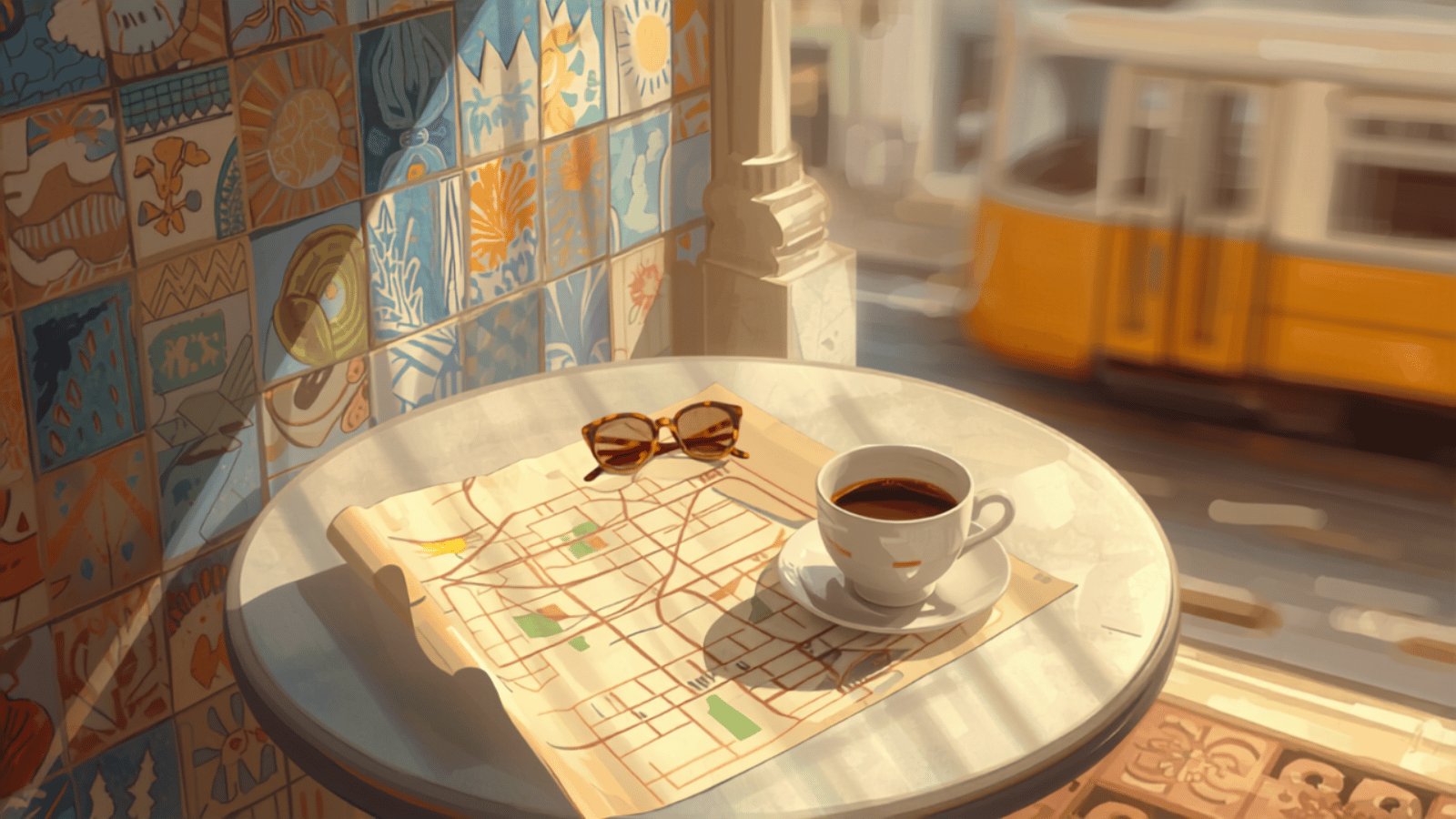
B1 · INTERMEDIATE Reading practice · ~2,600 words · 13-min read
This is an original story for intermediate learners. It is about a young traveller whose perfect plan goes wrong — and what happens next. First, read the ten key words. Then read the story in six short chapters. At the end, there are questions to check your understanding.
Before you read — 10 key words
- itinerary — a detailed plan of a journey: where you go, when, and how.
- charger — the small cable and plug you use to give a phone more battery.
- set off — to start a journey.
- valley — the low land between two hills or mountains, often with a river.
- stranger — a person you have never met before.
- sketchbook — a book of empty pages for drawing pictures by hand.
- guesthouse — a small, family-run place where travellers pay to sleep, like a little hotel.
- harbour — a place on the coast where boats stop and stay safe.
- ferry — a boat that carries people (and sometimes cars) across water on a regular timetable.
- souvenir — a small thing you keep or buy to remember a place or a journey.
The story
1 · The perfect plan
Amira Hassan had never travelled alone before. She was twenty-four, she worked in an office in Manchester, and she had spent two whole months planning this trip. Ten days in Portugal. It was going to be perfect, because Amira did not leave things to chance.
Everything lived inside her phone. She had built her itinerary in a travel app, hour by hour, day by day. An itinerary is a detailed plan of a journey, and Amira’s was a work of art. Day one: arrive in Lisbon at 11:40, hotel at 13:00, castle at 15:00, sunset viewpoint at 19:45. Day two: two museums, one famous café, one tram ride. The app showed her which bus to take, how long to wait, and even where to stand on the platform.
Her best friend Jess had laughed at her the night before she left.
“You’ve planned every minute,” Jess said. “What if something surprising happens?”
“Nothing surprising is going to happen,” Amira said. “That’s the point of a plan.”
And for two days, she was right. Lisbon was beautiful and everything ran on time. Amira stood in the right queues, ate in the right restaurants, and took the same photos that everyone takes. Each evening she ticked the boxes in her app: castle — done, tram — done, sunset — done.
But on the second evening, while she was eating dinner alone, a strange thought arrived with the dessert. She had seen everything on her list, but she couldn’t remember the smell of the city, or the sound of it. She had spent most of the day looking at a screen that told her where to look next.
She pushed the thought away. Tomorrow was day three, her favourite part of the itinerary: a bus into the mountains, to a small town called Pedrasol, and then, the next morning, a ferry from the harbour to a tiny island that a famous travel blogger had called “the most peaceful place in Europe”.
She set off early the next morning. To set off means to start a journey, and Amira set off the way she did everything — on time, with a fully charged phone, and with no idea that her perfect plan had about three hours left to live.
2 · The dead phone
The bus climbed slowly out of the city and into a green valley. A valley is the low land between hills, and this one was lovely: olive trees, a thin river, white houses with orange roofs. Amira filmed it all through the window. She filmed the valley, the river, the sky. She filmed so much that, when the bus finally stopped in Pedrasol, her battery was at nineteen per cent.
“No problem,” she thought. “I’ll charge it at the guesthouse.”
Then she opened her bag, and her stomach dropped. The charger wasn’t there. She could see it in her mind, white and neat, still plugged into the wall beside the hotel bed in Lisbon, one hundred and forty kilometres away.
“Okay,” she said out loud. “Don’t panic. Pedrasol will have a shop that sells chargers.”
She tried the bakery first. The baker, a huge man with flour on his arms, listened politely to her English, looked at the black screen, and offered her a warm cake instead. She tried the church, which was cool and silent and beautiful, but churches have never sold phone chargers and this one was not going to start today. Finally she tried the tiny supermarket at the end of the square.
Pedrasol did not have a shop that sold chargers. Pedrasol had a bakery, a church, a tiny supermarket, and a café with three metal tables in the square. It was the kind of town where everyone knew everyone, and where nobody had ever worried about battery life. The woman in the supermarket smiled kindly, looked at Amira’s phone, and shook her head.
“Loja de telemóveis?” she said. “Faro. Or Lisboa.” She pointed far away, over the hills.
Amira walked back to the square. Twelve per cent. She opened her app one last time, like a person saying goodbye at a hospital bed. Everything was in there: the name of her guesthouse, the ferry time, the map of the town, her tickets. She took a pen from her bag and wrote three things on the back of her hand: Casa das Andorinhas. Ferry 7:30. Harbour.
At 14:52, in the middle of the square in Pedrasol, the screen went black.
Amira stood very still. No map. No app. No blue dot to tell her where she was. She hadn’t felt this kind of fear since her first day of school. She was alone, in a foreign country, in a town she couldn’t pronounce, and for the first time in her adult life, no machine was going to help her.
3 · The stranger at the café
There was one other customer at the café in the square: an old man with white hair, brown skin like leather, and small round glasses. In front of him there was a coffee, a glass of water, and a large open sketchbook. He was drawing the church with a black pen, slowly and carefully, line by line.
Amira had never liked talking to strangers. A stranger is a person you have never met before, and in Manchester she avoided them professionally. But a dead phone changes a person quickly.
“Excuse me,” she said. “Do you speak English?”
The old man looked up and smiled. “A little more than my church speaks Portuguese,” he said. “Sit down. You look like a person whose phone has died.”
“How did you know?”
“Because you are holding it like a dead bird,” he said. “Sit. I am Duarte.”
Amira sat down and told him everything: the itinerary, the charger that was still in Lisbon, the guesthouse whose address she didn’t know, the ferry that she had already paid for, which left the harbour at half past seven the next morning.
Senhor Duarte listened. Then he turned to a clean page in his sketchbook and began to draw. He drew the square where they were sitting. He drew the street that went down the hill. He drew a bridge, a line of trees, a house with a bell on the gate.
“Casa das Andorinhas,” he said, tapping the little house. “The House of the Swallows. Rosa’s place. Ten minutes on foot. If you get lost, walk towards the sound of the river.”
Then he kept drawing. He drew a path that left the town and followed the valley. He drew a small circle and wrote miradouro next to it. He drew a tree with a strange, twisted shape, and a tiny table under it.
“What are these places?” Amira asked. “They weren’t in my app.”
“Of course they weren’t,” said Duarte. “Apps show you where everyone has already been. I have lived in this valley for seventy-one years. I am showing you where you should go.” He tore the page out of the sketchbook and gave it to her. “A paper map never runs out of battery. It only runs out of luck, and you look lucky to me.”
Amira looked at the drawing in her hands. It was the first map she had ever owned that was made for her, by a person, for free.
“Why are you helping me?” she asked.
“Because forty years ago, in Morocco, my bus left without me,” he said, going back to his drawing of the church. “And the man who helped me changed my life. I have been paying him back ever since.”
4 · The long way round
The paper map worked. Amira found the bridge, the line of trees, and the house with the bell on the gate. Rosa, who ran the guesthouse, was a round, loud, cheerful woman who hugged her like family and showed her a small white room with a window full of valley.
“Phone?” Rosa asked, holding out her hand. Amira’s heart jumped — but Rosa didn’t have a charger that fit either. Rosa’s daughter Inês, who was fifteen and spoke excellent English, translated her mother’s advice: “She says the town has lived without phones for five hundred years, and dinner is at eight.”
It was only five o’clock, so Amira did something she had not planned. She followed the rest of Duarte’s map.
The path along the valley was quiet and smelled of warm dust and rosemary. Nobody knew where she was, which had frightened her at two o’clock and felt strangely wonderful at five. Once, where the path divided in two, she stood still for a whole minute, holding the paper map and turning it round and round. Then she remembered Duarte’s advice, closed her eyes, and listened. Somewhere to the left, water was moving over stones. She walked towards the sound of the river, and five minutes later the path found her again.
She found the miradouro — a viewpoint where the whole valley opened out below her like a green sea — and she sat there for half an hour, doing absolutely nothing, which was not something the app had ever scheduled. An old dog arrived from nowhere, decided she was acceptable company, and fell asleep on her feet. In two days of following her itinerary she had collected two hundred photos. In half an hour of sitting still she collected one sleeping dog, one pink evening sky, and a feeling she couldn’t name yet.
She found the twisted tree, and under it the tiny table from the drawing, where an old woman was selling honey and small paintings of swallows. Amira bought a jar of honey and a painting the size of a postcard. A souvenir is a small thing you keep to remember a journey, and this one cost three euros and meant more to her than anything she had photographed in Lisbon.
At dinner, Rosa’s long table was full: a cyclist from Germany, two sisters from Brazil, Inês doing her homework, and a farmer who brought his own cheese and told jokes that Inês refused to translate. Amira talked for three hours. Not once did she look at where her phone would have been.
“You’ve had a good day,” Inês said, in perfect English, as they cleared the plates.
“I’ve had a terrible day,” Amira said. “I’ve lost my charger, I’ve lost my itinerary, and I’ve missed two museums.” She smiled. “It’s the best day of the whole trip. Don’t tell my app.”
5 · The ferry
The next morning, Amira woke to the sound of bells — real bells, on real goats — and for one cold second she panicked. No phone meant no alarm. What time was it? The ferry left the harbour at 7:30, and if she missed it, there wasn’t another one until the next day.
She ran downstairs. The kitchen clock said 6:40. Rosa, who had clearly been awake for hours, pushed a coffee and a warm roll into her hands and said something long and fast in Portuguese.
“She set an alarm in her head,” Inês translated, yawning. “She says machines forget, mothers don’t.”
The walk to the harbour took twenty minutes, downhill through the morning mist. A harbour is the place where boats stay safe on the coast, and Pedrasol’s was tiny: one stone wall, a dozen fishing boats, and a small white ferry that was already making impatient noises.
Amira had one bad moment at the ticket board. Her ticket, of course, was inside the dead phone. She showed the sailor her booking reference, which she had copied onto the back of her hand next to the ferry time, now half washed away. The sailor looked at her hand, looked at her face, and laughed for about a minute. Then he waved her on board.
The island was everything the blogger had promised — white houses, blue water, absolute peace — but Amira noticed something funny about herself. She kept reaching for a phone that wasn’t there, and every time her hand came back empty, she saw something instead. A cat asleep in a window. Two fishermen arguing happily about nothing. The exact colour of the water at midday, which no camera has ever really caught.
At lunchtime she found a family restaurant with four tables and no menu. The owner simply told her what the sea had given them that morning, and twenty minutes later she was eating the best fish of her life. The owner’s mother, who must have been ninety, sat in the corner shelling beans and watching Amira with bright, amused eyes. When Amira paid, the old lady pressed a small white shell into her hand and closed her fingers over it, as if it were a secret. Another souvenir that no shop could sell her. Her bag was filling up with them.
She sat by the water and wrote a postcard to Jess with a borrowed pen. You were right, she wrote. Something surprising has happened. I lost my plan and found a valley, a guesthouse, a paper map, and about eleven new friends. If I had kept my charger, I would have missed all of it.
She posted it before the ferry took her back across the water. That evening, at Rosa’s table, they celebrated her last night in Pedrasol with the farmer’s cheese and the old woman’s honey. Amira had been a stranger here for exactly one day and a half. It felt like much longer, in the best possible way.
6 · The last page
On her final morning, before the bus back to Lisbon, Amira went to the café in the square to say thank you. She had bought a small gift — a new black pen from the supermarket, the best one they had — and she had practised one sentence of Portuguese with Inês until she could say it properly.
But Duarte’s table was empty. No coffee, no glass of water, no sketchbook.
“Senhor Duarte?” she asked the waiter.
“Ah,” the waiter said. “He has gone walking. He goes every year, in September, somewhere new. He left this morning, very early.” Then the waiter smiled, reached under the counter, and brought out an envelope. “He said a girl with a dead phone would come. He left this for you.”
Inside the envelope there was a single page from the sketchbook. Amira unfolded it and her mouth fell open.
It was a map of Manchester. Her Manchester — drawn by hand, from memory, by a seventy-one-year-old man in a Portuguese mountain town. There was the cathedral, the river, the library. And in the north of the city, in an area Amira had never once visited in her whole life, Duarte had drawn a small careful circle around one street, with a tiny table, a tiny tree, and four words in his neat black ink:
“Your turn. Start here.”
Amira looked at the circle for a long time. She had lived in Manchester for twenty-four years. What was on that street? How did Duarte know her city? And why that street, of all places?
The bus to Lisbon was leaving in ten minutes. Amira folded the map, put it carefully next to the honey and the painting of the swallows, and smiled all the way down the valley. Her phone was still dead in the bottom of her bag. She had decided it could wait one more day.
Check your understanding
Read each question. Think about your answer. Then click “Show answer” to check.
Words to remember
Here are the key words again, in new sentences. Say each one out loud.
- itinerary — Our itinerary for Rome includes three museums and a cooking class.
- charger — I always pack a spare charger in my hand luggage now.
- set off — We set off at six in the morning to avoid the traffic.
- valley — From the top of the hill, you can see the whole valley below.
- stranger — A kind stranger helped me carry my suitcase up the stairs.
- sketchbook — She filled a whole sketchbook with drawings of the old town.
- guesthouse — The guesthouse was cheaper than a hotel, and the breakfast was homemade.
- harbour — We watched the fishing boats come back into the harbour at sunset.
- ferry — The ferry to the island runs twice a day in summer.
- souvenir — I didn’t buy an expensive souvenir — just a postcard and a fridge magnet.
Grammar in this story: the present perfect
This story is told in the past simple, but the characters often use the present perfect (have/has + past participle) — the tense we use when a past action still matters now, or when we talk about life experience. Look:
Amira had never travelled alone before. “You look like a person whose phone has died.” “I have lived in this valley for seventy-one years.” “I‘ve lost my charger, I‘ve lost my itinerary, and I‘ve missed two museums.”
Notice the difference: “My phone died at 14:52” (past simple — a finished moment) but “My phone has died“ (present perfect — and that is my problem right now).
👉 Learn the full rule here: Understanding the Present Perfect Tense: Usage and Examples.
Talk about it · Write about it
Talk about it: Are you a planner like Amira, or do you prefer to travel without a plan? Has technology ever failed you on a journey? What happened, and who helped you?
Write about it: Write 8–10 sentences about a journey that did not go as planned. Use the past simple to tell the story, and use the present perfect at least twice (for example: “I have never forgotten that day” or “Since then, I have always packed a spare charger”).
🎉 Well done — you have just read a 2,600-word story in English! That is real intermediate reading, and you met ten useful travel words along the way.
But one question stays open, doesn’t it? Somewhere in the north of Manchester, there is a street with a circle drawn around it — and Amira still hasn’t been there. What did Duarte want her to find? Perhaps a future story will take us to that street…
Mira thinks she knows her fishing village. Read about a strange light in the bay and compare the possible explanations. Next story: The Light in the Bay (B1 Reading Story)
About this story: This is an original B1 graded reader (~2,600 words). The vocabulary is controlled for intermediate learners, so you should understand about 98% of the words. The grammar focuses on past-tense storytelling with the present perfect, relative clauses, and simple conditionals. Any harder word is explained before the story and used again inside it.

I’m Khamis Maiouf. I’m studying Health and Social Care and have completed Functional Skills Level 2 in English and Level 3 Hairdressing. I have taught ESOL in my community and helped students with GCSE English. I run English Teacher Site to help people learn and practise English.