
The Repair Café (B1 Reading Story)

B1 · INTERMEDIATE Reading practice · ~3,000 words · 15-min read
This is an original story for intermediate learners. First, read the ten key words below. Then enjoy the story — it is told in six short chapters. At the end, there is a quiz, a grammar focus, and ideas for speaking and writing.
Before you read — 10 key words
- appliance — a machine you use at home, like a kettle, a toaster, or a washing machine.
- repair — to fix something that is broken so it works again.
- volunteer — a person who works to help others and does not ask for money.
- spare part — a new piece that replaces a broken piece inside a machine.
- screwdriver — a tool for turning screws; you use it to open machines.
- throw away — to put something in the rubbish because you do not want it any more.
- community — the group of people who live in the same area.
- patient — able to wait, or to work slowly and carefully, without getting angry.
- plug — the part at the end of a cable that you put into the wall for electricity.
- lonely — sad because you are alone and far from friends or family.
The story
1 · The broken kettle
Dina has lived in Westfield for three months, and in all that time she has not made a single friend. She moved here in April because of her new job. The job is fine — she checks orders on a computer for a company that sells office furniture. Her small flat is fine too. The problem is the evenings and the weekends. In her old city, she had her sister, her old school friends, and her mother’s kitchen, which always smelled of mint tea. Here she has a sofa, a television, and a window that looks out at a bus stop.
“You’ll meet people soon,” her sister says on the phone every Sunday. “Three months is nothing.”
“I know,” Dina always answers. But she doesn’t really believe it. At work, everyone is friendly for exactly eight hours, and then everyone drives home to their own lives. She has tried a gym. She has tried a book club that met in a cold room above a bank. She has even tried talking to the woman at the bus stop, who only wanted to talk about the weather. Nothing has worked. Being lonely, Dina has learned, is not dramatic. It is quiet and grey, like a long Sunday afternoon.
Her evenings have found a shape she does not like: dinner for one, an hour of television she doesn’t remember afterwards, and then twenty minutes of looking at photos of other people’s interesting lives on her phone. Once a week she writes a shopping list, and the list is always the same. If somebody asked her, “Are you unhappy?”, she would honestly say no. But if somebody asked her, “When did you last laugh until your face hurt?”, she would have to think for a worryingly long time.
On the first Saturday of October, it rains all morning. Dina decides that the day can still be saved with a big cup of tea. She fills her kettle, pushes the button, and waits. Nothing happens. No light, no sound. She checks the plug in the wall. She tries a different socket. She pushes the button again, harder, as if being angry with an appliance has ever fixed one. The kettle is dead.
It is not an expensive kettle, but it was a goodbye present from the people at her old job, and there is a small message on the bottom written in silver pen: Good luck, Dina! Don’t forget us.
She stands in the kitchen with the dead kettle in her hands. The sensible thing is to throw it away and buy a new one for fifteen pounds. She actually opens the bin with her foot. Then she stops, because she remembers something — a bright yellow poster she saw last week on the door of the supermarket. She puts the kettle down, finds her raincoat, and walks to the supermarket to read the poster again.
DON’T THROW IT AWAY! the poster shouts in big letters. Bring your broken things to the REPAIR CAFÉ. First Saturday of every month, 10:00–16:00, Westfield Community Hall. Free help, free tea, friendly people. We fix it with you, not for you.
Dina looks at her phone. It is a first Saturday, and it is only half past ten. She walks home, picks up the kettle, and, feeling a little silly, carries it through the rain in a shopping bag.
2 · The community hall
The community hall is an old brick building behind the library. Dina has walked past it many times without ever looking at it. Today the doors are open, and warm yellow light falls out onto the wet street. She can hear voices and, strangely, laughing.
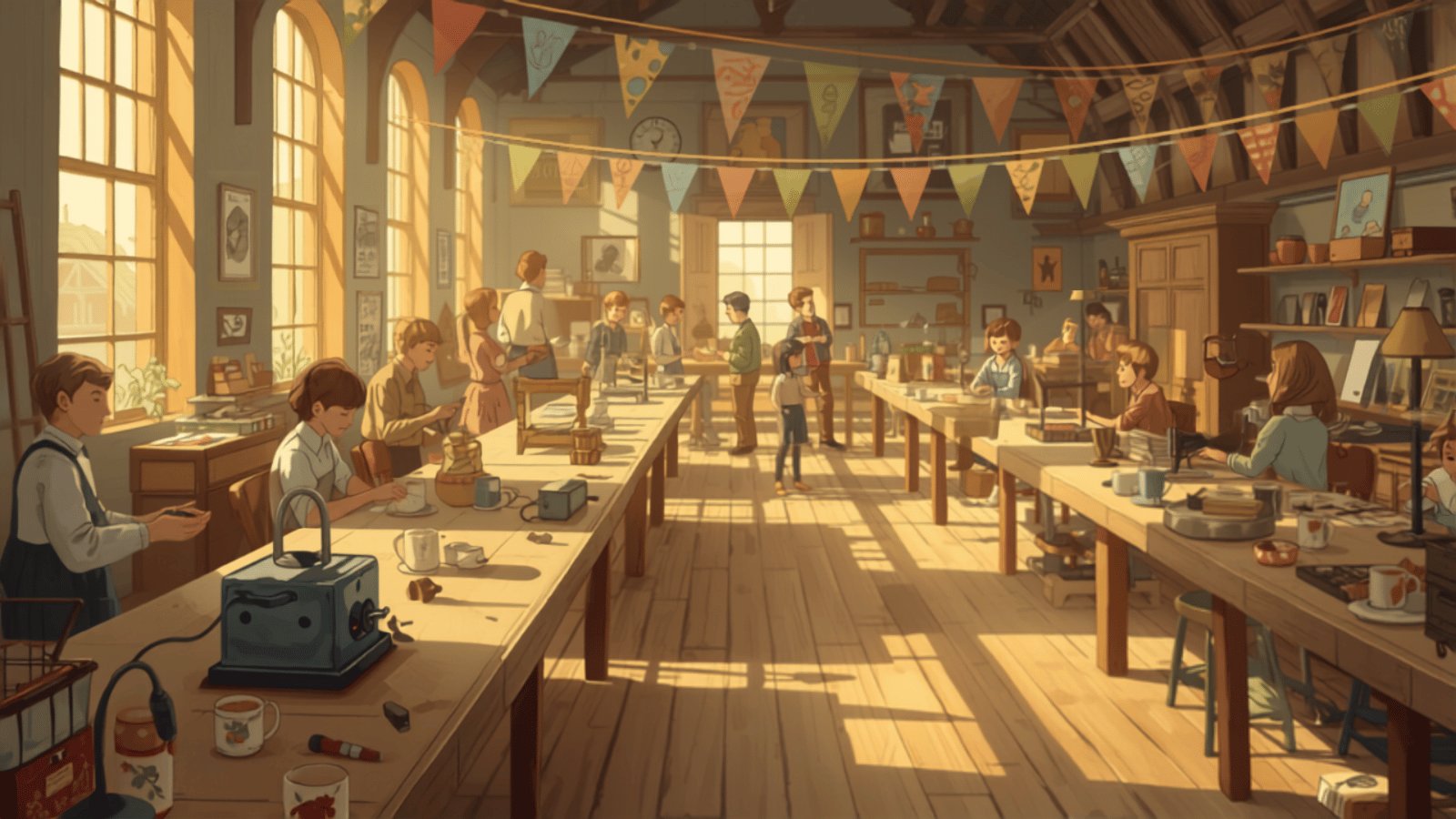
Inside, the hall is full of long tables, and every table is busy. At the first one, a man in a green jumper is taking a toaster to pieces while its owner, an old lady, watches like a worried parent at a hospital. At another table, a young volunteer with purple hair is sewing the arm back onto a child’s teddy bear. There is a table covered in lamps, a table where a bicycle hangs upside down, and a corner where a tall girl is showing a boy how to open the back of his robot toy with a tiny screwdriver. Near the door, a hand-written sign says: Everything here gets a second chance. That includes people.
A woman with a clipboard smiles at Dina. “First time?”
“Yes. Sorry. Is this — can anyone come?”
“Anyone with something broken,” the woman says. “So, really, everyone. What have you brought us?”
Dina lifts the kettle out of the bag. The woman writes kettle — no power on a ticket, gives Dina the number twelve, and points to the far corner. “Electrical things go to Ernest. The gentleman with the white beard. You might have to wait — Ernest is popular.”
Dina waits on a plastic chair with a free cup of tea that somebody puts into her hand. She watches the room. Nobody is in a hurry. Nobody is looking at a phone. A radio is playing old music, and two men are arguing happily about the right way to fix a chair. It is the first place in Westfield, she realises, that feels like her mother’s kitchen.
On the wall beside her there is a big board covered in photographs: a washing machine with a red ribbon on it, a grandfather clock, a hair dryer, dozens of smiling owners holding their rescued appliances like babies. Under the board, someone has written the café’s results by hand: Last year we repaired 214 things. Together they weighed more than an elephant. None of them went to the rubbish tip.
The boy with the robot toy sits down next to her while the tall girl looks for a new battery. “Is your kettle broken?” he asks, looking into her bag with the honest curiosity of a seven-year-old. “My robot’s arm fell off. Jess says we can fix it, and Jess has fixed a drone before, so.” He says it the way other people say so it is decided. Dina decides she likes this place.
“Number twelve!” calls a deep voice. “Who has the kettle with no power?”
3 · Ernest
Ernest is about seventy-five, with a white beard, enormous glasses, and hands that look strong enough to bend metal. He worked as an electrician for fifty years, he tells her, and he has repaired everything from cinema projectors to a queen-sized electric blanket that once belonged to an actual mayor.
He puts the kettle on the table between them, but he does not touch it. Instead he pushes a screwdriver across the table towards Dina.
“Rule one,” he says. “At this café, we fix it with you, not for you. If I repair it, you have a working kettle for a year. If you repair it, you have working hands for life. Open it up.”
“I’ve never opened an appliance in my life,” Dina says. “What if I break it more?”
“It doesn’t work now,” Ernest says. “You can’t make ‘doesn’t work’ worse. That is the beautiful secret of broken things — they set you free.”
So Dina, order-checker for an office furniture company, turns her first screw. Under the bottom of the kettle there is a small world she has never seen: wires, metal parts, and dust. Ernest gives her a small machine called a tester and shows her how to check each connection. He is endlessly patient. When her hand shakes, he doesn’t take the screwdriver from her. He just says, “Slower. Good. Now look — what do you see?”
“This wire,” Dina says slowly. “It’s not connected to anything. And this metal piece looks burnt.”
“Exactly.” Ernest looks genuinely delighted. “The connection has broken, probably years ago, a little more every day. Today it finally gave up. We can fix that in ten minutes. Have you ever used a soldering iron? No? Then today is a big day.”
While they work, Ernest talks. He started the Repair Café eight years ago, he says, after he retired and discovered that a man cannot drink tea and read the newspaper for more than two weeks without going slightly mad. “People think we’re here to save appliances,” he says, holding the wire steady while Dina works. “Machines are just the excuse. What people bring in that bag is never only a kettle. It’s a story. Yours, for example, has a message written on the bottom, so I already know it’s not about the fifteen pounds.”
Ten minutes later, the kettle’s light comes on, and the water inside begins to make its small, familiar song. Around them, the whole table cheers — the lady with the toaster, the boy with the robot, the girl with the purple hair. Dina stands there with the warm kettle and feels absurdly proud, prouder than she felt when she passed her driving test.
“There’s a message on the bottom,” Ernest says, turning it over. “Don’t forget us. Well. Now you never will. A repaired thing remembers better than a new one.” He wipes the table and looks at her over his enormous glasses. “We’re always short of volunteers, by the way. You have careful hands and you ask good questions. Come back next month.”
“I don’t know anything about repairs,” Dina says.
“Nobody does,” says Ernest, “until somebody shows them.”
4 · The sewing machine
Dina goes back in November. Not with anything broken — she goes back because for four weeks she has thought about that warm hall almost every day. The woman with the clipboard, whose name is Priya, gives her an apron and a job: making tea and writing tickets. By the December café, Dina is sitting next to Ernest, learning to test plugs and change fuses. By February, she has her own corner of the table and has repaired eleven kettles, four lamps, two toasters, and one electric guitar that made everybody’s hair stand up.
She knows the regular visitors now. She knows Mrs Okafor, who has brought in the same ancient radio-cassette player three times, mostly, everyone suspects, for the tea and the conversation. She knows the twins who broke their games console and, while fixing it with Ernest, accidentally learned what electricity is. The lonely grey Sundays have not completely disappeared, but they have become rarer, like rain in summer.
Her sister notices the change before Dina does. “You sound different,” she says one Sunday on the phone. “You’ve talked about these café people for twenty minutes and you haven’t mentioned the bus stop once.” Dina laughs, and then realises something: she has plans this week. Jess is teaching her to solder properly on Tuesday. Priya has invited her for dinner on Thursday. On Saturday she has promised to help Ernest sort a mountain of donated spare parts into little labelled boxes, which he calls “the best fun a person can have indoors”.
Then, on the first Saturday of March, Marco arrives.
He is a quiet man of about forty who works in the pharmacy on the high street. Dina has seen him there — polite, serious, never more words than necessary. He comes in carrying something heavy wrapped in a blanket, and he carries it the way people carry things that matter. Under the blanket is a sewing machine. It is old, black and gold, and beautiful, like a small piano.
“It was my mother’s,” Marco says. “She died last year. She made clothes for half our street on this machine — wedding dresses, school uniforms, everything. It stopped working before she died, and she always said, ‘Marco, one day we will repair it.’ We never found the time.” He touches the machine’s wheel gently. “I don’t sew. I just — I can’t throw it away. If you tell me it’s impossible, I’ll accept that.”
Ernest examines the machine for a long time. The problem is not the electrics, which Dina tests herself — the problem is a small broken gear deep inside, a spare part that this company stopped making before Dina was born.
“Impossible?” Marco asks.
“Difficult,” says Ernest, and in Ernest’s language, Dina has learned, difficult means interesting. “Leave it with us. This is not a one-Saturday job. This is a community job.”
5 · A hundred small hands
What happens next is the thing Dina later tells her sister about for forty-five minutes without stopping.
Priya photographs the broken gear and posts it in the town’s online group. Within two days there are ninety comments. A man offers a box of parts from a completely different machine, “just in case”. Somebody’s uncle in Scotland thinks he has one, then finds he doesn’t, then apologises with a long message about his uncle’s garage. A woman writes simply: My mother had a machine like this. I remember the sound. Good luck. The whole town, it seems, has a memory connected to a machine like Marco’s.
Then a retired teacher writes that her late husband collected old sewing machines and his garage is still full of boxes she has never had the courage to open. Volunteers spend a whole Sunday helping her sort them, and she cries, but in the good way, and they find three machines of almost the right model. Almost. None of the gears fits.
Then the tall girl from the robot-toy table — her name is Jess, and she is seventeen — looks at the broken gear for a long time and says, “My school has a 3D printer. If I measure this carefully, I think I can print a copy in strong plastic. If it wears out, we’ll just print another one.”
It takes her four tries. The first copy is too big. The second breaks in Ernest’s fingers. The third fits but slips. The fourth, printed late on a Thursday after her physics exam, drops into place with a small, perfect click.
On the first Saturday of April — exactly one year, Dina realises, since she arrived in Westfield — the hall is fuller than usual, because word has travelled. Marco stands at the electrical table. Ernest, who believes in ceremony, makes a short speech about machines and memory. Then he steps back and says, “Dina. It’s your repair. You do the honours.”
Dina turns the wheel. The needle rises and falls, smooth and quick, sewing a clean line across a piece of blue cotton — the machine’s first stitches in six years. The hall cheers the way it cheered for her kettle, only louder, and Marco covers his face with both hands and laughs and cries at the same time.
“I’ve decided something,” he tells them, when he can speak again. “I’m going to learn to sew. On this machine. If my mother could dress half a street, I can at least repair a shirt. Jess — if I pay for the materials, will you print me a spare gear, just in case?”
“I’ll print you two,” says Jess.
6 · Ten to four
By late afternoon, the hall grows quiet. The tables are being cleaned, the last toaster has gone home happy, and Priya is counting tickets: thirty-one repairs, a new record. Marco has stayed all day, asking the sewing volunteers a hundred questions and writing the answers in a little notebook from the pharmacy. Jess is showing two new teenagers how to use the 3D-printing files she has made, “so the knowledge doesn’t live in only one head”. Ernest is drinking his fifth tea of the day and telling anyone who will listen that this is exactly what he means about second chances.
Dina washes cups at the little sink and thinks about the strange mathematics of the year. If her kettle hadn’t died on that rainy Saturday, she would have bought a new one for fifteen pounds. She would never have walked into this hall. She would not know how to change a fuse, or test a plug, or hold a soldering iron steady. She would not know Priya, or Jess, or Marco, or a patient old electrician with enormous glasses. Nobody in Westfield would know her name. It is strange, she thinks, how a broken thing repaired her life.
At ten minutes to four, the door opens.
A small, very old woman comes in slowly, carrying a wooden box with a round metal face — an old radio, older than anything the café has ever seen. She sets it down on Ernest’s table with great care.
“I’m sorry to come so late,” she says. “I’ve walked from the other side of town. This radio hasn’t worked since 1974. My husband promised to fix it the week he — well. He never did. I’ve kept it for fifty years, and this morning I decided: enough. Either it plays again, or I say goodbye to it.”
“We close at four,” Priya begins gently, “but you’re welcome to—”
She stops, because Ernest has gone completely still. He is staring at the radio the way people stare at photographs of themselves when they were young. He puts on his enormous glasses, leans close, and reads the small silver letters on the corner of the wooden case. His voice, when it finally comes, is not much more than a whisper.
“Madam,” he says, “I have seen this radio before. In 1974, I was the apprentice who failed to fix it.” He looks up at her, and his eyes are shining. “I’ve waited fifty years for a second chance.”
Check your understanding
Read each question. Think about your answer. Then click “Show answer” to check.
Words to remember
Here are the key words again, in new sentences. Try to make one more sentence of your own for each word.
- appliance — Our new flat came with every kitchen appliance except a fridge.
- repair — It cost less to repair my phone screen than to buy a new phone.
- volunteer — She works as a volunteer at the animal shelter every weekend.
- spare part — The garage has ordered a spare part for our car, so we must wait a week.
- screwdriver — You’ll need a small screwdriver to change the battery in this toy.
- throw away — Don’t throw away that jacket — we can wash it and give it to charity.
- community — The whole community came together to clean the beach after the storm.
- patient — A good teacher is patient and never makes students feel stupid for asking.
- plug — The lamp isn’t broken — the plug wasn’t in the wall properly.
- lonely — He felt lonely during his first month abroad, but then he joined a football club.
Grammar in this story: the present perfect
This story uses the present perfect (have/has + past participle) to connect the past to now. Look at these lines from the story:
Dina has lived in Westfield for three months. · “I‘ve never opened an appliance in my life.” · “This radio hasn’t worked since 1974.” · “I‘ve waited fifty years for a second chance.”
Notice the pattern: we use for with a period of time (for three months, for fifty years) and since with a starting point (since 1974). We use never for life experience up to now.
👉 Learn the full rule here: Understanding the Present Perfect Tense.
Talk about it · Write about it
Talk about it: When something breaks in your home, do you usually repair it or throw it away and buy a new one? Why? Is there a repair café or anything similar in your town? Would you go?
Write about it: Write a short paragraph (6–8 sentences) about an object you have kept for a long time even though it is old or broken. What is it? How long have you had it? Why is it important to you? Try to use the present perfect with for and since.
🎉 Excellent work — you have just read a complete 3,000-word story in English! Notice how much you understood, and how the ten key words came back again and again.
But one question stays open: can Ernest fix the radio he failed to fix fifty years ago — and what happened to him in 1974? Perhaps you will meet him again in a future story…
Choose Your Next Story
This is the last story in the work and trust group. Choose another B1 story from the reading collection when you are ready.
Other Story in This Group: The Weekend Baker (B1 Reading Story)
About this story: This is an original B1 graded reader (~3,000 words), written with controlled intermediate vocabulary so you can understand about 98% of the words without a dictionary. Harder words are explained before the story and repeated inside it, and the grammar stays at B1 level: past narrative, present perfect, relative clauses, and first conditional.

I’m Khamis Maiouf. I’m studying Health and Social Care and have completed Functional Skills Level 2 in English and Level 3 Hairdressing. I have taught ESOL in my community and helped students with GCSE English. I run English Teacher Site to help people learn and practise English.