
The Weaver and the Silent River (B1 Reading Story)

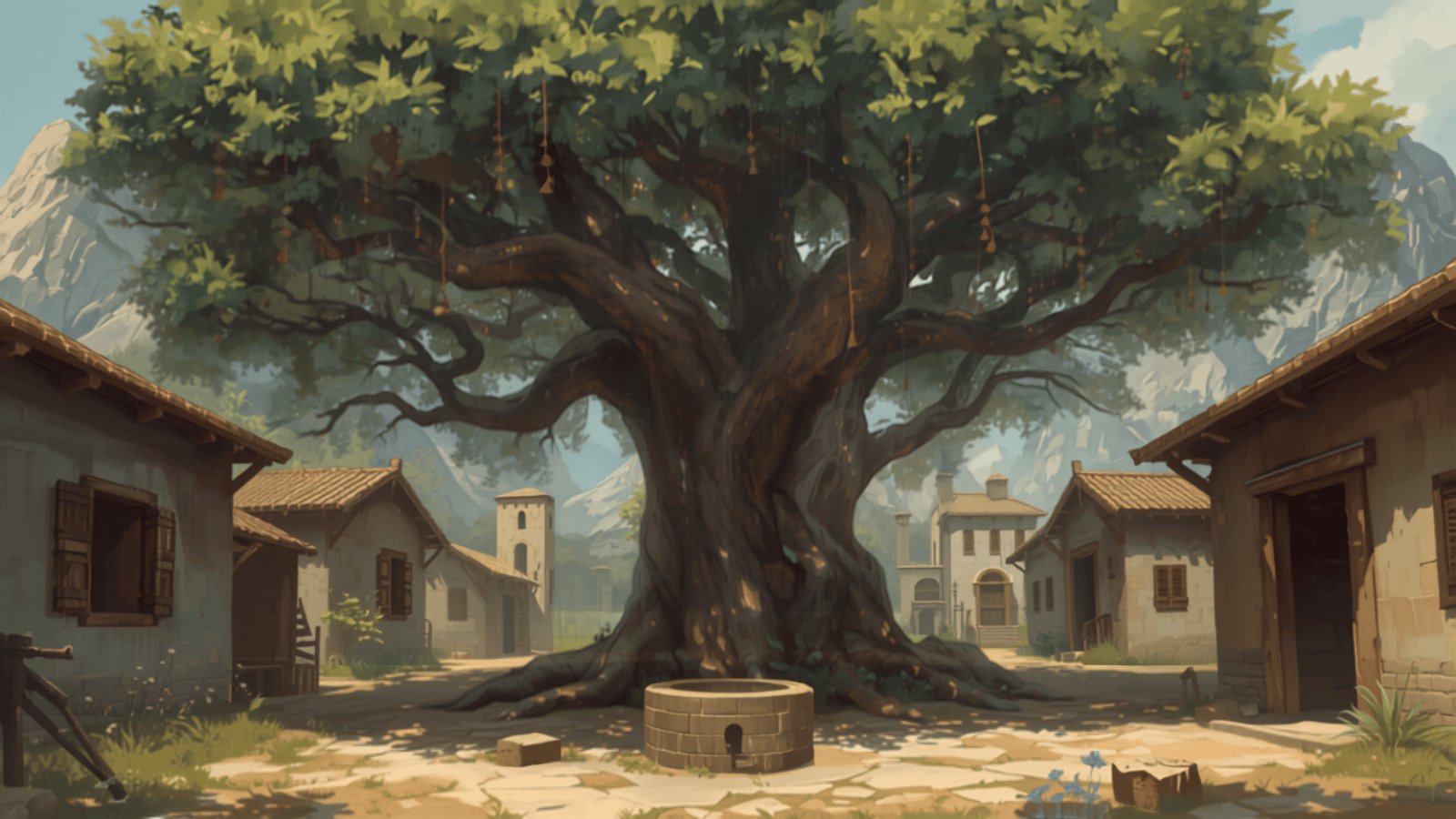
B1 · INTERMEDIATE Reading practice · ~3,000 words · 15-min read
This is an original folk tale for intermediate learners. Before you start, read the ten key words below — they all appear in the story more than once. When you finish, there is a short quiz, and a question the story never answers…
Before you read — 10 key words
- weaver — a person who makes cloth by crossing threads over and under each other.
- loom — the wooden machine a weaver uses to make cloth.
- thread — a long, thin line of cotton or wool, used for making cloth.
- spring — a place where water comes up naturally out of the ground.
- drought — a long period with no rain, when the land becomes very dry.
- bargain — an agreement in which each side promises to do something for the other.
- spirit — a being without a body; in old stories, spirits often live in mountains or rivers.
- pattern — a design of shapes, lines, or colours that repeats.
- whisper — to speak very, very quietly.
- fade — to slowly become weaker, quieter, or less bright.
The story
1 · The village that forgot the sound of water
High in the mountains, at the end of a narrow stone road, there was a village called Karadin. It was the kind of village that maps forget. Fifty houses, one square, one old walnut tree, and — once — the most beautiful spring in the whole valley.
The spring was the heart of Karadin. Cold, clear water came up out of the rock, ran down through the village in a small river, and fed the fields below. People said the water tasted of snow and stars. Travellers who drank it always came back.
But that was a long time ago.
For three years now, the spring had given less and less water. First the river became a stream. Then the stream became a line of wet stones. Then, one dry summer morning, the last drop disappeared into the ground, and the riverbed fell silent. The drought had arrived, and it had stayed.
In a small house near the square lived a young weaver named Mira. Her grandmother had taught her the work when she was a child: how to choose the wool, how to dye the thread, how to sit at the big wooden loom and turn a thousand separate lines into one piece of cloth. Her grandmother had been the finest weaver in the valley, and people said that Mira had become even better.
“Cloth remembers,” her grandmother used to say. “Every pattern is a story. If you weave with care, the cloth will keep the story long after we have gone.”
Her grandmother had been gone for two years now, but Mira still heard her voice every time she sat down at the loom.
That evening, the whole village met under the walnut tree. The mayor, a tired man called Orhan, stood on a chair so everyone could see him.
“You all know why we are here,” he said. “The well behind the church is almost empty. The animals are thin. If the spring does not return by winter, we will have to leave Karadin.”
Nobody spoke. Leaving Karadin was a sentence nobody wanted to say out loud.
Then old Besa, who was ninety years old and slept most of the day, opened her eyes and said something strange.
“The spring has not died,” she said. “It has been closed. There is a difference. My mother told me: the water belongs to the mountain, and the mountain gave it to us as part of a bargain. If the water has stopped, it is because we have broken our side of it.”
People smiled politely, the way people smile at very old women. Only Mira did not smile. She walked home in the dark, and Besa’s words walked with her.
2 · The stranger’s bargain
The stranger arrived the next day, in the hottest hour of the afternoon.
He was old — or he looked old. He wore a long grey coat that was far too warm for summer, and he carried no bag, no water bottle, nothing. He walked slowly across the empty square and stopped at Mira’s open door.
“I have walked a long way,” he said. “Could you give me some water?”
Mira looked at her jug. There was one cup of water left in it — her water for the whole evening. She hesitated for only a second. Then she filled the cup and gave it to him.
“It’s the last of it,” she said, “so drink it slowly.”
The stranger drank it slowly. He drank it the way you would drink something expensive and rare. When he finished, he looked at her with eyes that were the grey-green colour of deep water.
“You gave your last cup to a stranger,” he said. “Interesting. In the last village, they asked me for money first.”
“Water isn’t something you sell to a thirsty man,” Mira said. “Anyway, it’s done. I hope it helped.”
The stranger stepped inside without being invited and looked at the loom, at the coloured thread hanging on the wall, at the half-finished cloth with its pattern of mountains and birds.
“You are the weaver,” he said. It was not a question. “Then listen. I know why your spring has stopped.”
Mira went very still. “Everyone knows why. Three dry winters. No snow, no water.”
“Other valleys had the same three winters,” the stranger said. “Their springs still run. No, Mira. Long ago, this village made a bargain with the spirit of the mountain. The mountain gave water; the village gave something in return. For two hundred years, both sides kept their promise. Then your people forgot theirs. The old woman is right — the spring has not died. It has been closed.”
“How do you know my name?” Mira asked quietly.
The stranger smiled and did not answer the question. “The spirit of the mountain is old and angry, but it is fair. It will open the spring again — for a price. Bring it three woven things. First: the song of the river, woven in cloth. Second: the colour of the wind, woven in cloth. Third: the promise your village has forgotten, woven in cloth. Bring all three to the flat stone above the dry spring before the first snow. If the mountain accepts them, the water will return.”
Mira laughed — a short, tired laugh. “Nobody can weave a song. Nobody can weave the wind. And how can I weave a promise that everyone has forgotten? If I knew what it was, it wouldn’t be forgotten.”
“That,” said the stranger, walking back out into the sunlight, “is why the mountain asked for a weaver.”
When Mira reached the door, the square was empty. The stranger had gone, and there were no footprints in the dust.
3 · The song of the river
For three days, Mira did not touch the loom. The task felt impossible, and impossible tasks are heavy things to carry.
On the fourth morning she thought: I cannot weave a song. But I have never tried to listen like a weaver. Maybe that is where I should start.
She went down to the dry riverbed and sat on the white stones where the water used to run. She closed her eyes. There was nothing to hear, of course — only wind and dust. So she began to ask people instead.
She asked old Besa, who said: “The river sounded like rain on a roof, but underneath, always underneath.”
She asked the baker, who said: “In spring it was loud and white and it shouted. By August it was thin and silver and it whispered.”
She asked the schoolteacher, who had grown up beside the water, and he was quiet for a long time and then said: “It sounded like someone who is happy but doesn’t know anyone is listening.”
Mira wrote nothing down. She carried the answers home in her head, the way you carry a full cup without looking at it. Then she sat at the loom and began.
She wove for eleven days. She used every blue she had, and greys, and one thin line of white that ran through the whole cloth and never stopped. Near the top, the pattern was wide and wild — the river shouting in spring. Near the bottom it became narrow and soft and silver — the river whispering in August. She did not weave a picture of a river. She wove the way a river sounds, and anyone who had ever lived beside one could see it at once.
When Besa saw the finished cloth, she started to cry. “Turn it over,” she whispered. “Turn it over — I can almost hear it.”
That night, Mira folded the cloth carefully and put it in her grandmother’s wooden chest. One task was done. Two remained, and the mornings were already getting colder.
4 · The colour of the wind
The second task defeated her for a whole week.
“The wind has no colour,” she said to her empty kitchen. “That is the whole point of wind.”
She tried anyway. She wove a grey cloth: it looked like fog, not wind. She undid it. She wove a white one: it looked like snow. She undid that too. Thread lay in angry piles all over the floor.
Then, one afternoon, she climbed onto her roof to fix a broken tile, and the wind came up the valley — and Mira forgot the tile completely.
From the roof, she could see the wind. Not the wind itself — but everything it touched. It turned the dry grass pale gold as it bent. It turned the olive trees silver as it flipped their leaves. It pulled brown dust up from the road in long curling lines, and it pushed one small white cloud across the sky like a boat. The wind had no colour of its own. The wind’s colour was every colour it borrowed.
She had been trying to weave the wind. What she needed to weave was everything the wind touched.
This cloth took sixteen days. Pale gold bending one way, silver flashing the other way, a long curl of road-brown, one small stubborn white boat of a cloud. None of the shapes were finished — everything leaned, everything moved. When she finally cut it from the loom and held it up, the baker, who was passing her window, stopped and said: “Close the door, Mira, it’s windy in there.” Then he looked again and saw that the air was completely still.
It was that week that Tomas came to her door. Tomas was the richest man in the village, a wool merchant with soft hands and quick eyes, and he had heard talk about the two cloths.
“I’ll be honest with you,” he said. “Those two pieces are the best work this valley has ever produced. I can sell them in the city for more money than you have seen in your life. Half for you, half for me. You could leave this dying village and never weave by candlelight again.”
“They’re not for sale,” Mira said. “They’re a payment. There’s a difference.”
Tomas smiled the way he smiled when a price was too high. “A payment to a mountain? Mira, be serious. If the spring comes back, it will be because of rain, not cloth. And if it doesn’t, you will have given your best work to a rock.” He leaned closer. “If I were you, I would take the money.”
“If you were me,” said Mira, “you would have sold the loom three years ago. Goodnight, Tomas.”
5 · The forgotten promise
Now only the third task remained, and it was the worst one: weave the promise your village has forgotten. How do you find something whose whole problem is that nobody remembers it?
Mira asked everyone. The mayor knew nothing. The priest found nothing in the church books, which only went back eighty years. Besa remembered that there was a promise — her mother had mentioned it — but not what it said. “Things fade, child,” she said sadly. “Even important things. Especially important things, because everyone believes someone else is remembering them.”
The first cold rain of autumn came and went. The mountain’s top turned white. Time was running out.
One night, too worried to sleep, Mira opened her grandmother’s wooden chest to look at the two finished cloths — and, underneath them, at the bottom of the chest, her fingers found something she had never really looked at before. It was a small square of very old cloth, hard with age, its colours almost gone. As a child she had thought it was a rag her grandmother kept for luck.
She carried it to the lamp. And her breath stopped.
It was not a rag. It was weaving — unbelievably fine weaving — and though the colours had faded, the pattern was still there, and the pattern was a story. She read it the way only a weaver could. At the top: the mountain, with the spring flowing from its side. Below: the village, small and new, only a few houses. And between them, repeated around the border like a signature, one image again and again: a human hand planting a young tree beside water.
That was the bargain. That was the whole bargain. The mountain gave the village water; the village planted trees beside the spring and along the river — every year, one tree for every child born — so that the roots would hold the rain in the earth and feed the spring, and the mountain would never be bare. Water for trees. Trees for water. Each side helping the other, forever.
Mira thought of the hills around Karadin and felt cold. There were no trees on them. Her great-grandparents’ generation had cut them, slowly, one by one — for firewood, for timber to sell, for a little more field. Nobody had decided to break the promise. They had simply stopped keeping it, and then forgotten it had ever existed. And without the roots, every year, the rain had run down the bare hills and away, and the spring had grown weaker, until at last the mountain closed its hand.
She sat down at the loom that same night.
Into the third cloth she wove the old pattern, line for line — the mountain, the spring, the planting hands — but she did not stop where the old cloth stopped. She wove what came next: the bare hills, the empty riverbed, the village grey with dust. And then, below that, she wove the future as a promise: small green trees on the hills, first ten, then a hundred, and the spring running again, and around the bottom border, like a signature, the same image repeated — a hand planting a tree — but now the hands belonged to everyone: big hands, small hands, old hands, children’s hands.
She finished it at dawn on the day the first snow clouds gathered over the mountain.
6 · The flat stone
The path to the dry spring was steep, and the wind was bitter. Mira climbed with the three folded cloths on her back, and — she had not asked them to come — half the village climbed behind her. Besa rode on the baker’s donkey. Even Tomas came, at the back, with his collar turned up, telling everyone he was only there “to see the end of this nonsense”.
The flat stone above the spring was grey and old and completely ordinary. Mira laid the three cloths on it, one beside the other: the song of the river, the colour of the wind, the promise remembered.
Nothing happened.
The wind dropped. The whole mountain seemed to hold its breath. Somewhere behind her, Tomas started to laugh — and stopped, because at that moment a voice spoke. It did not come from one place. It came from everywhere, from the rock and the cold air and the ground under their feet, and it was quiet, like a whisper in a huge empty room.
“Two hundred years,” it said. “I have waited two hundred years for someone to remember. Others came to this stone and asked. You are the first who came and answered.”
Mira found her voice. “The promise was forgotten,” she said. “That was wrong, and it hurt you. But look at the third cloth. We have not just remembered it — we have woven what we will do next. A tree for every child, every year, beside the water and on the hills. It will take a whole generation to make the hills green again. We know that. We will start today, before the snow, if you give us the chance.”
The silence lasted so long that her hands began to shake.
Then, deep inside the mountain, something moved. It was not a sound so much as a feeling — like a great hand slowly opening. And out of the dark crack in the rock where the spring had died, water came. It came first as a shine, then as a thread, then as a rope of silver, then as a cold, laughing rush that leapt down the stones towards the village, and the sound of it — the shout and the whisper together — was exactly, exactly, the pattern of the first cloth.
What happened next in Karadin became its own story: the shouting, the crying, old Besa drinking the first cup with shaking hands, and Tomas — this surprised everyone — walking down the mountain in silence and returning an hour later with a spade and forty young trees that nobody knew he had bought. They planted until dark, and the snow that fell that night fell on new roots.
The three cloths were gone from the flat stone the next morning. Nobody in the village had taken them. On the stone, held down by a small white pebble, someone had left a single square of new cloth that no loom in the valley could have produced. Mira has kept it on her wall from that day to this, and she has never fully understood it.
Because the pattern shows a weaver with a pack on her back, walking away from the mountains — down, and down, and down — towards a wide grey-green flatness that Mira has never seen in her life.
Old Besa looked at it for a long time, and smiled, and said only this: “The mountain has a sister, child. And the sea keeps her promises even less often than we do.”
Check your understanding
Read each question. Think about your answer. Then click “Show answer” to check.
Words to remember
Here are the key words again, in new sentences. Try to make one more sentence of your own for each.
- weaver — My aunt is a weaver; she has made cloth by hand for thirty years.
- loom — The old wooden loom in the museum still works perfectly.
- thread — I need a needle and some blue thread to fix this shirt.
- spring — The walkers stopped to drink from a mountain spring.
- drought — After months of drought, the farmers finally saw rain.
- bargain — They made a bargain: he would cook if she would wash up.
- spirit — In many old tales, a spirit guards the forest or the river.
- pattern — The carpet has a beautiful pattern of stars and flowers.
- whisper — You don’t have to whisper — the baby is already awake.
- fade — Old photographs fade if you leave them in the sun.
Grammar in this story: the present perfect
The story is told in the past, but when the characters speak, they often use the present perfect (have/has + past participle) — because they are talking about a past action that still matters now. Look:
“The spring has not died. It has been closed.” · “I have walked a long way.” · “I have waited two hundred years for someone to remember.” · “Mira has kept it on her wall from that day to this.”
In every example, the action started in the past, but the speaker cares about the result in the present: the spring is still closed, the spirit is still waiting, the cloth is still on the wall. That connection between past and present is exactly what the present perfect is for.
👉 Learn the full rule here: Understanding the Present Perfect Tense.
Talk about it · Write about it
Talk about it: Besa says important things fade “because everyone believes someone else is remembering them”. Do you agree? Is there a tradition or a promise in your town, family, or country that people have slowly forgotten? Should it be brought back — why or why not?
Write about it: Tomas offered Mira a lot of money for the cloths, and she refused. Write a short paragraph (6–8 sentences): Have you ever refused something tempting because of a promise or a principle? What happened? Use the present perfect at least twice (for example: I have never regretted it…).
🎉 Well done — you have just read a 3,000-word story in English. A year ago, could you have done that? Probably not. That is real progress, and you earned it one paragraph at a time.
But one thread is still loose. Who wove the cloth that was left on the flat stone? Why does it show Mira walking towards the sea? And what did Besa mean about the mountain’s sister? Some bargains, it seems, are not finished yet…
Rosa helps her grandmother light a lamp each evening. Read the folk tale and notice why this small routine matters. Next story: The Lamp at the Crossroads (B1 Reading Story)
About this story: This is an original B1 graded reader (~3,000 words) written for englishteachersite.com — the plot is invented and appears nowhere else. It follows the graded-reader method: vocabulary is controlled to intermediate level, the grammar uses past narrative plus the present perfect, relative clauses, and simple conditionals, and every harder word is explained before the story and used at least twice inside it, so you can read for pleasure and still learn.

I’m Khamis Maiouf. I’m studying Health and Social Care and have completed Functional Skills Level 2 in English and Level 3 Hairdressing. I have taught ESOL in my community and helped students with GCSE English. I run English Teacher Site to help people learn and practise English.