
The Empty Till (B1 Reading Story)

B1 · INTERMEDIATE Reading practice · ~3,100 words · 16-min read
This is an original story for intermediate learners. It is about work, money, and trust. Before you start, read the ten key words below — they all appear in the story more than once. At the end, there is a quiz, a grammar focus, and ideas for speaking and writing.
Before you read — 10 key words
- salary — the money you receive every month for your job.
- savings — money that you keep and do not spend, usually in a bank.
- till — the box or machine in a shop where the money is kept.
- receipt — a small piece of paper that shows what a customer paid.
- loan — money that you borrow and must pay back.
- borrow — to take money (or a thing) that you must give back later.
- interest — extra money you must pay back on top of a loan.
- accuse — to say that somebody has done something wrong.
- honest — an honest person tells the truth and never steals.
- afford — to have enough money to pay for something.
The story
1 · The shop on Miller Street
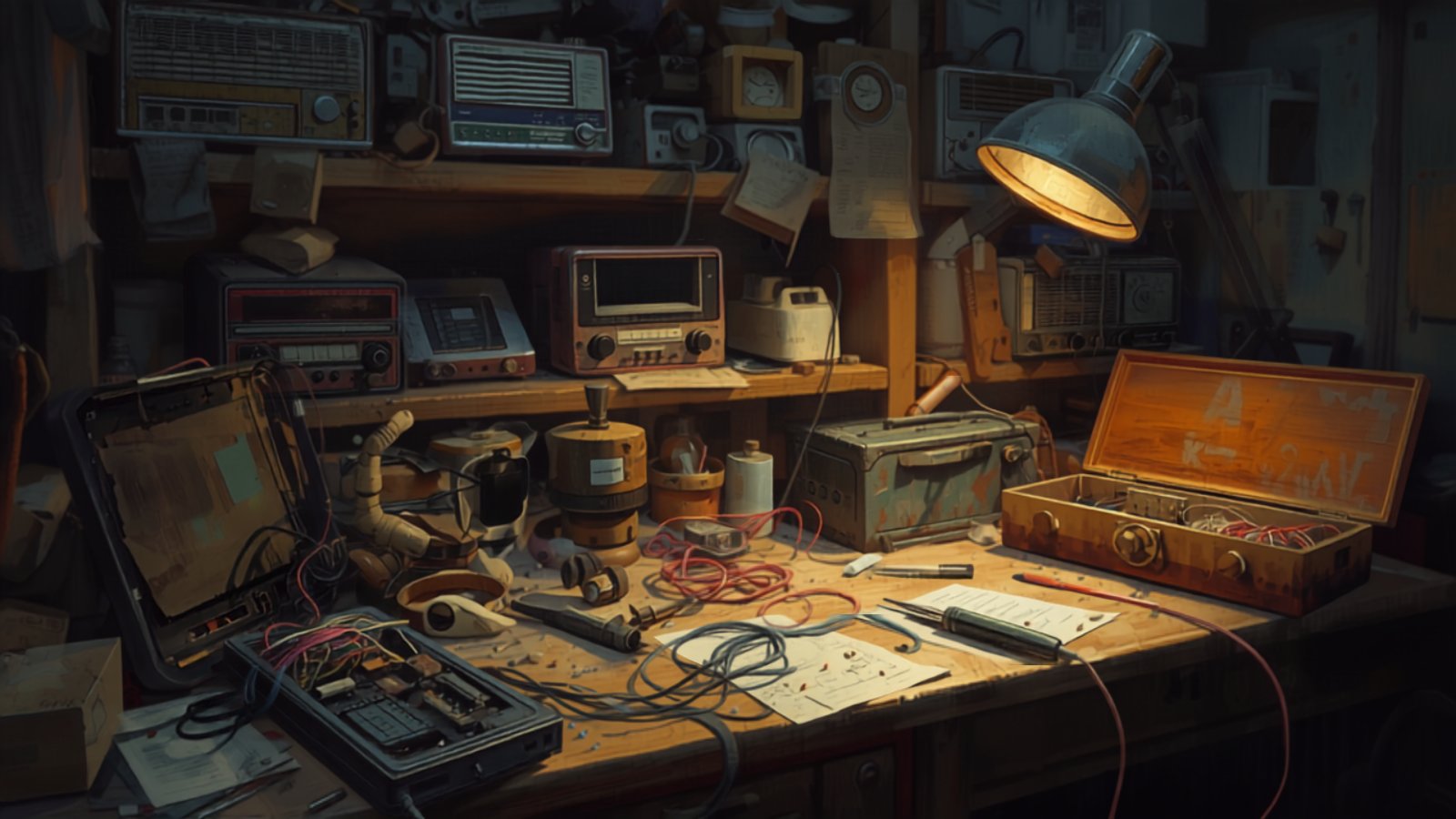
Amira Haddad had worked at Petrov’s Repairs for six years, and in all that time she had never once been late. The shop stood in the middle of Miller Street, between a bakery and a shop that sold cheap shoes. It was small and a little dark, and it smelled of dust and hot metal, but Amira loved it. She could fix almost anything that people brought through the door — phones with broken screens, laptops that would not start, old radios that families had kept for fifty years.
Her salary was not big. On the last Friday of every month, Mr Petrov opened the till, counted out her money carefully, and said the same words: “Thank you, Amira. This shop would fall down without you.” A salary is the money you receive for your job, and Amira knew exactly what she did with hers. Some of it paid the rent for her small flat. Some of it paid for food and bus tickets. And every month, without fail, she carried part of it to the bank and added it to her savings.
Those savings were her secret plan. For six years she had saved something every single month, even in the months when it was hard. She had written the number in a little blue notebook, and she had watched it grow slowly, like a plant. One day — she did not know when — she wanted to open a repair shop of her own. If she had her own shop, she would paint the door yellow. She would put a long table in the window so that people could watch her work. She had imagined it a thousand times.
Mr Petrov, who owned the shop, was sixty-one years old. He was a kind man with grey hair and glasses that were always dirty. He was wonderful with customers and terrible with paper. Receipts, bills, letters from the bank — he pushed them all into an old shoebox under the counter and promised himself that he would sort them out “next week”. Next week had not come for about ten years.
The till itself was older than Amira. It was a heavy metal box with a drawer that rang a little bell when it opened. There was no computer, no card machine. Customers paid in cash, Mr Petrov wrote a receipt by hand, and the money went into the drawer. It was old-fashioned, but it had always worked — because everyone at Petrov’s Repairs trusted each other.
People on Miller Street knew what Amira could do. One morning, a woman had come in almost crying, holding a phone that had fallen into the bath. On it were the only photos of her mother, who had died in the spring. Two other shops had already told her the phone was finished. Amira worked on it for three evenings, and on Thursday the woman turned it on and saw her mother’s face again. She tried to pay double. Amira refused. “You paid for a repair,” she said. “The rest is free.” That was the kind of shop it was — and that was exactly why the thought of losing it would hurt so much.
There was one more person in the shop. On Saturdays, Mr Petrov’s nephew Marco came to help. Marco was nineteen, tall and quiet, and he was studying computers at college. He cleaned the shelves, carried boxes, and served customers when the shop was busy. Amira liked him. He always asked her questions about her work, and he remembered the answers.
2 · Bad news
One grey morning in October, Amira arrived at eight o’clock, as always, and found Mr Petrov sitting behind the counter with a letter in his hand. He did not say good morning. He just looked at her over his dirty glasses and said, “The rent is going up again. That’s the third time in four years.”
Amira put down her bag. “How bad is it?”
“Bad.” He dropped the letter into the shoebox with all the others. “Electricity has gone up. Parts have gone up. Everything has gone up except the prices on my wall. Amira, I have to tell you something, and I don’t want to say it.” He took off his glasses and cleaned them on his shirt, which made them dirtier. “I have thought about selling the shop.”
The words hit Amira like cold water. She had worked in this room since she was twenty years old. She knew every screwdriver, every drawer, every mark on the wooden counter. “Selling it? To who?”
“There’s a company that buys small shops and turns them into coffee places. They have offered me money — not a lot, but enough to stop worrying.” He shook his head slowly. “I haven’t decided anything. But the numbers are not good. Every month I put money in the till, and every month there seems to be less than I expect. I’m getting old, Amira. Maybe I have made mistakes.”
Amira looked at the shoebox, which was so full that the lid would not close. Mr Petrov had never learned bookkeeping. He had never wanted to. But she was good with numbers — she had always been good with numbers — and an idea was forming in her head.
“Let me check the money,” she said. “Give me the receipts, and I’ll compare them with the till at the end of every day. If the shop is really losing money, we’ll see where it goes. And if it isn’t — then you can stop worrying and tell that coffee company no.”
For the first time that morning, Mr Petrov smiled. “You see?” he said. “This shop would fall down without you.”
3 · The empty till
That week, Amira started a new evening job that nobody paid her for. Every day at six o’clock, after the door was locked, she took out the receipts and added up the numbers. Then she counted the money in the till. If the receipts said the shop had taken three hundred euros, there should be three hundred euros in the drawer. Simple.
Monday matched. Tuesday matched. Wednesday, Thursday, Friday — every evening the numbers agreed, down to the last coin. Amira began to relax. Perhaps Mr Petrov had simply been careless with the shoebox. Perhaps nothing was wrong at all.
Then came Saturday.
On Saturday evening, the receipts said five hundred and forty euros. Amira counted the money in the till twice, then a third time, then a fourth. Four hundred and eighty euros. Sixty euros were missing.
She sat very still. A mistake, she told herself. Maybe a customer had paid less than the receipt said. Maybe a receipt was wrong. There were a hundred innocent reasons. She wrote the numbers in her blue notebook and said nothing to anyone.
The next week, Monday to Friday matched perfectly again. And on Saturday evening, when she counted the till, sixty euros were missing again.
Now it was not a mistake. Money does not walk out of a locked drawer two Saturdays in a row. Somebody was taking it. And only three people ever stood behind that counter: Mr Petrov, who owned every euro in the drawer anyway; Marco, who came on Saturdays; and Amira herself.
She did not sleep well that night. On Monday morning, she showed Mr Petrov the notebook. She kept her voice calm and pointed at the two Saturdays. “The money only disappears on Saturdays,” she said. “Every other day is perfect.”
Mr Petrov looked at the page for a long time. He did not say Marco’s name. Neither did Amira. But the name stood in the air between them, as clear as if someone had shouted it.
4 · The question that hurt
Something changed in the shop after that morning. Mr Petrov became quiet. He watched the till out of the corner of his eye. He counted the drawer at lunchtime, which he had never done in his life. And on Wednesday, while Amira was repairing a phone, he cleared his throat and asked the question that she would remember for a long time.
“Amira,” he said slowly, “is there something you want to tell me? Anything at all? If a person needed money — for rent, for family — I would understand. I would only want them to say it.”
Amira put down her screwdriver. Her hands had started to shake, so she pressed them flat on the counter. He was not asking a general question. He was accusing her — softly, politely, in his kind old voice, but accusing her all the same. To accuse somebody means to say they have done something wrong, and it hurts most when the person doing it is someone you respect.
“I have worked here for six years,” she said quietly. “I have opened the shop, I have closed the shop, I have counted this till a thousand times. Have you ever, in all that time, found even one euro missing because of me?”
Mr Petrov looked ashamed. “No,” he said. “Never. I’m sorry. It’s just — Marco is my sister’s boy. I’ve known him since he was born. It cannot be him, so my head keeps looking for another answer.”
Amira went home angry that evening, and under the anger there was something worse: sadness. She made tea and sat by the window and had a long conversation with herself. If Mr Petrov really believed she was a thief, why would she stay? She could take her savings, leave, and start again somewhere else. Nobody could stop her.
But if she left now, she would leave as “the one who probably took the money”. Six honest years would end with a question mark over her name. No. She would not let that happen. An honest person has one thing that money cannot buy — a clean name — and Amira decided that night to protect hers.
She would find the truth herself. And she knew, even then, that the truth might be something she did not want to find. If it was Marco, the news would break Mr Petrov’s heart twice — once because of the money, and once because of the boy. But a repair always starts the same way, whether it is a phone or a family: you open it up, you look inside, and you do not lie to yourself about what you see.
5 · Saturday
Amira planned it like a repair job: carefully, step by step. First, the facts. She went through two months of receipts from the shoebox and matched them against her notebook. The pattern was perfect and terrible. Money had gone missing on six different Saturdays — never more than seventy euros, never less than forty. On days when Marco did not come, nothing ever disappeared.
She did not want it to be true. She remembered Marco asking her how to test a battery, writing the answer in his phone, thanking her twice. Quiet, polite Marco. But facts are facts, and these facts all pointed the same way.
The next Saturday, Amira finished at four o’clock, as usual, said goodbye, and walked out of the shop. She walked exactly as far as the bakery next door. Then she stopped, waited ten minutes, and walked back. Through the window, between the phones on their shelves, she could see the counter clearly.
Mr Petrov was in the back room — she could hear his radio. Marco stood alone at the till. Amira watched him serve a customer, take the money, and give change. The customer left. The shop was empty. And then Marco did something that broke her heart a little: he opened the drawer again, took out three notes, folded them fast, and pushed them deep into his jacket pocket. His face, the whole time, looked like the face of someone in pain.
Amira opened the door. The little bell rang, and Marco went white.
“I forgot my scarf,” she said calmly. She picked it up from the chair where she had carefully left it. Then she looked at him. “Walk with me to the bus stop, Marco. We need to talk — just you and me.”
6 · Marco’s story
They did not go to the bus stop. They sat on a bench at the end of Miller Street, and for a minute Marco said nothing at all. Then he took the folded notes out of his pocket and held them out to her, and everything came out of him in a rush, like water from a broken pipe.
“It started in the summer,” he said. “My laptop died — completely dead, you couldn’t fix it, nobody could. I can’t study computers without a computer. And I couldn’t ask my mum, because she’s already working two jobs, and I couldn’t ask Uncle Petrov, because everyone knows the shop is in trouble.”
“So you borrowed money,” Amira said.
“There’s a man near the college. Everybody knows him. He lends money to students — no bank, no papers, no questions. I borrowed four hundred euros for the laptop. He said I could pay it back a little every week. He didn’t talk much about the interest.” Marco laughed, but it was not a real laugh. “The interest is the whole trick, Amira. Every week that you don’t finish paying, the loan grows. I have already paid him more than three hundred euros, and yesterday he told me I still owe four hundred and fifty. It never gets smaller. It’s like trying to empty the sea with a cup.”
“And your Saturday money wasn’t enough.”
“My Saturday money is fifty euros.” He looked at his shoes. “He wants seventy a week now. So I took the difference from the till. I wrote it all down — look.” He showed her a note in his phone: every date, every amount, down to the euro. “I was always going to pay it back. I know how that sounds. Everybody who takes money probably says that. But I hated it. Every Saturday I felt sick.”
Amira was quiet for a moment. She thought about her blue notebook, about six years of small numbers growing slowly. She understood money. She understood what it was to want something and not be able to afford it.
“Marco, listen to me,” she said at last. “You have made two mistakes, and they are not the same size. Borrowing from that man was a small mistake — a young person’s mistake. Taking from the till and hiding it, that’s the big one. A loan you can finish. A lie only grows — faster than any interest.” She stood up. “Tomorrow is Sunday. We are going to see your uncle, and you are going to tell him everything, exactly like you told me. Because right now, Marco, he thinks it’s me.”
Marco looked up, horrified. “You? He accused you?” He put his head in his hands. “Okay,” he said through his fingers. “Okay. Tomorrow.”
7 · Sunday at the kitchen table
Mr Petrov lived above the shop, in a flat full of old furniture and photographs. On Sunday afternoon, the three of them sat around his kitchen table, and Marco told his story again, from the dead laptop to the man near the college to the folded notes in his pocket. He did not cry until the end, when he said, “And Uncle — you blamed Amira. Because of me, you looked at the most honest person in that shop and you doubted her.”
For a long time, Mr Petrov said nothing. He looked older than Amira had ever seen him. Then he stood up, walked around the table, and put his hand on Amira’s shoulder. “I have known you for six years,” he said, “and I doubted you after six days of missing money. I am ashamed. I hope you can forgive a frightened old man.”
“I can,” said Amira. “But we’re not finished. There’s still a man near the college who thinks Marco is his little money machine.”
They made a plan at that kitchen table, and it was Amira’s plan, because plans were what she did best. Mr Petrov would pay off the whole loan on Monday — one visit, one payment, finished, so the interest could never grow again. It emptied his old leather wallet, but as he said, “I can afford one bad day. I cannot afford to lose this boy.” Marco would pay his uncle back every week from a proper Saturday salary, written down properly, with a receipt, signed by both of them. “Real money has paper,” Amira told him. “Remember that.”
Then Amira opened her bag and took out the shoebox, which she had quietly carried up the stairs. “And now the shop,” she said. “Because I have spent two months inside these papers, and I have found something you need to see.”
She laid the papers out in neat rows. “The shop is not dying, Mr Petrov. The paperwork is. Look — here are repair jobs that customers have never paid for, because you never sent them the bill. Here are three receipts you wrote and never added up. This shop has earned good money all year. It just hasn’t collected it.” She pushed her blue notebook across the table. “If we send these bills, take card payments, and keep real books, you can pay the new rent and say no to the coffee company.”
Mr Petrov looked at the neat rows of paper for a long time. Then he said something that Amira was not expecting at all.
“Partners,” he said. “I’m too old to learn books and card machines, and you were born for it. Buy half of Petrov’s Repairs with those famous savings of yours, and it’s Petrov and Haddad from Monday. Paint the door yellow if you want.”
Amira sat very still. Six years of small numbers in a blue notebook, and suddenly the dream had walked up to her and shaken her hand. “Yes,” she said, before her careful head could argue with her happy heart. “Yes. Partners.”
Mr Petrov smiled, and then his face turned serious again. He reached under the table and lifted an old brown envelope that had been taped, for years, to the bottom of the till drawer. “In that case, partner,” he said slowly, “there is one thing about this shop that I have never shown anybody. Not my sister. Not Marco. Nobody.” He put the envelope on the table between them. “You should open it before you sign anything.”
The end — for now
What is inside the envelope? That is another story.
Check your understanding
Read each question. Think about your answer. Then click “Show answer” to check.
Words to remember
Here are the ten key words again, in new sentences. Try to make one more sentence of your own for each word.
- salary — Her new job is harder, but the salary is much better.
- savings — We used our savings to buy the car, so we didn’t need a loan.
- till — At the end of the day, the manager counts the money in the till.
- receipt — Keep the receipt — you’ll need it if you want to return the shoes.
- loan — They took out a loan from the bank to start their business.
- borrow — Can I borrow twenty euros? I’ll pay you back on Friday.
- interest — The interest on that credit card is very high, so pay it off quickly.
- accuse — Don’t accuse anyone before you know all the facts.
- honest — She gave the wallet back to the police — she’s a very honest person.
- afford — I’d love a bigger flat, but I can’t afford the rent.
Grammar in this story: the present perfect
This story uses the present perfect (have/has + past participle) again and again — especially when a past action still matters now. Look at these lines from the story:
“Everything has gone up except the prices on my wall.” · “I have worked here for six years.” · “I have already paid him more than three hundred euros.” · “I have known you for six years, and I doubted you after six days.”
Notice the pattern: we often use the present perfect with for (for six years), already, and never (I have never shown anybody). The action started in the past, but its result is important right now — that is the heart of this tense.
👉 Learn the full rule here: Understanding the Present Perfect Tense.
Talk about it · Write about it
Talk about it: Marco borrowed money from a dangerous lender because he was too embarrassed to ask his family. Was that understandable, or simply wrong? What would you have done in his place? And do you think Mr Petrov was right to forgive him so quickly?
Write about it: Write a short paragraph (6–8 sentences) about something you have saved money for — or something you are saving for now. How long have you saved? What have you given up to do it? Try to use the present perfect at least three times.
🎉 Well done — you have just read a complete story of over 3,000 words in English. A year ago, could you have done that? Probably not. That is real progress, and you earned it one paragraph at a time.
But one question is still open: what has Mr Petrov been hiding under the till all these years? What is in the brown envelope — and will Amira still want to sign after she opens it? Write your own ending, using details from the story to explain your choice.
Maya and Tom share a dream. Read about the two names on the door and explain how a secret affects their friendship. Next story: Two Names on the Door (B1 Reading Story)
About this story: This is an original B1 graded reader (~3,100 words). The vocabulary is controlled for intermediate learners, and the grammar focuses on past narrative with the present perfect, relative clauses, and conditionals. Any harder word is explained before the story and used again inside it, so you should understand about 98% of the words you read.

I’m Khamis Maiouf. I’m studying Health and Social Care and have completed Functional Skills Level 2 in English and Level 3 Hairdressing. I have taught ESOL in my community and helped students with GCSE English. I run English Teacher Site to help people learn and practise English.