
Degrees of Adjectives: Comparatives and Superlatives Explained in Simple Terms

Quick Answer
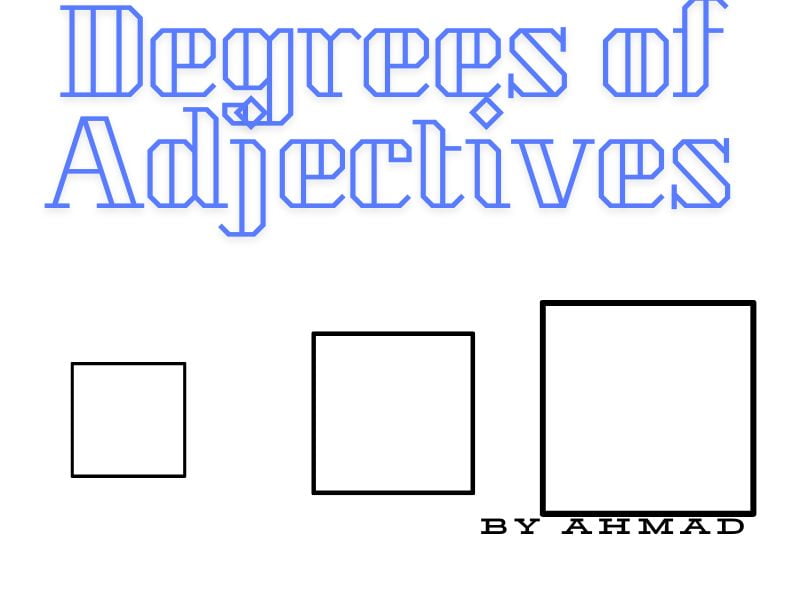
Adjectives have three forms: the base form (tall), the comparative form (taller), and the superlative form (tallest). Use the comparative to compare two things. Use the superlative to compare three or more things.
Tall, Taller, Tallest — See the Pattern
Look at these sentences. The key words are in blue:
- This building is tall. (just describing one thing)
- This building is taller than that building. (comparing two things)
- This building is the tallest building in the city. (comparing three or more things)
Did you see the pattern? The word tall changes depending on how many things you compare. We add -er for two things and -est for three or more.
Here is how it works with more adjectives:
| Base Form | Comparative (-er) | Superlative (-est) |
|---|---|---|
| fast | faster | fastest |
| big | bigger | biggest |
| happy | happier | happiest |
| hot | hotter | hottest |
| smart | smarter | smartest |
How to Make Comparatives and Superlatives
The rule depends on how long the adjective is. Here are the three groups:
1. Short adjectives (one syllable — like tall, big, fast):
- Add -er to compare two things: tall → taller
- Add -est to compare three or more: tall → tallest
- If the adjective ends in one vowel + one consonant, double the last letter: big → bigger, hot → hotter
2. Adjectives ending in -y (like happy, easy, funny):
- Change the y to i, then add -er or -est: happy → happier → happiest
3. Long adjectives (two or more syllables — like beautiful, interesting, important):
- Put more before the adjective to compare two things: more beautiful
- Put most before the adjective to compare three or more: most beautiful
4. Irregular adjectives (these do not follow the rules — you just need to remember them):
| Base Form | Comparative | Superlative |
|---|---|---|
| good | better | best |
| bad | worse | worst |
| far | farther | farthest |
| little | less | least |
| much / many | more | most |
Easy way to remember: Count the syllables. One syllable? Add -er/-est. Two or more syllables? Use more/most. Ends in -y? Change y to i first. And the five irregular ones (good, bad, far, little, much) — just learn them by heart.
The Rule in One Line: Short adjectives add -er/-est. Long adjectives use more/most. Five irregular ones — just memorise them.
How to Use Comparatives and Superlatives in Everyday English
Here are sentences you might hear or use every day:
- My coffee is hotter than yours. (comparing two coffees — short adjective, add -er)
- This is the best pizza I have ever eaten. (comparing all pizzas — irregular: good → best)
- Learning English is more interesting than I thought. (long adjective — use more)
- She is the funniest person in our class. (ends in -y — change y to i, add -est)
- Today is worse than yesterday. (irregular: bad → worse)
You are doing great. Now let’s look at the mistakes many learners make.
Three Mistakes to Avoid With Comparatives and Superlatives
Even advanced learners mix up comparatives and superlatives sometimes — so if you get confused, you are not alone. Even native speakers make these mistakes in everyday speech.
Mistake 1: Using “more” AND “-er” together (double comparative)
✗ She is more taller than her sister.
✓ She is taller than her sister.
Mistake 2: Adding -er/-est to long adjectives
✗ This painting is beautifuler than that one.
✓ This painting is more beautiful than that one.
Mistake 3: Forgetting irregular forms
✗ This is the goodest day of my life.
✓ This is the best day of my life.
How to remember: Pick ONE method only — either add -er/-est OR use more/most. Never both at the same time. And for good, bad, far, little, and much — the forms are completely different, so learn them as special words.
Test Yourself: Comparative or Superlative?
Choose an answer to see your feedback immediately. Your first answer counts towards your score.
1. My house is _______ than yours.
2. She is the _______ student in our class.
3. This movie is _______ than the last one.
4. He is the _______ swimmer on the team.
5. Today is _______ than yesterday.
Keep Going — You Are Building Something
You just learned how to make comparatives and superlatives. That is one more grammar skill you will never get wrong again.
Use the examples above to practise this pattern. When you are ready, choose your next topic below.
Choose Your Next Topic
This path ends here. Choose another B2 lesson from the collection when you are ready for a new topic.
Related Lesson for Review: What Are Verb Tenses? Understanding Past, Present, and Future
Source

I’m Khamis Maiouf. I’m studying Health and Social Care and have completed Functional Skills Level 2 in English and Level 3 Hairdressing. I have taught ESOL in my community and helped students with GCSE English. I run English Teacher Site to help people learn and practise English.