
The Last Wash at Fontaine’s (C1 Reading Story)

C1 · ADVANCED Reading practice · ~3,300 words · 17-min read
This is an original story for advanced learners. The language is rich but controlled: any word you are unlikely to know is explained before you begin, and then used again inside the story so that it sticks. Read the ten key words first, then settle in — and at the end, test yourself with the comprehension questions.
Before you read — 10 key words
- launderette — a shop with coin-operated washing machines where people wash their clothes.
- lease — the legal contract that lets you rent a building for a fixed period.
- threadbare — (of cloth) worn so thin from use that you can almost see through it.
- gentrification — the process by which wealthier people move into an area, changing it and pushing prices up.
- petition — a written request, signed by many people, asking those in power to do (or stop) something.
- mundane — ordinary and unexciting; part of everyday routine.
- eavesdrop — to listen secretly to a conversation you are not part of.
- resign yourself to — to accept something unpleasant because you cannot change it.
- makeshift — temporary and improvised; made from whatever is available.
- linger — to stay somewhere longer than necessary, as if unwilling to leave.
The story
1 · The machine gives up
The washing machine died on a Tuesday, which struck Mara as typical. Dramatic things — floods, break-ups, redundancies — were supposed to happen at weekends, when you at least had time to fall apart properly. Instead, her machine chose ten past eight on a Tuesday morning, mid-cycle, with a sound like a spoon caught in a blender, and then a silence so complete that she knew, without opening the door, that it was over.
She was thirty-four, she worked from home as a marketing consultant, and she had lived on Verity Street for eight months without learning a single neighbour’s name. This was not something she was proud of, exactly, but nor had it cost her any sleep. Her life ran on quiet, efficient systems — groceries delivered, meetings online, friendships maintained through a group chat that had not produced an actual meeting in over a year. The machine had been part of the system. Now the system had a hole in it, and a drum full of wet towels.
The repair company offered her an appointment in eleven days. The retailer offered her a replacement in nine, “subject to availability”. Which is how, having resigned herself to the situation, Mara found herself standing outside the one place on the street she had never once entered: Fontaine’s Launderette.
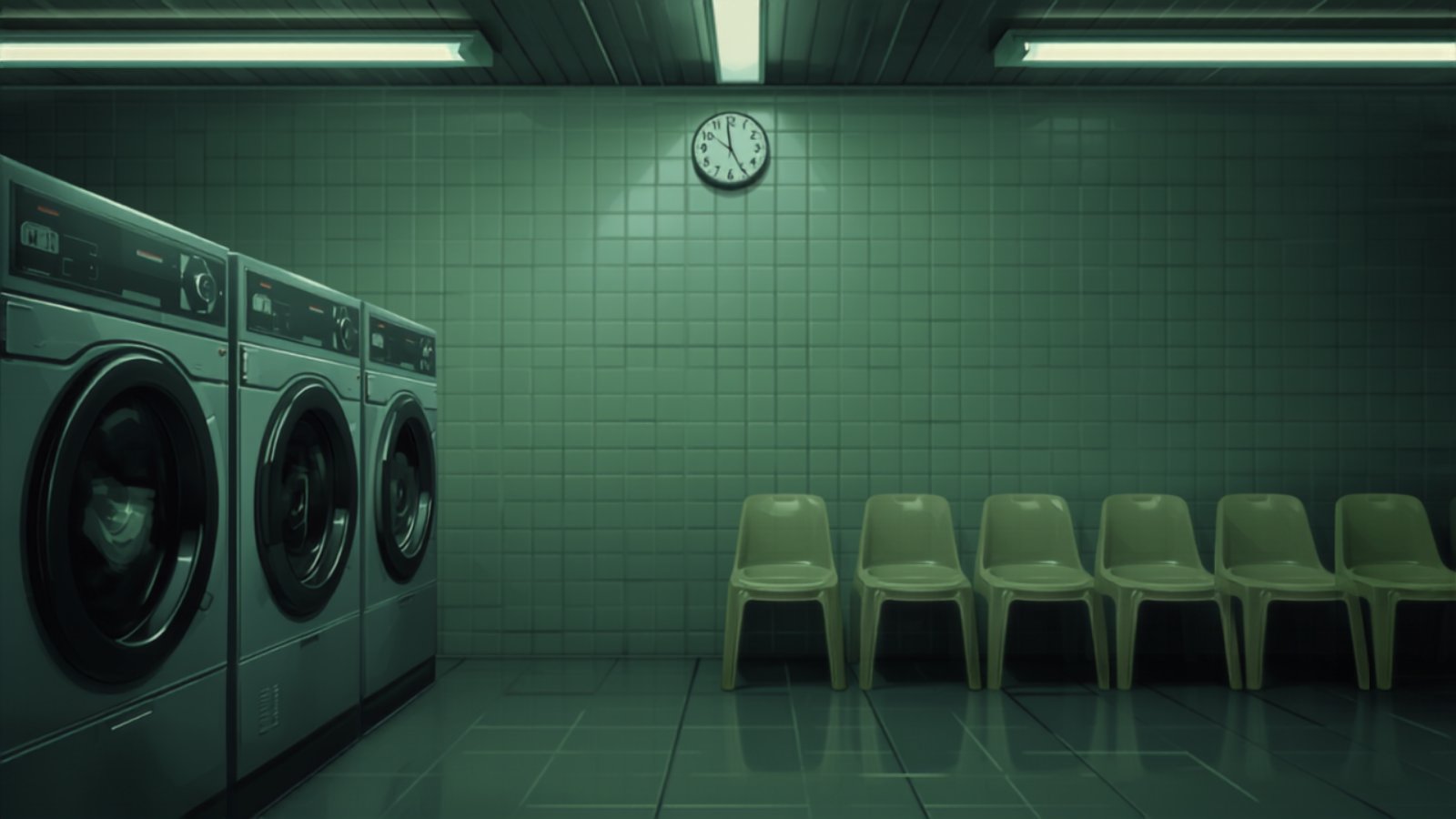
She had walked past it perhaps two hundred times. It sat between a shuttered betting shop and a bakery that had recently started charging four pounds for a croissant, and it looked like a photograph from another decade: steamed-up windows, a hand-painted sign, a row of orange plastic chairs bolted to the floor. Pushing the door open, she was met by warmth, the smell of soap, and a low, steady hum of machines that seemed to come from the building itself rather than from anything in it.
“Machine broken?” said a voice.
The woman behind the counter was somewhere in her seventies, small and upright, with silver hair pinned back and an accent that carried a faint trace of French. She did not say it unkindly. She said it the way a doctor says flu season — as a diagnosis so common it barely needed confirming.
“How did you know?”
“Nobody under forty comes in here for pleasure,” the woman said. “Machines four and six are free. Powder is included, whatever the sign says — the sign is older than you. I am Odile.”
She hesitated in the doorway, doing the maths of embarrassment. She had not used a launderette since university, and some part of her — the part that optimised things for a living — regarded the whole institution as a system failure, a place you ended up when your real arrangements collapsed. Which, she conceded, was precisely what had happened. Odile watched this internal negotiation with the patience of a woman who had seen it several thousand times, then pointed, wordlessly, at machine four.
Mara loaded machine four, sat on an orange chair, and prepared to be bored. The whole errand was so gloriously mundane — coins, powder, a forty-minute wait — that she almost laughed at it. She opened her laptop out of habit. Then, slowly, without quite deciding to, she closed it again and simply watched her towels — threadbare, she noticed now, in a way she had never noticed at home — turning over and over behind the glass, like something being gently persuaded to change its mind.
2 · Regulars
She went back the following Tuesday, although the new machine had already been delivered. She told herself it was because the launderette’s machines were bigger, which was true, and cheaper, which was not. The real reason was harder to name.
Fontaine’s, she discovered, ran on an invisible timetable. Between seven and nine came the night workers, dropping off scrubs and uniforms on their way home to sleep. Grace, a nurse with fourteen years on the same ward, occupied the chair nearest the radiator as if it had been issued to her along with her badge. Mid-morning belonged to Mr Bennett, a retired history teacher who did the crossword aloud, inviting the whole room to fail with him. And after school there was Tomasz, sixteen, who had built himself a small business ironing shirts for the men in the new flats — five shirts, five pounds, folded with a precision that bordered on the architectural.
Presiding over it all was Odile, who had run the launderette for thirty-one years and who enforced exactly three rules, handwritten on a card by the till: No dye. No shoes in the dryers. No leaving your washing overnight and telling me it was an emergency.
It took Mara three visits to understand what the place actually was. It was not, or not mainly, a room for washing clothes. It was the last room in the neighbourhood where people had a legitimate excuse to sit beside strangers for forty minutes with nothing to do. Conversations started because they had nowhere else to go. Grace knew about Mr Bennett’s hip operation before his own son did. Odile held spare keys for half the street in a biscuit tin under the counter. A noticeboard by the door offered guitar lessons, a lost cat, a room to rent, and — pinned at a diplomatic height — a card reading If you are struggling, ask Odile about the Tuesday wash. No questions.
She saw the Tuesday wash in action only once, and nearly missed it. A man came in just before closing — young, exhausted, carrying his whole life in two bags — and murmured something to Odile at the counter. Odile did not change her expression. She simply took his washing, waved away the coins he was counting out, wrote a collection time on a scrap of paper, and asked him whether he preferred tea or coffee, as if this were the only question of any importance. No announcement, no ceremony, no lesson for the room. Mara pretended to read her book and understood that she was witnessing a welfare system with a staff of one.
Mara, who eavesdropped for a living — “audience research”, her invoices called it — found herself doing it here helplessly, and then, week by week, doing something she had not done in years: joining in. She learned that Grace’s daughter was applying to study engineering. She learned that Mr Bennett had proposed to his late wife in a launderette in 1974, “because the cinema was flooded and I panicked”. She learned to fold sheets in a two-person team, an operation involving more eye contact than most of her video calls.
She noticed, too, that people lingered. Long after the dryers had finished, they stayed — folding more slowly than necessary, starting one more story, letting the warmth hold them a little longer. She had begun to linger herself. Her towels had never been so clean. That was, she was fairly sure, beside the point.
3 · The notice
The notice appeared on the first cold morning of October, taped inside the window at an apologetic angle. Printed on the letterhead of Halloran Property Group, it announced that the building had been acquired, that the ground-floor premises would close on the thirtieth of November, and that the site would be “reimagined as a boutique wellness studio serving the vibrant local community”.
Mr Bennett read it twice, put on his glasses, and read it a third time. “Reimagined,” he said at last. “We had a word for this when I was teaching. The word was demolished.”
The room absorbed the news the way rooms do — in fragments, over days. Grace pointed out, with a nurse’s practicality, that the nearest launderette was now two bus rides away, and that half the street’s machines, like half the street’s boilers, were held together with hope. Tomasz did the maths on his ironing business and went quiet. Somebody used the word gentrification, and somebody else said that was just a fancy name for what happened when a croissant hit four pounds, and Mr Bennett said they were both right, which satisfied no one.
Odile said almost nothing, which everyone assumed was dignity.
In truth, the street had been rehearsing this loss for years, one shopfront at a time. The ironmonger’s had become a shop selling nothing but candles. The old barber’s, where three generations of Bennetts had been given the same haircut, was now a studio offering “sound baths”, whatever those were. Each closure had followed the same script: the notice, the murmuring, the farewell cards in the window, and then, within months, a new business calibrated for people who were passing through the neighbourhood rather than living in it. The launderette had always seemed exempt — too useful, too ordinary, too obviously loved. It turned out that none of those things appeared anywhere on a balance sheet.
Mara surprised herself with how angry she was. It was not her street, she kept thinking — except that somewhere in the past year it had become exactly that. She had moved here, she could admit now, as a small unit of gentrification herself: the remote worker with the delivery subscriptions, the sort of resident the wellness studio was presumably being built for. The thought sat uncomfortably. She decided to do something with it.
“I run campaigns,” she told the Tuesday room. “For brands, usually. Products. But the mechanics are the same. If we want to fight this, we fight it properly — a petition, press, the council. Closure needs planning permission for change of use. Objections slow things down. Sometimes they stop them.”
It was the longest speech ever given in Fontaine’s, and it was received in silence. Then Grace stood up, wiped her hands on her uniform, and said, “Where do I sign?”
4 · The petition
For three weeks, Mara ran the campaign the way she ran everything: thoroughly. The petition lived on the counter beside the biscuit tin and online beside a photograph of the steamed-up window that made the launderette look, Tomasz said, “like a place in a film where nothing bad is allowed to happen”. Eight hundred and forty signatures in the first fortnight. A piece in the local paper. A councillor who came, was photographed holding a folded sheet, and promised to “raise questions”.
The canvassing was Tomasz’s idea, and it was Tomasz who turned out to be a natural. They went door to door on the estate two evenings a week, Mara with the clipboard, Tomasz with the argument. He never mentioned community, or heritage, or any of the words from Mara’s carefully tested messaging. He simply asked people what they would do when their machine broke, let the silence do its work, and then held out the pen. “You sell the problem, not the dream,” he told her on the walk home, with the weary authority of a sixteen-year-old who had ironed shirts for half the street. Mara, who charged companies a day rate for exactly that insight, decided not to mention it.
Having spent her career measuring engagement, Mara knew genuine momentum when she saw it, and this was genuine. What the campaign did not have, she gradually realised, was Odile.
Odile signed the petition, of course. She thanked the signers, fed the journalists coffee, said we shall see a great many times. But she would not be interviewed, would not be photographed, and steered every conversation about the future gently back towards powder and change for the dryers. It was Mara’s job to read audiences, and this audience was hiding something.
She found out by accident, eavesdropping one evening without meaning to — the shop empty, Odile on the phone in the back room, her voice low and tired and in French. Mara’s French was hotel-grade at best, but she caught ma sœur, and Lyon, and janvier — January — and one sentence, delivered with a sigh, that she understood completely because Odile said it half in English: “The lease, chérie, is already finished. I signed the surrender in August.”
August. Before the notice. Before the petition. Before eight hundred and forty people had signed their names to save a shop whose owner had already agreed to let it go.
Mara waited until closing time, then asked, as neutrally as she could manage, whether there was anything Odile wanted to tell her.
Odile looked at her for a long moment, then locked the door, turned the sign, and made two cups of coffee.
“I am seventy-four,” she said. “My knees are older. My sister in Lyon is unwell, and she is also my favourite person alive. Halloran offered money for the last years of my lease — good money, since you are wondering — and I took it, and then I watched you all fight for me, and I did not know how to say stop.” She turned her cup slowly. “I had resigned myself to leaving quietly, you understand. Thirty-one years I have kept this room warm. I am allowed to be tired. But I did not want the street to think I sold them. So I said nothing, and the nothing got bigger every week.”
Mara sat with this. The campaigner in her saw the headline collapsing: there was no villain now, or rather the villain and the victim had turned out to be standing in the same cardigan. Had she known in October what she knew now, she would never have started the petition at all.
“Everyone will understand,” she said finally. “You’re not the story we told, but you’re a better one. The question is what we do with eight hundred and forty people who’ve just discovered they care about the same thing.”
Odile raised an eyebrow. “You have an idea. I can hear it.”
“Half of one,” said Mara. “I need Grace and Mr Bennett for the other half.”
5 · What a launderette is for
The idea, once assembled around the folding table, was this: they had all been fighting to save the wrong thing. The machines were replaceable. The lease was lost. What was worth saving was the function — the last room where the street sat together — and a function, unlike a shop, could move.
St Saviour’s church hall stood two streets away, underused since the playgroup had folded, with a kitchen, a water supply, and a vicar who agreed before Mara had finished her second sentence. Halloran Property Group was a harder audience. Their representative, a polite man named Douglas who apologised for the building works before they had begun, met Mara in the empty betting shop next door, and for twenty minutes they conducted the conversation entirely in each other’s professional languages. She wore her most corporate blazer and said “community goodwill” eleven times; he said “not in a position to commit at this stage” four times, which in his dialect meant keep talking. What settled it, in the end, was not the blazer but the local paper. Mara laid that morning’s edition on the table — the photograph of the steamed-up window, the headline asking whether the street needed another wellness studio — and observed, pleasantly, that stories like this one tended to have second chapters. Douglas looked at the paper for a while. Then Halloran agreed to donate four of the launderette’s machines and a modest sum the press release would call an investment in local wellbeing. Grace organised a rota of volunteers with the calm ruthlessness of someone who had run a hospital ward through three winters. Mr Bennett appointed himself “director of conversation”, a role nobody dared define. Tomasz negotiated a corner for his ironing board and, after a pause, a Saturday assistant’s job to go with it.
They would call it the Tuesday Room. Open two evenings a week to start with: washing at cost, coffee free, the biscuit-tin key service transferring intact. The card from the noticeboard would be pinned by the new door, at the same diplomatic height: If you are struggling, ask about the Tuesday wash. No questions.
It would be, Mara admitted, a makeshift thing — folding tables, donated chairs, a hall that smelled faintly of nativity plays. But she had come to suspect that makeshift was not the opposite of permanent. Fontaine’s itself had been improvised into existence in 1995 by a young Frenchwoman with a bank loan and no plan. The mundane, repeated faithfully enough, becomes an institution. Nobody had designed the launderette’s community; it had simply been given a warm room and forty-minute waits, and it had grown, the way anything grows when it is watered every week.
When they told the street the whole truth — Odile’s surrender, the money, Lyon, all of it — the reaction was not the one Odile had dreaded. Embarrassingly, people mostly wanted to talk about her sister’s health. The petition, having failed at its official purpose, had quietly achieved a different one: eight hundred and forty people now knew what they had nearly lost, which is the only reliable way human beings ever learn the value of anything.
6 · The last wash
The last night of November, Fontaine’s held its final wash, and the street treated it as the party it refused to call a funeral. Every machine ran full. Grace brought the entire night shift, still in their coats. Mr Bennett gave a speech from a plastic chair, proposing a toast “to the only classroom that ever taught this street anything”. Tomasz ironed, free of charge, the shirt of every man who had ever underpaid him, which he announced was not generosity but a lesson. Somebody had strung fairy lights along the dryers, and the steamed-up window glowed orange into the dark street like a lantern.
On the wall where the noticeboard had hung, Grace had pinned a makeshift gallery: photographs the street had brought in, spanning thirty-one years of the same small room. Odile in 1995, absurdly young, standing beside brand-new machines with her arms folded like a woman daring the future to argue. A children’s birthday party from 2003, held between the dryers because it was raining and the flat was too small. A christening photo. Someone’s graduation. The great flood of 2011, everyone laughing, ankle-deep. Nobody could remember the launderette being photographed on purpose; it had simply appeared in the background of the street’s life, decade after decade, the way true landmarks do — not because people looked at it, but because they stood in front of it while looking at each other.
Mara stayed to the end, folding the final load — Grace’s towels, threadbare and heroic — in a two-person team with Odile, the sheets snapping between them in the emptying room. People lingered, naturally. Nobody wanted to be the one whose leaving turned the lights off. It was nearly midnight when Odile locked the machines for the last time, took a worn envelope from under the till, and pressed it into Mara’s hands.
“For the Tuesday Room,” she said. “But you do not open it until the machines are running in the church hall. That is my condition. I want to be in Lyon when you find out what it is, so that you cannot argue with me.”
The envelope was light. Too light for money, Mara thought — and then, feeling a small, hard shape slide to one corner, not money at all. A key. But Fontaine’s had already surrendered its keys, every one of them, biscuit tin and all. So it was a key to somewhere else.
“Odile,” she said slowly, “what does this open?”
Odile buttoned her coat, smiled the smile of a woman who had kept a street’s secrets for thirty-one years, and turned the sign on the door from OPEN to CLOSED.
“Tuesday,” she said. “Everything important happens on a Tuesday.”
Check your understanding
Read each question. Think about your answer. Then click “Show answer” to check.
Words to remember
Here are the ten key words again, in fresh sentences. Try writing one sentence of your own for each.
- launderette — When my machine flooded the kitchen, I spent two weeks carrying bags to the launderette.
- lease — Our lease runs out in March, and the landlord is refusing to renew it.
- threadbare — He refuses to throw away that threadbare old jumper; he says it has “character”.
- gentrification — Gentrification brought better cafés to the district — and rents that none of the original residents could afford.
- petition — Over two thousand people signed the petition against closing the library.
- mundane — She found unexpected peace in mundane tasks: peeling potatoes, hanging out washing, sweeping the step.
- eavesdrop — I didn’t mean to eavesdrop, but the walls in that office are paper-thin.
- resign yourself to — After the third cancelled train, we resigned ourselves to spending the night at the station.
- makeshift — The volunteers built a makeshift stage out of pallets and an old door.
- linger — The guests lingered over coffee long after the meal was finished, reluctant to end the evening.
Grammar in this story: participle clauses
This story leans on participle clauses — a favourite tool of native writers for packing two actions into one elegant sentence. Look at these lines from the story:
Pushing the door open, she was met by warmth… · Having spent her career measuring engagement, Mara knew genuine momentum when she saw it. · The petition, having failed at its official purpose, had quietly achieved a different one.
Instead of writing two full sentences (“She pushed the door open. She was met by warmth.”), the writer shortens the first one to an -ing clause. The perfect form (having spent, having failed) shows that one action was completed before the other. One warning: the subject of the participle clause must match the subject of the main clause — otherwise you create a “dangling” participle, one of the most common advanced-level mistakes.
👉 Master the full rule here: Participle Clauses in English: Shorten Sentences Like a Native Writer.
Talk about it · Write about it
Talk about it: Is there a “third place” in your neighbourhood — not home, not work — where people naturally meet? What would be lost if it closed? And is gentrification always a bad thing, or can a changing neighbourhood gain as well as lose? Argue both sides.
Write about it: Write 200–250 words: a local place you know is closing, and you are writing the text for the petition to save it. Persuade a stranger to sign. Use at least four of the key words from this story, and try to include two participle clauses.
🎉 Well done — that was a full-length C1 story, and you read it in English. Notice how the ten key words came back again and again? That repetition is how they move from “words I met once” to “words I own”.
But the envelope is still sealed. A key that opens no door anyone knows of, a condition nobody can argue with, and a woman on a train to Lyon smiling to herself. What has Odile done? You’ll find out when the machines start running in the church hall…
Thomas has spent his life repairing clocks. Follow the sixty-fourth square and notice how patience shapes the story. Next story: The Sixty-Fourth Square (C1 Reading Story)
About this story: This is an original C1 graded reader (~3,300 words), written with the Oxford Bookworms method: vocabulary controlled to an advanced headword ceiling, a full range of grammar including participle clauses and discourse markers, and every harder word glossed before the story and reused inside it — so you meet new language at “i+1”, just above your comfort zone, while still understanding about 98% of the running words.

I’m Khamis Maiouf. I’m studying Health and Social Care and have completed Functional Skills Level 2 in English and Level 3 Hairdressing. I have taught ESOL in my community and helped students with GCSE English. I run English Teacher Site to help people learn and practise English.