
The Cartographer of Missing Places: The Life of Inês Barroca (C1 Reading Story)

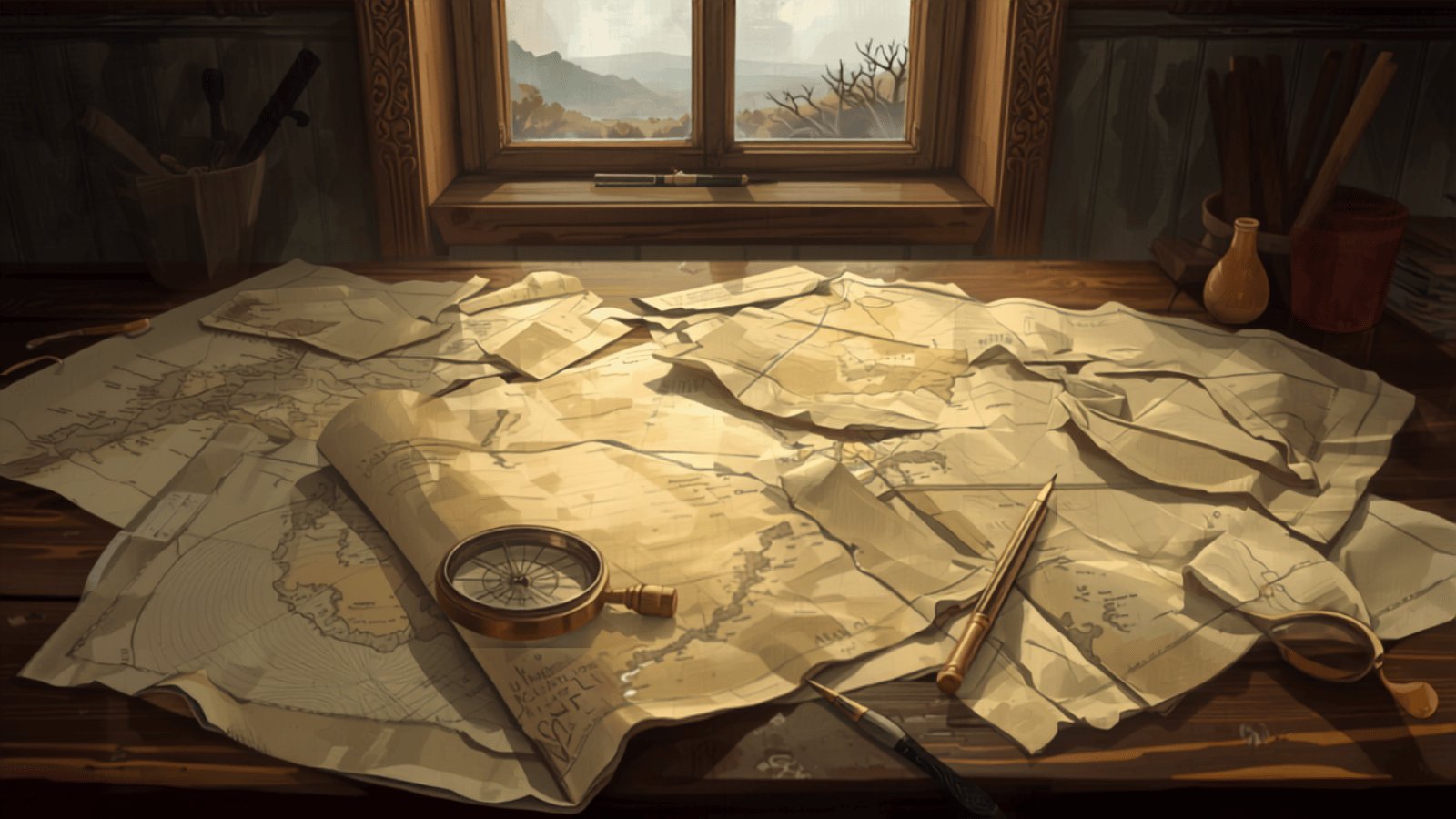
C1 · ADVANCED Reading practice · ~3,950 words · 26-min read
This is an original short biography for advanced learners. It tells the invented life of Inês Barroca, a Portuguese cartographer who devoted her career to hand-drawing the villages of her country in the years before they were flooded to make way for hydroelectric reservoirs. Read the ten key words before you begin, then take the story slowly — the sentences are long on purpose, and the tenses move backwards and forwards through a whole life. A short comprehension quiz follows at the end.
Before you read — 10 key words
- cartographer — a person whose profession is drawing or designing maps; the related noun is cartography, the whole discipline of mapmaking.
- contour — on a map, a line joining points of the same height above sea level; more broadly, the shape or outline of a landscape, a face, or an idea.
- bureaucracy — the system of offices, forms, and formal procedures used to run a government or large organisation. The word often carries a mild criticism of slowness.
- inundation — the act of covering an area with water, especially deliberately, as when a valley is flooded for a dam. The verb is to inundate.
- dispossessed — no longer in possession of something you once owned, especially land, a home, or a way of life you have been forced to give up.
- tenacity — a firm, patient refusal to give up; determination that outlasts opposition. Someone who is tenacious keeps working long after most people would stop.
- legacy — what a person leaves behind at the end of a life or a career: their lasting mark, contribution, or inheritance to those who follow.
- threshold — literally, the strip of stone or wood at the bottom of a doorway; figuratively, the point at which something new begins (“on the threshold of a discovery”).
- archive — a collection of historical records preserved for study; also the physical place where such records are kept and organised.
- reservoir — a large artificial lake, usually formed behind a dam, that stores water for drinking, irrigation, or electricity generation.
The story
1 · The child who read the land
Long before she ever held a compass, Inês Barroca could read the land. She had been born, on the coldest morning of January 1928, in a granite village called Fonte-Velha in the northern hills of Portugal — a place so small that its name did not appear on any of the printed maps her father occasionally brought home from Porto. This absence puzzled her. She would sit at the kitchen table with the maps unfolded, tracing the roads with a small, patient finger, and ask, with the stubbornness of a child who has not yet learned that questions can offend adults, why the mapmakers had left her village out.
“Because the mapmakers have never come here,” her mother would say. “Nobody has told them we exist.”
“Then somebody should tell them,” Inês replied. “I will do it, when I am older.”
Her mother, who was the village schoolteacher, laughed a little, though not unkindly. She had learned, over the years, to take her daughter’s declarations seriously.
Inês grew up in a two-room house at the edge of a long, quiet valley. Her father was a small farmer who kept goats and grew rye, and her mother taught the village children in a bare, whitewashed room furnished with a single long bench. There was no electricity in Fonte-Velha until Inês was twelve years old, and no proper road until she was sixteen. What the village did have was distance — long, careful distance in every direction — and a way of noticing things that only silence teaches. She learned to read the sky before she learned to read letters. She could tell, from the way the mist gathered above the pine, whether it would rain by evening.
She also learned early that land had memory. The old people spoke of terraces that had once grown vines but now stood empty; of a mill on the small river that had ground flour for six generations before being abandoned in a single week; of a chapel whose roof had fallen in when the priest went south and never returned. Nothing about the shape of the land was accidental. Every stone wall, every bent olive, every dry watercourse had been placed or worn by human hands over centuries. To know a place, Inês came to understand, was to know its history.
Her formal schooling ended, as most girls’ did in that part of Portugal, at fourteen. There was no secondary school for miles, and no money to send her away. Her mother, however, quietly and against the wishes of her father, went on teaching her at night — mathematics, Portuguese, a little rudimentary Latin, and geography from a battered atlas that had been left in the village by a Belgian priest during the war. It was in that atlas that Inês first understood what a map could be. It was not merely a picture of a place. It was a promise: I have seen this, and I have written it down so that others may know.
It was also, she noticed, a way of choosing what mattered. Every map was a decision. Somebody had decided that this town would be labelled and that one would not; that this road would appear and that goat path would not. The Belgian atlas did not show Fonte-Velha. It did not show the small stream where she had learned to swim, or the ruined chapel on the hill above the village, or the family whose farm had been swallowed by pines after the last son emigrated to Brazil. The map was silent about all of it.
In the winter of 1946, when she was eighteen, Inês packed a small suitcase and travelled by bus, and then by train, to Lisbon. She had written, in her careful schoolgirl handwriting, to the National Cartographic Office, asking whether they took female apprentices. They had replied politely that they did not, but that they occasionally accepted female clerks. Inês read the letter three times. Then she folded it into her pocket, told her mother she would come home a cartographer, and left. She was standing, though she could not yet have named it, on the threshold of a life that would take her longer to grow into than she had guessed.
2 · The apprentice in Lisbon
Lisbon in the late nineteen-forties was a city of contradictions. The trams rattled up its hills; the river, wide and calm, opened out to the Atlantic; and above it all, in offices smelling of ink and old paper, the vast bureaucracy of the Estado Novo went about its slow, careful work. It was into one of those offices — a long, dim room on the third floor of a stone building near the Praça do Comércio — that Inês Barroca walked, on her second morning in the capital, with her letter of introduction folded neatly in her hand.
The head of the drafting department was a man called Senhor Almeida. He had been drawing maps for the state since before Inês was born. He looked at the letter for a long time, without saying anything. Then he looked at Inês, in her grey country coat, and said, “You wish to be a clerk?”
“No,” she said. “I wish to be a cartographer.”
He smiled with only half his mouth. “That is not one of the roles we offer to young women.”
“Give me a small task,” Inês said, “and see how it comes back to you.”
Whatever it was that Senhor Almeida saw in her — the steadiness of her voice, perhaps, or the calm way she stood on the threshold of his office — was enough. He gave her a small task. She was to ink over a draft survey of a village in the north, a place she had never heard of, from the pencilled field notes of a surveyor who had done the fieldwork the previous summer. When she brought it back three days later, cleaner and more careful than any of the trainee draftsmen could have managed, he set aside his coffee cup and looked at her properly for the first time.
“You will start on Monday,” he said. “As a clerk. But if you continue as you have begun, we shall see.”
For the next eight years, Inês Barroca became one of the most quietly determined figures in the office. Officially, she was a filing clerk. Unofficially, she taught herself the work of a cartographer by watching, by asking, and by taking home the drafts that nobody else wanted to finish. She learned projection systems and contour drawing and the fine, slow art of hand lettering. She learned to read a survey sheet the way her mother had taught her to read a poem — slowly, and with an attentive eye for what had been left out.
She also learned the shape of the office itself. She saw who was tolerant and who was small-minded; who could be trusted with an honest question; who resented her presence and would try, quietly, to make her fail. She learned to answer criticism with better work rather than with words. It was not that she was without pride; it was that she had understood, early, that within an institution such as this, quiet tenacity was the only kind of pride that survived. Argument bounced off. Excellence, over years, was harder to ignore.
By 1956, she was signing her own draft sheets. By 1958, she was leading a small team of trainees. And in the autumn of 1961, when a memorandum arrived from the Ministry of Public Works announcing that a new hydroelectric commission had been formed and that cartographic staff would be seconded to survey the valleys that were about to be flooded, Senhor Almeida — now old, and less than a year from retirement — sent for her.
“They have asked for our best,” he said. He placed the memorandum on the desk between them. “I am sending you.”
Inês read the paper carefully. It described, in the flat and courteous language of state documents, a project that would eventually dam three rivers and flood forty-one villages. The list of villages was attached on the second sheet. She ran her eye down it and stopped near the bottom.
Fonte-Velha was on the list.
She looked up at Senhor Almeida. He knew what she had seen. He had checked it before summoning her.
“They will drown my village,” she said.
“Yes.”
“When?”
“The valley is scheduled for inundation in the summer of 1966. You have four years, and a great deal of paper, before then.”
She folded the sheet slowly and put it in her bag. It was in that moment, standing in the dim office by the river, that she began to understand the second promise of her professional life. She had learned to draw the land. Now she would have to learn to mourn it, and to do so on paper, so that others might one day know what had been there.
3 · São Vicente, 1963
The first village she surveyed for the commission was not Fonte-Velha. Her superiors, sensing the personal element, had been careful to keep her away from her own valley until she had proved that she could do the work of the commission without emotion. Instead, she was sent, in the spring of 1963, to a hamlet called São Vicente da Ribeira, on the middle course of the same river system. The valley in which it stood was scheduled to disappear in fourteen months.
São Vicente had, at that time, about three hundred inhabitants. It had a small square with a fountain, a church with a single bell, three streets of white houses, a cork oak that was said to be four hundred years old, and — on the eastern edge — a cemetery in which the same six family names appeared on nearly every stone. It was a village very like Fonte-Velha, but not identical. That difference, Inês came to understand, was the entire point.
She arrived by bus with two junior surveyors and a heavy trunk of instruments. The commission had authorised her to spend six weeks in the valley producing a “documentary cartographic record” — a mapping product for which, at that time, there was no clear standard. She invented one as she went.
Instead of producing only the required contour maps and land-use surveys, she and her team also drew the streets by their local names, the houses by their surviving owners, the paths through the cork woods, the exact position of the fountain, the position of every stone cross by the roadside, and the position of the old oak. On separate sheets, in careful copperplate, she wrote down the stories the villagers told her when she asked what the place had been. She did not have permission to do this. She did not, at first, quite know why she was doing it. She only knew that if the map showed only the elevations and the property boundaries, then the map would have lied about what was to be lost. It would have said: here is a valley. And she wanted her maps to say instead: here was a village whose people knew every stone of it, and whose children had learned to walk on these very slopes, and whose dead lay beneath this particular soil.
The villagers, at first, were suspicious. They had been told that a woman from Lisbon was coming to take measurements for the dam. They assumed that she was another face of the same slow, distant machine that had already decided their fate without consulting them. But Inês, who had learned tact from her mother and patience from her father, made a point of eating in the small tavern each evening and of listening rather than talking. Within a fortnight, an old shepherd was showing her the ancient path over the hill that did not appear on any state chart. Within a month, the schoolteacher was giving her the school’s own hand-drawn plan of the village, made by the children twenty years earlier. Within six weeks, a woman whose father had been the last miller unrolled, on the tavern table, a map of the village’s water channels that had been in her family for a hundred and thirty years.
Inês copied all of it. She copied it with a fidelity so exact that a young surveyor once complained she was slowing them down. She simply smiled and said, “This is the slow part. The dam is the fast part.”
When she left São Vicente at the end of June 1963, she carried away with her four large portfolios of maps and one narrow notebook of family names. She also carried, in a way that would take her years to articulate, an entirely new understanding of what she had chosen to do with her life. Cartography, as she had been taught it, was the accurate representation of terrain. She had begun to see it instead as an act of witness. What she loved most, she came to think, was not the drawing of a line but the naming of a thing before it was lost.
It was in that summer, too, that she wrote her first letter to the commission’s director, arguing that every village scheduled for inundation should receive the São Vicente treatment — full documentary mapping, not merely engineering survey. The director’s reply was courteous and slow. He agreed in principle. He warned her, however, that in practice the budget would not stretch. He suggested that she should be prepared to work, at times, on her own time and at her own expense.
Rarely, in her long career, had she felt so precisely understood and so precisely resisted at the same moment. It was, she would say later, the most Portuguese answer she ever received.
4 · The names she saved
Over the fifteen years that followed, Inês Barroca surveyed thirty-seven villages, several small towns, and one entire monastery, all of which were subsequently drowned. She used her official hours to satisfy the commission’s engineering requirements, and she used her weekends, her evenings, her holidays, and — when she had none of those left — her savings, to complete the second, private layer of each map: the layer she came to call, only half in jest, the layer of the dispossessed.
The work was not glamorous. Much of it was uncomfortable. She slept in cheap pensions or, when the village had no inn, in the spare rooms of grieving families. She caught two long fevers, and once broke her ankle when a footpath collapsed beneath her under heavy rain. She learned to work in the cold, in the dark, and on very little sleep. She learned that when a bureaucracy does not want to help you, it will not say so; it will simply be busy. And she learned that the only person she could ultimately rely upon was the woman she had trained herself to become.
Her personal life was quieter than she had once expected. There had been a young engineer, in the early years of the commission, whom she had loved for a time; he had wanted a wife who would move to Coimbra with him and raise a family. It was not the marriage she refused so much as the departure. She could not, she realised, leave the work half-finished. Not while there were villages left on the list, and not while the families dispossessed by the rising water still needed their streets and their fountains and their dead recorded on paper. He married someone else, and remained a courteous correspondent. She never regretted the decision. She sometimes regretted, however, that the choice had ever been necessary.
Her family, back in Fonte-Velha, understood her only partly. Her father died in 1968 without ever quite grasping what his daughter did in Lisbon; her mother, who lived long enough to see the reservoir begin to fill, understood only too well. When Fonte-Velha was inundated in the summer of 1971, Inês’s mother refused to leave until the last week. She sat in the doorway of her old house with her hands folded in her lap while the state officials came and went. When Inês arrived from Lisbon to help her pack, her mother would not weep. She simply said, “Show me the map.”
Inês had brought it. It was the largest map she had ever drawn — three sheets, folded together, mounted on cloth. Her mother spread it slowly across the kitchen table. She traced the stream where Inês had learned to swim, and the goat path over the ridge, and the ruined chapel where a Belgian priest had once left an atlas that had changed the shape of the world for a small girl born on the coldest morning of January 1928. She read every name. Only then did she cry.
“You have not saved the village,” she said quietly.
“No,” said Inês. “I have not.”
“But you have saved its name. That is not nothing.”
It was, in the end, the only compliment on her work that Inês ever kept in her wallet. She wrote her mother’s sentence down that same night on a scrap of card and carried it with her for the next forty years. Whether she ever showed it to anyone else is not recorded.
By the time she formally retired from the state cartographic service in 1988, she had produced more than two thousand sheets of what she now openly called “witness maps”. The commission had never officially funded them. They lived, unloved and uncatalogued, in a series of cardboard boxes at the back of the Lisbon office, stacked between broken chairs and old tax records. When she left, she asked to be allowed to take them with her, at her own cost, and to place them in the university library. The bureaucracy, still faithful to its own peculiar rhythm, refused. The boxes remained where they were, and they gathered dust.
For a long time, it seemed that this would be the end of the story: a life spent on maps that no one would ever see; a woman whose work had been tolerated by an office that had never entirely believed in it. Had Inês been another sort of person, she might have given the whole matter up. Instead, she went on drawing. Her tenacity had survived far worse than institutional silence. In the years after her retirement, she lived alone in a small flat in the Alfama, walked each morning to a café near the river, and taught, for a modest fee, at a private academy of surveyors. She rarely mentioned the boxes. When asked whether her career had been what she had hoped, she would say only that she had done the work she was given, and some of the work she had not been given, and that it had been enough for one life.
Nobody who spoke to her in those years suspected that the door of the office was about to open again.
5 · What remained
It opened in 2003, and it opened almost by accident. A young doctoral student called Marta Vaz, working at the University of Lisbon on a thesis about vanished settlements, wrote to the state cartographic archive to ask whether any historical documentation of the flooded valleys had survived. She was expecting a polite letter of refusal. Instead, an amused older archivist replied that there were “certain boxes” that nobody had ever known quite what to do with, and that Marta was welcome to come and look at them if she was prepared to bring her own gloves.
Marta arrived on a hot afternoon in July. The archivist unlocked a store cupboard on the fourth floor, apologised for the dust, and left her there with a lamp and a chair. What she found in the twenty-three cardboard boxes stacked against the wall was not merely a set of technical maps. It was, she realised within an hour, an unbroken hand-drawn history of every rural community drowned by the great dam projects between 1963 and 1985 — every street, every family name, every path, every well, every cross, every stone. She spent three days there. She did not go home. She telephoned her supervisor from a public callbox and said, in a voice that shook a little, “You need to come and see this.”
The archivist offered a name. “The lady who made these was called Barroca,” he said. “I believe she is still alive. Would you like her address?”
Inês Barroca was seventy-five years old and living quietly in Alfama when the letter arrived. It was written in the careful, respectful voice of a young researcher who had not yet dared to hope that its recipient would reply. Inês read it three times, exactly as she had once read her own letter of rejection from the National Cartographic Office fifty-seven years earlier. Then she wrote back.
Marta came to visit on a Sunday afternoon. She stayed for four hours. She left with the beginnings of a doctoral thesis that would, three years later, become a book. The book was called Mapas Contra o Esquecimento — Maps Against Forgetting — and it did what Inês had never quite managed to do on her own: it made the invisible archive visible. The boxes were transferred to the university library. A digital catalogue was begun. A modest exhibition opened in Lisbon in the autumn of 2007, showing forty of the maps side by side with photographs of the vanished villages taken from beneath the surface of each new reservoir. Inês, then almost eighty, attended the opening in a plain grey dress. When a journalist asked her whether it felt strange to see her private work displayed on public walls at last, she smiled and said only, “It has taken its time. Maps are patient.”
She died in the spring of 2011, at the age of eighty-three, after a short illness. Her flat was found to contain very little of obvious value: some cooking pots, a small collection of books, a lamp, a table, and — in a wooden chest under her bed — the original hand-drawn map of Fonte-Velha, mounted on cloth, with her mother’s sentence pinned to the corner in her mother’s own handwriting. It is now the first exhibit visitors see when they cross the threshold of the Barroca Room at the university library. Beside it, on a small brass plate, are her name and the two dates of her life. Below that, in Portuguese and in English, is the sentence: “She could not save the villages. She saved their names.”
Not only did Inês Barroca outlast the office that had first refused her; she also outlasted, in the end, the certainty of the age that had drowned so many small places without asking. If her legacy has a single lesson, it is perhaps that patient, careful work — the kind that pays no attention to who is watching — has a way of accumulating quietly, and of arriving at a moment for which it has always been waiting. Only later, when a whole generation of scholars had begun to catalogue her sheets and to teach from them, did the true scale of that legacy become clear. She had begun her life asking a single question at her mother’s kitchen table: why is my village not on the map? She spent the rest of it answering it, one name at a time.
Check your understanding
Read each question. Think about your answer. Then click “Show answer” to check.
Words to remember
Here are the ten key words again, in new sentences that are unrelated to the story. Read each one aloud and try to notice how the word behaves in a fresh context.
- cartographer — Every mountaineering guide in the region owes something to the nineteenth-century cartographer who first walked those ridges with a barometer and a sketchbook.
- contour — Learning to read contour lines transforms the way you plan a walk: what looked like a gentle path on the map turns out to climb three hundred metres in a single kilometre.
- bureaucracy — What frustrated her most about the new visa system was not any single rule but the way the whole bureaucracy seemed designed to exhaust anyone who tried to use it.
- inundation — After three days of unusually heavy rain, the low-lying farms along the river faced the worst inundation the region had seen in half a century.
- dispossessed — The novel follows three generations of a single family, all of them dispossessed by the same coastal development that had promised to enrich the town.
- tenacity — Whatever else one might say about the young reporter, her tenacity in tracking down reluctant sources was already beginning to unsettle the older editors.
- legacy — He was well aware that the difficult conversation he was about to have with the board would define his professional legacy for years to come.
- threshold — After two years of daily practice, she found herself standing on the threshold of fluency — able to follow the news at natural speed, though still hesitant when it came to jokes.
- archive — Much of the correspondence between the two poets was thought lost until a small archive turned up in an attic in Prague, wrapped carefully in newspaper from 1946.
- reservoir — The city’s oldest reservoir, built in the 1890s, is now being reinforced against the more extreme storms the climate models expect over the coming decade.
Grammar in this story: cleft sentences
A cleft sentence takes a normal statement and splits it in two so that one part of the information stands out more strongly than the rest. Advanced writers use them to place emphasis exactly where they want it — usually on time, place, cause, agent, or the thing that really matters. Notice how often this biography does that.
The two commonest patterns are the it-cleft and the what-cleft (also called the pseudo-cleft).
It-cleft (highlights when, where, who, or which thing):
Neutral: She understood the second promise of her professional life in that moment.
Cleft: It was in that moment that she understood the second promise of her professional life.
What-cleft (highlights what the speaker really means):
Neutral: She loved the naming of a thing before it was lost most of all.
Cleft: What she loved most was not the drawing of a line but the naming of a thing before it was lost.
A close cousin is inversion after a negative or restrictive adverbial, which reverses subject and auxiliary for emphasis:
Neutral: She had rarely felt so precisely understood and so precisely resisted at the same moment.
Inverted: Rarely had she felt so precisely understood and so precisely resisted at the same moment.
Overuse these structures and your writing sounds theatrical; use them sparingly and you gain a very C1 kind of control — you decide, sentence by sentence, what your reader is meant to feel most.
👉 Learn the full rules here: Cleft Sentences — a C1 grammar guide.
Talk about it · Write about it
Talk about it: Inês chose to spend her career recording places that could not be saved. Is there anything in your own community — a neighbourhood, a language, a craft, a way of doing things — that you feel is quietly disappearing? Would you rather spend your energy trying to preserve it, trying to change it, or trying to accept it? Why?
Write about it: Imagine you have been asked to contribute a short obituary (about 180–220 words) to a national newspaper on the day after Inês Barroca’s death in 2011. Introduce her to a reader who has never heard of her. Include her early life, at least one turning point in her career, one direct quotation invented in her voice, and a final sentence that captures her legacy. Try to use at least one it-cleft, one what-cleft, and one example of inversion after a negative adverbial.
🎉 Well done — you have finished a full C1 biographical short story of nearly four thousand words (about 3,950 in the story body itself). Notice how the sentences moved through decades in a single paragraph, how discourse markers like however, instead, in principle, and in the end quietly guided you through the argument, and how cleft sentences and inversion appeared just often enough to shape the emphasis without becoming ornamental. That is what C1 reading really trains: not the vocabulary alone, but the ear for exactly how careful English handles time, judgement, and understatement.
But we have not, of course, told you everything. Two questions remain open. What was inside the twenty-third box that Marta Vaz never quite got around to opening in 2003 — the one that the Lisbon archivists later described as “unlike the others”? And who was the young engineer in Coimbra whom Inês almost married, and what did he think, half a century later, when he read Maps Against Forgetting in his own front room? Those are stories for another day.
Choose Your Next Story
This is the last story in the memory and place group. Choose another C1 story from the reading collection when you are ready.
Other Story in This Group: The Last Night Ferry to Igoumenitsa (C1 Reading Story)
About this story: This is an original C1 graded reader (~3,950 words). It draws on the near-full range of advanced English — cleft sentences, inversion after negative adverbials, participle clauses, past perfect and mixed tenses, hedged judgement, and discourse markers such as however, instead, and in the end — while keeping controlled C1 vocabulary (roughly 1,800–2,500 headwords). The ten key words above were introduced before the story and reused inside it at least twice, so you meet them in more than one context. The person, places, dam projects, and book Mapas Contra o Esquecimento are entirely fictional.

I’m Khamis Maiouf. I’m studying Health and Social Care and have completed Functional Skills Level 2 in English and Level 3 Hairdressing. I have taught ESOL in my community and helped students with GCSE English. I run English Teacher Site to help people learn and practise English.