
The Sixty-Fourth Square (C1 Reading Story)

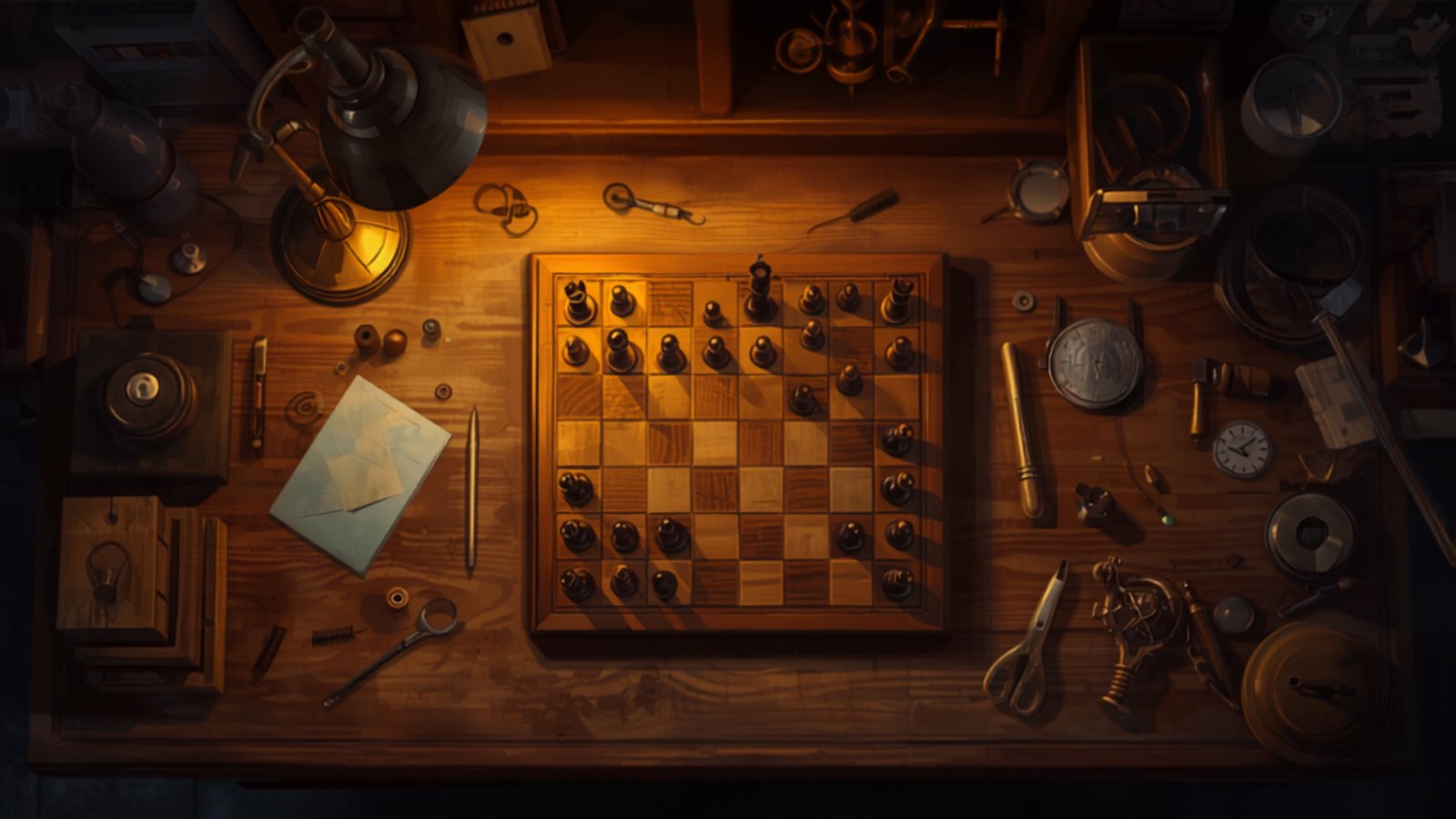
C1 · ADVANCED Reading practice · ~3,200 words · 16-min read
This is an original story for advanced learners. The language is rich but controlled: you should recognise almost every word. Before you begin, study the ten key words below — each one appears several times in the story. At the end, there are questions to check your understanding, and one grammar point worth stealing for your own writing.
Before you read — 10 key words
- correspondence — the letters two people write to each other over a period of time.
- adversary — an opponent; the person you play or compete against.
- gambit — a chess opening in which you sacrifice a piece to gain an advantage; also, a risky move designed to start something.
- meticulous — extremely careful and precise about small details.
- reticent — unwilling to reveal your thoughts or feelings.
- poignant — causing a sharp feeling of sadness, often mixed with tenderness.
- unravel — to come apart thread by thread; (of a plan or an idea) to fall apart.
- deception — the act of making someone believe something that is not true.
- bereft — suffering the loss of something or someone; left sadly without.
- legacy — something valuable that a person leaves behind for others after their death.
The story
1 · A game of forty-one years
Thomas Merrick had spent his working life repairing clocks, which perhaps explains why he never minded waiting. In the small coastal town of Salthaven, where the fog rolled in off the North Sea most mornings and rolled out again by lunchtime, waiting was practically a local industry. Fishermen waited for the tide. Shopkeepers waited for the summer visitors. And Thomas, every second Tuesday, waited for the post.
The letters came in pale blue envelopes with Hungarian stamps, addressed in a small, upright hand that had barely changed in four decades. Inside each one there was always the same thing: a page or two of news, a dry joke or an argument about history, and — at the bottom, written with ceremonial care — a single chess move.
Gregor Antal and Thomas Merrick had been playing chess by post since 1985. They had found each other through the pen-friend column of a chess magazine, in the days when such columns existed: Hungarian player, 31, seeks patient adversary abroad for correspondence chess. Slow players preferred. Thomas, then a young clock repairer who distrusted anything that moved quickly, had replied the same afternoon. Neither of them could have guessed that this modest gambit — a three-line advertisement in a magazine — would open a friendship lasting the rest of their lives.
They played one move per letter. A full game could take two years; a good one, three. Having finished a game, they would immediately begin another, alternating colours as solemnly as diplomats. In forty-one years they had completed twenty-six games. Gregor had won eleven, Thomas ten, and five had been draws — a statistic both men could recite instantly, and did, whenever the other grew too confident.
But the chess, if Thomas was honest, had long ago become the excuse rather than the point. The point was the letters themselves. Around the moves had grown an entire correspondence: marriages, children, the fall of a wall in Berlin, the slow closing of Gregor’s engineering works, the death of Thomas’s wife, Eileen, after which Gregor had written every single week for a year without once mentioning chess. Thomas still had that year of letters in a biscuit tin. He had never told anyone what was in them. Both men were reticent in speech and fluent on paper; the letterbox had suited them perfectly. Some friendships are conducted entirely in the open and weigh nothing; theirs had been conducted through a letterbox and weighed a great deal.
They had never met. Not once. There had been plans, naturally — a chess congress in Vienna in 1994 that Thomas couldn’t afford; a visit to England in 2003 that collapsed when Gregor’s wife fell ill. After a while, the not-meeting became a sort of superstition between them. “If we ever meet,” Gregor wrote once, “we shall discover that we are two ordinary old men, and the game will lose its mystery. Better to remain magnificent strangers.” Thomas had laughed, agreed, and quietly regretted agreeing ever since.
On the second Tuesday of March, the twenty-seventh game stood at move thirty-two, delicately balanced, with Gregor — playing white — a pawn up but exposed on the queenside. Thomas posted his reply, a quietly venomous bishop move he was rather proud of, and settled down to wait the usual three weeks.
Six weeks later, no answer had come.
2 · The silence
At first Thomas invented sensible explanations, as one does. The post was slow. Gregor was travelling. There had been a strike somewhere. But by the eighth week the explanations had begun to unravel, one after another, and what remained underneath them was a cold, specific fear that he did not want to name.
Gregor was eighty-three. Thomas was seventy-two. These were facts they had always handled lightly in their letters, the way you handle a knife by the handle rather than the blade.
It was during those silent weeks that Thomas did something he had never done before: he took the last two years of letters out of the biscuit tin and read them again in order. He told himself he was simply passing the time. In truth he was looking for something, and what he found disturbed him more than the silence itself.
The letters had changed. Not dramatically — had they changed dramatically, he would have noticed at the time. But reading twenty of them in a single evening, he could see what he had missed reading them a fortnight apart. The handwriting, always small and upright, had become somehow too perfect around two years ago, as though written slowly, meticulously, by someone concentrating. The jokes were still Gregor’s jokes, but they arrived a beat late, like a translation. The old man had stopped complaining about his knees, and Gregor had complained about his knees, with great artistry, since 2011. And the chess — this was the strangest thing — the chess had improved. Move after move of patient, correct, careful play, where the real Gregor had always been a gambler, a lover of the reckless gambit, a man who would cheerfully ruin his own position for the pleasure of complicating yours.
A reticent man by nature, Thomas mentioned his fear to nobody. There was nobody much to mention it to: Eileen was twelve years gone, his daughter lived in Canada, and one does not walk into the Salthaven post office and announce that one’s best friend of forty-one years — a man one has technically never met — may be dead, and that, worse, someone may have been impersonating him for two years.
Said aloud, it would have sounded absurd. Felt in the chest at three in the morning, it was not absurd at all.
In the tenth week of silence, Thomas Merrick — who had not left England since 1989, who owned a passport only because Eileen had once insisted, who distrusted airports on principle and aeroplanes on evidence — booked a flight to Budapest. Never in forty years had he imagined actually doing it. Not until the letters stopped did he understand that the superstition about never meeting had only ever been fear wearing a clever disguise.
He packed one small suitcase. Into it, wrapped in a jumper, he put the wooden chess set from his front room, its pieces worn smooth by forty years of solitary analysis. If he was too late — and he had a heavy, tidal feeling that he was too late — then at least the game would have travelled, once, in person.
3 · Number 11, Kertész Street
The address he had written on four hundred envelopes turned out to belong to a tall, tired, dignified building the colour of weak tea, with a courtyard smelling of rain and somebody’s cooking. Thomas stood in front of the door of flat 11 for a long moment, holding his suitcase, feeling every one of his seventy-two years and several years belonging, apparently, to other people.
He knocked.
The woman who opened the door was about thirty, dark-haired, with flour on one wrist and reading glasses pushed up into her hair. She looked at the old Englishman on her doorstep with polite incomprehension — and then her eyes moved down to the suitcase, and across to the corner of the wooden chess box visible under his arm, and every drop of colour left her face.
“You’re Thomas,” she said, in careful English. “You’re Thomas Merrick.”
“I am,” said Thomas. “And I think you’ve been writing to me.”
Her name was Anna. She was Gregor’s granddaughter. She stood aside to let him in, having apparently decided that a conversation like this one could not be conducted on a doorstep, and led him down a dark hallway into a sitting room that Thomas recognised instantly, completely, and painfully — the overloaded bookshelves, the engineering diplomas, the photograph of the Danube in winter — because Gregor had described it to him, item by item, over four decades. On a small table by the window, its position clearly permanent, stood a chessboard.
The position on it was the twenty-seventh game. White a pawn up, exposed on the queenside, waiting for black’s thirty-second move — the quietly venomous bishop move that was, at that moment, folded inside an unanswered envelope on the desk beside it.
“My grandfather died two years ago in October,” Anna said. She said it quickly, the way you pull off a plaster. “His heart. It was fast. He was not afraid, and he was not in pain.” She paused. “You would want to know that. He always said you were a man who would want the facts first and the feelings after.”
Thomas sat down, rather suddenly, in the armchair that forty years of letters had told him was Gregor’s.
Two years. He had grieved for ten weeks; the grief was two years old. Somewhere in the muddle of what he felt — and he would spend months sorting through it — there was a small, terrible accountancy running: the letters about the hard winter, the letter about the blackbird nesting on the balcony, the letter that had gently teased him about his cautious rook endings. All of them written by a dead man’s granddaughter. He had been bereft for two years, he thought, without being told. There ought to be a word for that. Perhaps in Hungarian there was.
“Then the letters,” he said at last. “The last two years of letters.”
“Yes,” said Anna, and lifted her chin slightly, like someone stepping forward to be sentenced. “I wrote them. All of them. It is the only dishonest thing I have done in my life, and I did it forty-eight times.”
4 · Anna’s confession
She made coffee, because her grandfather’s rule had been that no serious conversation could occur without it, and told him everything in order, meticulously, checking dates against a small notebook. Thomas, who had spent his life taking clocks apart to find the one bent tooth on the one small wheel, recognised the method and found it steadying. She was, he thought, very like her grandfather. This turned out to be truer than he knew.
Gregor had known his heart was failing for over a year before it did. Being Gregor, he had approached death as an engineering problem: wills, accounts, instructions, everything labelled. And one October afternoon he had called Anna to this room, shown her the chessboard by the window, and presented her with a folder. Inside were twelve envelopes, numbered, addressed to England, each containing a finished letter and a chess move.
“He had written twelve moves ahead,” Anna said. “He had analysed the game to move thirty. He said —” and here she read from the notebook, translating slowly, wanting it exact — “‘Thomas will play the obvious recapture on move twenty-four, because he is an honest man, and honest men take with the pawn. After I am gone, post one letter each time his reply comes. When the twelve are finished, write to him yourself and tell me — tell him — the truth.'” She closed the notebook. “He never noticed the mistake he made in that sentence. Tell me the truth. I have thought about that mistake many times.”
For a year, the plan had worked with the smoothness of all Gregor’s plans. Anna posted the letters. Thomas’s replies arrived. She played his moves out on the board by the window, took the next numbered envelope, and sent her dead grandfather’s living voice across Europe every three weeks.
“And then the twelfth envelope was gone,” she said. “And I sat at this table with your last letter and a pen, and I was supposed to write: Dear Mr Merrick, I am sorry to tell you that my grandfather died last October. I started that letter eleven times.” She looked at the chessboard rather than at him. “You must understand what those letters were, by then, in this flat. My grandmother died when I was nine. My father lives in Germany; we speak twice a year, politely. When Grandfather died I was — to use one of his favourite English words — bereft. He raised me here, in these rooms, and when he died the family I had left was a man in England I had never met, who did not know I existed, and who wrote to my grandfather as if — as if the world was still interesting. You wrote about the fog and the tide and a gull that stole a sandwich from a tourist. I read that letter, Mr Merrick, at this table, in an empty flat, and I laughed until I cried. And then I learned chess.”
“You learned chess,” Thomas repeated. “In order to keep the game going.”
“I learned chess,” said Anna, “the way a person learns a language in prison. I had his books. I had his notebooks — forty years of games against you, all annotated. Thomas defends too early. Thomas cannot resist an open file. Offer Thomas a pawn and he will inspect it like a customs officer.” Despite everything, Thomas laughed out loud. “I studied you for months before I dared to play move thirty-one. I knew the deception was wrong. I would say to myself: one more letter, only one more, and in the next one I will tell him. Forty-eight letters, Mr Merrick. I am not proud. But I could not make him die twice — once for me and once for you. I could not post that.”
There was a long silence, of the kind that only exists between people who have already, in some way, known each other for years.
“I knew,” Thomas said at last, gently. “Not with my head — my head made excuses. But somewhere lower down, I knew. The handwriting slowed. The jokes came a beat late. And nobody who ever played your grandfather could mistake your chess for his, my dear. You play like a lawyer. He played like an arsonist.” He turned his coffee cup slowly on its saucer, a clock repairer’s habit, something for the hands to do while the mechanism inside worked. “That is why I came, I think. Not to catch you. To stop being lied to kindly. There is a point at which a kind deception becomes unkind, and we had reached it, you and I. And once a kind lie begins to unravel, it is kinder to let it unravel completely.”
Anna nodded, and did not defend herself, which he respected.
“Will you tell me one thing honestly?” she asked. “The letters — the forty-eight. Were they… were they no comfort at all?”
Thomas considered lying and found he had lost his appetite for it, in this room of all rooms. “They were the chief comfort of my week,” he said. “That is the poignant thing about it, and the strange thing, and we shall both need some time to decide what it means. Somebody I loved died two years ago, and yet not one of those Tuesdays was a lie to me. The friendship in those letters was real. It was simply — ” he searched for the word — “re-addressed.”
5 · The sixty-fourth square
They finished the twenty-seventh game that evening, at the small table by the window, on Gregor’s board — the first face-to-face game of a correspondence begun in 1985. Anna played white, defending her inherited position; Thomas played the bishop move at last, with his hand instead of his pen, forty-one years and one thousand miles from the magazine advertisement that had started everything. There was something poignant in finishing it face to face at last — but neither of them said so, and both of them knew it. Outside, Budapest turned on its lamps.
She defended well — carefully, correctly, like a lawyer — and he attacked as his old adversary would have wished, taking risks Gregor would have applauded and Gregor’s granddaughter clearly considered irresponsible. On move forty-four, with both kings exposed and nothing sensible left to play for, they agreed a draw, which brought the lifetime score to eleven wins, ten wins, and six draws, and left the rivalry — as Thomas pointed out — officially unresolved, which meant, by the iron logic both of them had inherited from the same man, that it would have to continue.
“By post,” Anna said. It was not quite a question.
“By post,” Thomas agreed. “In your own name, in your own hand, and with your own terrible cautious openings. No more ghosts. A friendship is not a museum, Anna. Your grandfather never intended you to be his forger; whatever legacy he planned for you, it was never that. But I begin to suspect he intended something. Twelve envelopes was a very odd number for a man who analysed everything to the end. He must have known the game would outlast them. He knew exactly what you were like. And he knew exactly what I was like.” He tapped the notebook. “Tell me the truth, he wrote. I don’t believe that was a mistake at all. I believe we have both been part of somebody’s very long opening — his last gambit, if you like — and I believe it has worked.”
Anna was quiet for a moment. Then she stood, went to the desk, and came back holding an envelope — the last piece, as it turned out, of Gregor’s carefully arranged legacy. It was not pale blue but heavy and cream-coloured, sealed with actual wax, because Gregor had never once in his life resisted a theatrical touch. On the front, in the true handwriting — the real, hurried, alive handwriting that Anna’s meticulous copies had never quite captured — were the words:
For Thomas Merrick. To be given to him only when the game is over — and only in this room.
“He gave me thirteen envelopes,” Anna said. “Not twelve. This one had conditions. I used to think the conditions were impossible — you were in England; you were never going to be in this room. Then tonight I understood. He wasn’t setting conditions.” She smiled, for the first time all day, and it was her grandfather’s exact smile, the one Thomas had somehow known for forty years without ever seeing it. “He was making a prediction.”
Thomas took the envelope. It was heavier than a letter had any right to be — there was something small and hard inside it, something that shifted. His name sat on the front in his dead friend’s living hand, and the wax seal gleamed dark red in the lamplight, and the game, as of twenty minutes ago, was officially over, and he was, as the letter had always somehow known he would be, in this room.
He turned it over. He slid his thumb under the seal.
“Well,” said Gregor’s first line, “you took your time.”
Thomas laughed until his eyes streamed. Then he read the second line, and stopped laughing, and looked up at Anna with an expression she would spend the whole of the next day trying to describe to herself. Because what the letter asked of the two of them — and what was inside the envelope, small and hard and older than either of them — was the beginning of an entirely different story.
Check your understanding
Think about each question first. Then click “Show answer” to compare. Several questions ask you to read between the lines — at C1, understanding what is implied matters as much as understanding what is stated.
Words to remember
Here are the ten key words again in fresh sentences. Try writing one sentence of your own for each.
- correspondence — Their correspondence lasted longer than most marriages.
- adversary — She respected her old adversary far too much to let him win.
- gambit — His opening gambit at the meeting was to offer his resignation.
- meticulous — The accounts were kept with meticulous, almost obsessive, care.
- reticent — He was famously reticent about his years abroad.
- poignant — There is something poignant about a letter that arrives after its writer has died.
- unravel — Under questioning, his neat explanation began to unravel.
- deception — It was a deception carried out entirely out of love, which made it no easier to forgive.
- bereft — After the shop closed, the old man seemed utterly bereft.
- legacy — The greatest legacy he left was not money but a friendship.
Grammar in this story: participle clauses
This story leans heavily on participle clauses — a signature of advanced written English. They compress two sentences into one and keep narrative prose moving. Look at these examples from the story:
Having finished a game, they would immediately begin another. (= After they had finished a game…)
She stood aside to let him in, having apparently decided that a conversation like this one could not be conducted on a doorstep.
Being Gregor, he had approached death as an engineering problem. (= Because he was Gregor…)
Notice the rule at work in every example: the subject of the participle clause must be the same as the subject of the main clause. Master this and your writing instantly sounds a level more sophisticated.
👉 Learn the full rule here: Participle Clauses in English: Shorten Sentences Like a Native.
Talk about it · Write about it
Talk about it: Can a friendship conducted entirely at a distance — by letter, or today by message — be as deep as one conducted face to face? Thomas and Gregor thought meeting might “lose the mystery”. Were they right to wait forty years? And was Anna’s deception an act of love, a theft, or both?
Write about it: Write the letter Anna could not finish — the honest one telling Thomas the truth (150–250 words). Alternatively, write Gregor’s thirteenth letter: what would a man who planned everything want to say, and ask, after the game was over? Use at least two participle clauses.
🎉 Well done — that was a full-length C1 story, and you followed a plot built on implication, irony, and things left unsaid. That is exactly what advanced reading is for.
But the wax seal is broken, the envelope is open, and something small and hard is resting in Thomas’s palm. What did Gregor’s last gambit actually ask of them? That, as the story says, is the beginning of an entirely different one…
Nora puts an unexpected letter aside. Follow the allotment on Whitmore Lane and notice how a place draws people back into life. Next story: The Allotment on Whitmore Lane (C1 Reading Story)
About this story: This is an original C1 graded reader (~3,200 words). Vocabulary is controlled to an advanced learner’s range, so you should understand about 98% of the running words. The ten harder words essential to the plot are glossed before the story and deliberately reused inside it. Grammar spans the full C1 range: participle clauses, inversion, conditionals, and nuanced discourse markers.

I’m Khamis Maiouf. I’m studying Health and Social Care and have completed Functional Skills Level 2 in English and Level 3 Hairdressing. I have taught ESOL in my community and helped students with GCSE English. I run English Teacher Site to help people learn and practise English.