
The Wrong Train to Fonte Alta (B2 Reading Story)

B2 · UPPER-INTERMEDIATE Reading practice · ~3,100 words · 15-min read
This is an original B2 story about a solo traveller who takes the wrong train and finds something better than the plan she had lost. The story uses natural upper-intermediate English, with plenty of passive verbs. Read the ten key words first, then enjoy the story. A short comprehension quiz is at the end.
Before you read — 10 key words
- detour — a longer or different route, not the one you had planned.
- stranded — stuck somewhere and unable to leave.
- cobblestones — small round stones used to make old streets.
- guesthouse — a small hotel usually run by a family (in Italian, a pensione).
- shrine — a small holy place, often built around something old like a spring or a statue.
- fluent — able to speak a language easily and well.
- flexible — willing to change your plan or your mind.
- spontaneous — done suddenly, without planning it in advance.
- regret — a sad feeling because you did, or did not do, something.
- layered — with many things one on top of another (used here for the history of a place).
The story
1 · The tight plan
Priya loved lists. Before her trip to Italy, she had built a spreadsheet with seventeen colourful columns. Every train, every hotel, every meal was mapped out in advance. If everything went to plan, she would see six cities in fourteen days. Her friends had laughed at her. “Priya,” her sister had said the night before she flew, “you can’t schedule a holiday like a work project. You’re going on holiday, not launching a satellite.” But Priya had not been convinced.
She had been dreaming about this trip for three years. She had saved carefully, and she was determined not to waste a single hour. When she landed in Milan on a bright Monday morning, she was already ahead of schedule. By day five, she had ticked off Venice, Verona, and half of Bologna. Tonight, she had a hotel booked in Florence, and she wanted to be there before dark.
Bologna station was crowded. Priya stood on platform seven with her small suitcase and a printed ticket. The departure board said her train was leaving at 14:03. A tired-looking regional train pulled in at exactly 14:02. Perfect. She climbed on quickly, found a seat by the window, and let out a happy breath. Everything was going to plan.
She put in her earphones and opened her book. The train started to move. Outside the window, Bologna slid away. Fields of yellow sunflowers appeared. Then the flowers were replaced by trees, and the trees were replaced by rocks. The train climbed a small hill. That was strange, she thought. She did not remember hills on the map to Florence.
She looked at the ticket in her hand, then at the little screen above the door. The screen said the next stop was Fonte Alta. Priya had never heard of Fonte Alta. Her heart began to beat a little faster. She pulled out her phone. There was almost no signal. She opened her offline map. Fonte Alta was a tiny dot, high in the Apennine mountains — seventy kilometres east of where she was supposed to be.
The wrong train.
She had taken the wrong train.
Priya closed her eyes. If she had checked the platform number more carefully, this would not be happening. If she had waited one more minute, she would be on her way to Florence right now. But it was too late. The train slowed down. Outside, she saw a single grey platform and, above it, a hand-painted wooden sign: FONTE ALTA — 812 m. A cold mountain wind came in through the open door.
Priya picked up her suitcase and stepped off the train. What else could she do?
2 · Stranded
The station was tiny. There was no ticket office. There was no café. There was one wooden bench, one broken vending machine, and a small blue timetable on the wall. Priya walked over to read it.
Her stomach dropped.
There was only one train a day back to Bologna. It left at 13:20. She had just missed it — by three hours. The next one would leave tomorrow, at exactly the same time.
For a full minute, she stood completely still. She was stranded — stuck somewhere and unable to leave. Her hotel in Florence was already paid for. Her train to Rome the following day was already booked. Her whole beautiful plan, all seventeen columns of it, had been ruined by one wrong platform.
Priya was not a person who cried in public. But she was very close to it now.
She sat on the wooden bench and tried to think. Could she take a taxi? She looked around. There were no taxis. There were no cars at all. There was only an old man in a green coat, walking a small brown dog. He nodded at her politely and continued on his way.
She looked up the village on her phone. Fonte Alta, population 341. No car rental. No bus service after 5 p.m. One guesthouse — a small family-run hotel — called “Pensione Il Forno”, right above the village bakery. It had four rooms. She rang the number. A woman answered in cheerful Italian. Priya’s Italian was very limited.
“English?” Priya asked hopefully.
“Ah… un po. A little,” the woman said. “You need room?”
“Yes, please. For one night. Just one night.”
“Come. I wait for you.”
The woman gave her simple directions: turn left out of the station, follow the road up the hill, and look for the sign of the bread.
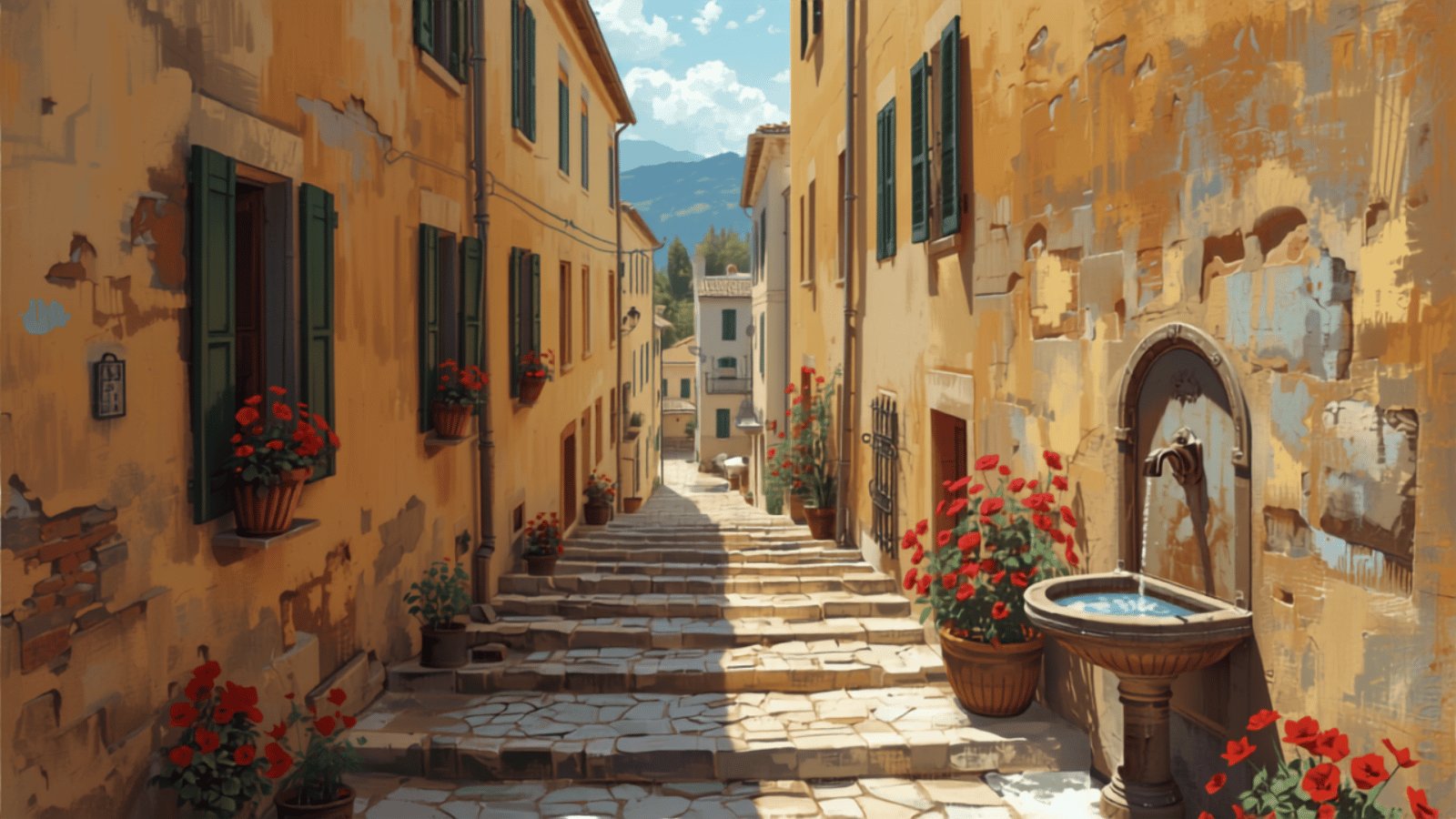
Priya pulled her suitcase along the road. The wheels made a loud rattling noise on the cobblestones — the small round stones used to make old streets. The village was quiet. It was the middle of the afternoon, and everyone seemed to be indoors. Windows were shuttered against the sun. Two cats slept on warm stone steps. A church bell rang somewhere, slow and heavy.
At the top of the hill, she saw it: a small yellow building with green shutters. A wooden sign above the door showed a painted loaf of bread. Underneath, in old-fashioned letters: PENSIONE IL FORNO — dal 1962. From inside came the warm, unmistakable smell of baking.
The door was opened before Priya could knock. A small, round woman stood in the doorway, with grey hair pinned back, dark kind eyes, and flour on her hands. She looked Priya up and down, and then broke into a wide smile.
“You are the English girl,” she said. “Come in, come in. My name is Gina. Everyone calls me Nonna Gina — it means grandmother.”
Priya stepped inside. The smell of fresh bread hit her like a warm hug. And for the first time since Bologna station, she began to relax a little.
3 · Nonna Gina
The pensione was above the bakery, up a narrow wooden staircase. Nonna Gina led Priya to a small room with a big window. The floor was made of polished stone. The bed was covered with a heavy white sheet. On the wall, there was one old photograph in a wooden frame — a young man in a dark suit, smiling shyly at the camera.
“My husband, Enzo,” Nonna Gina said. “He is gone now. But the pensione is still ours. He always said, ‘If someone knocks on our door, we open it.’ So I open.”
“Thank you,” Priya said. “I really did not plan to be here.”
Nonna Gina laughed. “Of course you did not! Nobody plans to come to Fonte Alta. That is the whole point. People come by accident. Or they come because their grandmother’s grandmother used to live here.”
She showed Priya the small bathroom, the switch for the shower, and how to close the shutters against the mosquitoes. Then she looked at Priya carefully.
“You are hungry, no? You have that face.”
“A little,” Priya admitted. She had not eaten since Bologna.
“Good. Come down at half past seven. I will make you something.”
At half past seven, Priya went downstairs. The bakery, which had been full of trays and flour that afternoon, had been transformed. Two small wooden tables had been set with white cloths. Candles had been lit. A jug of red wine had been placed in the middle, along with a bowl of green olives. It felt more like being invited into someone’s family kitchen than sitting down in a restaurant.
Nonna Gina brought out the food one plate at a time. First, thin slices of cured ham on warm bread. Then a bowl of thick vegetable soup, called ribollita. Then a plate of pasta with butter and sage from the garden. Nothing on the table had been bought in a supermarket. The bread had been baked that morning. The oil had been pressed by Nonna Gina’s brother, up the hill. The pasta had been rolled by hand.
Priya ate slowly. She had planned to check her phone during dinner and start rearranging her hotel bookings. But somehow, she did not.
Nonna Gina sat across from her with a glass of wine. Her English was not fluent — meaning able to speak a language easily and well — but she spoke slowly and used her hands a lot.
“Tell me. Why do you come to Italy?”
“To see everything,” Priya said. “Six cities in two weeks.”
Nonna Gina blinked. Then she laughed — a big, deep laugh that made her whole body shake.
“Six cities! In two weeks! Ah, cara — you see nothing. You see the outside of everything.”
Priya felt a little defensive. “I wanted to make the most of my time.”
“Yes, yes,” Nonna Gina said kindly. “Everyone says this. But time — it is not made of hours. It is made of memories. And memories are not made when you run.”
Priya did not know what to say. She looked out of the window. The village square below had come alive in the evening light. Old men were playing cards under a tree. Children were chasing each other across the cobblestones. Somewhere, a guitar was being played.
“Tomorrow is our festival,” Nonna Gina said. “Every year, in July, we celebrate our old spring — the fonte alta, the high spring, the one that gives our village its name. It has been celebrated in the same way for four hundred years. It is a small thing. But it is ours.”
“Is there music?” Priya asked. “Food?”
“Music, food, dancing, stories, everything,” Nonna Gina said. “And a small procession up to the shrine on the mountain. It is beautiful. If you were staying, I would take you.”
Priya looked at her wine glass. If she were staying.
4 · A village with layers
That night, Priya could not sleep. The bed was comfortable and the window was open to a cool mountain breeze. But her mind was running.
She sat up and opened her laptop. Her original plan glowed at her in seventeen colourful columns. Tomorrow: Florence. The Uffizi at 10 a.m., booked and paid for. Dinner at Trattoria Marco at 8 p.m., booked. The day after: Rome. And she had a non-refundable train ticket to Milan at the end of the week.
If she stayed one extra day, she would lose the Uffizi booking. If she stayed two, she would lose the Florence hotel. If she stayed three, the trip she had planned for three years would look nothing like the spreadsheet.
But — and this was the strange part — a small voice inside her was saying, stay.
The next morning, Priya was woken up by bells. Not the deep, slow church bells of the afternoon before, but bright, quick, happy bells. She opened the shutters and looked out. In the square below, the villagers were setting up long tables. Flowers had been tied to every door. A red-and-white cloth had been hung right across the street.
Downstairs, Nonna Gina was in the bakery, up to her elbows in flour.
“You are still here!” she said. “Good, good. The train does not leave until 13:20. You have time for the morning procession. Come.”
Priya followed her outside. The whole village seemed to be in the square. An old man was carrying a wooden statue of a woman in blue. Children in white shirts walked in front of him, holding small candles. Musicians followed with drums and a single trumpet. Behind them, the entire village walked slowly up a small path that led towards the mountain.
“Where does it go?” Priya whispered.
“To the shrine,” Nonna Gina said. “The small holy place on the mountain, at the spring. It is where our village was born.”
The walk took nearly an hour. They climbed a rocky path between olive trees. The sun rose higher and the cicadas began to sing. And when they reached the top, Priya understood.
The shrine was tiny — just four white walls and a wooden roof, built around a small stone pool. Water came up out of the ground, clear and cold, and ran away down the mountain. Villagers took turns filling little bottles from the pool. An old woman, older even than Nonna Gina, said a prayer in a voice that shook slightly.
“This spring has been here for two thousand years,” Nonna Gina told her quietly. “Before Italy, before Rome, before Christianity. The Etruscans came here. Then the Romans. Then the monks. Then us. The stones you are standing on were placed by a monk in the year 1178. His name was Brother Antonio. It is written on that stone, there.”
Priya looked. There, cut into the grey stone, in old letters: A · MCLXXVIII.
She had been looking at Italian churches for five days. She had ticked off the Basilica di San Marco in Venice. She had rushed through the cathedral in Verona. But she had not, until this moment, actually felt what it meant to stand somewhere so old.
The village was layered — with many things one on top of another. The Etruscans, the Romans, the monks, Nonna Gina, and now her. And the spring had kept flowing through all of them, cold and clear, indifferent to which century it happened to be.
Priya sat down on a low stone wall. She did not want to leave.
5 · The choice
At noon, the procession returned to the village. The tables in the square had been filled with food. Homemade pasta, roast meat, tomatoes still warm from the gardens, tiny cakes covered in honey. Bottles of the village wine were opened. A small band began to play. People danced — old couples, small children, teenagers, everyone. Nobody was on a phone.
Priya’s train would leave in an hour.
She thought of her spreadsheet. She thought of the Uffizi, waiting for her at 10 a.m. the next morning. She thought of what her sister had said before she left: “You’re going on holiday, not launching a satellite.”
She pulled out her phone. There was a signal today, for some reason.
She opened her hotel app. The Florence hotel could not be refunded, but the booking could be pushed back by three nights. She would lose the money for tonight and tomorrow night. It hurt a little. But she had saved for three years. She had not saved to run.
She cancelled the Uffizi ticket. She rescheduled the train. She wrote a short message to her sister.
“Missed my train. Ended up in a village called Fonte Alta. Staying three more nights. I think you were right.”
Then she put the phone away.
When she looked up, Nonna Gina was watching her from across the square, holding two small glasses of wine. She raised her eyebrows.
“So?” she called. “The train?”
“The train can go without me,” Priya said.
Nonna Gina laughed and walked over. She handed Priya one of the glasses. “You are learning,” she said.
Over the next three days, Priya learned things that no guidebook could have told her. She was shown how the bread was made, from the flour all the way to the oven. She was taught to play a card game called scopa by four old men who did not speak a word of English but who were extremely patient. She was taken by Nonna Gina’s brother up to the olive groves, where she was told which trees had been planted by his great-grandfather.
She learned the word piano — meaning slowly, gently, softly. It was said all the time in the village. Piano, piano. Take it easy. Don’t rush.
She was flexible for the first time in her adult life — willing to change her plan without feeling that she was failing at something. She did spontaneous things — things done suddenly, without planning them in advance. She went swimming in a cold river with three teenagers who had waved her over. She helped Nonna Gina paint a green bench. She sat for two hours by the spring, doing absolutely nothing at all.
On her last morning, she stood at the small station with her suitcase. The 13:20 train to Bologna pulled in on time. Nonna Gina had walked her down the hill.
“Well,” Priya said. “I really am going this time.”
“Good,” Nonna Gina said. “Go and see your Florence. But come back to us.”
“I will,” Priya said. And she meant it.
She got on the train and sat by the window. Fonte Alta slid away behind her, small and yellow in the mountain sun. She did not open her laptop. She did not open her book. She just watched.
6 · What she carried home
Two weeks later, Priya was back in her small flat in London. Her friends came over on Saturday night. They wanted photos, stories, the full report.
She showed them the Uffizi, of course. She showed them the Roman Forum. She showed them the pasta she had eaten in Naples. But the photos she kept coming back to were the ones from Fonte Alta — the yellow bakery, the shrine on the mountain, Nonna Gina with flour on her nose.
“So which was your favourite city?” her sister asked.
Priya thought about it for a moment.
“It wasn’t a city,” she said.
She had no regret — that sad feeling because you did, or did not do, something. She did not regret missing the Uffizi booking. She did not regret losing the money for the Florence hotel. She regretted only one thing: that she had been on a train for three years of her adult life without ever once looking up at the mountains.
She still made lists. She still liked her plans. But now, at the bottom of every spreadsheet, she added one new line: Leave a day for the detour. A detour is a longer or different route — not the one you had planned.
On her fridge, she stuck a small piece of paper. It said, in Nonna Gina’s shaky handwriting: Piano. Piano.
And on her bedside table, in a small glass bottle, she kept a little water from a shrine on a mountain in Italy — water that had been drunk by monks in 1178, by Romans before Christ was born, and now by an English girl who had once taken the wrong train.
She was already planning her next trip back. But this time, she was planning something new. This time, she was planning to arrive without a plan.
Check your understanding
Read each question. Think about your answer. Then click “Show answer” to check.
Words to remember
Here are the ten key words again, in fresh sentences. Read each one out loud and try to build your own example.
- detour — The main road was closed, so we had to take a long detour through the hills.
- stranded — When my flight was cancelled, I was stranded at the airport for eighteen hours.
- cobblestones — Walking on wet cobblestones in high heels is a very bad idea.
- guesthouse — We stayed in a small family guesthouse instead of a hotel, and the breakfast was incredible.
- shrine — At the top of the hill, we found a tiny shrine covered in flowers and candles.
- fluent — After ten years in Berlin, she is completely fluent in German.
- flexible — Good travellers are flexible: when something goes wrong, they change the plan without panicking.
- spontaneous — We didn’t plan the party — it was completely spontaneous.
- regret — My biggest regret is that I never learnt to play a musical instrument.
- layered — Rome is a layered city — every street has ancient, medieval and modern history stacked on top of each other.
Grammar in this story: the passive voice
This story uses the passive voice again and again, especially when Priya is describing Fonte Alta and its history. We use the passive when the action itself is more important than the person who did it — or when we don’t know (or don’t care) who did it.
The pattern is: subject + form of “to be” + past participle. Look at these examples from the story:
• “The bread had been baked that morning.”
• “The stones you are standing on were placed by a monk in the year 1178.”
• “Candles had been lit.”
• “Flowers had been tied to every door.”
• “She was taught to play scopa by four old men.”
Notice how the writer uses the passive to make descriptions feel calm and finished — the village had been decorated for the festival, and we don’t need to know exactly which villager hung which cloth. The result is what matters.
👉 Learn the full rule (with practice questions) here: Active vs Passive Voice Explained.
Talk about it · Write about it
Talk about it: Have you ever had a travel plan go wrong — a missed flight, a wrong train, a closed hotel? What happened? Did the “mistake” turn out to be a good thing, or a bad thing? Would you rather travel with a strict plan like Priya’s, or with no plan at all?
Write about it: Write a short paragraph (about 150 words) describing a small, ordinary place you love — a café, a park, a train station, a shop. Use at least five passive verbs to describe how it was built, decorated, or looked after. For example: The tables are wiped down every morning. The old sign was painted by the owner’s father in 1988.
🎉 Well done — that was a full 3,000-word story in real B2 English, and you made it to the end. Notice how many passives you understood without stopping. Your reading is getting stronger.
But Priya said she was already planning her next trip back to Fonte Alta. What do you think happens when she returns? Does the village welcome her the same way? Does Nonna Gina still have flour on her nose? Or has something changed while she was away? That story is waiting for you…
Marta is travelling alone. Follow the Wednesday ferry and notice how a new encounter changes her view of the journey. Next story: The Wednesday Ferry (B2 Reading Story)
About this story: This is an original B2 graded reader (~3,100 words), written using the Oxford Bookworms method. Vocabulary is controlled to roughly a 1,400-headword upper-intermediate ceiling, so most readers at B2 should understand around 98% of the running words. Any harder word is glossed before the story and used again inside it. The story practises B2 grammar — especially the passive voice, second and third conditionals (“If she had checked… this would not be happening”), and reported speech.

I’m Khamis Maiouf. I’m studying Health and Social Care and have completed Functional Skills Level 2 in English and Level 3 Hairdressing. I have taught ESOL in my community and helped students with GCSE English. I run English Teacher Site to help people learn and practise English.