
The Detour to Vardia (B2 Reading Story)

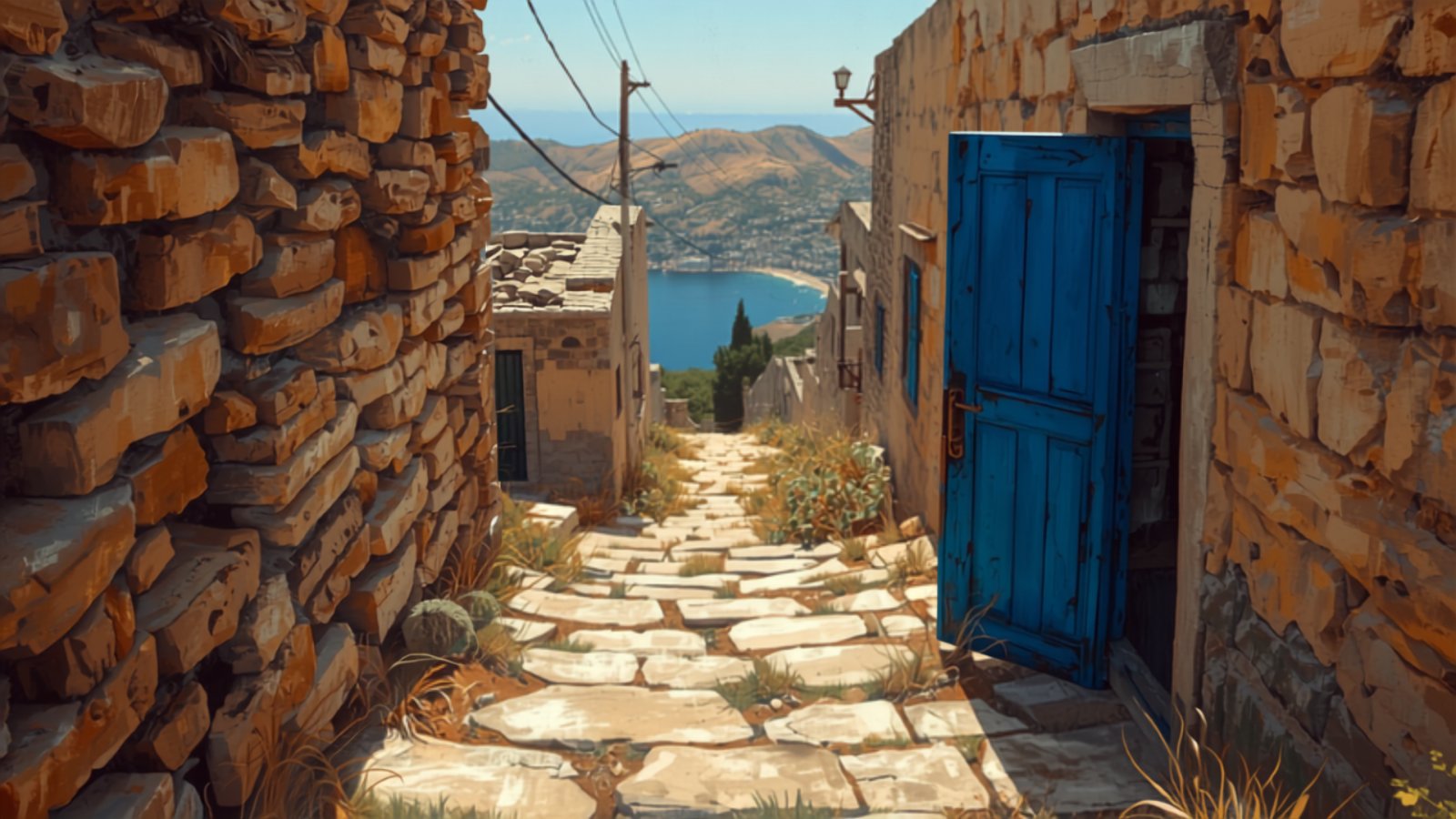
B2 · UPPER-INTERMEDIATE Reading practice · ~4,000 words · 26-min read
This is an original short story for upper-intermediate learners. It is a quiet travel story about a photographer whose whole trip is broken by a strike, a small honey shop on an island she never wanted to visit, and a village that was left empty seventy years ago. Read the ten key words first. Then read the story slowly. At the end there is a small comprehension quiz.
Before you read — 10 key words
- itinerary — a planned route or schedule for a journey, usually written down day by day: which hotel, which train, which city.
- detour — a longer or different route than the one you originally planned, often taken because a road is closed — or because you want to explore something new.
- cancellation — the act of stopping something planned from happening. When a ferry is cancelled, there is a “cancellation.”
- reluctantly — unwillingly; slowly, because you do not really want to do the thing. “She reluctantly agreed” = she agreed, but her heart was not in it.
- abandoned — left empty; no longer used or lived in. An abandoned house has no people in it and probably has not had any for a long time.
- weathered — worn down and marked by long exposure to sun, wind, and rain. A weathered stone is smooth and pale. A weathered face has been shaped by many years of outdoor life.
- fresco — a painting done directly onto a wall or ceiling, usually in a church, while the plaster is still wet. Old frescoes fade slowly but can last for hundreds of years.
- inscription — a short message carved or written into something solid, like a stone, a piece of metal, or the front of a book.
- compelled — feeling a strong pull or need to do something, often for a reason you cannot fully explain. “I felt compelled to go back” = something inside me made me go back.
- procession — a line of people moving forward together in a slow, formal way, for example at a wedding, a funeral, or a religious ceremony.
The story
1 · The cancelled ferry
The message came through at 5:47 in the morning, just as Elena had begun to fall back asleep. She reached for her phone without opening her eyes, expecting a delayed marketing email or a spam alert. Instead, she saw a short paragraph from the ferry company: because of a nationwide strike, every service from Athens to Santorini had been cancelled for the next two days.
Elena sat up very slowly in the small hotel bed. Outside the window, the sky was still grey. She read the message three times. Cancelled. Two days. She had already paid for a non-refundable room in Santorini for that night — a small white villa with a blue-domed church behind it, exactly the kind of place she needed for her portfolio. She had booked it four months earlier.
She swung her legs out of bed and opened her laptop. Her itinerary — the careful, colour-coded schedule she had built and rebuilt for six weeks — was suddenly meaningless. Every hotel, every ferry, every photo location had been chosen to fit together like a puzzle. Now the puzzle was scattered on the floor. An itinerary is a planned route or schedule for a journey, and hers had been ambitious: seven islands in twelve days, with a specific shot list for each one.
She was thirty-two years old, a photographer who had not sold anything in almost a year. This trip was supposed to change that. Her small savings, her last three commissions, and a loan from her sister had all been poured into this itinerary. She had told everyone in London that when she came back, her work would finally be noticed.
Now, before the trip had really begun, the sea had already refused her.
Elena forced herself to breathe. She opened the ferry company’s website. Everything to the popular islands was marked red — cancellation, cancellation, cancellation. She scrolled further. Only three services were still running, all of them to small, unfashionable places that tourists rarely mentioned. One was a night ferry to an island called Astravi, leaving from a different port at eleven o’clock that evening.
She had never heard of Astravi. She looked it up. Population: about eight hundred. No airport. Two small beaches, one harbour, one bakery, no photograph on the front page of any travel magazine she recognised. If the ferry ran on time, she would arrive there at four in the morning, and she would have to wait forty-eight hours before another boat could take her anywhere else.
For a moment, Elena felt a hot rush of anger. She almost booked a flight home. If she hadn’t spent all her savings, she would have flown back to London that afternoon. But she had spent them, and she couldn’t. So she did what she had learned to do in the last difficult year of her life: she made a small, unhappy decision.
She would take the night ferry to the wrong island.
The cancellation, she told herself, was only a delay. Two quiet days somewhere she didn’t want to be, then the next boat to Santorini, and back to the plan. She would still get the shots.
She was wrong about that. But she couldn’t have known.
2 · The wrong island
The night ferry to Astravi was old, orange, and much smaller than Elena had expected. There were perhaps forty passengers on board — a few sleeping families, some men in work clothes, two dogs tied to a bench near the door. She found a corner seat by the window and tried to sleep. She could not. The engine made a heavy, uneven sound, and the sea outside was black.
Around three in the morning, she went out onto the deck. Above her, there were more stars than she remembered seeing anywhere in Europe. For the first time since the cancellation, she was not angry. She was only tired.
Astravi appeared as a dark shape against the sky, then as a few yellow lights along a harbour, then as a small town waking up too early. The ferry slid against a stone pier and the engine cut. Elena walked down the ramp with her heavy backpack and stood in the empty street, unsure where to go.
A man in a fisherman’s cap pointed her toward a narrow lane. “Sofia’s rooms,” he said. “Very cheap, very clean. Tell her Yannis sent you.”
Sofia’s rooms turned out to be three simple bedrooms above a bakery, run by a woman who spoke almost no English but who pressed a small cup of thick coffee into Elena’s hands before she could even ask about the price. The room had a bed, a chair, a small window facing a courtyard, and nothing else. Elena dropped her bag, lay down, and slept for six hours.
When she woke up, it was midday. Sunlight fell across her face in a warm gold band. She could smell fresh bread from downstairs and, beyond it, the sea. She sat on the edge of the bed and looked at her phone. No signal. She smiled — a small, tired smile — for the first time in a week.
Astravi in daylight was not a beautiful island. That was the first honest thing Elena thought about it. It did not have the postcard perfection of the places on her list. The houses were plain, painted in faded pinks and yellows. The streets were narrow and dusty. The harbour was working, not decorative — small fishing boats with peeling paint, nets drying in the sun, the smell of engine oil under everything.
She took her camera out, more out of habit than intention. Through the viewfinder, she began to notice things. An old woman shelling beans. A cat asleep across a bag of flour. A boy of ten, painting a boat with careful strokes, his tongue between his teeth. Nothing that would sell.
She lowered the camera. What she was doing was a kind of travel she was not used to — travel with no target. She had come here reluctantly. To do something reluctantly means to do it unwillingly, because you do not really want to. And yet, walking through this ordinary town, she felt an unexpected softness in her chest. There was nowhere she was supposed to be for the next two days. The strike, she realised, had also given her something.
She wandered without a plan. At the top of a steep street, she found a small shop with the word “MELI” — honey — painted in blue on a wooden sign. In the window there were rows of glass jars filled with something the colour of dark amber. Elena pushed open the door and a tiny brass bell rang above her head.
An old man looked up from behind the counter.
3 · Kostas and the honey shop
The man was tall and very thin, with silver hair and a face that had been marked by long years of Aegean sun. He was probably close to eighty. His eyes were bright, though — a pale, tired blue, like a sea in winter.
“Kalimera,” he said. Good morning.
“Kalimera,” Elena said back, using one of the four Greek words she had learned. She smiled and pointed at the jars. “May I look?”
“You may look, you may taste, you may sit down.” His English was slow but clean, with a soft, precise accent. “Which do you like — thyme, pine, or mountain flower?”
Elena had not planned to buy honey. But something about the shop — the warm, wooden smell, the neat lines of jars, the way the old man rested his hands calmly on the counter — made her want to stay. She let him spoon a little of each honey onto a small silver dish. The mountain flower was the strongest: dark, almost bitter at the edges, sweet in the centre.
“That one,” she said. “That’s beautiful.”
The old man smiled for the first time. “My mother made mountain flower honey,” he said. “For sixty years. It was her honey that taught me how to keep bees.”
“Is she a beekeeper?”
“Was. She has been gone a long time.” He paused. “But her bees are still working. If I hadn’t kept them, there would be no mountain flower honey on Astravi at all.”
Elena bought two jars. Then, because she was in no hurry, and because the shop was cool and shaded and full of a kind of quiet she had not felt in a year, she asked if she could take his photograph. He looked at her for a long moment. Then he shook his head — but not unkindly.
“Not me,” he said. “Photograph the bees. Photograph the mountain. My face is old, and there are already too many pictures of old Greek men in the world.”
She laughed. “That is fair.”
His name, he told her, was Kostas Vardis. He had lived on Astravi for most of his life, but he had not been born there.
“I was born in a small mountain village,” he said. “Very high, very quiet. It was called Vardia. That is where our family name comes from.” He spread his fingers and made a small, sad shape in the air. “It is not there any more. Not really.”
Elena leaned against the counter. “What happened to it?”
Kostas looked out of the window for a moment, as if he needed to check that the village outside was still Astravi and not Vardia. Then he began to tell her the story.
In 1953, when he had been six years old, a strong earthquake had shaken the southern part of Greece. Vardia had suffered more than most. The church had cracked from roof to floor. Half the houses had fallen, and the mountain road had broken into three pieces. There had been very few deaths — that was the miracle people still spoke about — but the government had decided the village could not be safely rebuilt, and Kostas’s family had been moved down to Astravi with the other thirty families of Vardia.
“For a year, my mother would not unpack the boxes,” he said quietly. “She kept them stacked against the wall. She was sure we would go back.”
“Did anyone ever go back?”
“A few, for one summer. Then a second summer. Then people stopped going. The houses have been abandoned for more than seventy years now.”
Something is abandoned if it has been left empty and is no longer used or lived in. Elena had photographed abandoned places before — old hospitals, closed cinemas, empty factories on the edge of London. She had a certain feeling for them. She was already imagining the light on cracked walls, the strange plants growing through kitchen floors, the way an empty village keeps a kind of memory that a busy one cannot.
“Can you still get there?” she asked. Her voice was more careful than she had meant it to be.
Kostas studied her for a long moment. “You would need good shoes. Water. It is a hard climb — perhaps two and a half hours. Are you a walker?”
“I am when I need to be.”
“And why do you need to be?”
Elena hesitated. In her old life in London she would have said something about “capturing the story of a lost community.” Now, she felt too tired for the neat answers.
“I don’t know,” she said honestly. “I only know that I would like to try.”
Kostas studied her, then nodded. He pulled a folded paper map from a shelf at the back of the shop, and drew a route for her in careful blue pen: harbour → stone path behind the town church → up through the olive groves → past a broken wall marked “Kalyvi” → then along a ridge for about forty minutes.
“You will see it below you,” he said. “Do not go alone if the sky is grey. And when you reach the church — please —” he paused. “Look at the marble tablet beside the door. On the right. If the letters are still there, tell me what you see.”
Elena took the map. “I will tell you.”
She thanked him, put the honey jars carefully into her bag, and walked out into the strong island light. She did not know, then, that this would be the most important detour of her working life. A detour is a longer or different route than the one you originally planned. Elena’s whole trip had already become one.
4 · The path to Vardia
She left the following morning at six, with two litres of water, a hat, an apple, and Kostas’s map folded in her back pocket. The bakery downstairs had just opened, and Sofia had pressed a warm slice of cheese pie into her hand as she walked out.
The path behind the church was easy to miss. Elena walked past it twice before she saw the small blue mark that Kostas had described — a hand-painted arrow no larger than a coin. The road up the mountain was made of pale, dry stone, worn smooth by centuries of feet and hooves. The word for that is weathered: worn down and marked by long exposure to sun, wind, and rain. The stones were weathered. The wooden gates were weathered. The whole island, she was beginning to think, was one long weathered surface.
The first hour was gentle. She climbed through olive groves so old that the trees had begun to twist into strange, human shapes. She passed a small chapel no bigger than a garden shed, with the door half open and a bunch of dried herbs hanging above the entrance. A single donkey watched her over a stone wall and returned to its shade.
The second hour was harder. The path narrowed. The trees stopped. She was climbing along a bare ridge now, with the whole of Astravi spread out below her — the harbour a tiny bright shape, the sea a solid deep blue. Her legs ached in a way she had not felt for years.
At the broken wall marked “Kalyvi,” she sat down and ate her apple. The sky was cloudless. Below her, the world was quiet in a way that made her aware of her own breathing.
At two hours and twenty minutes, she came around a bend and stopped walking.
Vardia lay just below her, in a shallow bowl of stone.
She had photographed many abandoned places before — empty factories with broken windows, mountain huts where the tables were still set for a meal that would never be eaten. But she had never seen anything like Vardia.
There were perhaps thirty houses. They were all built from the same pale, honey-coloured stone as the mountain itself. Their roofs had fallen in decades ago. Some walls had collapsed inwards, so that the houses looked like open hands. Others were still standing, their doorways empty, their windows shaped like small dark eyes. In the middle of the village stood the church, tall and narrow, with a broken bell tower and a wide crack running from the roof down almost to the door.
Nothing moved. No bird, no wind, no distant car. The village had been holding its breath for seventy years.
Elena stood on the ridge for several minutes before she remembered her camera.
She walked down the last stony path very slowly, as if entering a room where someone was sleeping. Small yellow flowers grew from cracks in the walls. In one house, a fig tree had grown up through what had once been a bedroom — its branches now heavy with fruit, pushing gently against a broken window frame from the inside. She thought: if the earthquake had not happened, that fig tree would not be there. And she felt something turn over quietly inside her.
She began to work.
She photographed the doorways. She photographed the fig tree. She photographed a chipped blue cup that someone had left, seventy years earlier, on a stone shelf, still there because nobody had ever moved it. She worked without thinking, the way she used to work at twenty-three, before she had begun to worry about markets and prizes and Instagram.
Two hours passed and she barely noticed.
Then she remembered the marble tablet.
5 · The abandoned church
The church door was gone. Only the frame remained. She stepped inside carefully.
The roof was mostly open to the sky. Sunlight fell in strong, sharp bars across the stone floor, and the air inside was surprisingly cool. Broken wooden pews lay in a corner. High on the eastern wall, above where the altar had once stood, she could see the pale, faint remains of a fresco. A fresco is a painting done directly on a wall or ceiling, usually in a church, while the plaster is still wet. This one was mostly gone — only the outline of a robed figure with a raised hand was left, and a few faint gold stars near the top. It was more beautiful for being almost erased.
Elena felt compelled to sit down for a moment. To feel compelled is to feel a strong pull or need to do something you cannot easily explain. She sat on the edge of a broken pew and just looked. She was quite alone. And yet the room did not feel empty. It felt kept — as if the villagers had left their prayers behind, and the walls had held them.
After a while, she remembered why she was there.
She went outside and walked around to the right of the entrance, as Kostas had told her. The tablet was there, set into the stone wall about the height of her shoulder. It was made of white marble, veined with grey, and much smaller than she had expected — no bigger than a hardback book. An inscription had been carved into it. An inscription is a short message carved or written into something solid, like a stone, a piece of metal, or the front of a book.
She knelt down. The Greek letters were half worn away, but she could still trace their shapes with her finger. She took a picture. Then another. Then, in her notebook, she copied down what she could see, letter by letter, comparing shapes against the small alphabet chart on the back of her map.
She could make out four things: a date — 8 September 1952. Two names, one of them clearly “Vardis.” One word she did not know. And, at the bottom, a small carved image of two hands holding what seemed to be a crown.
She sat back on her heels. The last wedding, she thought. This is what he wanted me to find. Kostas had never spoken the words, but she knew, in the way you sometimes know a piece of a stranger’s story without being told, that this had been a wedding. Perhaps his brother’s. Perhaps a cousin’s. The last wedding of Vardia, one year before the earthquake.
She spent another hour in the village, photographing quietly. When she left, she touched the church door frame with her palm — an ordinary, small goodbye.
She reached Astravi as the sun was beginning to soften, and walked straight to the honey shop.
Kostas was outside, watering a pot of basil. He looked up when he heard her step, and something in her face made him put the watering can down slowly.
“You went,” he said. It was not a question.
“I went.”
“And the tablet — the letters are still there?”
“Some of them. I copied down what I could see.” She took the notebook from her bag and held it out to him.
He read the page for a long time. He did not speak. When he finally looked up, his eyes were wet, but he was not crying. It was simply the shape his face made when it was old and moved.
“Eighth of September, 1952,” he said quietly. “My brother’s wedding. He was married in the church you saw. He and his bride went to live in Athens. They never returned to the village.”
“I am so sorry,” Elena said.
“Do not be.” Kostas closed the notebook gently and gave it back. “For seventy years I have known this in my head. Today, I know it again on paper. That is not a sad thing. That is a gift.”
6 · The photograph
The next morning, the ferry to Santorini finally left. Elena stood on the deck as Astravi grew smaller behind her — the harbour, the honey shop, the shape of the mountain where Vardia was hiding. She held her camera loosely in one hand, and in the other, a folded page that Kostas had given her at dawn.
He had come down to the harbour to say goodbye, with Sofia at his side. He had handed Elena a small jar of mountain flower honey and, with it, a piece of paper folded very carefully.
“My mother gave this to me when she was old,” he had said. “It is the church at Vardia. Nineteen forty-nine. Before the roof fell. Before we left.” His voice had been steady. “You have your own picture of it now. Keep this one with yours, so the two of them can look at each other.”
The photograph was black and white and about the size of a postcard. The church stood upright and complete. On its steps was a wedding procession — the bride at the front, her white dress bright even in the old grey image, and behind her a long line of villagers walking slowly forward together in the formal way people move at a wedding.
Elena had not trusted herself to speak. She had only nodded and put the photograph between the pages of her notebook.
Now, on the deck, she thought about the strange, ordered week she had planned and the messy, honest week she had actually lived. If the strike had not happened, she would still be chasing the postcard shots she had booked four months earlier — blue domes, white houses, the same white houses everyone photographs. If she weren’t so short of money, she would probably have flown home the moment her ferry was cancelled. If she hadn’t walked into a small honey shop on the wrong island, she would never have heard of Vardia.
The whole trip had rearranged itself. And she felt, for the first time in a very long year, that she had actually seen something.
Six weeks later, back in London, she showed the Vardia photographs to a small gallery in the east of the city. She almost hadn’t gone in. But she did, and she left her portfolio, and eight days later the director rang her: “We would like to show these in October. Fifteen images. And we would like you to write about the woman who told you about the village.”
“The woman,” Elena said.
“The old woman in the honey shop. On Astravi.”
There was a pause. Elena closed her eyes for a moment, and then she smiled.
“It was not a woman,” she said. “It was a man. His name is Kostas.”
“Of course,” said the director. “Kostas. Bring us his story too.”
The show opened four months later. It was not large or famous. But someone from a bigger gallery came, then someone from a magazine, and Elena’s inbox began to fill in a way it had never filled before.
She had wanted to invite Kostas to the show, but the honey shop had no email, and every letter she sent came back marked “unknown at this address.”
And then, at the end of the first week, an email arrived from the gallery director. The subject line was only three words: “There is another village.”
Elena set down her cup of coffee very slowly.
She read the email once. She read it a second time. Then she picked up her phone and, without quite knowing why, she typed a single question to her sister: “How much leave do you have in November?”
The strike, it turned out, had not finished with her yet.
Check your understanding
Read each question. Think about your answer. Then click “Show answer” to check.
Words to remember
Here are the ten key words again, in fresh sentences. Say each one out loud, and try to write your own example for two or three of them.
- itinerary — My itinerary for next week has three cities, four hotels, and two very early trains.
- detour — The main road was closed, so we had to take a long detour through the mountains.
- cancellation — After the sudden cancellation of the concert, thousands of fans asked for their money back.
- reluctantly — He reluctantly agreed to work on Saturday, but he made it clear he was not happy about it.
- abandoned — The old railway station has been abandoned for thirty years, but children still climb through the broken fence to explore it.
- weathered — The fisherman’s face was deeply weathered from decades of sun and salt wind.
- fresco — On the ceiling of the small chapel there was a faded fresco of angels and stars.
- inscription — The inscription on the back of the watch read: “For my father, on his sixtieth birthday.”
- compelled — I felt strangely compelled to read the letter again, even though I already knew what it said.
- procession — A long, quiet procession of villagers walked behind the priest through the narrow streets.
Grammar in this story: mixed conditionals
Near the end of the story, Elena looks back at her whole trip and thinks about what has changed. She uses a very useful B2 pattern called the mixed conditional. It joins a past condition to a present result, or a present condition to a past result:
“If the strike had not happened, she would still be chasing the same postcard shots.”
(past condition → present result)
“If she weren’t so short of money, she would probably have flown home the moment her ferry was cancelled.”
(present condition → past result)
Mixed conditionals let you connect two different times in one sentence, which is exactly what you need when you are thinking about how a past event still shapes your life today.
👉 Learn the full rules here: Mixed Conditionals — a B2 grammar guide.
Talk about it · Write about it
Talk about it: Has a cancelled plan ever led you somewhere unexpected — a different train, a different city, a different meeting? Tell a partner what happened, and what you would have missed if things had gone the way you first wanted.
Write about it: Write 120–180 words about one detour in your own life (in travel, work, study, or a relationship). Use at least two mixed conditionals. For example: “If I hadn’t missed that bus, I wouldn’t be living in this city today.”
🎉 Well done — you have just read a nearly 4,000-word story in English. That is a real B2 achievement. And you noticed, didn’t you? The ten new words are already easier the second time you meet them.
But there is a small unfinished thread here. Whose email did Elena get? Which second abandoned village is waiting for her in November — and is Kostas somehow behind it? Write your own ending, using details from the story to explain your choice.
Priya has planned every detail of her Italian trip. Follow the wrong train and notice what changes when her list no longer helps. Next story: The Wrong Train to Fonte Alta (B2 Reading Story)
About this story: This is an original B2 graded reader (~4,000 words). It follows the Oxford Bookworms method: vocabulary is controlled to the B2 level (around 1,400 headwords), the grammar showcases mixed conditionals and past perfect, and any harder word is glossed up front and reused inside the story so that an upper-intermediate reader can understand roughly 98% of the running words. The plot is 100% original — not adapted from any published book.

I’m Khamis Maiouf. I’m studying Health and Social Care and have completed Functional Skills Level 2 in English and Level 3 Hairdressing. I have taught ESOL in my community and helped students with GCSE English. I run English Teacher Site to help people learn and practise English.