
The Wednesday Ferry (B2 Reading Story)

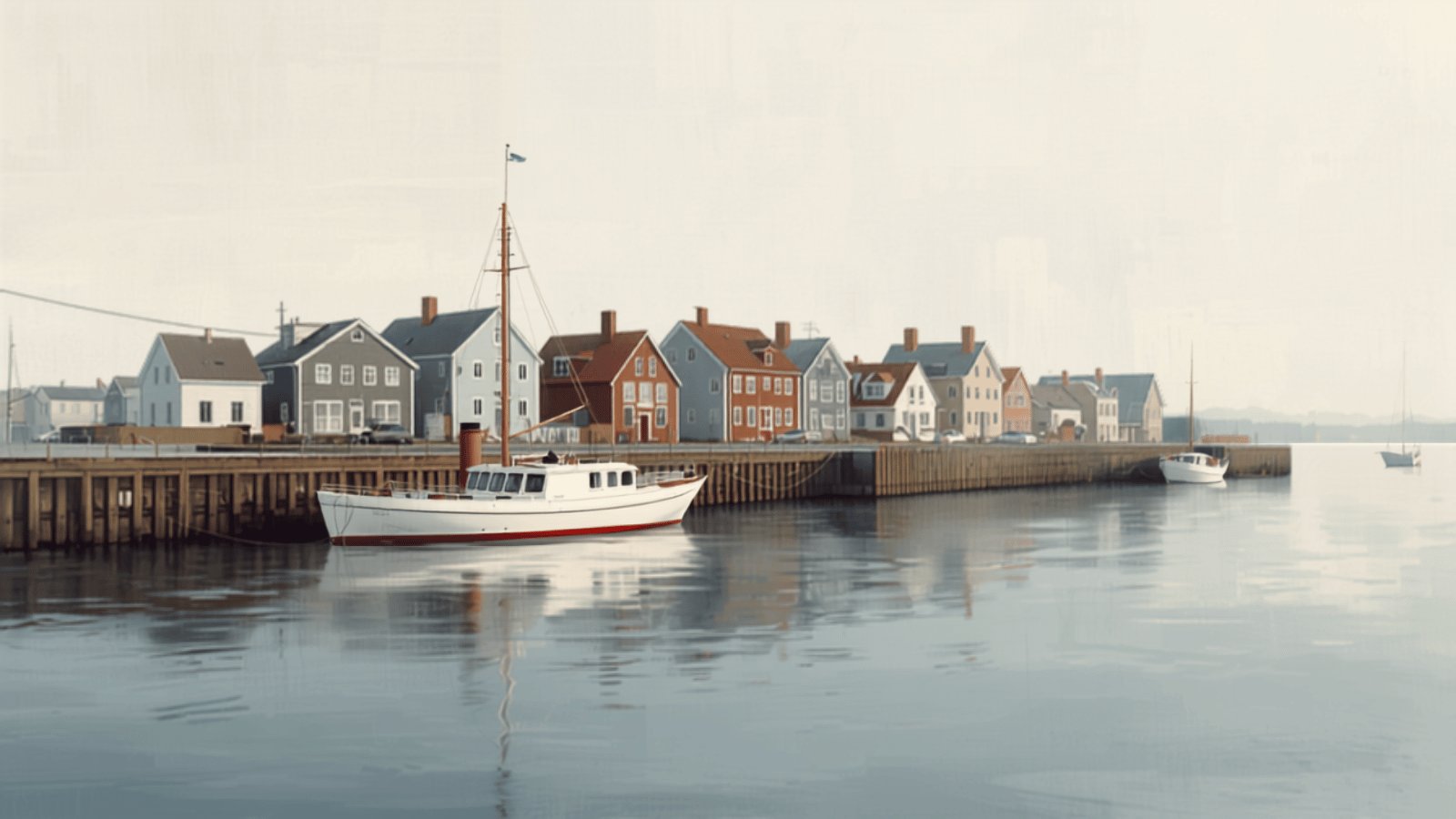
B2 · UPPER-INTERMEDIATE Reading practice · ~3,100 words · 20-min read
This is an original short story for upper-intermediate learners. It is a quiet travel story about a young woman who takes a strange ferry to a small northern island — one that only sails once a week — and meets one of the last people who still lives there. Read the eight key words first. Then follow the story chapter by chapter. There is a comprehension quiz at the end.
Before you read — 8 key words
- remote — far away from towns, cities, and other people, and often difficult to reach. A remote island is one you cannot easily walk, drive, or fly to.
- weathered — worn and shaped over a long time by wind, rain, sun, and salt. A weathered face is one that has clearly spent many years outside; a weathered sign is one whose paint has faded.
- cobblestone — a small, rounded stone that was used, especially in old towns, to pave streets before smooth concrete and tarmac existed. Cobblestone streets are pretty but hard to walk on quickly.
- linger — to stay somewhere longer than you really need to, because you do not want to leave. You linger over a good meal, or on a beach at sunset.
- inhabitant — a person or animal that lives in a particular place. The inhabitants of a small village are the people who live there all year round, not the visitors.
- timetable — a written list showing the exact times at which buses, trains, boats, or planes arrive and leave. Also, in schools, the plan of lessons for the week.
- inheritance — money, property, or a way of life passed from an older generation to a younger one, especially after someone dies. An inheritance can be a house, a business, a language, or even a whole village.
- dwell — to think or talk about something for a long time, usually about the past. Also, in older English, to live somewhere. “Do not dwell on it” means: do not keep thinking about it.
The story
1 · Off the timetable
Marta had been travelling on her own for three weeks, and she had already learned two things about herself. The first was that she was, in fact, capable of eating dinner alone in restaurants without pretending to read her phone. The second was that whenever she saw a timetable — that is, a list of arrivals and departures — pinned to a wall in a language she did not really understand, she wanted to get on whichever bus, train, or boat left first.
That was how she had ended up in Halsviken, a small coastal town in the far north, on a cold, bright Tuesday morning in September. The town had a single main street, a fish market that closed at eleven, and a stone harbour where the water was so clear you could see the ropes trailing under the boats. Marta drank a slow coffee in the harbour café and watched a red fishing boat leave in the direction of the open sea.
On the wall of the café, between a poster for a summer festival that had already ended and a hand-drawn map of the coast, there was a small wooden sign. It was clearly old. The paint on it had faded to a pale grey-blue, and the letters had been worn down by decades of wind and salt. Marta got up from her table, walked across the café, and read it slowly.
The sign said:
FERRY TO SKARÖ · WEDNESDAYS ONLY · 09:00 · RETURNS 15:00
That was it. No prices, no phone number, no year. Just those three lines.
Marta went back to the counter. The woman behind it, who had been washing cups when she came in, was reading a magazine now. Marta pointed at the sign through the window.
“Excuse me,” she said, in careful English. “The ferry — the one to Skarö. Does it still run?”
The woman looked up, followed Marta’s finger, and smiled a small, tired smile. She said that it did still run, yes, though not many people took it any more. She said that in summer there were maybe fifteen passengers on a good day, and that in October it dropped to five or six, and that by January it was often just her cousin and the postman. She said that Marta had come at a strange time — the sea was not yet cold, but the tourists had already gone home. If Marta really wanted to see the island, she added, tomorrow was the day.
Marta asked how far Skarö was. The woman said it was one hour by boat — that used to be remote, meaning far away and hard to reach, but now, with the ferry, it was really just a morning. She added that once you were on Skarö you were on Skarö. There was no bridge. If you missed the return ferry, you slept in a fisherman’s shed and waited a week.
Marta thought about this for a moment. She had not planned to stay in Halsviken more than one night. She had a train ticket to the capital for Thursday morning. She could still make that train if she caught the return ferry at three o’clock. She had four hours on an island she had never heard of before, in a country she had known for exactly nineteen days, with strangers who would probably speak very little English.
She said, “One ticket, please.”
The woman laughed and reached for a small cash box under the counter. She said the ticket was not sold at the café — it was sold on the boat itself, by the captain — but she would keep a place for Marta with her cousin, and Marta should be on the harbour wall at ten to nine tomorrow morning. She should not, the woman said, be late. There was no second boat.
2 · The four-hour promise
At ten to nine on Wednesday morning, Marta was on the harbour wall. She had a small backpack, a bottle of water, a sandwich wrapped in wax paper, and a notebook she had barely opened for a week. It was cold. Her breath made a thin white cloud in the still air. The sky was the pale blue of very early autumn, and the sea was as flat as a mirror.
She had expected the ferry to be bigger. When it came round the corner of the harbour wall, she saw a small blue and white fishing boat with the word SKARÖ painted along the side in fresh white letters. The captain was a broad-shouldered man of about sixty, with a face that had clearly spent many decades looking into the wind. Marta learned later that the word for such a face was weathered — worn and shaped by many years of sun, rain, and sea air.
There were only four other passengers. A young man with a large bag of tools. Two older women with wicker baskets covered in cloth. And a boy of about ten, who stood at the front of the boat and watched the water without speaking.
The captain sold Marta her ticket in exchange for a folded note that she was fairly sure was twice the price she should have paid. He did not give her change. Instead, he pointed at the sea and said, in slow, patient English: “One hour there. Four hours on Skarö. One hour back. This is the whole day. Miss the boat and you stay one week.”
Marta nodded seriously. She promised him that she would not be late.
The captain smiled — one quick, kind smile — and told her that if she wanted to understand Skarö, she should not try to walk everywhere. He said she should sit in one place and let the island come to her. He said that most visitors tried to see everything and saw nothing. He said the old people on the island would find her long before she found them. Then he turned and started the engine.
The engine was much louder than Marta had expected. The boat pulled away from the harbour, past the sleeping fishing boats and the low grey warehouses, and out into the open sea. The wooden bench she was sitting on was cold through her jeans. She watched the town shrink behind her until the wooden sign in the café window was too small to see, and Halsviken was only a handful of red and white shapes at the base of the cliffs.
For nearly an hour, they saw no land at all. Then, very slowly, a low, dark shape rose out of the sea ahead of them. It was not a mountain and not a hill: it was more like the back of a whale, resting on the water. A single white church tower stood at one end. A grey stone lighthouse stood at the other. Between them, half hidden in a soft morning mist, was a scatter of small red and yellow houses.
That, the captain shouted over his shoulder, was Skarö.
3 · Signe
Marta stepped off the boat onto a small stone jetty and looked around.
Skarö was, she thought immediately, even more beautiful than the woman in the café had said. It was also more empty. She could count only four boats in the tiny harbour, and one of them looked as though it had not moved in years. The road that led up from the jetty was made of round grey cobblestones — small, rounded stones used to pave streets a long time before roads were smooth. Wild grass grew between them. A single yellow cat sat on a low wall and watched her arrive without much interest.
She started walking, slowly, into the village. The captain had told her the boat would leave again at three o’clock sharp. She looked at her watch. It was ten past ten. She had almost five hours.
The village had one main street. It ran from the harbour up to a small square with a stone well in the middle. On either side of the street stood small painted houses — red, yellow, and one, quite unexpectedly, bright pink. Most had white shutters. Most of the shutters were closed. Above the door of one house, a wooden board had been carved in careful old letters. It read BAKERY. But when Marta pressed her nose to the glass, the room inside was completely empty.
She was standing there, trying to make sense of it, when a voice behind her said, in surprisingly clear English: “There is no bread on Wednesdays. There is no bread most days.”
Marta turned. On a bench across the street, in the pale sunshine, sat an old woman with short, straight, silver-white hair. She wore a heavy dark green coat and thick woollen socks inside leather sandals, and her hands were folded neatly in her lap. She was, Marta guessed, in her late seventies.
The old woman said her name was Signe. She said that she had watched Marta since the ferry arrived — that from her bench she saw every visitor, all fifteen of them in a good summer week — and that she liked to guess where they had come from before they told her. She said she had already decided that Marta was travelling alone, that she had missed a train somewhere and did not really care, and that she would probably almost miss the ferry home. Marta laughed. Signe was two-thirds right on the very first Wednesday of her life on the island.
Marta sat down on the bench next to her. It felt like the natural thing to do.
Signe told her, in the slow way of someone who has had many months to think about what she wants to say, that she had been born on Skarö in a year that was hard to imagine now. She said her father had been the last lighthouse keeper, and her mother had been the schoolteacher. She said that in the small stone school building on the hill she had learned to read and write, first in her own language and then, one strange winter, in English — from a book the village priest had brought back from the mainland.
Marta told her, in return, where she had come from and where she was going. Signe listened without interrupting. When Marta had finished, Signe asked her, quietly, whether she had planned this trip, or whether it had happened to her. Marta thought about that for a long moment before she answered.
“It has mostly happened to me,” she said.
Signe nodded, as if that was the right answer.
The word linger means to stay somewhere longer than you really need to, because you do not want to leave. Marta had planned to walk up to the lighthouse, then to the church, then along the low grey cliffs. She did none of those things. She lingered on the bench with Signe.
4 · The last inhabitants
For the next two hours, in the pale September sun, Signe told Marta the story of Skarö.
She said that when she had been a small child, seventy years ago, there had been more than four hundred inhabitants on the island — meaning more than four hundred people who lived and worked there all year round. She said there had been three small fishing companies, a school with two teachers, a doctor who came every fortnight from the mainland, and a small dance hall above the bakery where the boys had learned to dance so badly with the girls that some of them had never dared to marry.
There had, she said, been a proper timetable on the wall of the harbour house — a full list of arrivals and departures — with a ferry to the mainland five times a week. Two ferries in summer. Sometimes she remembered the timetable so clearly that she could still recite the times of the Tuesday afternoon boat. She said that when the big storm of 1963 tore down the roof of the fish hall, everyone on the island had helped to rebuild it in six weeks. She said the smell of new wood in her memory was the smell of her whole childhood.
Then she talked about the leaving.
The young people, she said, had begun to move to the mainland in the late 1970s. There was more money there, and more work, and more of everything except silence and open sky. Her own two brothers had gone to work in the shipyards on the west coast when they were nineteen and twenty-one. The school had closed in 1989. The bakery had closed in 2004. The doctor had stopped coming in 2011. By now, said Signe, only nine people still lived on Skarö all year round, and seven of them, including herself, were over seventy. The word for the wooden houses that stood empty along the main street was, she said, a very ordinary word: houses. But they were also, in another way, an inheritance — the buildings, skills, and knowledge passed from an older generation — and there was no next generation on the island to inherit them.
Marta asked, gently, why she stayed.
Signe did not answer straight away. She looked at the harbour, where the small blue and white boat sat waiting in the still water, and she said something that Marta thought about for many months afterwards.
She said that she had thought about it every year on her birthday for twenty years. Her son had told her, several times, that the family had built a small warm flat for her in the town where he lived. He had told her that the winters on Skarö were becoming dangerous, and that she was no longer young. He had told her that if she came to the mainland, she would see her grandchildren every Sunday, not once a year, and that she would live longer.
Everyone had been right, Signe said, about all of these things. But every time she had lifted her bag to go, she had realised that she would not be Signe on the mainland. She would be an old woman in a warm flat who had come from somewhere and now lived here. On Skarö, she was still, and would always be, the schoolteacher’s daughter, the lighthouse keeper’s daughter, the girl who had helped rebuild the fish hall in 1963.
She said that maybe, at seventy-nine, that was not a good enough reason.
But it was the reason.
Marta said nothing for a long time. Then she asked whether she could write some of this down. Signe smiled the same small, tired smile the woman in the harbour café had given her the day before, and said she did not mind if Marta wrote it down, so long as she did not lie about it. She said Marta could pretend, if she liked, that Signe’s name had been something else — perhaps Elin, or Kajsa — but that the island had to be Skarö. It was, she said, the whole point.
Then Signe pointed at Marta’s watch. It was already half past two.
Marta had dwelt on the bench — meaning she had stayed and let her mind stay on Signe’s words — for over two hours without noticing. The captain had been right: she had not walked to the lighthouse. She had not seen the church. She had not eaten her sandwich. And she had not, until this exact moment, remembered that she had a ferry to catch.
She stood up so quickly she nearly knocked over Signe’s tea, which the old woman had, at some point Marta could not quite remember, put down beside her on the bench.
5 · The whistle
Marta ran.
She ran down the cobblestone street, past the empty bakery, past the yellow cat, past the closed shutters and the pink house and the stone well. Her backpack banged against her back. The captain’s warning was suddenly loud in her head, in the same careful English he had used on the boat: Miss the boat and you stay one week.
Halfway down the street, she made herself stop. She turned and looked back up the hill. Signe had stood up from the bench and was watching her go. From this distance, she looked smaller than she had felt beside her — a small green figure in front of a small pink house in front of a huge grey sky.
Marta raised a hand. Signe raised hers. They held the wave for maybe five seconds, and then Signe sat down again on the bench, and Marta turned and ran on.
She reached the jetty at twenty-two minutes to three. The captain was already on the boat, checking his ropes. He looked up when he saw her running and shook his head slowly, but he was smiling. He said, in his slow English, that he had known she would be late. He said that if she had not come, he would have waited only two more minutes and then he would have left, because the tide was going. He said that the woman in the café had told him: she has a look; she will linger.
That, Marta thought as she climbed on board, was the third time in two days that a stranger had told her exactly what kind of traveller she was, without her ever having to say a word.
The engine started. The blue and white boat pulled away from Skarö. Marta stood at the back and watched the island for as long as she could see it — the church, the lighthouse, the tiny scatter of red and yellow houses, the small green figure that she was sure, though she could no longer really see, was still sitting on a bench in the empty main square.
When Skarö had shrunk to a low, dark shape on the horizon, Marta finally opened her notebook. She turned to a clean page and began to write. She wrote about the timetable that no longer worked. She wrote about the empty bakery. She wrote about the four hundred inhabitants who had once lived on the island, and the nine who still did. She wrote what Signe had told her about the winter, and the flat on the mainland, and the reason she had not gone. She wrote, carefully and in the past, every sentence she could remember exactly.
Reported speech, she realised, was for a moment like this: when you tried to give someone else’s words a second life, days or years later, in a room they would never see. Signe said that she had always known she would stay. She said her son had asked her to come many times. She had told him no.
Marta was still writing when the boat rounded the harbour wall of Halsviken. She had her four hours behind her now. She had a train ticket in her pocket for Thursday morning. And she had, she thought, the first real chapter of her whole journey.
She did not, yet, know what Skarö would become for her over the winter that was coming, or why she would find herself, six months later, sitting in a small warm flat on the mainland opposite Signe’s son, showing him the notebook.
But that is another story.
Check your understanding
Read each question. Think about your answer. Then click “Show answer” to check.
Words to remember
Here are the eight key words again, in fresh sentences. Say each one out loud, then try to make your own sentence with it.
- remote — The research station stood on a remote stretch of coast, more than eighty kilometres from the nearest town.
- weathered — His hands were rough and weathered from thirty winters of fishing in the North Sea.
- cobblestone — Tourists love the cobblestone streets of the old quarter, but they are hard to walk on in heels.
- linger — We lingered at the café long after our coffee had gone cold, because the conversation was too good to end.
- inhabitant — The island has fewer than two hundred permanent inhabitants, most of them over the age of sixty.
- timetable — I always check the train timetable the night before, because in winter the last service leaves an hour earlier.
- inheritance — Her grandmother’s recipes were a small but meaningful inheritance, and she cooked from them every Sunday.
- dwell — Try not to dwell on the interview any more — you did your best, and the result is out of your hands now.
Grammar in this story: reported speech
Almost the whole story is reported speech — the writer telling us what other people said, rather than showing us the words in direct quotes. Look at these examples from the boat trip and from Signe’s bench:
Signe said that she had been born on Skarö in a year that was hard to imagine now.
Her son had told her that she would see her grandchildren every Sunday.
The captain said that the woman in the café had told him: “she has a look; she will linger.”
Notice how the tenses “step back” one step into the past. Signe’s original words were probably: “I was born on Skarö…” — present-day past simple was. When Marta reports it later, was moves back into the past perfect: had been. In the same way, direct will see becomes reported would see, and direct said becomes reported had told.
This is why reported speech feels so useful in travel writing: it lets you carry a whole conversation home with you and put it on the page hours, weeks, or months later. That is exactly what Marta does with her notebook on the ferry back to Halsviken.
👉 Learn the full rules and see more examples here: Reported Speech — a B2 grammar guide.
Talk about it · Write about it
Talk about it: Signe stays on Skarö because leaving would change who she is. Is there a place — a town, a village, a house, a country — that shapes your identity in that way? Would you stay there even if everyone you loved moved away? Why, or why not?
Write about it: Write 120–150 words about a real conversation you have had with a stranger while travelling. Use reported speech for at least three sentences, for example: She said that she had lived in the town all her life. She told me that the bus would not come until eight. She asked me where I was going.
🎉 Well done — you have just finished over 3,000 words of real, unadapted English reading. That is a serious workout for your brain, and you did it.
But wait — why is Marta, six months later, sitting in a warm mainland flat opposite Signe’s son, showing him the notebook? What happens between one Wednesday in September and a spring afternoon on the mainland? Write your own ending, using details from the story to explain your choice.
Dina receives a memo about a tram line. Read the last-tram story and compare a decision on paper with its effect on people. Next story: The Last Tram (B2 Reading Story)
About this story: This is an original B2 graded reader (~3,100 words). The vocabulary is kept inside the B2 range, and any harder word (like remote, weathered, inheritance, or dwell) is glossed before the story and reused inside it and again in the review list. The grammar mixes past simple, past perfect, and reported speech — the shapes upper-intermediate readers most need to see in real, connected prose.

I’m Khamis Maiouf. I’m studying Health and Social Care and have completed Functional Skills Level 2 in English and Level 3 Hairdressing. I have taught ESOL in my community and helped students with GCSE English. I run English Teacher Site to help people learn and practise English.