
The Woman Who Listened to Bridges (B2 Reading Story)

B2 · UPPER-INTERMEDIATE Reading practice · ~3,200 words · 16-min read
This is an original biography of an imagined woman: an engineer who was never allowed to call herself one. It is written for upper-intermediate readers. First, study the ten key words below. Then read the story — it is told in seven short chapters. At the end, there are questions to check your understanding.
Before you read — 10 key words
- apprentice — a young person who learns a skilled job by working with an expert.
- vibration — a very fast, small shaking movement that you can often feel or hear.
- rivet — a short metal pin that holds two pieces of steel together, used in old bridges.
- tuning fork — a small metal tool that makes one pure musical note when you strike it.
- inspection — a careful official check of something, to make sure it is safe or correct.
- collapse — (of a building or bridge) to fall down suddenly; also the noun for this event.
- dismiss — to refuse to take a person or an idea seriously.
- reputation — the opinion that people in general have about someone.
- archive — a collection of old documents, kept so that history is not lost.
- obituary — a short article in a newspaper about the life of a person who has just died.
The story
1 · The piano tuner’s daughter
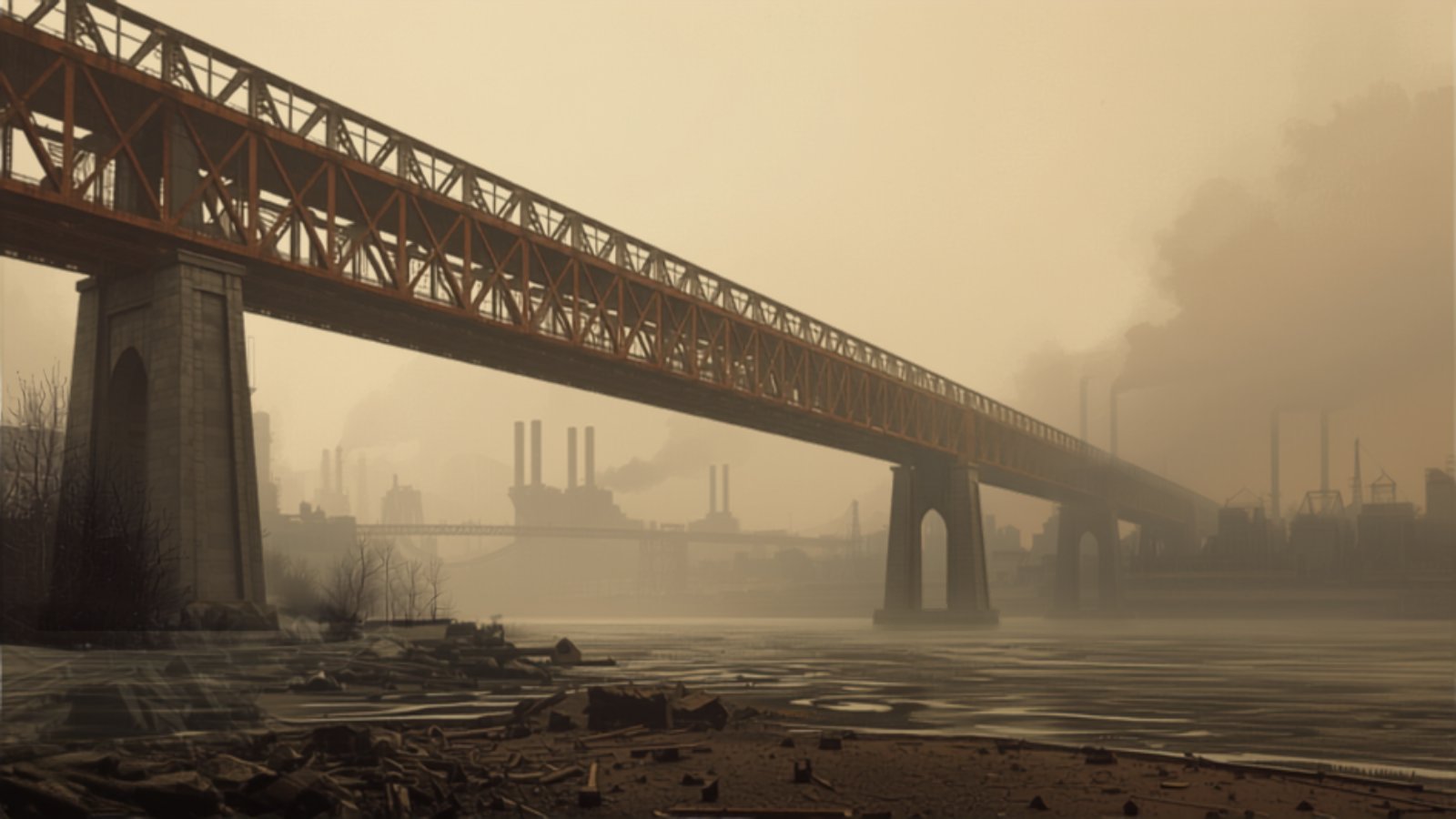
Elena Varga was born in 1904 in Greywater, a cold industrial city built on both sides of a wide river. The city was famous for two things: its steel works and its bridges. Seven bridges crossed the river, and the largest of them, the Corvin Bridge, was said to be the finest piece of engineering in the country. Postcards were printed of it. Songs were written about it. Every child in Greywater grew up under its long iron shadow.
Her family lived in three rented rooms above a bakery on Chain Street, close enough to the river to smell it. Her mother took in sewing work and dreamed, out loud and often, of a quieter town with fewer chimneys. Elena had no brothers or sisters, which meant she spent most of her childhood in the company of adults — and of sounds. The bakery ovens ticked as they cooled at night. The baker’s cat purred against the warm wall. Greywater was never silent, and Elena never wanted it to be.
Elena’s father, Tomas Varga, was a piano tuner. He was a quiet man who carried his tools in a leather bag and his tuning fork in his breast pocket, next to his heart. From the age of six, Elena went with him to grand houses, concert halls and dusty schoolrooms. While other children were taught to look, Elena was taught to listen.
“Every object has a voice,” her father told her. “Wood, wire, iron — everything. When something is healthy, it sings in tune. When something is damaged, it sings a little flat. You cannot always see the damage. But if you are patient, you can always hear it.”
He would strike his tuning fork against his knee, hold it to a piano string, and close his eyes. Elena learned to do the same. By the time she was ten, she could tell which string was wrong before her father had opened the piano lid. By the time she was twelve, she had discovered something stranger: the whole city had voices. Tram rails hummed differently on cold mornings. Factory chimneys moaned before storms. And the bridges — the bridges sang.
Her favourite was the Corvin Bridge. She would stand beneath it with her eyes closed while trains crossed above her, and listen to the deep steel note that rolled down through the girders. Years later, she wrote in her notebook: “Other girls had lullabies. I had the Corvin Bridge. It was the first thing I ever truly listened to, and the last thing I ever stopped hearing.”
2 · The apprentice who was not an apprentice
Elena finished school at fourteen with the best marks in her class, especially in mathematics. Her teacher visited the family and suggested, carefully, that the girl might study engineering. Her mother laughed. Her father did not laugh, but he shook his head. It was 1918, the war had just ended, money was short, and in Greywater there was a simple rule: engineering was not for women. The technical institute did not accept female students. It was not even necessary to write the rule down; everybody knew it.
So Elena did the next best thing. At sixteen, she was given a job as a copyist in the drawing office of the City Bridge Authority — the department responsible for the inspection and repair of all seven bridges. Her work was to make clean copies of engineering drawings. She was, officially, a kind of human photocopier.
Unofficially, she became an apprentice — an apprentice who was never called one. While she copied the drawings, she studied them. She taught herself the language of load, stress and tension. She borrowed technical books through a friendly librarian, since women were not permitted to enter the institute’s library themselves. If a calculation appeared in a drawing, she repeated it at home until she could do it faster than the engineers who had signed it.
Her routine in those years hardly ever changed. She worked at the Bridge Authority from eight until six. She ate supper with her parents. Then, from eight until midnight, she studied at the kitchen table: mathematics on Mondays and Thursdays, materials science on Tuesdays and Fridays, and on the other nights whatever the librarian, Miss Adler, had managed to find for her. Miss Adler was a small, fierce woman who considered the institute’s rule about female readers to be personally offensive, and who smuggled books out under her coat with the calm face of a criminal mastermind. Without her, Elena said later, there would have been no method, no notebooks, and no story worth telling.
The chief engineer, a heavy, red-faced man named Brandt, barely noticed her. But an older inspector called Mr Okafor did. He had worked on bridges for thirty years, and he had lost two fingers and many illusions doing it. One evening, he found Elena correcting an error in a drawing she was supposed simply to copy.
“Who taught you that?” he asked.
“Nobody,” she said, frightened. “The number was wrong. If it had been built like this, the beam would have failed.”
Mr Okafor looked at the drawing for a long time. Then he said quietly, “From now on, you check everything that crosses this desk. And we will not mention it to anyone.”
For ten years, that was the arrangement. The reports were signed by men. The mistakes were found by Elena. It was said in the office, as a joke, that the drawings “corrected themselves at night”. Elena kept the joke, and her silence, and her notebooks.
3 · The bridge that sang flat
In the autumn of 1934, Elena was thirty years old, and the Corvin Bridge was fifty. On a grey October morning, she was walking to work beneath it, as she had done for years, when a coal train crossed above her. She stopped in the middle of the street.
The bridge sang flat.
It was a tiny change — the deep steel note was lower and rougher than it should have been, like a great string that had begun to lose its tension. No ordinary passer-by would have noticed anything at all. But Elena had listened to this bridge for a quarter of a century. She knew its voice the way you know the voice of someone you love. And she knew, with cold certainty, that something inside it had changed.
That evening she returned with her father’s old tuning fork and a notebook. She struck the fork against the iron and listened to how the sound travelled. She did this at twenty different points along the structure, night after night, for two weeks. The pattern she found frightened her. Near the third pier, on the northern side, the vibration died early — the sound was being swallowed. In a healthy structure, the vibration should ring on; where metal is cracked, the ring is cut short. Somewhere inside that pier, hidden under fifty years of paint, rivets were failing. She could not see a single one of them. She could hear them all.
The work was slow, cold and, if she had been caught, impossible to explain. She went out after eleven, when the last trams had stopped, wearing her father’s old coat and carrying a shaded lantern. To reach the lower girders of the third pier she had to climb down an iron service ladder above black, moving water — a climb that frightened her every single time, and that she made forty times that autumn. She numbered every testing point with chalk, struck the fork, counted the seconds of ring, and wrote the figures down with fingers that could barely hold the pencil. If the method sounds simple, the discipline behind it was not. Science, her father had once said, is mostly the art of doing the same boring thing correctly, many times, in the dark.
Elena wrote a report — the first report of her life that she intended to sign with her own name. She described her method, her measurements, and her conclusion: the Corvin Bridge should be closed to heavy rail traffic until the third pier had been opened and examined. She was careful, precise and, she believed, impossible to ignore.
She was wrong about the last part.
4 · Dismissed
Chief Engineer Brandt read the report in four minutes, which was less time than Elena had spent checking a single line of it. He announced that the bridge had passed its official inspection only two years earlier. He reminded the office that the city’s anniversary celebrations — with a parade across the Corvin Bridge — were planned for the spring. And then he asked the question that Elena would remember for the rest of her life:
“Are we really being asked to close the finest bridge in the country because a girl from the copying room says it sounds sad?”
The room laughed. The report was dismissed. It was not filed, it was not answered; it was simply dropped into a drawer, the way you drop a ticket after the journey. Elena was warned that if she “spread alarm” outside the office, she would lose her job.
Only Mr Okafor, now close to retirement, came to her desk that evening. “They laughed at you because of two things,” he said. “Because of what you are, and because of what your method is. If you had been a man with a machine, they would have listened. You are a woman with a tuning fork.”
“Then what should I do?”
“What tuners do,” he said. “Test the string again. And again. And write everything down. Paper is patient. One day, someone will read it.”
All that winter, Elena continued her measurements in secret. The flat note grew flatter. In February she sent her report directly to the city council — and this time she was punished. She was moved out of the drawing office to a clerk’s job in the records department, in the basement, where, it was assumed, she could do no more damage to anyone’s reputation. Her new office had no window. It did, however, have the entire archive of the City Bridge Authority, going back seventy years. Locking a researcher in an archive as a punishment is like locking a child in a sweet shop. Within a month, Elena had found the construction records of the Corvin Bridge — and in them, a quiet horror: in 1884, to save money, the builders had used cheaper rivets in exactly one place. The third pier. Northern side.
5 · The eleventh of April
What happened on the night of 11 April 1935 was reconstructed many times afterwards — by the newspapers, by the courts, and, decades later, by historians. This much is agreed by everyone.
Shortly before midnight, a storm rose over Greywater, the heaviest in thirty years. Elena, who had been recording the bridge’s voice in the rain, heard something new: a slow tearing sound from the third pier, repeated every time the wind pushed against the structure. It was no longer the sound of a bridge that might fail one day. It was the sound of a bridge that was failing now — and the 2 a.m. night train from the steel works, four hundred workers aboard, was due to cross in two hours.
She ran first to the bridge master’s house and was not believed. She ran next to the police station, dripping and shouting, and was nearly arrested. It was Mr Okafor — woken by her hammering on his door — who saved everything. He was known; he was trusted; he was a man. He telephoned the railway’s night controller and told him, calmly, that he would take personal responsibility. The 2 a.m. train was held at the steel works. The bridge was closed with lanterns and rope.
At 3:40 a.m., with the storm at its worst, the northern side of the third pier gave way. The Corvin Bridge did not fall completely — bridges of that design rarely do — but eighty metres of track folded slowly into the dark river, with a sound that people across the city mistook for thunder. The collapse killed no one. The station clock at the steel works showed exactly where the night train would have been if it had not been held: on the eightieth metre.
The four hundred workers of the night shift learned what had nearly happened to them only at dawn, when they walked to the riverbank and saw the gap where the track had been. Some of them wept. One of them, a furnace man named Petrescu, asked who had raised the alarm, and was told that an old inspector had made a telephone call. He shook Mr Okafor’s hand so hard that it hurt for a week. Mr Okafor, to his lasting credit, kept saying the same sentence to anyone who would listen: “I only made the call. The warning was hers.” Very few newspapers printed the second half of that sentence.
In the morning, the city stood on the riverbank in silence and looked at the broken postcard picture. The inquiry that followed lasted a year. Brandt claimed that no clear warning had ever reached his desk; the warning was then found in his drawer, with Elena’s signature on it, dated six months before the collapse. He was quietly retired. Elena Varga’s name appeared in the newspapers for the first time in her life — spelled wrong.
6 · The method without a name
You might expect that Elena’s life changed overnight. It did not — or not in the way that a film would tell it. The technical institute did not suddenly open its doors. She was never given the title of engineer, and her salary as a “records clerk” rose only once in the next ten years. But something more interesting happened: her method survived, even where her name did not.
The new chief engineer, a younger man shaken by how close the city had come to catastrophe, asked her to explain how she had known. Elena taught him what her father had taught her: strike, listen, compare, record. Struck metal rings true where it is healthy and rings short where it is cracked. The Bridge Authority began to test rivets by sound as part of every inspection. Inspectors were trained — trained, though nobody said so aloud, by the woman from the basement. When acoustic testing machines were finally invented years later, the old inspectors of Greywater shrugged; they had been doing it with hammers and tuning forks since 1936. The technique was known in the trade simply as “the Greywater method”. If anyone asked where it came from, the answer was vague. Methods, like bridges, are usually assumed to have been built by men.
Then came the second war, and Greywater’s bridges became targets. Twice the city was bombed; twice the raids missed the rebuilt Corvin and struck the smaller crossings instead. In those years Elena’s listening skills were suddenly wanted everywhere. Damaged structures had to be tested quickly, with no instruments and no time, and it turned out that the fastest testing instrument in the city was a middle-aged records clerk with a tuning fork. She examined bombed bridges, cracked factory roofs and one shaking water tower, always arriving on a bicycle, always writing her findings in the same small notebooks. If the war had lasted longer, she might finally have been given a title. It ended, the men came home, and Elena went back to the basement.
Elena never married, which the neighbours found strange, and never complained, which historians later found stranger. She looked after her father until his death in 1949, and she kept his tuning fork in her own breast pocket ever after. Each year, on the eleventh of April, she walked to the rebuilt Corvin Bridge, struck the fork against the new steel, and listened. “In tune,” she would write in her notebook — one entry a year, for thirty-eight years.
She retired at sixty-five from the same basement office she had been sent to as a punishment. At her small leaving party, the young engineers presented her with flowers and called her “the memory of the department”. By then, hardly anyone remembered that the memory of the department had once saved four hundred lives with a piece of bent metal that made a single pure note.
7 · The obituary
Elena Varga died in the winter of 1979, at the age of seventy-five. The Greywater Evening Post printed a three-line obituary: “VARGA, Elena. Retired records clerk of the City Bridge Authority. She is remembered by her colleagues.” That, it seemed, was to be the final word on her life: a woman filed away, like her first report, in a drawer.
It was not the final word, because of a student.
In 2004 — one hundred years after Elena’s birth — a young engineering student named Ada Bell was sent into the city archive to research the 1935 collapse for her thesis. In a box that had not been opened for decades, she found forty-one notebooks in small, neat handwriting: measurements, calculations, sound patterns, and the sentence about lullabies and the Corvin Bridge. It took Ada three days to understand what she was holding, and three years to convince the world. The notebooks were examined by historians and engineers; the method described in them was compared with modern acoustic testing and found to be, in the words of one professor, “sixty years ahead of its instruments”.
The rediscovery was not smooth. When Ada first presented the notebooks at a conference, an older professor suggested, politely, that a self-taught woman of that period could not have produced such work, and that the notebooks had probably been copied from some forgotten engineer. Ada answered by doing what Elena would have done: she tested the claim. The handwriting was matched to Elena’s employment records. The paper and ink were dated. The measurements in notebook nineteen were compared with the damage actually found in the collapsed pier in 1935 — they agreed to the centimetre. “At some point,” Ada told the conference, “the most scientific position in this room is to accept the evidence. She heard it. Nobody helped her. That is the whole, uncomfortable point.”
Today, if you visit Greywater, you can walk across the Elena Varga Bridge — the Corvin was renamed on the eightieth anniversary of the night it did not fall. On the third pier, northern side, there is a small bronze plaque showing a tuning fork, and beneath it her own words, taken from notebook number one: “You cannot always see the damage. If you are patient, you can always hear it.”
Ada Bell, now a professor herself, ends her lectures on Elena with the same challenge every year. “The notebooks contain one measurement we still cannot explain,” she tells her students. “Notebook forty-one, final page, dated three days before her death. Elena tested one of the six other bridges of Greywater — and marked it flat.”
She never wrote down which one.
Check your understanding
Read each question. Think about your answer. Then click “Show answer” to check.
Words to remember
Here are the key words again, in new sentences. Try to write one sentence of your own for each.
- apprentice — He spent four years as an apprentice before he was allowed to repair engines alone.
- vibration — If you touch the speaker, you can feel the vibration of the music in your fingers.
- rivet — Thousands of steel rivets hold the old ship’s plates together.
- tuning fork — The music teacher struck a tuning fork so the choir could find the right note.
- inspection — The restaurant was closed after it failed a health inspection.
- collapse — The old wall collapsed during the night, but luckily the street was empty.
- dismiss — Her warning was dismissed as impossible — until it came true.
- reputation — The company has a reputation for honesty, which took years to build.
- archive — The letters were discovered in the national archive, unopened for a century.
- obituary — His obituary described a quiet man who had secretly given millions to charity.
Grammar in this story: the passive voice
Biographies use the passive voice constantly, because what happened to a person often matters more than who did it. Look at these lines from the story:
Elena was born in 1904. Postcards were printed of the bridge. The report was dismissed. The train was held at the steel works. The Corvin was renamed on the eightieth anniversary.
Form: be (in the correct tense) + past participle. Notice how the passive lets the writer hide or ignore the “doer”: we never learn exactly who printed the postcards — and it does not matter. The story also uses the reporting passive: “The bridge was said to be the finest in the country.”
👉 Review the full rule here: Active vs Passive Voice Explained.
Talk about it · Write about it
Talk about it: Elena’s warning was dismissed because of who she was, not because of what she knew. Can you think of a real person — from history or from your own life — whose ideas were ignored at first and accepted later? What finally changed people’s minds?
Write about it: Write a short obituary (100–150 words) for an imaginary person who deserved more credit than they received in their lifetime. Use at least four passive forms, for example: was born, was known for, was never given, will be remembered.
🎉 Well done — you have just read a complete 3,200-word biography in English. That is serious reading practice, and you met all ten key words in action along the way.
But one question remains open, doesn’t it? Notebook forty-one, final page: one of Greywater’s six other bridges was marked flat — and Elena never said which. Somewhere in that city, a bridge is still singing slightly out of tune…
Amara works for the city council. Follow the piano in an empty building and consider what makes a place valuable. Next story: The Piano in the Empty Building (B2 Reading Story)
About this story: This is an original B2 graded reader (~3,200 words) about a fictional character. The vocabulary is controlled for upper-intermediate learners, and the grammar features passives, reported speech and conditionals — typical B2 structures. The ten harder words are explained before the story and reused inside it, so you should understand about 98% of what you read.

I’m Khamis Maiouf. I’m studying Health and Social Care and have completed Functional Skills Level 2 in English and Level 3 Hairdressing. I have taught ESOL in my community and helped students with GCSE English. I run English Teacher Site to help people learn and practise English.