
The Piano in the Empty Building (B2 Reading Story)

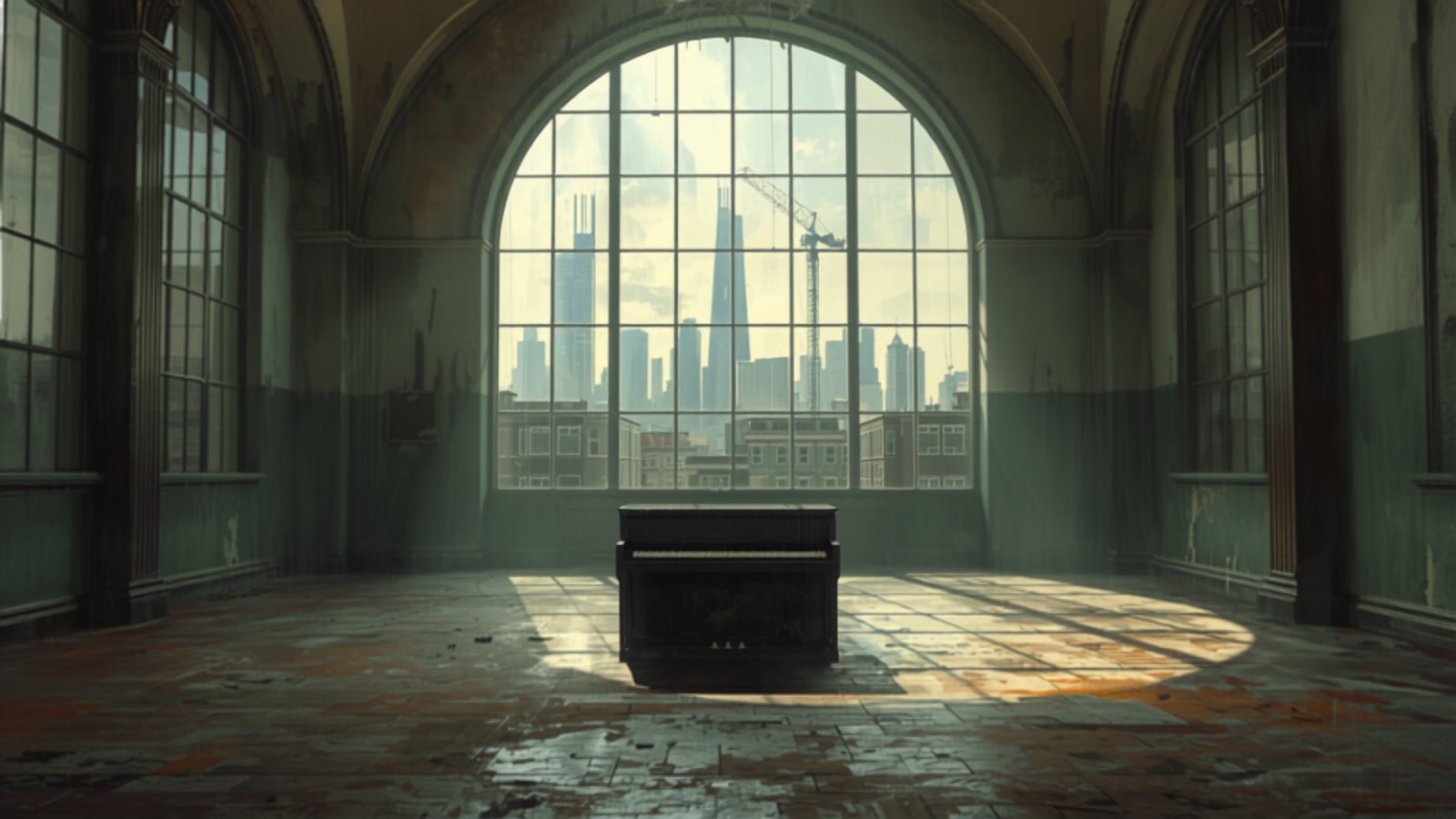
B2 · UPPER-INTERMEDIATE Reading practice · ~3,260 words · 16-min read
This is an original story for upper-intermediate learners. It is about a city that is changing fast — and about one sound that refuses to disappear. First, read the ten key words. Then read the story in eight short chapters. At the end, there is a quiz, a grammar focus, and ideas for speaking and writing.
Before you read — 10 key words
- demolition — the act of deliberately knocking down a building.
- condemned — officially declared unsafe, so nobody is allowed to live there.
- complaint — a formal statement that something is wrong or is annoying you.
- council — the local organisation that runs a town or city area.
- tenant — a person who pays rent to live in a flat or building.
- caretaker — a person whose job is to look after a building.
- petition — a document signed by many people, asking for something to change.
- developer — a company that buys land and puts new buildings on it.
- scaffolding — the metal poles and platforms built around a building while work is done on it.
- derelict — empty, no longer used, and in bad condition.
The story
1 · A complaint at two in the morning
Amara Okafor had worked for the city council for three years, and in that time she had learned one great truth about city life: nobody writes to the council to say thank you. People wrote when their bins were not collected. They wrote when the streetlight outside their window flickered all night. Mostly, they wrote about noise.
Amara worked in the noise team, on the fourth floor of the council offices, at a desk beside a window that had not been opened since 2009. Every morning she switched on her computer and read the complaints that had arrived during the night. Barking dogs. Late parties. A man on Cardew Street who practised the drums at midnight and claimed, when questioned, that he was “barely touching them”.
On the last Monday of September, at nine in the morning, she opened a complaint that made her put down her coffee.
“Piano music is being played every night in Harcourt Tower, usually between one and three in the morning. It is beautiful, but I have a baby who wakes up. Also — I thought that building was empty?”
Amara read it twice. The complaint had been sent by a young mother in the new riverside flats, the shining glass buildings that had grown up along the water in the last five years. And she was right to be confused. Harcourt Tower was not just empty. It was condemned.
The tower had been condemned two years earlier, after an inspection found cracks in the concrete. All the tenants had been moved out and rehoused across the city. The lifts had been switched off, the water had been disconnected, and the doors had been sealed. In six weeks, the building was going to be knocked down. The demolition had already been announced in the local paper: “Harcourt Tower to make way for 300 luxury apartments.”
So who, Amara wondered, was playing the piano on the thirty-first floor of a derelict building at two in the morning?
She should have simply forwarded the complaint to the security company. That was the procedure. Instead, she picked up her jacket and told her manager she was going out to investigate. If she had known where that decision would lead, she might have stayed at her desk. Or perhaps — and this is the strange thing about the choices we make in cities — perhaps she would have gone anyway, only faster.
2 · Harcourt Tower
Harcourt Tower stood at the edge of the old docks like a grey giant that the city was trying to forget. Thirty-four floors of concrete, built in 1968, when the future was supposed to be tall and everyone was supposed to want to live in the sky. Around its feet, scaffolding had already been put up, and a high fence carried the developer’s cheerful posters: smiling families, a gym, a café, a “sky garden”. Riverside Living. Coming 2028.
Amara showed her council card at the gate. The security guard, a tired man in his fifties called Denny, looked at her with mild surprise.
“Nobody from the council ever comes here,” he said. “They just send emails.”
“There’s been a complaint about music,” said Amara. “Piano music. At night. Coming from inside.”
She expected him to laugh. He didn’t. Instead, he looked away, towards the river, and rubbed the back of his neck the way people do when they are deciding whether to lie.
“Look,” he said at last. “You’ll find out anyway, and I’d rather you heard it from me. It’s not a ghost, and it’s not kids. It’s Mrs Marsh. Flat 31C. She never left.”
Amara stared at him. “That’s impossible. The building was emptied two years ago. Every tenant was rehoused. It was all signed off.”
“Every tenant signed the papers,” Denny agreed. “She signed them too. Then she gave the keys of her new flat to her nephew and walked back in through the car park. I was the caretaker here for twenty-two years before they made me a security guard, and I’ll tell you something for nothing: you can seal a building, but you can’t seal a person out of her own life.”
“And you didn’t report her?”
Denny shrugged. “She’s seventy-eight. She carries her shopping up thirty-one floors because the lifts are dead. In winter I run a cable from my hut so she has one heater and one lamp. If that costs me my job, so be it.” He paused. “Are you going to report her?”
Amara didn’t answer, because she didn’t know. “I’d like to meet her,” she said instead.
3 · Thirty-one floors
The staircase of a condemned tower is a museum of ordinary life. As Amara climbed, her torch picked out the things people leave behind when they are moved out in a hurry: a child’s shoe on the ninth floor, a calendar from 2024 still pinned to a door on the fifteenth, a plastic Christmas tree lying on its side on the twenty-second like a fallen soldier. The building was derelict, but it did not feel dead. It felt as if it were holding its breath.
By the twenty-fifth floor her legs were burning. By the twenty-ninth she had promised herself she would never complain about the office lift again. And then, somewhere above her, she heard it.
A piano.
Not practice scales. Not a learner picking out a tune. Real music — music that rose and fell like weather, that filled the concrete stairwell and made it sound, briefly, like a cathedral. Amara stood still on the stairs of a building that was scheduled to be destroyed, in the middle of an ordinary working day, and listened with her mouth open.
On the thirtieth floor she passed a door that had been painted with a rainbow, years ago, by some child who was now growing up on the other side of the city. Under the rainbow, in the careful letters of a person learning to write, someone had once added: WELCOME. The paint had faded, but the word was still doing its job.
The door of Flat 31C was open before she reached it.
“You took your time,” said the woman in the doorway. “I watched you cross the car park eleven minutes ago. Denny rang me on the walkie-talkie. Well? Come in. I’ve just put the kettle on the camping stove.”
Elena Marsh was small and straight-backed, with white hair pinned up and eyes that missed nothing. Her flat was warm with rugs and books, and completely ordinary — except for the wall of windows looking out over the whole glittering city, and except for the grand piano that stood in the middle of the living room like a black ship at anchor.
“Before you ask,” she said, pouring tea, “it came up in 1968, through that window, on a crane, when the building was three weeks old. My husband arranged it. It cannot go down the stairs, it cannot fit in a lift even if the lifts worked, and I am not leaving without it. The council moved my neighbours, my doctor’s surgery and my bus stop. It is not moving my piano.”
4 · Elena’s story
Over two cups of tea, Amara heard the whole story, and she forgot, for more than an hour, that she was there in an official capacity.
Elena Marsh had been a concert pianist. In the 1970s she had played in Vienna, Warsaw and Buenos Aires; there was a photograph on the piano of a young woman in a green dress bowing on a famous stage. Then her mother fell ill, and she came home, and somehow the concerts became lessons, and the world became this city, this tower, this flat. Her husband, a dock worker with enormous gentle hands, had died nine years ago. Half the city, she said, had learned the piano in her living room.
“For forty years, the children of this tower came up to me after school,” she said. “Plumbers’ daughters. Bus drivers’ sons. I charged whatever their parents could pay, and if they could pay nothing, they paid nothing. Three of my students became professionals. One of them played at the Proms.” She sipped her tea. “When the letter came saying the building had been condemned, everyone asked me where I would go. Nobody asked where the music would go.”
“Why do you play at night?” Amara asked.
“Because the city is honest at night,” said Elena. “During the day it pretends to be busy and important. At two in the morning it lies there like a tired dog and listens. And because,” she added, with the first crack in her voice, “the demolition is in six weeks, and I have not finished saying goodbye.”
Amara looked at the piano, at the photograph, at the whole city spread out below the windows — the new glass towers, the old brick streets, the river stitching them together. Somewhere down there, a baby was being woken every night by the most beautiful noise complaint she had ever investigated.
“Mrs Marsh,” she said slowly, “you understand that I’m required to report what I’ve found. You’re living in a condemned structure. It’s genuinely unsafe. If something happened to you up here — a fall, a fire — nobody could reach you.”
“Denny could,” said Elena. “But yes. I understand. You have your procedures.” She smiled, and it was a kind smile, which made it worse. “Tell me, dear. If the rules and the right thing point in different directions, which way does the council walk?”
5 · Rules are rules
Her manager’s name was Gerald, and Gerald had a poster on his wall that said TEAMWORK under a photograph of rowers, and Amara had never once seen him in a boat.
“Let me make sure I’ve understood,” he said, when she had finished her report. “An elderly woman has been living illegally in Harcourt Tower for two years. The security guard knew and said nothing. And your recommendation is — what, exactly? That we do nothing as well?”
“My recommendation is that we rehouse her properly, with the piano,” said Amara. “It was craned in through the window. It can be craned out the same way. The developer has cranes on site from next month anyway. It would cost them one morning.”
“The developer is not a removals company. And she was already rehoused. She was given a perfectly good flat, which she gave away. If it were up to me—” Gerald stopped, corrected himself. “It is up to me. She’ll be treated as a trespasser. I’m informing the demolition team and social services this afternoon. It’s for her own safety, Amara. If she were injured in there, it would be this office in the newspapers, not her.”
He was not entirely wrong, and that was the infuriating thing. The building really was dangerous. The rules really had been broken. If Amara had read this story in a report about another city, she might even have agreed with him.
But she had drunk Elena Marsh’s tea, and heard her play, and cities are not reports.
That evening, instead of going home, Amara sat in a café opposite the council offices and made a list on a napkin. She was a noise officer. She knew nothing about cranes, journalists or fundraising. But it is surprising what a person can find out in one evening if she is angry enough, and by the time the café closed, the napkin was full and her coffee was untouched.
At the top of the napkin she had written: SIX WEEKS. FIND THE STUDENTS.
Because that was the thing Gerald had missed, she thought, as she walked home through streets full of lit windows. He saw one old woman breaking a rule. But nobody teaches half a city to play the piano and remains one old woman. Somewhere behind those windows were forty years of students, and every one of them owed Elena Marsh a favour that had never been collected.
6 · The petition
It began with a post in a neighbourhood group online: “Did you learn piano with Mrs Marsh in Harcourt Tower? I’d like to hear from you.”
By midnight there were forty replies. By the end of the week there were three hundred, from four different countries. A bus driver wrote that Mrs Marsh had taught him for free for five years and had come to his wedding. A surgeon wrote that everything she knew about calm hands, she had learned at that piano. The professional — the one who had played at the Proms — turned out to be a cellist’s accompanist named Daniel Osei, and he telephoned Amara personally, and cried, and then apologised for crying, and then said the most useful sentence of the whole campaign: “Tell me who I need to embarrass.”
A petition was started. It asked for two things only: that Mrs Marsh be rehoused in a ground-floor flat in the new riverside development, and that her piano be lifted out by crane before the demolition. Within ten days it had been signed by nine thousand people. The local paper, which had announced the tower’s death so cheerfully, now printed a photograph of Elena at her keyboard under the headline THE LAST TENANT, and the story was picked up by the national news on a quiet Sunday.
The developer’s marketing department read the petition, looked at their posters of smiling families, and did the arithmetic. A meeting was held. Amara was not invited to it, but Denny, who heard everything, reported the result over the walkie-talkie: the company would pay for the crane, the ground-floor flat, and — because their marketing director had once failed grade two piano and never forgotten it — a farewell concert.
Gerald called Amara into his office. The TEAMWORK poster watched them both.
“You’ve been busy,” he said.
“On my own time,” said Amara. “Every email was sent after six o’clock. You’re welcome to check.”
Gerald looked at her for a long moment, and something complicated happened in his face — the look of a man watching a rule and the right thing walk, for once, in the same direction, and wondering why it had needed a noise officer and nine thousand signatures to arrange it.
“The complaint,” he said finally. “The original noise complaint. It will need to be closed with an outcome. What should I write?”
“Write resolved,” said Amara.
7 · The last concert
The concert was held on a cold, clear Saturday in November, in the car park at the foot of Harcourt Tower, one week before the demolition. The scaffolding was hung with lights. The developer provided chairs for five hundred people; two thousand came. They stood between the fence and the river with their coats buttoned up: old tenants, new tenants from the glass flats, the young mother whose complaint had started everything, her baby asleep against her chest — proof, she said, that the child could sleep through anything except two in the morning.
The piano had been brought down that morning. It had been lifted out through the window of Flat 31C by crane, wrapped in blankets, floating slowly down thirty-one floors against the grey concrete while the whole street held its phone in the air. Denny — twenty-two years the building’s caretaker, and still its caretaker in every way that mattered — had watched it descend with his cap pressed to his chest, as if a head of state were passing.
Before the music began, Daniel Osei stepped up to the microphone. He said that he had been asked to keep his speech short, and that for once in his life he would obey. He said that when he was nine years old, his mother had been told by a teacher that music lessons were “not for families like theirs”. He said that Mrs Marsh had heard about this, climbed down four floors, knocked on their door, and informed his mother — in a voice that accepted no argument — that her Thursdays were now free. “Everything I have,” he said, “came down those stairs to find me.” Then he stopped, because the audience was applauding, and because Elena, waiting beside the piano, had told him quite clearly not to make her cry before she played.
Elena Marsh walked out in a green dress — the same green, Daniel Osei swore, as the famous photograph — and sat down at her black ship of a piano in the middle of the car park where her neighbours’ children had once learned to ride bicycles.
She played for one hour. She played the pieces her students had struggled with, and the piece she had played in Vienna in 1974, and something slow and unnamed that she said afterwards was “just the sound of the lift working, back when the lift worked”. Nobody’s phone rang. The city, which pretends all day to be busy and important, lay there like a tired dog and listened.
When it ended, two thousand people stood in the cold and applauded a seventy-eight-year-old trespasser, and the sound bounced off the condemned tower and rolled out over the river, and if you had asked anyone there what a city actually is — the buildings or the people or the noise they make together — not one of them would have pointed at the scaffolding.
8 · What the crane lifted
Harcourt Tower was demolished on a Tuesday. It was done with careful explosives at seven in the morning, and it took eleven seconds. Amara watched from the far bank of the river with Denny, who had been offered early retirement and had accepted it on the condition — put in writing — that the new building’s community room be soundproofed “for musical purposes”.
Elena’s new ground-floor flat had wide windows and a door straight onto the riverside path, and the piano stood in the middle of the living room, at anchor again. On Thursday afternoons, children came after school. The first new student was the baby’s older cousin, aged six, who was learning a song about a boat. The lessons cost whatever the parents could pay, and if they could pay nothing, they paid nothing. Some things survive demolition.
On the evening after the tower came down, Amara visited with a box of cakes. Elena was sorting through papers that had been rescued from Flat 31C — programmes, letters, half a century of photographs. She pulled out one photograph, black and white, dated 1968, and laid it on the piano.
It showed Harcourt Tower brand new, white and hopeful against the sky, with a crowd in the car park and a crane lifting a grand piano slowly up towards the thirty-first floor.
“My husband took that,” said Elena. Then she tapped the corner of the photograph, where a second removal van could be seen, and a second, smaller piano was being unloaded by two men in hats. “But do you know, in fifty-eight years, I never found out where the other one went. Somewhere in this city there is another piano that came to the docks the same morning as mine.” She looked up at Amara with those eyes that missed nothing. “You found me from one complaint, dear. I wonder what you could find with one photograph.”
Amara looked at the two men in hats, and the second piano, and felt the list starting to write itself again.
Check your understanding
Read each question. Think about your answer. Then click “Show answer” to check.
Words to remember
Here are the key words again, in new sentences. Try to use each one in a sentence of your own.
- demolition — The demolition of the old cinema was watched by hundreds of people.
- condemned — The bridge was condemned after engineers found serious damage.
- complaint — She made a formal complaint about the constant building noise.
- council — The council has promised to plant more trees along the high street.
- tenant — Every tenant in the block received a letter about the rent increase.
- caretaker — The school caretaker locks the gates at six every evening.
- petition — More than a thousand residents signed a petition to save the library.
- developer — A developer has bought the land next to the station.
- scaffolding — The workers climbed the scaffolding to repair the roof.
- derelict — The derelict factory has been empty since the 1990s.
Grammar in this story: the passive voice
This story is full of the passive voice — and that is no accident. In city life, official things happen to people and buildings, often without us knowing exactly who did them. The passive is perfect for that. Look at these examples from the story:
The tower had been condemned two years earlier. · All the tenants had been moved out. · The demolition had already been announced in the local paper. · The piano was lifted out through the window by crane. · A petition was started.
Notice the pattern: be (in the right tense) + past participle — was lifted, had been condemned. We choose the passive when the action matters more than the person who did it, or when the doer is obvious or unknown.
👉 Review the full rule here: Active vs Passive Voice Explained.
Talk about it · Write about it
Talk about it: Has your city or town changed a lot in your lifetime? Was anything demolished that you miss? Do you think Amara was right to help Elena instead of simply following the rules — and where is the line between the two?
Write about it: Write a short newspaper report (120–180 words) about the farewell concert at Harcourt Tower. Use at least four passive forms (for example: the concert was held…, the piano was lifted…, chairs were provided…, the tower was demolished…).
🎉 Well done — that was a full-length B2 story, and you read every word of it. Did you notice how naturally the ten key words came back again and again? That is how vocabulary becomes yours.
But one question is still open: somewhere in the city, there is a second piano — delivered to the docks on the same morning in 1968, and never seen again. Amara has the photograph, and she has started a new list…
Nora receives a letter at the church. Follow the bell-tower story and notice how a message brings the past into the present. Next story: The Voice of the Bell Tower (B2 Reading Story)
About this story: This is an original B2 graded reader (~3,260 words). The vocabulary is controlled to upper-intermediate level, and the grammar uses the full B2 range — passives, conditionals and reported speech — so you can understand about 98% of the words without a dictionary. The ten harder words are explained before the story and reused inside it.

I’m Khamis Maiouf. I’m studying Health and Social Care and have completed Functional Skills Level 2 in English and Level 3 Hairdressing. I have taught ESOL in my community and helped students with GCSE English. I run English Teacher Site to help people learn and practise English.