
The Window Opposite (B2 Reading Story)

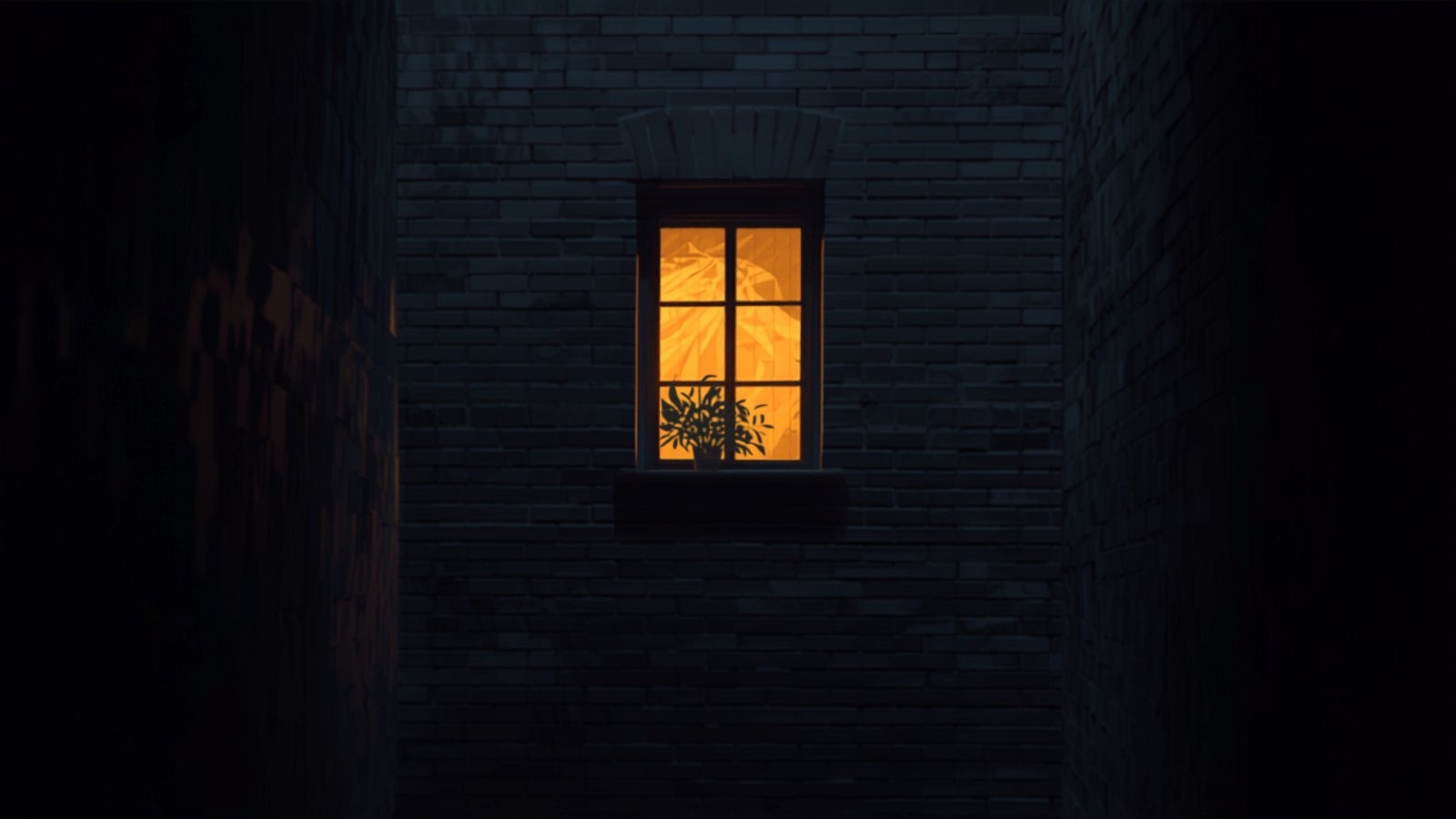
B2 · UPPER-INTERMEDIATE Reading practice · ~3,350 words · 22-min read
This is an original short story for upper-intermediate learners. It is a quiet city story about two women who live opposite each other across a small courtyard and slowly build a friendship without ever leaving their flats. Read the eight key words first. Then read the story chapter by chapter. There is a comprehension quiz at the end.
Before you read — 8 key words
- courtyard — an open outdoor space that has buildings on all sides of it. Many old blocks of flats are built around a small courtyard so that every window looks inward.
- carer — a person, usually paid, whose job is to look after someone who cannot fully look after themselves, especially an elderly or ill person at home.
- gesture — a movement of the hand, arm, or head that carries a meaning without any words. A wave, a nod, and a thumbs-up are all gestures.
- hesitate — to pause for a short moment before doing or saying something, because you are unsure or afraid. “She hesitated at the door” = she stopped and did not open it straight away.
- bond — a strong emotional connection between two people that grows slowly over time. It is stronger than friendliness and does not need many words.
- threshold — the strip of floor right at a doorway; also, in a wider sense, the moment you enter a new stage in your life. “She was on the threshold of a new job.”
- faint — very weak, so weak that it is hard to see, hear, or feel. A faint voice is a voice you can only just make out.
- council — the group of officials who run a town or city in Britain and Ireland. Councils manage housing, rubbish collection, and services for older people.
The story
1 · The woman in the flat opposite
For nearly two years, Iris had worked from home in a small first-floor flat in an old red-brick building on the north edge of the city. The flat was not much: one room for sleeping, one room for everything else, and a tiny kitchen where the kettle sang loud enough to wake the neighbours downstairs. She could easily have moved somewhere newer and cheaper on the far side of the ring road. She stayed because of the view.
Her one window faced a narrow courtyard — that is, an open space with buildings on all four sides. Across the courtyard, no more than fifteen metres away, stood another red-brick building, almost identical to hers. Its windows lined up almost exactly with her own. If she had wanted to, she could have thrown a small ball from her kitchen and landed it, easily, in the kitchen of the flat opposite.
The flat opposite belonged to an old woman.
Iris did not know her name. She did not know how long the woman had lived there. She knew only what she could see through the glass: a green kettle, a small round table, and a wooden chair by the window where the old woman sat every day.
The old woman was always there. From about seven in the morning, when Iris first drew back her curtains, until at least nine in the evening, she was at the window. Sometimes she was reading a large book. Sometimes she was doing what looked like a crossword. Sometimes she was simply looking out — not at Iris, exactly, but at the courtyard between them. Iris had, at first, been slightly unsettled by this. What kind of person watched the world from a window all day?
But as the months passed, she began to understand. The woman opposite did not go out. Iris never once saw her on the street. Twice a week, a young woman in a blue uniform arrived at the front door with a shopping bag; she stayed for an hour and then left. This visitor, Iris eventually realised, was a carer — a person paid to look after someone who cannot fully look after themselves at home. Apart from those two short visits, no one else came. In the rooms behind the old woman, no other lights ever moved. She lived, as far as Iris could tell, entirely alone.
Iris herself had grown up in a large, noisy family in a small northern town, and she had never really learned how to be so alone. She had chosen the city partly for its noise. She had chosen this particular flat, however, for its silence. Since her mother’s death two winters ago, silence had been the one thing she really needed. Perhaps that was why the old woman opposite fascinated her. Both of them, in different ways, had become people who preferred windows to doors.
By March of Iris’s second year in the flat, a quiet, private habit had built itself around the woman opposite. When Iris made her first coffee, she would glance across, and the woman would already be reading. When Iris took a break from her laptop at midday, the woman would be looking out at the sky. When Iris cooked her dinner, the woman would be finishing a slow cup of tea. It reminded Iris of a story her grandmother had once told her, of two lighthouses on opposite sides of a bay: neither had ever left its rock, but each had kept the other from feeling that it was alone in the dark.
If Iris had continued only to watch, the story would have ended there. But on a wet Thursday afternoon in April, she decided to do something small. She got up from her desk, walked to her window, and lifted her hand.
She waved.
She did not really expect an answer. It was a foolish little gesture, she thought at once, and the word gesture means a movement of the hand or head that carries a meaning without words. The woman probably could not see her clearly. Or, if she could, she might find the wave strange, even threatening. Who waved at strangers across a courtyard?
But the woman opposite lifted her own hand, slowly, and waved back.
2 · First contact
Iris was so surprised that she nearly stepped away from the window. But she did not. She stood there for a long moment with her arm still raised, until it began to ache. The old woman was waving back the whole time. Neither of them smiled at first. It felt too serious for that. Then, at exactly the same second, they both did.
The old woman held up one finger, as if to say wait, and disappeared from the window. When she returned a minute later, she was holding a large white sheet of paper. On it, she had written in thick black marker:
HELLO.
Iris laughed out loud. She had never even heard the woman’s voice, and now she was reading her handwriting. She hurried into her kitchen, tore a page from a notepad, and wrote back in the biggest letters she could manage:
HELLO. I’M IRIS.
The old woman read this, disappeared, and returned with a fresh sheet:
I’M MARGARET. NICE TO MEET YOU AT LAST.
That phrase — at last — surprised Iris almost as much as the wave itself. So the old woman had been watching her too. Of course she had. Iris felt suddenly, unexpectedly less lonely than she had felt in months.
Over the next hour, they exchanged eight sheets of paper. Margaret, it turned out, was seventy-nine years old. She had lived in the flat opposite for forty-one years. Her husband, a bus driver, had died a long time ago. She had two grown-up children, but they lived far away — one in Australia, the other in Scotland. Her hip was no longer strong enough for stairs, and so she had not left the building for almost two years.
Iris, in turn, wrote about her work — she edited books for a small publisher — and about her mother, who had died in February two years earlier. She wrote that she had nearly moved away last summer, but had changed her mind because of the courtyard, and the afternoon light, and, she confessed on the eighth sheet, because of the person she had been watching every day without knowing her name.
Margaret’s answer to that was a single word, held up in trembling letters that had taken her a long time to draw:
SAME.
Iris felt her eyes fill up. To hesitate means to pause before acting because you are unsure. Iris did not hesitate now. She lifted her sheet of paper, wrote THANK YOU in the largest letters she could manage, and held it up for a long time before she let it fall.
That was how it began. A courtyard, a hand, and the slow discovery that fifteen metres of empty air is not, in fact, very far at all.
3 · A language of windows
Over the following months, Iris and Margaret developed a language between their two flats. It was a language of paper, gesture, and light — silent, patient, and, in its own quiet way, richly expressive.
They wrote each other short messages every morning. Margaret would show her sheet first, because she was always awake before Iris; Iris would answer while her coffee was brewing. The messages were simple. RAIN AGAIN, Margaret would write, and Iris would answer, I’M WEARING TWO JUMPERS. Margaret would show a page reading BOOK GOOD?, meaning the novel she had seen Iris reading at breakfast, and Iris would give a thumbs-up or a thumbs-down through the glass.
They invented small signals. Two fingers held up meant tea in ten minutes. A tapping hand on the glass meant look at the bird on the wall. A drawn cloud meant feeling low, and it was always answered with a drawn sun. If Margaret was tired, she would touch her forehead; if Iris was proud of a good day’s work, she would raise both fists in a small silent cheer.
Iris, who spent most of her days looking at a laptop screen, began to time her breaks by Margaret’s window. When she was writing a difficult paragraph, she would look up and see Margaret with her crossword. When she deleted a whole page in frustration, she would find Margaret waving a small sheet that read BE KIND TO YOURSELF. Once, on a very bad afternoon, Iris put her forehead against the cold glass. When she looked up again, Margaret was holding a sheet that read, quite firmly: YOU ARE NOT ALONE.
There were things they could not say through a window, of course. Iris could not, for instance, easily tell Margaret about her mother’s slow last months. Margaret could not tell Iris the whole story of her husband’s death, or of the son who no longer called. But they had time. Over weeks, small pieces of both lives crossed the courtyard in fragments. Margaret’s marker letters became lighter and more shaky. Iris bought a bigger notepad and darker markers so that her own words would be easier for Margaret to read.
One evening in early June, after a stretch of unusually hot days, Iris held up a sheet that simply said: HOW DID YOU MEET YOUR HUSBAND? Margaret disappeared from her window for a long time. When she came back, she brought a small framed photograph and held it against the glass. Iris could just about make out a young couple in a park, laughing at something outside the picture. Margaret’s next sheet read: ON A BUS. NUMBER 74. I WAS SIXTEEN. They stayed at their windows until the light went, saying nothing more; sometimes, Iris realised, one small honest sentence across a courtyard is worth an hour of conversation over dinner.
If a friend had asked Iris to describe the connection that had grown between herself and Margaret, she would have struggled. A bond is a strong emotional link between two people, but the word felt too small for what she felt now. It was not romance. It was not exactly friendship in the ordinary sense; they had never touched. It was something like companionship, or perhaps the kind of quiet loyalty you might feel toward a lighthouse across a bay, if the lighthouse turned out to be a person.
By the middle of July, Iris had grown so used to Margaret’s window that she noticed the smallest changes in it. When Margaret was tired, she leaned more heavily on the little round table. When Margaret was cold, she wore a purple cardigan Iris had come to know well. When Margaret had passed a bad night, she would arrive at her window later than usual, and her writing would be smaller and less steady.
Which is why, on the morning of Wednesday the second of September, Iris knew immediately that something was wrong. She opened her curtains at half past seven, as she always did. She looked across the courtyard, as she always did.
Margaret’s window was dark. The chair by the little round table was empty.
4 · The dark window
Iris told herself, at first, not to worry. Margaret occasionally overslept. Once or twice — perhaps three times in almost five months — she had not arrived at the window until after nine. There was nothing yet to be alarmed about.
She made her coffee. She sat at her desk. She tried to edit a chapter about ancient trade routes, but she could not focus on a single sentence. Every three minutes, she looked up. The window opposite stayed dark. The chair stayed empty.
By eleven, Iris had stopped trying to work. By midday, her chest felt tight. She went to her window with a large sheet of paper on which she had written, in thick red marker:
MARGARET — ARE YOU THERE?
She held it up for a full five minutes. Nothing moved. She held up a second sheet:
PLEASE JUST WAVE.
The window stayed dark.
Iris tried not to think the worst. Perhaps the carer had come early and had taken Margaret to a hospital appointment. Perhaps she was simply ill in bed. Perhaps the chair had been moved for cleaning.
She checked the courtyard from her window one more time. A pigeon walked slowly along the low wall opposite. A single leaf spun down through the still air and landed on the concrete below. Everything was ordinary; everything was wrong. Iris realised, with a sudden ache in her chest, that in five whole months of daily conversation she had never asked Margaret for her surname. She did not know how to call a hospital and ask about a woman she knew only as “Margaret in flat four”.
But the truth was this. Margaret’s chair had not been moved in five months. The green kettle was still on the sideboard. The half-finished crossword was still on the table. Nothing at all had been touched.
If Margaret had been planning to go anywhere, she would have said so. Their silent language had grown far too careful for such silences.
Iris hesitated. Then she stopped hesitating.
She grabbed her jacket, her phone, and her keys, and she went out of her flat. Her heart was beating hard as she walked down her own staircase, along the wet pavement, around the corner of the courtyard, and up to the front door of Margaret’s building. She had, she realised, never once stood in this doorway before. She had known Margaret for five months and had never come within a metre of her front door.
The building’s outer door was unlocked. Iris climbed the narrow stairs. She had no idea which flat was Margaret’s. She thought carefully. Margaret’s flat was on the first floor, and its window looked into the courtyard. She would try the door on the courtyard side.
At the top of the stairs, on the left, she found a plain wooden door with a small brass number 4 on it and no name below the letterbox. Iris knocked. She waited. Nothing.
She knocked again, more loudly this time, and called through the wood: “Margaret? Margaret, it’s Iris. From the window.”
For a long moment there was only silence. Then, very quietly — as if from a great distance — she heard a voice. It said, “I’m here.”
The word faint means very weak, hardly there at all. Margaret’s voice was as faint as any voice Iris had ever heard.
Iris tried the door handle. It was locked. “Margaret,” she said, close to the wood, “can you get to the door?”
“No.” A pause. “I fell in the night. I can’t stand up.”
Iris was already dialling.
5 · The knock on the door
The ambulance arrived in twelve minutes. During those twelve minutes, Iris sat on the floor of the corridor outside Margaret’s door and talked to her through it. She told Margaret that help was coming. She told her that everything would be fine. She told her, when Margaret asked her to, about her mother, and about her work, and about the paragraph she had been trying to edit that morning. She told her, near the end, that if she had knocked on this door on any of the last hundred days, they would already have been in the same room.
“I would have opened it,” Margaret said, softly. “If you had ever knocked, I would have opened it.”
Iris laid her forehead against the wood.
The paramedics were kind and quick. They opened the door with a small, precise tool, went in, and lifted Margaret carefully onto a wheeled chair. When they carried her past Iris, Margaret reached out, and her small hand — cool, dry, older than Iris had imagined — closed briefly around Iris’s fingers. It was the first time they had ever touched.
“Thank you,” Margaret whispered.
Margaret spent six days in hospital. Her hip had been badly bruised but, luckily, not broken. During those six days, Iris took the bus across the city every evening and sat by Margaret’s bed for two hours, and slowly they filled in the shape of each other’s lives with real, spoken words for the first time. Margaret’s voice was low and dry and sometimes very funny. She laughed the first time Iris arrived, because Iris had brought a small notepad and a black marker in her bag out of habit.
The council — the local officials who run the city — arranged for a small red button to be fitted in Margaret’s flat, one which she could press if she ever fell again. Her son in Australia flew over for a week and asked her, in the awkward, guilty way of grown children who live too far away, whether she might like to move somewhere with more support. Margaret said no.
Then she added, “But I know someone who might visit.”
Which is how, in October, Iris began coming for tea on Sunday afternoons. She would walk down her own stairs, around the corner, up Margaret’s stairs, and across the threshold — the line at the doorway that marks the start of a new stage — into the same small room she had been watching for a year and a half. The green kettle sang. The chair by the window sat empty for a while, because on Sunday afternoons the two of them preferred the small sofa. From there, Iris could see her own window opposite, first floor on the left, the curtain moving slightly in the draught, the desk lamp still on.
It was, she thought, a very strange feeling: to look at her own life from someone else’s window. It was also, she realised, a quietly wonderful one.
There was a knock on Margaret’s door on the last Sunday of October. Iris looked up in surprise; Margaret only smiled.
“That will be your neighbour on the third floor,” she said. “She has seen us waving, apparently, for months. She wants to know if she may join us for tea.”
Iris got up to answer the door.
She had no idea, yet, what her small quiet flat and Margaret’s window and this Sunday tea would grow into over the coming winter. But when she opened the door and saw a nervous, hopeful face looking back at her, she understood one thing very clearly.
Sometimes the only thing standing between a lonely person and a whole life full of people is a hand, a window, and someone brave enough to wave first.
Check your understanding
Read each question. Think about your answer. Then click “Show answer” to check.
Words to remember
Here are the eight key words again, in fresh sentences. Say each one out loud, then try to make your own sentence with it.
- courtyard — Children play in the small courtyard behind our block of flats every evening after school.
- carer — After my grandfather’s stroke, a professional carer came to his home three mornings a week.
- gesture — Nodding your head is a common gesture for “yes” in most English-speaking countries.
- hesitate — She hesitated for a moment before she agreed to the interview.
- bond — A close bond had grown between the two colleagues after five years of working on the same team.
- threshold — She stood on the threshold of her new home and took a deep breath before she stepped inside.
- faint — From the top of the hill, we could hear the faint sound of a train far away in the valley.
- council — The local council has decided to build a new library on the site of the old car park.
Grammar in this story: the third conditional
Near the end of the story, Iris and Margaret both use the third conditional to talk about the past that did not happen — the visits they wish they had made sooner. Look at these two sentences from Chapter 5:
Iris: “If I had knocked on this door on any of the last hundred days, we would already have been in the same room.”
Margaret: “If you had ever knocked, I would have opened it.”
The pattern is: If + past perfect, would have + past participle. We use it to imagine a different past, especially when we regret what really happened. Neither Iris nor Margaret knocked. They both wish they had.
The story also uses the third conditional right at the start of Chapter 2 — “If Iris had continued only to watch, the story would have ended there.” Notice how it changes the whole meaning: everything that follows only happens because Iris did not just keep watching.
👉 Learn the full rule and get more practice here: The Third Conditional (B2 Grammar).
Talk about it · Write about it
Talk about it: In a big city it is very easy to live near hundreds of strangers and know none of them. Do you know the people who live in your building or on your street? Why or why not? What could you do this week to notice one of them?
Write about it: Write 120–150 words about a small kind gesture (a wave, a note, a favour) that changed something for you — or that you wish you had made. Try to use at least one third-conditional sentence, for example: “If I had spoken to her that day, we might have become friends.”
🎉 Well done — you have just finished more than 3,000 words of real, unadapted English reading. That is a serious workout for your brain, and you did it.
But wait — who is really at Margaret’s door? What might happen when a whole quiet building begins to wave at itself across the courtyard? Write your own ending, using details from the story to explain your choice.
Priya hardly knows her neighbours. Follow what happens when something is out of order and notice how people respond. Next story: Out of Order (B2 Reading Story)
About this story: This is an original B2 graded reader (~3,350 words). The vocabulary is kept inside the B2 range, and any harder word (like threshold, bond, or faint) is glossed before the story and reused inside it. The grammar mixes past simple, past perfect, and the third conditional — the shapes upper-intermediate readers most need to see in real, connected prose.

I’m Khamis Maiouf. I’m studying Health and Social Care and have completed Functional Skills Level 2 in English and Level 3 Hairdressing. I have taught ESOL in my community and helped students with GCSE English. I run English Teacher Site to help people learn and practise English.