
The Extra Zero (B2 Reading Story)

B2 · UPPER-INTERMEDIATE Reading practice · ~3,300 words · 17-min read
This is an original B2 reader about a small mistake with a big price tag — and the honesty test that follows. First, look at the nine key words below. Then read the story in five short chapters. At the end, there are six questions to check your understanding, plus a Grammar in this story section on the third conditional.
Before you read — 9 key words
- freelance / freelancer — someone who works for themselves, offering services to different clients, rather than being employed by one company.
- invoice — a document a worker sends to a client, showing what work was done and asking for payment.
- overdue — late; not paid or done by the agreed date. An overdue invoice has not been paid on time.
- windfall — a piece of money you did not expect and did not have to work for, that arrives suddenly.
- reconciliation — the office job of checking that the money in the accounts matches the money in the bank; the verb is reconcile.
- retainer — a fixed monthly fee that a client pays a freelancer to keep their time available for regular work.
- consolidate — to bring many separate things together into fewer, stronger ones (for example, cutting a long list of freelancers down to just a few).
- integrity — the quality of being honest, especially when nobody is watching and dishonesty would be easy.
- clerk — a junior office worker who handles routine paperwork, accounts, or admin tasks.
The story
1 · The slow season
Marta stared at her laptop screen and counted her invoices one more time. Three had been paid. Four were still overdue. And two of those four had been overdue for more than sixty days.
“Right,” she said out loud, to no one in particular. “Coffee.”
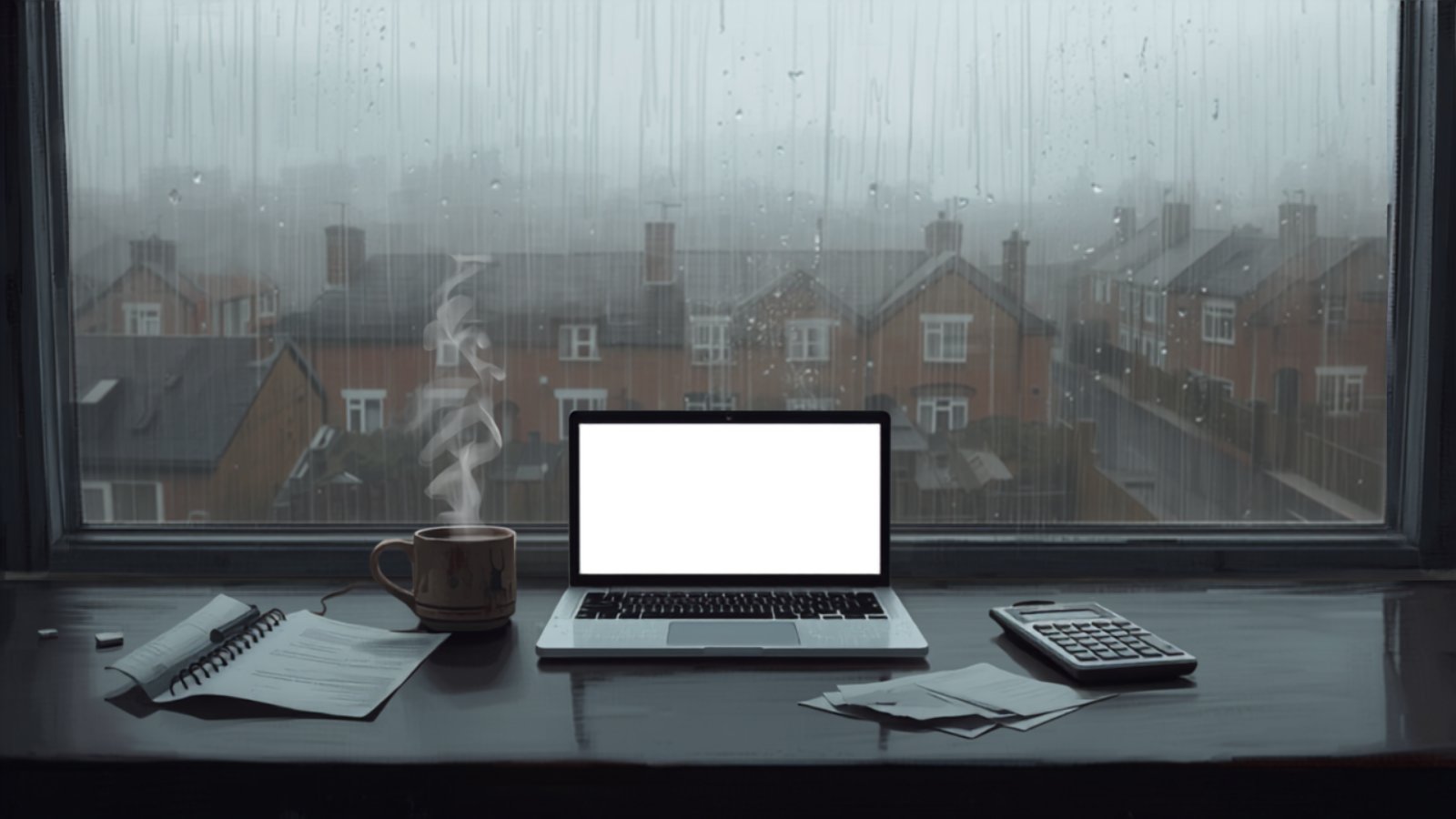
Her small flat in south Manchester was cold. She switched on the kettle and looked out of the kitchen window. It was a grey Wednesday in November, and Manchester was doing what Manchester always does in November — raining, without emotion, without pause.
Marta was thirty-four years old, and she had been a freelance graphic designer for exactly eight months. Before that, she had worked at a mid-sized branding agency in the city centre for six years, earning a steady salary and eating a sad supermarket sandwich at her desk every lunchtime. She had left because she wanted freedom. She had left because a manager had once told her, “You’ll never be senior material, Marta — you’re too quiet.” She had left because she believed she could build something of her own.
Freedom, she had discovered, was expensive. Freedom meant chasing late payments, writing careful emails to clients who had gone silent, and pretending on Instagram that everything was going brilliantly. Freedom meant not sleeping properly during the last week of every month, waiting to see whether she could pay her rent.
She poured hot water into her mug and opened her email again. There it was — a message from her landlord, sent at 7:04 that morning. The subject line said “Rent — reminder (2)”. She did not open it. She already knew what it said.
Instead, she opened her invoicing app and looked at Invoice #0217. She had sent it to a client called Ridgeway Communications ten days earlier. Ridgeway was a well-known branding agency in the Northern Quarter. She had produced two social-media banners for one of their smaller clients — quick work, nothing dramatic, but she had been proud of the colour palette. The invoice said, plainly, £480.
The invoice was already overdue. Not by much — only three days — but overdue enough that she had drafted, deleted and redrafted a polite reminder email six times that morning. She was afraid of sounding rude. She was afraid of losing the client. Ridgeway had big names on its books; if she could just stay in their orbit, more work might come along later.
She stared at her draft. Then she closed the tab and went to make lunch.
Lunch was two slices of toast with the last spoon of peanut butter in the jar. As she ate, she made a mental list of what she needed by the end of the week. Rent was £750. Council tax was £115. There was a phone bill somewhere in the pile of unopened envelopes on the hall table. Her total freelance income for the month, so far, was £312.
If she had known, back in March, how hard the slow season was going to feel, she thought, she would probably have stayed at the agency for another year — just to save more. But then she reminded herself of that manager’s comment, and of the six years of sad sandwiches, and she pushed the thought away.
“If it were easy, everyone would do it,” she told the empty peanut butter jar. The peanut butter jar had no reply.
She washed her plate. She checked her bank balance one more time — £84.19 — and then she made herself sit down and design something, anything, so that she could feel productive. She opened a new file and began sketching a logo idea for a small bakery she hoped, one day, might hire her.
It was 11:11 in the morning when her phone buzzed.
2 · The notification
Marta looked at her phone without much interest. Probably her sister Ola, who sent memes at random hours. Probably a delivery notification for something she had ordered a month ago and forgotten about.
She turned the phone over.
On the screen, a small grey rectangle from her bank glowed quietly:
Deposit received: £4,800.00
Reference: RIDGEWAY COMMS INV 0217
Marta blinked.
She read it again. Then she read it a third time.
Then she picked up the phone properly, opened the bank app and refreshed the account page. The number was still there. It sat at the top of her list of transactions, above the £3.20 coffee she had bought on Monday and below all the depressing outgoings from the week before.
£4,800.
Not £480.
For a moment, Marta wondered if there was some other Ridgeway — a different client with the same name, somewhere else in the country. She opened her invoicing app and looked at Invoice #0217 again. The amount was written in three places on the invoice, in bold, in neat black type. Four hundred and eighty pounds. Not a penny more. She had triple-checked it before sending, as she always did, because she was terrified of looking unprofessional.
She sat back in her chair and let the air out of her lungs slowly.
Ten times, she thought. They had paid her ten times what she was owed.
Her first feeling, strangely, was not joy. It was fear. Her second feeling was suspicion — a new kind of fraud, maybe? She had read about people who received strange transfers and were then asked to “return” the money to a different account, and lost everything. But no — the reference matched her invoice number exactly. The sender was Ridgeway’s usual finance address. The transfer had all the fingerprints of an ordinary business payment.
Only her third feeling was the one that made her heart beat faster. She could pay her rent three months in advance. She could pay her council tax. She could buy her mother a proper Christmas present for the first time in two years. She could stop, just for a little while, feeling as if she was drowning.
She stood up. Then she sat down again.
The kettle in the kitchen clicked off, though she had not turned it on.
“Calm down, Marta,” she said. Her voice sounded slightly strange.
She thought about the process on the other side. Ridgeway was a company with perhaps forty employees. Their finance team was two or three people. Somebody had typed her invoice number into a payment system. Somebody had added an extra zero. It was an easy mistake — the kind of mistake anybody makes on a Tuesday afternoon when their child has been up sick the night before and they are on their second Diet Coke of the day. It could happen to anyone.
Marta pulled her laptop closer. She opened a blank email. In the “To” field, she typed the address for Ridgeway’s finance team. Her fingers hovered above the keys.
Then she closed the laptop.
“Not yet,” she said. “I need to think.”
She made another coffee, though she did not really need one. She looked at the rain on the window. She looked at her phone. £4,800 was, she realised, roughly what she had earned across her three worst months of the year, put together. It was two months of freedom. It was breathing space.
Nobody, right now, knew about the mistake except her.
3 · A week of silence
Marta did not send the email that afternoon. She told herself that she was still gathering her thoughts. She told herself it would be more professional to write it in the morning, when her head was clearer.
But she did not send it in the morning either.
For the next six days, she carried the secret around like a stone in her pocket. She kept expecting an urgent email from Ridgeway — a panicked “sorry! wrong amount!” — but no such email arrived. On Thursday she noticed that her landlord’s tone had suddenly softened; the rent had been paid that morning, one month plus a fifty-pound “sorry” on top. On Friday she bought a bag of proper coffee and a small block of cheese that was not on offer. She felt guilty and pleased at the same time.
On Saturday she met her sister Ola at a café near Deansgate. Ola was two years younger, a nurse at the children’s hospital, and she had opinions about everything.
“You look better,” Ola said, before they had even ordered. “Something has happened. What is it?”
Marta was ready for the question. “One of my invoices got paid,” she said. “A small windfall.”
“Windfall,” Ola repeated, tasting the word. “That is a very big word for someone whose weekend plan last week was ‘finish the pasta’.”
“Hypothetically,” said Marta, “what would you do if a client paid you a lot more than they owed you?”
Ola looked at her over the top of her tea. “How much is ‘a lot more’?”
“Not enormous. Say — ten times the invoice.”
“Ten,” said Ola slowly. She stirred her tea while she thought. Then she said, “If it were me, I would keep quiet. Big companies write these things off. They probably have a whole department for mistakes.”
“But it would not be right,” Marta said.
“It also would not be your mistake,” Ola replied. “Look — if a supermarket undercharges you by ten pounds, do you drive back to the shop and hand it in? No. Neither do I.”
“Ten pounds is not the same.”
“It is the same principle,” Ola said. “Only the size is different.”
They talked about other things after that, but the conversation stayed with Marta all evening. Ola was persuasive. Ola made keeping quiet sound reasonable, even sensible. And yet — Marta could not sleep that night. She lay in her small bedroom staring at the ceiling, and she thought about the person on the other end who had made the mistake.
She had never met that person, but she could picture them clearly. A junior clerk. Perhaps twenty-three years old. Perhaps in their first proper job. Somebody who was not paid very much, and whose supervisor was cold about small errors. If the mistake were discovered months later — by an auditor, or by somebody reconciling the accounts at the end of the financial year — then that clerk would be blamed. Perhaps they would be quietly moved to a worse team. Perhaps they would be sacked altogether.
There was another problem, too. The freelance world in Manchester was small. If it ever came out that she had knowingly kept money that was not hers, it would follow her. Not immediately — but somewhere, at some pitch meeting three years from now, somebody would remember, and somebody would say, “Isn’t she the one who…?”
On Sunday afternoon, Marta went for a long walk along the canal. It was cold and bright. Joggers went past her in both directions, and a barge full of very serious-looking geese sailed slowly by. She thought about the money the way you think about a difficult sentence in a foreign language — turning it around, testing it, looking at it from different angles. If she kept quiet, she told herself, the world would probably not punish her. If she confessed, the world would probably not reward her either. There was no clever business logic here. There was only the person she wanted to be.
She stopped on a small bridge and watched the water for a while. Then she walked home.
By Sunday evening, Marta had made her decision. She was ashamed that it had taken her a whole week to make it.
4 · The email
On Monday morning at 8:57, Marta sat at her kitchen table with a fresh coffee and opened a blank email. This time she did not hover. This time she wrote.
Subject: Overpayment on Invoice #0217 — please advise
Dear Ridgeway Finance,
On Wednesday I received a bank transfer of £4,800 with the reference “RIDGEWAY COMMS INV 0217”. Invoice #0217, however, was issued for £480 (the two social-media banners for the Cavendish Bakery project). I have attached a copy of the invoice and a screenshot of the transaction for your records.
It looks as though an extra zero may have been added by mistake. I am ready to return the difference (£4,320) immediately, by whichever method is easiest for your team. Please let me know how you would like to proceed.
Kind regards,
Marta Doran
She read the email three times. She checked the spelling. She attached the invoice and the screenshot. She hit Send at 9:03.
Then she stared at the ceiling and waited.
The morning felt slow. She tried to work on the bakery logo, but she could not concentrate. Every twenty minutes she checked her inbox. She washed a plate she had already washed. She made a third coffee, which she did not drink.
At 10:41, an email arrived.
It was from Nathan Whitcroft, Head of Finance at Ridgeway Communications. It was short.
Marta —
Thank you for flagging this. You are absolutely right. Priya, one of our newer clerks, typed the wrong figure on Tuesday afternoon. It would have been picked up at our month-end reconciliation, but not for another three weeks, and by then it would have caused a considerable headache.
Speaking honestly: most freelancers would not have written this email. Some would, but not most.
I will send you our sort code and account number in a separate message. Please transfer £4,320 back at your convenience. Thank you again.
Nathan.
Marta read it twice. She felt something quiet and warm settle in her chest — the sort of feeling that is stronger than money, if less useful for paying rent. She had done the right thing. And, more importantly, she could look at herself in the mirror without having to argue back.
She transferred the £4,320 back that afternoon. She kept the £480, which was hers. Her bank account was, once again, honest.
Marta thought that was the end of the story.
But at 4:19 that afternoon, a second email arrived. It was not from Nathan. It was from someone called Ellis Wren, who signed off as Creative Director, Ridgeway.
Marta,
Nathan has just forwarded me a note about the invoice mix-up, and about the way you handled it. I would very much like to buy you a coffee this Friday, if you can spare an hour. I promise it is not about the money.
Ellis
5 · The retainer
Ellis Wren turned out to be a woman in her mid-forties, with grey-streaked black hair and an easy, direct handshake. She had suggested a small coffee place two streets from Piccadilly station. Marta arrived seven minutes early. Ellis arrived exactly on time.
For the first ten minutes they talked about ordinary things — how badly the trams had been running that morning, why cafés in Manchester always seemed to play the same three songs. Then Ellis put her cup down and got to the point.
“I’ll be direct with you,” she said. “For the last six weeks, I have been consolidating our freelance roster. We had twenty-three regular freelancers on our books. Everyone was fine, but nobody was great. I have been asked to consolidate that number down to four.”
Marta nodded and tried to look calm.
“You were not on my shortlist,” Ellis went on. “Not because your work is bad — those banners for Cavendish were sharp. You simply had not been with us long enough. I had not decided on the fourth spot yet, and honestly, I was leaning towards a designer we have used for years.”
“I understand,” said Marta, who did understand, and who was already preparing to smile politely and finish her coffee.
“But then Nathan sent me your email,” Ellis said. “And here is the thing. Design skill I can find. There are talented designers in this city on every street corner. What I struggle to find, especially now that so much work is remote, is people I can trust with anything financial. People who won’t quietly overcharge for revisions. People who won’t disappear when a project gets messy. People who will tell me the truth when I do not want to hear it. Design skill is common. Integrity, less so.”
She took a slim folder out of her bag and slid it across the table.
“This is a proposed retainer contract,” she said. “£1,200 a month, guaranteed. In exchange, we get first call on your time for social-media and small brand-refresh work — up to a set number of hours a month. Anything above that hourly ceiling, we pay separately at your usual rate. It is not life-changing money, but it is steady. And it keeps rent-anxiety off your kitchen table.”
Marta opened the folder. She read the top page slowly, so that Ellis would not see that her hands were, very slightly, shaking. The word retainer sat at the top of the page in bold, dark ink. A retainer — a fixed monthly base that meant she would not have to start from zero every month.
“Take it home,” Ellis said. “Read it properly. Show it to your accountant, if you have one — if you do not, I can recommend a good one. Come back to me by the end of next week.”
“Thank you,” Marta said, and it came out a little rough, so she said it again. “Thank you.”
On the tram back to her flat, Marta did the maths. £1,200 a month, for twelve months, was £14,400. She had given up £4,320 to earn £14,400 — and, more importantly, a steady base and a proper client who would recommend her elsewhere. Financially, of course, it was an obvious win. If she had said nothing about the overpayment, the mistake would have been discovered three weeks later by whoever was reconciling the books, and this offer would never have arrived.
But financially was not what she was thinking about. She was thinking about being able to sleep. She was thinking that when Priya, one day, discovered that Marta had been the freelancer who flagged the extra zero, Priya would know that somebody had, in a small way, looked out for her. She was thinking about how the manager at her old agency had once told her that she was “too quiet to be senior material”, and how that manager had been completely wrong about what strength actually looks like.
The tram pulled into her stop. Marta got off, walked home in the light rain, and put the kettle on. Her flat was still cold. Her window still looked out onto grey November. But something inside her small kitchen was warmer than it had been in a long time.
That evening, Marta took herself out for a small, honest celebration — a bowl of noodles at the Vietnamese place around the corner, and a piece of chocolate cake she did not share with anybody. She thought about how strange it was that the best financial news of her year had come from returning money, not keeping it. If somebody had told her that in March, she would have laughed. Now, she was starting to understand what Ellis had meant. There were designers in every city. There were far fewer freelancers whose word could be trusted around an invoice.
She signed the retainer contract two weeks later.
On the Monday after that, an email arrived from Ellis. The subject line said: Your first proper project — and please don’t say no straight away.
Marta made a coffee, took a slow breath, and opened the email.
Check your understanding
Read each question. Think about your answer. Then click “Show answer” to check.
Words to remember
Here are the nine key words again, in fresh sentences. Read each one out loud and try to build one more sentence of your own.
- freelance / freelancer — Since her son was born, she has worked freelance from home; she is a freelancer now, not an employee.
- invoice — Please send us an invoice at the end of the month, and we will pay within thirty days.
- overdue — The electricity bill is two weeks overdue; I need to pay it today.
- windfall — When his grandmother left him a small sum in her will, it felt like a windfall — money he had never expected.
- reconciliation — Every month, the finance team does a bank reconciliation to check that no transactions have been missed.
- retainer — The lawyer works on a retainer — a fixed monthly fee — so the client can call her whenever a problem comes up.
- consolidate — The company wants to consolidate its five small offices into one bigger one, to save on rent.
- integrity — What impressed me most about him was not his talent but his integrity; he told the truth even when it hurt him.
- clerk — She started as a junior clerk in the accounts department and, ten years later, she was running it.
Grammar in this story: the third conditional
This story is built around a decision — and, therefore, around the imagined worlds that would have followed a different choice. In English, we describe those imagined past worlds with the third conditional. The pattern is:
If + past perfect, would/could/might have + past participle.
Look at these lines from the story:
“If she had known, back in March, how hard the slow season was going to feel, she would have stayed at the agency for another year.”
“If she had said nothing about the overpayment, the mistake would have been discovered three weeks later, and this offer would never have arrived.”
In both examples, the past cannot be changed. Marta did not stay at the agency; Marta did speak up. The third conditional lets us imagine — and often, regret or celebrate — the alternative history that never happened.
Notice, too, that we can use could have for possibility, and might have for uncertainty: “If Ellis had not received the email, she might have chosen a different designer.”
👉 Learn the full rule, with more examples and common mistakes, here: The Third Conditional — If I Had Known.
Talk about it · Write about it
Talk about it: Have you ever been given too much change, charged the wrong price, or received a delivery that was not yours? What did you do — and, honestly, what were you tempted to do? Did the size of the mistake change your answer?
Write about it: In 150–200 words, describe a small ethical choice at work or with money (a real one, or one you can imagine). Use at least three third-conditional sentences (If I had…, I would have…) to describe the alternative history. Try to use at least three of these key words: integrity, windfall, invoice, overdue, retainer, consolidate.
🎉 Well done — you just read a full 3,300-word story in English. That is a proper piece of reading, not a warm-up. And you did it while learning nine new words in real context.
But wait — what is the “first proper project” that Ellis has just sent Marta? Why does she suspect Marta will want to say no? And what will Marta discover about Ridgeway that she has not seen so far? Write your own ending, using details from the story to explain your choice.
Marcus works at a warehouse that never sleeps. Follow the overtime ledger and weigh the responsibilities behind the numbers. Next story: The Overtime Ledger (B2 Reading Story)
About this story: This is an original B2 upper-intermediate graded reader (~3,300 words). It follows the Oxford Bookworms method: the vocabulary is controlled to roughly 1,400 headwords, and any essential above-level words (freelance, invoice, windfall, retainer, reconciliation, consolidate, integrity, clerk) are glossed before the story and reused inside it. Featured grammar: the third conditional, alongside natural passives (had been added by mistake, would have been picked up) and reported speech. Aim: 98% of the running words should already be familiar to a strong B2 reader.

I’m Khamis Maiouf. I’m studying Health and Social Care and have completed Functional Skills Level 2 in English and Level 3 Hairdressing. I have taught ESOL in my community and helped students with GCSE English. I run English Teacher Site to help people learn and practise English.