
The Spare Keys (B2 Reading Story)

B2 · UPPER-INTERMEDIATE Reading practice · ~3,100 words · 16-min read
This is an original story for upper-intermediate readers. It is about ordinary life in an ordinary building — and about what happens when old habits meet new technology. First, look at the ten key words below. Then read the story in six short chapters. At the end, there are questions to check your understanding.
Before you read — 10 key words
- tenant — a person who pays rent to live in a flat or house.
- landlord — the person or company that owns the building and receives the rent.
- caretaker — a person whose job is to look after a building: small repairs, cleaning, keys.
- refurbishment — the work of repairing and modernising a building to make it look new.
- key fob — a small plastic device that opens an electronic lock when you touch it against a reader.
- glitch — a small, sudden fault in a machine or computer system.
- power cut — a period when the electricity stops working in a building or an area.
- spare — an extra one, kept in case the first one is lost or broken (a spare key, a spare tyre).
- reluctant — not wanting to do something, and showing it by hesitating.
- mutter — to speak in a low, quiet voice, often because you are annoyed.
The story
1 · The tin on the shelf
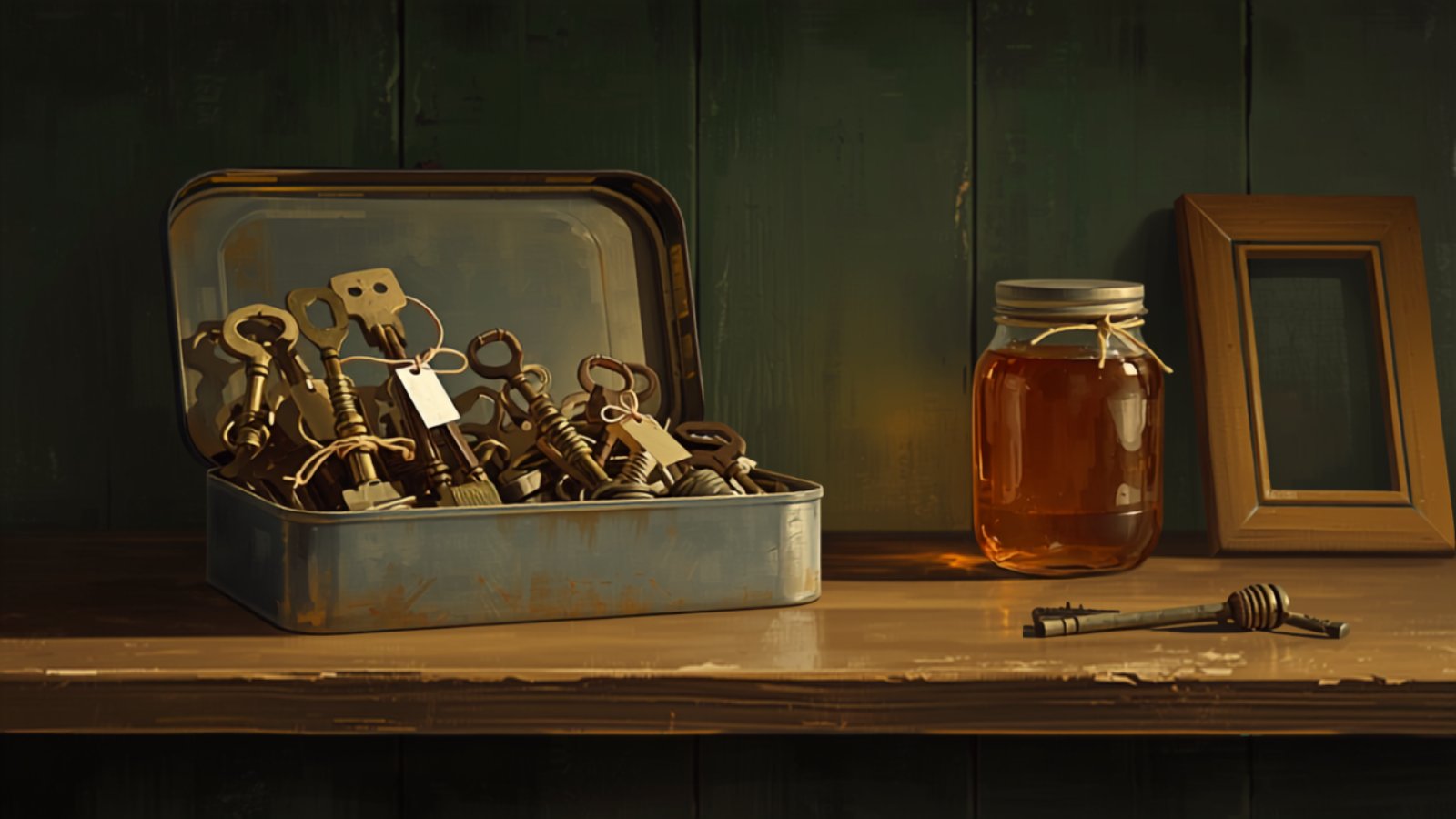
On the second shelf of Vera Antonova’s kitchen, between a jar of honey and a photograph of her late husband, stood an old biscuit tin. It had not held a biscuit for forty years. Inside, resting on a folded tea towel, lay twenty-six keys, and every key wore a little paper label tied on with string: Flat 3 — front door. Flat 7 — balcony. Flat 15 — cellar. Mrs Okafor — letter box.
Rosemount House had been built in 1962, and Vera had lived there since 1979. She was seventy-four now, small and quick, with silver hair that she cut herself and opinions that she did not. Over the decades, without anyone ever officially deciding it, she had become the keeper of the building’s spare keys.
It had started by accident. In 1987, her neighbour Tomas had locked himself out in his slippers, holding a pan of soup. Vera had a spare key to his flat because she watered his plants in August. After that, word travelled the way word does in a building: slowly, through the walls, and then all at once. If you lived in Rosemount House, sooner or later you climbed the stairs to Flat 12, knocked, and handed Vera a spare key.
She never asked why. She never charged a penny. She simply wrote the label, tied the string, and said the same sentence she always said: “It will be here when you need it.”
And people did need it. Keys were dropped down drains and left in offices. They were carried away in coat pockets to other cities. One was swallowed, briefly and mysteriously, by a dog named Biscuit — which Vera considered a personal insult to her tin. Each time, the tenant would appear at her door, embarrassed, and each time Vera would take down the tin as calmly as if she were serving tea.
The young tenants amused her most. Amir from Flat 9, a nurse who worked night shifts at the hospital, had lost his key three times in one winter. “If you lose it a fourth time,” she told him, “I will tie it to your scarf like a child’s glove.” He laughed, but she noticed that he started wearing a scarf.
The building had a caretaker too — Joseph, who had swept the corridors and fixed the boiler for twenty-two years. Joseph and Vera ran Rosemount House between them, though neither of them would ever have said so. He looked after the pipes and the lights; she looked after the people. When old Mr Fenwick on the ground floor stopped answering his door one January, it was Vera’s tin and Joseph’s shoulder that got them into the flat in time to call an ambulance. Nobody wrote about it. Nobody needed to. That was simply how the building worked.
“A building is not made of bricks,” Vera liked to say, tapping the tin’s lid. “It is made of trust, with bricks around it.”
2 · New management
The letter arrived on a Tuesday in March, printed on paper so white and stiff that it seemed offended to be pushed through a letter box. Rosemount House, it announced, had been sold. The new landlord was a company called Brightside Property Solutions, and the building would shortly benefit from “a full programme of refurbishment and modernisation”.
“Benefit,” muttered Vera, reading it at her kitchen table. In her experience, when a company promised that you would benefit from something, it was wise to sit down first.
At first, the changes were small and mostly pleasant. The front steps were repaired. The hallway was repainted in a colour the letter called “Morning Mist” and Joseph called “hospital grey”. A shiny sign appeared by the entrance with a photograph of a smiling family who did not live there.
Then, in April, a second letter arrived, and this one changed everything. As part of the modernisation, the old locks would be replaced with a state-of-the-art digital entry system. Every tenant would be given a key fob — a small plastic device that opened the doors electronically. The system would be managed remotely by Brightside’s office, thirty miles away. The letter was signed by a regional manager named Mr Pryce, whom nobody had ever seen.
There was a final paragraph, short and polite as a closing door. Since the building would now be managed digitally, the position of on-site caretaker was no longer required. Joseph was thanked for his years of service and given six weeks’ notice.
Vera read that paragraph three times. Then she put on her good coat, the one she wore for funerals and arguments, and went downstairs to find Joseph. He was in the boiler room, oiling a hinge that, strictly speaking, no longer belonged to him.
“Twenty-two years,” he said, not looking up. “And I was informed by a letter. Not even a telephone call, Vera. A letter, with a smiling sun printed on the top.”
“They will regret it,” said Vera.
“They won’t,” said Joseph. “Companies don’t regret. Regret is done by people.” He closed his toolbox with a soft click. “You know what worries me? Not my job. I’ll manage. What worries me is this: who will they call at two in the morning when the water comes through a ceiling? An app?”
Vera wrote a letter of complaint that evening, in her best handwriting, on behalf of what she called “the residents of Rosemount House, who were not consulted”. Fourteen tenants signed it, including Amir, who signed it twice by accident because he had just finished a night shift. The reply, when it came, thanked them warmly for their feedback and changed absolutely nothing. If the residents had any questions, they were invited to visit the Brightside website, where, the letter promised, answers could be found. Vera visited the website. The answers could not be found.
3 · The fob
The refurbishment reached the doors in May. The locks were changed over three noisy days. Workmen in orange jackets moved from door to door, and when they had finished, every tenant was handed a small black key fob in a plastic bag, together with a leaflet that began with the words Welcome to easier living!
To be fair — and Vera was always fair, even when she would rather not be — the system worked well at first. You touched the fob against a black reader beside the door, the reader blinked green, and the lock opened with a smooth, expensive click. There was no key to lose, no key to forget, no key to be swallowed by a dog. Amir was delighted. “Vera, it’s the future,” he said, waving his fob at her like a tiny flag.
“The future,” said Vera, “should still answer its telephone.”
Because there were problems, and the problems had a new and modern shape. When old Mrs Okafor’s fob stopped working — a glitch, the company said — she stood outside the building for two hours in the sun, because the helpline played her music and then, gently, hung up. When the reader on the cellar door blinked red for a whole weekend, nobody could reach the bicycles. Under the old system, these things would have been solved in five minutes by a knock on Joseph’s door. Under the new system, they were “logged as tickets”. Vera learned to hate the word ticket. A ticket, as far as she could see, was a promise that nothing would happen, delivered with a number attached.
Even Amir’s enthusiasm for the future did not survive the summer. In July, after four night shifts in a row, he came home at dawn to find that his fob had been deactivated. The system, it turned out, had been updated overnight, and a certain number of fobs — nobody would say how many — had simply been forgotten by the software. He rang the helpline, listened to the music, and fell asleep standing up against the door of the building he paid rent to live in. It was Vera, coming down for her morning paper, who found him there. She could not let him in — that was the point, of course; nobody in the building could let anybody in any more — so she did the only thing that remained. She brought him tea and a chair, and sat with him on the front steps like two passengers waiting for a delayed train, until the office thirty miles away opened at nine and a bored voice reactivated him with a click.
“Say it,” said Vera.
“I’m not saying it,” said Amir. But he had stopped waving the fob like a flag.
One afternoon a young man from Brightside came to photograph the new doors for the company website. He was polite and rather nervous, and Vera invited him up for tea, partly from kindness and partly for information. His name was Daniel; he had worked for the company for five months; and no, he admitted, he did not know who you were supposed to call if the system failed at night. “There’s a process,” he said, in the voice of someone reading a word from a leaflet.
“There was a process before,” said Vera. “He was called Joseph.”
Before Daniel left, he noticed the biscuit tin on its shelf, with its twenty-six labelled keys. He asked what it was, and Vera told him. He looked at it for a long moment, the way you look at something from another century — with respect, and with no idea what to do with it.
“You can probably throw those away now,” he said kindly. “The old locks are dead. The doors are all digital.”
“Probably,” said Vera, and moved the tin two centimetres further from the edge of the shelf.
She was reluctant to throw away the keys, and she could not fully explain why, even to herself. Perhaps it was habit. Perhaps it was stubbornness — her daughter would certainly have said so. Or perhaps, somewhere behind her ribs, she held a simple belief that forty years of trust should not be carried down to the bins in a plastic bag just because a reader blinked green.
4 · The night of the storm
The storm arrived on a Friday night in October, and it did not knock. It threw rain against the windows in handfuls, bent the young trees on the street until they touched their own shadows, and at seventeen minutes past eleven, with a sound like a switch being flicked by a giant, it took the electricity out of six streets.
Vera was awake — she slept less every year, as if life were rationing it — and she felt the power cut before she saw it: the fridge stopped humming, and the little green numbers on the oven vanished. She lit the candle she kept for such nights, went to the window, and looked down.
Below her, in the streaming rain, stood four people.
They were pressed against the entrance of Rosemount House, and one of them was waving a small black fob at the reader again and again, the way you might wave a ticket at a train that has already left. The reader was dark. The door was locked. The building’s expensive new brain had gone to sleep with the electricity, and the emergency battery, which should have kept the system alive, had failed — a glitch, it would later be called, in a report nobody would read aloud.
Vera recognised Amir, drenched in his nurse’s uniform after a late shift. Beside him stood the Okonkwo family from Flat 5, back from a birthday dinner, the youngest child asleep on her father’s shoulder with rain running off her small shoes.
Vera did not hesitate. Hesitation, she felt, was for people with more time. She put her coat on over her nightdress, took the candle in one hand and the biscuit tin under her arm, and went down the dark stairs, one careful step at a time, seventy-four years old and entirely certain of her direction.
The main entrance could not be opened from inside without power — a detail the leaflet had never mentioned. But Rosemount House was older than its new brain. At the back of the building, behind the bins, there was a service door that the workmen in orange jackets had considered too unimportant to modernise. It still wore its original 1962 lock, heavy and stubborn and completely indifferent to electricity. And in the tin, between Flat 15 — cellar and Mrs Okafor — letter box, hung a key with a label in faded ink: Back door — service entrance.
The lock had not been turned for years, and for three long seconds it resisted, while the rain drummed on the bins and the candle died in the wind. Then something inside it remembered its job. The key turned. The door opened. Vera walked through the pitch-black ground floor, drew back the old iron bolt on the main entrance — a bolt, thankfully, asks no questions and needs no battery — and pulled the door open against the storm.
“Good evening,” she said to the dripping crowd, as calmly as if she were serving tea. “Mind the step. It is darker than it looks.”
They came in laughing and shivering — relief makes people do both at once. And they kept coming. Word travelled through the dark building the way it had travelled in 1987: a knock here, a call there. By midnight, Vera’s kitchen held eleven people, four candles, one teapot working as hard as a small factory, and a sleeping child wrapped in the good blanket. Amir stood guard at the front door, letting in each soaked neighbour with a theatrical bow.
“Welcome to easier living,” he announced each time, and each time, the kitchen laughed.
5 · Monday morning
The power cut ended at six in the morning, and the readers woke up blinking green, innocent as children. But something had shifted in Rosemount House, and it was not the electricity.
The storm, it turned out, had caught more than one of Brightside’s buildings. At a property across town, tenants had been locked out until three in the morning; someone had filmed it, and by Sunday the video had been watched several hundred thousand times. It showed a row of people in the rain, waving fobs at a dead reader, while a recorded voice told them their call was important. On Monday, a local newspaper telephoned Brightside with questions. On Tuesday, a reporter knocked on doors at Rosemount House, and the tenants, who had been raised to be polite, were polite — and thorough.
On Wednesday, a silver car parked outside, and out of it stepped a man in a soft grey suit. It was Mr Pryce, the landlord’s regional manager, seen at last. He had the careful smile of a man who has been sent somewhere by people more senior than himself, and he asked, in the hallway, whether he might speak to “the resident with the keys”.
He was directed to Flat 12. Vera received him with tea and with the particular politeness she reserved for opponents.
To his credit, Mr Pryce did not pretend. The battery had failed; the helpline had failed; the process had failed. “If you hadn’t opened that door, Mrs Antonova,” he said, “we would have been in the newspaper for a much worse reason.” He hesitated, in the manner of a man about to say an unbudgeted sentence. “May I ask what you would do, in our position?”
Vera poured the tea and told him.
First, the building needed its caretaker back, because a fault at two in the morning is not a ticket, it is a person’s night, and it should be answered by a person. Second, every digital door needed an old-fashioned lock beneath it, and the spare keys needed to be kept in the building — “not thirty miles away, in an office that closes at five”. Third — and here she refilled his cup, giving him time — the company should write to its tenants the way you write to people, not to units. “You bought a building, Mr Pryce,” she said. “But the building was never the bricks.”
Mr Pryce wrote all of it down. Vera watched him do it and permitted herself one small, private smile: sixty years of letters, she thought, and it took a biscuit tin to be taken seriously.
6 · The keeper of keys
Change, having arrived once with letters and workmen, arrived a second time — quietly, and rather better dressed in humility. In November, Joseph was offered his job back, three days a week, with a pay rise that he pretended not to be pleased about and mentioned to everyone, muttering that it was only sensible. Mechanical locks were fitted beneath the readers on every door, “as a backup”, the letter said, and this letter, Vera noticed, had no smiling sun on it at all.
And a small metal cabinet was mounted on the wall of the entrance hall, with a brass plate that read: Spare keys — see Flat 12. The residents of Rosemount House had been asked who should keep them. The vote, Amir reported, had not been close.
Vera transferred the keys one Sunday afternoon, unhurried, like a ceremony only she could perform: each key lifted from the tin, its faded label copied out in fresh ink, each one hung on its own numbered hook. Amir sat on her kitchen stool and watched. He had offered to help and had reluctantly accepted, instead, the important job of holding the string.
“Admit it,” he said. “You enjoyed being right.”
“I did not enjoy the rain,” said Vera. “The rest, a little.”
It was Amir who found it, at the very bottom of the tin, under the folded tea towel that had lain there for forty years: a small brown envelope, soft with age. Inside was a single key — unlabelled, which was unthinkable — and a note in a handwriting Vera had not seen for eleven years. Her husband’s handwriting. Five words, written with his usual mixture of mischief and certainty:
For the day you need it.
Vera turned the key over in her palm. It fitted no lock in Rosemount House; she knew every one of them the way a conductor knows an orchestra. It was old, and light, and it looked like it had been waiting.
“Well?” said Amir, leaning forward. “What does it open?”
“I have no idea,” said Vera slowly. And then, for the first time in a long while, the keeper of keys smiled at a locked door she could not name. “But I know how we are going to find out.”
Check your understanding
Read each question and think about your answer. Then click “Show answer” to check.
Words to remember
Here are the ten key words again, in new sentences. Try to write one sentence of your own for each.
- tenant — The tenants on the top floor have complained about the lift again.
- landlord — Our landlord raised the rent but finally repaired the roof.
- caretaker — The school caretaker locks the gates at six every evening.
- refurbishment — The station is closed for refurbishment until next spring.
- key fob — I touched my key fob against the reader, but the light stayed red.
- glitch — A software glitch deleted half of the booking system’s records.
- power cut — During the power cut, we played cards by candlelight.
- spare — Leave a spare key with someone you trust, just in case.
- reluctant — He was reluctant to sign the contract without reading it twice.
- mutter — She muttered something about the price and left the shop.
Grammar in this story: the passive voice
This story often uses the passive voice — especially when the company acts and nobody takes personal responsibility. That is exactly what the passive is good at: hiding, or de-emphasising, who did the action. Look:
Rosemount House had been sold. The old locks would be replaced. Joseph was thanked for his years of service and given six weeks’ notice. The power was restored at six in the morning.
Notice the pattern: be (in the right tense) + past participle. “I was informed by a letter,” says Joseph — and the passive makes his point for him: no person told him, only a letter. When you read English news or formal letters, watch how often the passive appears when someone would rather not say who did it.
👉 Review the full rule here: Active vs Passive Voice: Examples and Practice.
Talk about it · Write about it
Talk about it: Vera believes technology should support people, not replace them. Do you agree? Think of one piece of “convenient” technology in your daily life. What would happen if it failed for 24 hours — and who would you turn to?
Write about it: Write a short letter of complaint (100–150 words) from a Rosemount House tenant to Brightside Property Solutions after the storm. Use at least three passive forms (for example: we were locked out, no warning was given, the battery had not been tested).
🎉 Well done — that was a full B2 graded reader, around 3,100 words, and you finished it. Did you spot how many times the passive voice appeared when the company wanted to avoid responsibility? Read Chapter 2 again and count.
But one question is still open: a key with no label, a note eleven years old, and a lock that is not in Rosemount House. What did Vera’s husband leave her — and where is the door it opens?
Mira moves into Arden House. Read the polite notices and notice the difference between what people write and what they mean. Next story: The Polite Notices (B2 Reading Story)
About this story: This is an original B2 graded reader (~3,100 words), written with controlled upper-intermediate vocabulary and grammar (passives, conditionals, reported speech), following the graded-reader method: you should understand about 98% of the words. The ten harder words are explained before the story and reused inside it.

I’m Khamis Maiouf. I’m studying Health and Social Care and have completed Functional Skills Level 2 in English and Level 3 Hairdressing. I have taught ESOL in my community and helped students with GCSE English. I run English Teacher Site to help people learn and practise English.