
The Polite Notices (B2 Reading Story)

B2 · UPPER-INTERMEDIATE Reading practice · ~3,100 words · 16-min read
This is an original story for upper-intermediate readers. Somebody in a block of flats is leaving polite, anonymous notices — and nobody knows who. First, read the ten key words below. Then enjoy the story. At the end, there are questions to check your understanding, plus a grammar point that is hiding in plain sight all the way through.
Before you read — 10 key words
- noticeboard — a board on a wall where messages and announcements are pinned for everyone to read.
- tenant — a person who pays rent to live in a flat or house that belongs to someone else.
- caretaker — a person whose job is to look after a building: small repairs, cleaning, keys.
- anonymous — written or done by a person who does not give their name.
- complaint — a statement, often formal, that you are unhappy about something.
- leak — water escaping through a hole or crack where it should not go; also a verb.
- fortnight — two weeks (a common British word).
- typewriter — an old machine with keys, used for typing letters before computers existed.
- suspicious — feeling that someone may be doing something wrong or hiding something.
- invisible — impossible to see; a person can feel invisible when everyone ignores them.
The story
1 · Flat 12
Mira Devlin moved into Arden House on the first Saturday of March, in the rain, with two suitcases, a dying plant, and a sofa that refused to go round the corner of the stairs. Arden House was a red-brick block of eighteen flats on an ordinary street in an ordinary city, and Mira, who had just started an ordinary job at the library, thought it looked perfect. She had been searching for a flat for three months. Twelve had been viewed, four had been lost to faster tenants, and one had smelled so strongly of fish that she had not even taken off her coat.
Flat 12 was on the third floor. It had a small kitchen, a bedroom with a view of a car park, and a radiator that made a sound like a distant drum whenever it was turned on. Mira didn’t mind. It was hers — or at least, it was hers as long as the rent was paid on the first of every month.
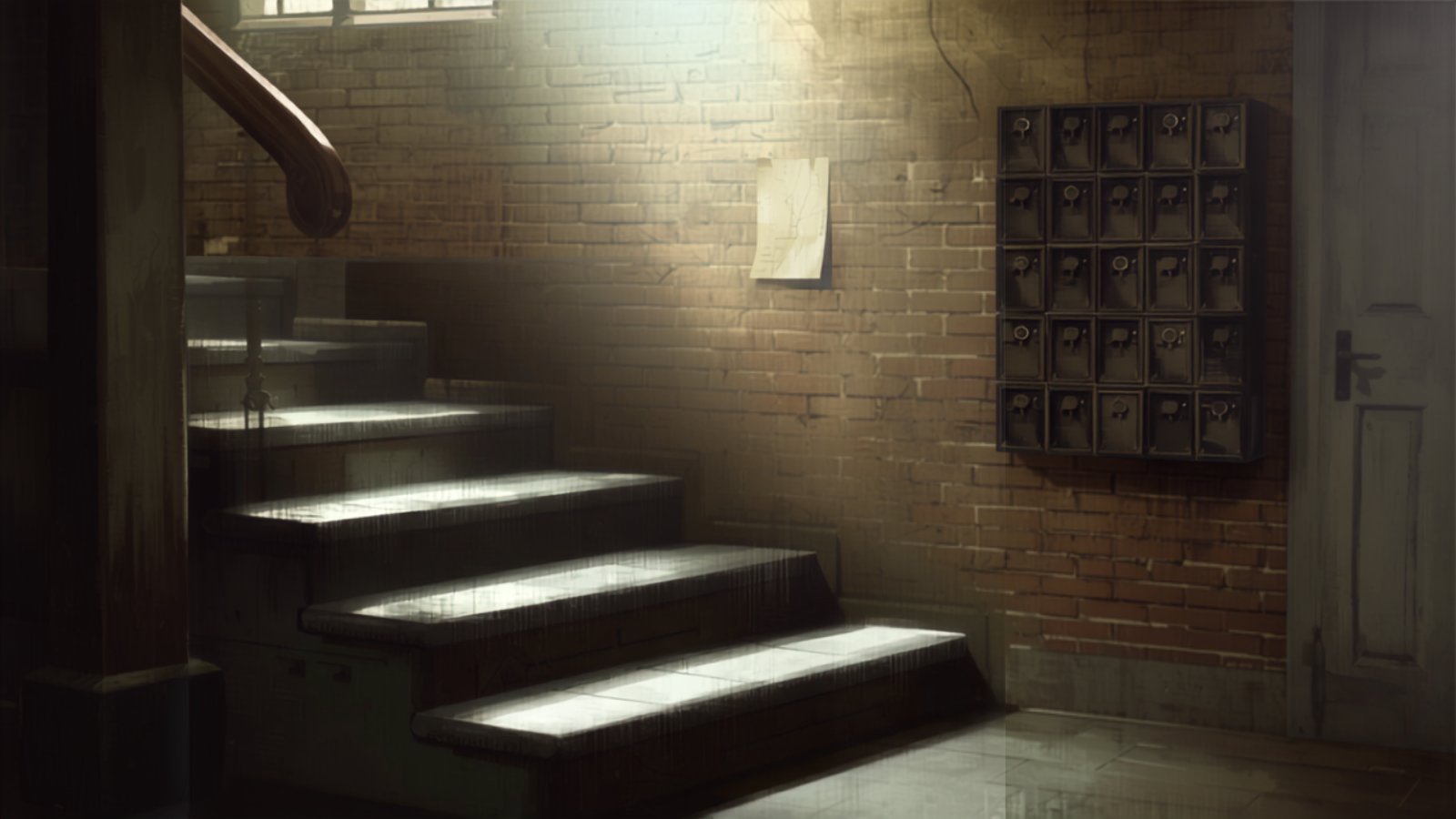
On her way up with the last box, she stopped in the entrance hall to catch her breath. That was when she saw the noticeboard. It hung beside the postboxes, behind a sheet of scratched glass, and in the middle of it, perfectly straight, was a single typed notice:
“Residents are politely reminded that the front door should be closed firmly after 8 p.m. Last Tuesday it was left open all night. Nothing was stolen, but a cat was found asleep on the stairs, and it did not belong to anyone in this building. Thank you.”
Mira laughed out loud, alone in the hall, with the box still in her arms. There was no name at the bottom. No signature, no flat number, nothing. The notice was completely anonymous — and yet somehow it was the most polite piece of writing she had ever read. Whoever had typed it had even given the cat its own sentence.
“The management company, probably,” she told her sister on the phone that evening. “Or some retired head teacher with too much free time. Every building has one.”
“Or a ghost,” said her sister, “who died waiting for someone to close the door properly.”
Mira laughed and forgot about it. She had boxes to unpack, a plant to rescue, and a new life to begin. She had no idea that within a fortnight, the notices would become the most interesting thing in the building — or that she would end up spending her evenings trying to catch the person who wrote them.
2 · Residents are reminded
The second notice appeared ten days later, and this time it was personal — although, in the most careful way possible, it named nobody at all.
“Residents are reminded that the hallway is shared by everyone. A bicycle has been left outside Flat 7 for six days. It has been knocked over twice. If it is moved to the bike shelter behind the building, it will be both safer and drier. The shelter has recently been repaired. Thank you.”
Mira read it on her way to work and noticed two things. First, the bicycle outside Flat 7 disappeared that same evening, moved by its embarrassed owner before anyone could mention it. Second — and this was the strange part — the bike shelter had been repaired. She had seen it herself: the broken roof panel had been replaced, quietly, at some point during the week. Nobody knew who had done it. The management company, everyone assumed. Who else repairs things?
After that, the notices arrived regularly, one every week or two, always typed, always anonymous, always devastatingly polite. Rubbish that had been left beside the bins, instead of inside them, was mentioned — and the next day it was gone. A dripping tap in the shared laundry room was reported to be “in need of attention”, and within a fortnight it had been fixed. When the light on the second-floor landing began to flicker like something from a horror film, a notice promised that “the matter has been raised”, and three days later the flicker was gone.
The building talked about nothing else. In the entrance hall, tenants who had ignored each other for years now stopped and traded theories like detectives. Mrs Fenwick from Flat 3, who knew everything about everyone, swore the notices were written by the management company “to avoid paying for a proper caretaker”. Tom and Priya from Flat 9, who were saving for a wedding and found free entertainment where they could, kept a list of suspects on their fridge. Old Mr Whitfield from Flat 1, who complained about everything on principle, complained that the notices were “cowardly” — although it was noticed that he had started closing the front door very firmly indeed.
Mira found the whole thing delightful. She had lived in three buildings before this one. In the first, problems had been ignored. In the second, problems had been argued about loudly at midnight. Only in Arden House were problems solved by mysterious typed paragraphs and quiet midnight repairs. If she hadn’t been so curious, she would have simply enjoyed it.
But she worked in a library. Curiosity was practically her profession.
She started paying attention to small things. The notices were never pinned crookedly; whoever put them up took their time. The paper was always the same — heavy, cream-coloured, slightly old-fashioned, the kind that is no longer sold in supermarkets. And the language never slipped. Even when a notice mentioned something genuinely annoying, like the rubbish that had been dumped by the bins, the tone stayed calm and almost affectionate, as if the building were a slightly forgetful relative who simply needed reminding. It was, Mira thought, the writing of someone who loved the place — and had loved it for a very long time.
3 · The denial
The mystery deepened in April, when the rent statements were sent out. At the bottom of Mira’s statement, under the usual numbers, the management company had added a short message of its own:
“NOTE TO ALL TENANTS: It has been brought to our attention that unofficial notices are being displayed in the entrance hall of Arden House. These notices are not produced by this office. Tenants are advised that only official communications should be treated as official. We are investigating.”
Mira read it three times, then laughed for a full minute. The management company — a distant office that took six weeks to answer an email — was denying everything. Which meant the polite notices were not official at all. Someone inside the building was writing them. Someone inside the building was also, apparently, fixing taps, repairing shelters and replacing light bulbs, silently doing the job the company was being paid to do.
That evening the entrance hall was crowded. Mrs Fenwick stood in front of the noticeboard like a general in front of a map. “Well,” she announced, “if they’re not from the office, then one of us is a liar. A helpful liar, but a liar.”
“Why a liar?” asked Mira. “The notices never say they’re official. They never say who wrote them at all. That’s the trick — look at the sentences. Residents are reminded. A bicycle has been left. The matter has been raised. Things are done, but nobody does them. The writer has removed themselves completely.”
Tom whistled. “So we’re looking for someone who’s good with words, good with tools, and doesn’t want to be seen.”
“Someone with a typewriter,” added Priya. “Look at the letters — the ink isn’t even. That’s not a printer. Who still owns a typewriter?”
Everyone became a suspect. Mr Whitfield was suspicious of the young couple; the young couple were suspicious of Mrs Fenwick; Mrs Fenwick was suspicious of a quiet man on the ground floor whose name nobody could remember. For a week, tenants watched each other with narrow, friendly eyes, and the entrance hall had never been so full of conversation.
Then, at the end of April, a notice appeared that changed the mood entirely.
“Residents may have heard that these notices are being investigated. No harm has ever been intended by them. If they are unwelcome, a single word — STOP — may be written below, and no further notices will be displayed. Thank you.”
For two days, the space below the notice stayed empty. Nobody wrote STOP. On the third day, somebody — nobody ever admitted to it — pinned a biscuit to the board in a small plastic bag, with a handwritten label: “Please continue.”
4 · The investigation
It was the biscuit that made Mira decide. A person who repaired roofs at night and offered to disappear if asked — a person who was thanked with a biscuit by a whole building — deserved to be found by someone kind, before they were found by someone official. The management company’s “investigation” would probably arrive by June and blame the wrong person. Mira intended to get there first.
She began with the facts, the way she catalogued books at the library. Fact one: the notices always appeared overnight, between roughly eleven and six. Fact two: they were typed on a real typewriter. Fact three: whoever wrote them knew the building intimately — which pipes leaked, which doors stuck, which light on which landing had begun to flicker. Fact four: they knew how to repair things, and they owned the keys to do it, because the bike shelter had been locked when its roof was mended.
Keys. That was the detail that would not leave her alone. Tenants didn’t have keys to the shelter. The management company did — but the company had denied everything, and besides, no one from that office would cross the city at midnight to fix a tap for free. So who else had keys? Who else had ever had keys?
She asked Mrs Fenwick, as casually as she could, whether Arden House had ever had a caretaker.
“Oh, years ago,” said Mrs Fenwick, waving a hand. “Before the new company took over. They said a caretaker was too expensive and a phone number was cheaper. Ridiculous. The place was never dirty in those days.” She frowned into the distance. “Funny — I can’t remember when he left. One of those men you never really notice. Quiet. He was just… always here, and then people stopped seeing him.”
Nobody else could tell her more. Tom and Priya had moved in long after the company took over, and Mr Whitfield, when she asked him, only grumbled that “the last person who actually worked in this building was got rid of by people who have never set foot in it”. Even the internet failed her: the management company’s website listed sixteen buildings, one phone number, and no names at all. Whoever the old caretaker was, he had been removed from the record as completely as the doer of a passive sentence — the work remained, but the worker had disappeared.
People stopped seeing him. The phrase followed Mira up the stairs and sat with her all evening. A man could become invisible like that, she thought. Not all at once, but slowly — the way a notice fades in the sun. First your job is taken away, then your title, then your name, and finally people’s eyes slide past you in the hallway as if you were part of the wall.
That night she did something she was slightly ashamed of. She sat on the stairs above the entrance hall, in the dark, with a flask of tea, and she waited. Eleven o’clock passed. Midnight passed. At half past twelve the radiator in the wall behind her began its distant drumming; at one she nearly fell asleep. And then, a few minutes after two, she heard the softest sound in the world: the click of a door opening below — not the front door, but the narrow grey door beside the postboxes, the one she had always assumed was a cleaning cupboard.
A thin figure stepped out into the half-light, holding a sheet of paper and a small box of drawing pins.
5 · The typewriter
He was older than she had expected — seventy, perhaps more — with white hair combed carefully back and a cardigan buttoned to the top despite the season. He pinned the notice to the board with the precision of a man hanging a painting, straightened it twice, and stepped back to check his work.
“It’s very straight,” said Mira from the stairs.
She had meant to sound gentle. He still jumped like a man who had touched electricity, and for a moment she was afraid he would simply run. Instead he stood very still, facing the board, his shoulders high. When he finally turned round, his face wore the expression of a schoolboy caught writing on a wall — a schoolboy of seventy-something, caught being helpful.
“I’ll take it down,” he said quietly. “No harm was meant by it.”
“I know,” said Mira. “I’ve read them all. Nothing rude has ever been written in a single one. That’s rather the problem — nobody believes a management company could be so polite.” She came down the last few steps and held out her hand. “Mira. Flat 12. The one whose sofa got stuck on your stairs in March.”
He hesitated, then shook it. His hand was dry and strong, a worker’s hand. “Ernest Hale,” he said. “I used to be the caretaker here. Twenty-six years.” He nodded at the grey door. “They let me keep the room when the company took over. Cheaper than paying me, they said, and somebody had to hold the spare keys. I was asked to stop working. I was never asked to stop caring.”
The room behind the grey door was small and impossibly tidy: a bed, a chair, a shelf of repair manuals, a wall of labelled keys — and on the desk, under the window, a black typewriter that must have been fifty years old, polished like a trophy.
“My wife’s,” said Ernest, seeing her look. “She typed all the building’s notices on it, back when I was official. After she died, the building went quiet, and so did I. Then last winter the front door was left open all night, and I thought — well. One more notice wouldn’t hurt. It’s easier to fix a tap at two in the morning than to explain at two in the afternoon why an old man who isn’t paid any more is fixing it at all.” He smiled, embarrassed. “And if I’m honest, it was the first time in years that anything I did was noticed. Even if I wasn’t.”
“You were noticed,” said Mira. “You were pinned to that board and discussed every single evening. Half the building thinks you’re a ghost, and the other half pinned you a biscuit.” She paused. “Why never sign your name?”
Ernest looked at the typewriter for a long time. “Because a complaint from Ernest Hale is just an old man complaining,” he said. “But a notice that belongs to nobody — that belongs to everybody. People argue with a person. They don’t argue with a sentence.”
6 · Signed
They talked until the sky outside the little window turned grey, and by the end of it, Mira had made two promises. The first was that his secret would not be given away — not by her, at least. The second was that he would let her help. There were things a librarian could do that a caretaker with a typewriter could not, and the first of them was paperwork.
Over the next month, quietly, things were done. A letter was written to the management company — typed, naturally, on the black typewriter, checked by Mira, and signed by eleven tenants — pointing out that the building had been maintained for months by “persons unknown”, and asking why the company should be paid for work it had never carried out. The reply took five weeks, but when it came, it contained something remarkable: an offer. The company would pay a small monthly fee for “an on-site maintenance contact”, if a suitable person could be found.
A suitable person could.
Ernest read the offer three times at his desk, holding the letter the way other men hold photographs. “If I’d known a letter would do it,” he said at last, “I would have asked you to type one years ago.” Mira pointed out, reasonably, that he owned the only typewriter in the building and had never needed her at all. Ernest shook his head. “The machine was never the problem,” he said. “The signature was. Some things can’t be done anonymously, and asking to be seen is one of them.”
On the first Saturday of June, exactly three months after Mira had carried her boxes past the noticeboard, the residents of Arden House held a meeting in the entrance hall — the first in anyone’s memory. Tea was made. Biscuits were provided, a whole tin of them, and this time nobody had to pin them to anything. Mrs Fenwick claimed she had suspected Ernest all along. Mr Whitfield complained that the meeting had started four minutes late, and then, in front of everyone, shook Ernest’s hand and called the notices “the only well-written things in this city”. Tom and Priya crossed the last name off the list on their fridge.
The next morning, a new notice appeared on the board. The typing was familiar. The last line was not.
“Residents are warmly thanked for their kindness at Saturday’s meeting. The gutter above Flat 15 will be repaired on Thursday. The hallway will be painted in July, and suggestions for the colour may be posted below. — E. Hale, Caretaker.”
Mira stood in front of it for a long moment on her way to work, smiling at that last line the way you smile at a friend across a crowded room. A name, at last. It had taken the building six months to see the man who had been looking after it for twenty-six years.
It was only when she turned to go that she saw the second piece of paper, pinned neatly in the corner of the board. It was small, and handwritten, and it was not Ernest’s writing — Mira had seen his careful capitals, and these letters leaned the other way. It said:
“Something has been left for the lady in Flat 12. It is waiting behind the grey door. It should be opened before Thursday.”
There was, of course, no name.
Check your understanding
Read each question. Think about your answer. Then click “Show answer” to check.
Words to remember
Here are the ten key words again, in fresh sentences. Try covering the sentence and making your own before you read it.
- noticeboard — Check the noticeboard in reception; the new opening hours are pinned there.
- tenant — The previous tenant left the flat spotless, which made moving in much easier.
- caretaker — If the heating breaks at the weekend, ring the caretaker — he lives on site.
- anonymous — The charity received an anonymous donation of ten thousand pounds.
- complaint — She made a formal complaint about the noise, and the hotel moved her to a quieter room.
- leak — There’s a leak under the sink — the cupboard floor is soaked.
- fortnight — The results will be published in a fortnight, so try not to think about them until then.
- typewriter — My grandfather still writes letters on a typewriter because he says screens make him careless.
- suspicious — The guard grew suspicious when the same car passed the gate for the third time.
- invisible — After twenty years in the same office, he felt almost invisible to the new managers.
Grammar in this story: the passive voice
This story is secretly about the passive voice. Ernest’s notices always hide the person who does the action — and that is exactly what the passive does. Compare:
Active: I am reminding you to close the door. (We know who is speaking — and we can argue with him.)
Passive: Residents are reminded to close the door. (The doer has vanished. The sentence belongs to nobody, so it belongs to everybody.)
The story is full of examples: a bicycle has been left… the matter has been raised… no harm was meant… tea was made… things were done. Notice the pattern each time: a form of be + the past participle. Writers choose the passive when the action matters more than the person — or, like Ernest, when they would rather not be seen at all.
👉 Learn the full rule, with practice questions, here: Active vs Passive Voice Explained.
Talk about it · Write about it
Talk about it: Ernest says people argue with a person but not with a sentence. Do you agree? Is it ever better to say something anonymously — or is it always braver to sign your name? Think of a real example from your own life, school or workplace.
Write about it: Write your own polite anonymous notice (60–100 words) about a small problem in a building you know — a noisy lift, a messy kitchen, a door that is always left open. Use at least three passive forms, such as residents are reminded, the matter has been raised, or a bag has been left.
🎉 Well done — that was more than three thousand words of real English, and you read it to the end. Did you spot the passives hiding in the notices before the grammar section told you about them?
But one question is still open. Someone in Arden House left a second note — handwritten, unsigned, and not by Ernest. What is waiting behind the grey door for the lady in Flat 12? And who in the building has been watching quietly all along…?
Iris works alone at home. Read about the opposite window and distinguish what she sees from what she assumes. Next story: The Window Opposite (B2 Reading Story)
About this story: This is an original B2 graded reader (~3,100 words), written with a controlled upper-intermediate vocabulary in the style of a Stage 4 graded reader. It uses the grammar of the level — passives, reported speech and conditionals — so that you meet about 98% known words. Any harder word is glossed before the story and repeated inside it.

I’m Khamis Maiouf. I’m studying Health and Social Care and have completed Functional Skills Level 2 in English and Level 3 Hairdressing. I have taught ESOL in my community and helped students with GCSE English. I run English Teacher Site to help people learn and practise English.