
The Glow Under the Beech (B2 Reading Story)

B2 · UPPER-INTERMEDIATE Reading practice · ~3,350 words · 22-min read
This is an original short story for upper-intermediate learners. It is a quiet countryside story about a science teacher who inherits her grandmother’s cottage and slowly uncovers a small scientific wonder in the garden — one that changes her whole autumn. Read the ten key words first. Then read the story chapter by chapter. There is a comprehension quiz at the end.
Before you read — 10 key words
- bioluminescence — the natural production of light by a living organism. Some deep-sea fish, some jellyfish, fireflies, and a small number of fungi are all bioluminescent — they make their own cold chemical light, without any heat or flame.
- mycologist — a scientist who studies fungi. Mycologists work in laboratories and out in the field, and they know which mushrooms are safe, which are poisonous, and which have a role in keeping woodlands alive.
- fungus (plural: fungi) — a large group of living organisms that includes mushrooms, moulds, and yeasts. Fungi are not plants and not animals; they form their own kingdom of life, and they play a huge role in the recycling of dead material in a forest.
- glow (verb & noun) — to shine with a soft, steady light, without any flame. It can also be used as a noun: “There was a faint green glow at the base of the tree.”
- decay (verb & noun) — the slow natural process by which dead plants, wood, or bodies are broken down. In a healthy forest, decay is not a bad thing: it feeds new life in the soil.
- specimen — a small, carefully chosen sample of something, taken for scientific study or display. A single leaf, a piece of bone, or a jar of pond water can all be specimens.
- habitat — the natural home of a living thing — the particular place where the climate, food, and shelter allow it to survive. If one part of the habitat is removed, the species may leave or die.
- preserve (verb) — to keep something safe from harm or change, especially over time. We preserve old buildings, ancient forests, and rare species by making rules and choices that protect them.
- canopy — the top layer of leaves and branches in a forest or in one single large tree. From the ground, the canopy is what shades you and what filters the light.
- inherit (verb) — to receive property, money, or a house from someone who has died. In a wider sense, you can also inherit less physical things: an interest, a family recipe, or a way of seeing the world.
The story
1 · The cottage in Little Hallow
When Iris was told that her grandmother had left her the cottage in Little Hallow, she almost said no. She was a science teacher in the city. Her flat was above a coffee shop. Her weekends were spent marking test papers and walking in the low hills outside town. A small stone cottage two hours from anywhere was the last thing she needed.
But she went, one weekend in early autumn, “just to look”.
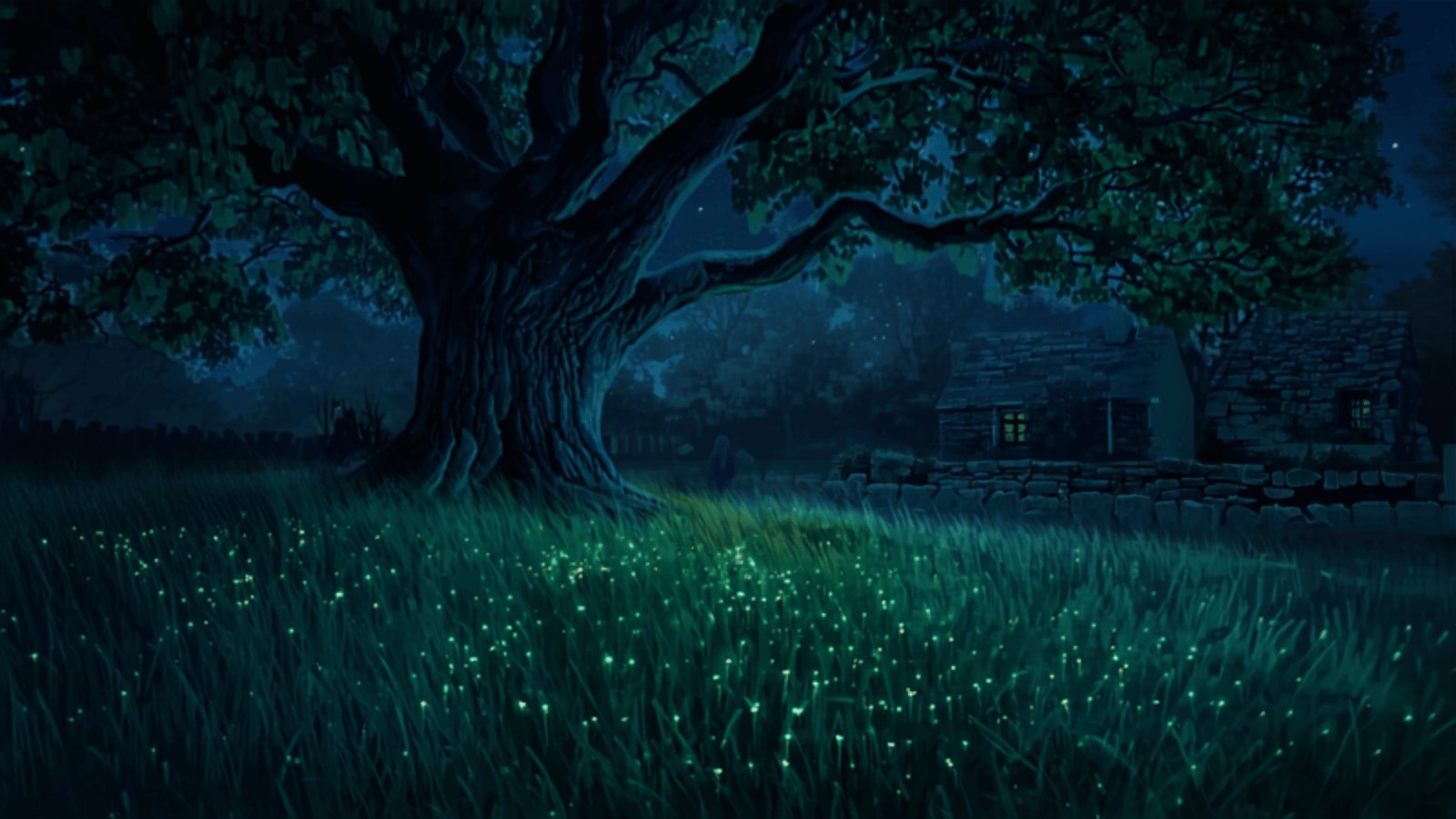
The cottage sat at the top of a quiet lane, half-hidden by hedges. Behind it, a garden climbed up to a low stone wall, and behind the wall stood a small wood of birches and, at the very centre, one huge old beech tree. The beech was easily four times taller than the cottage. Its trunk was as wide as a small car. Its canopy — the top layer of leaves and branches — spread out and covered nearly the whole back garden in a soft green ceiling.
Inside the cottage, everything smelled of woodsmoke and old paper. Iris walked slowly from room to room. Her grandmother had lived here alone for the last twenty years of her life. Now the house had been inherited by Iris. To inherit something is to receive property or money from someone who has died. She had known this day would come, but she had not expected the small building to feel so alive.
On the kitchen table, there was a note in her grandmother’s careful, sloping handwriting.
Iris,
Everything in the drawers is yours. Please look after the garden. And if you see the ghost light under the beech tree — do not be afraid. It has been there since I was a child. It means the wood is well.
Grandma
Iris read the note twice. “The ghost light.” She smiled. Her grandmother had always loved stories. When Iris was small, they had walked in the woods together and Grandma had told her that every stream had a small spirit, and that every old oak tree had a name that only it knew. Grandma had been born in this village and had never wanted to live anywhere else. She had grown vegetables in the garden and baked bread every Wednesday. She had also been, in her own quiet way, a very keen observer of the natural world.
Iris went to the back door and looked out. The beech tree stood in the afternoon light. The wind moved its leaves. A blackbird sang somewhere in the wood. It was a peaceful, ordinary scene.
“Ghost light,” Iris said out loud, and shook her head. “Oh, Grandma.”
But that evening, after the sun had gone down, Iris did notice something odd.
She was standing at the kitchen window, drying a plate, when she saw a very faint green colour at the far end of the garden. It was only there for a moment. It was so weak that she almost thought her eyes had made it up. She pressed her face to the glass and looked again. Nothing. The garden was dark. The great beech was only a black shape against the sky.
She put the plate down. She told herself it was probably a car light from the lane, or a torch, or the moon on a wet leaf. Iris had trained herself, as a science teacher trains herself, to look for the ordinary explanation first. If it walks like a duck and quacks like a duck, she often told her students, it is very rarely a swan in a costume.
She went to bed. But before she closed her eyes, she thought about the note again — if you see the ghost light under the beech tree, do not be afraid. Something about that one sentence would not let her sleep.
2 · The first sighting
The next evening, Iris was ready.
She had spent the day walking around the wood in daylight and had seen nothing unusual — just the beech, a few small mushrooms among the roots, and a heap of old fallen wood at the tree’s base. Some of the wood was soft with decay. To decay is the slow natural process of rotting away, and in a wood, decay is not a bad thing. Fallen wood feeds new life. It is the forest’s way of tidying up after itself.
That night, she sat on the small stone bench in the garden with a blanket over her knees. She had a notebook and a pencil. All the cottage lights had been switched off. Above her, the sky was full of stars — more stars than she ever saw from the city.
The moon rose slowly over the wall. An owl called twice from somewhere in the wood. Iris waited.
At about ten o’clock, she saw it.
At first it was so faint that she thought her eyes were playing a trick. Then, slowly, the light became clearer. It was low down, close to the ground, right at the base of the beech tree. It was pale green, the colour of a young apple. It was not steady like a lamp — it moved a little, breathed a little, as if it were alive. It made no sound. It cast no shadow. It gave off no heat.
Iris did not move for a long time.
She sat and watched. Her heart was beating fast, but not from fear. It was the same feeling she used to get in her old lab at university, when an experiment gave her a result she had not expected.
Slowly, very slowly, she stood up. She walked towards the light. Step by step. She half-expected it to vanish, but it did not. As she got closer, she could see that the glow was not one single light. It was spread across a small area — perhaps the size of a dinner plate — over the fallen wood at the foot of the beech. To glow is to shine with a soft, steady light without any flame. The wood was glowing.
She knelt down. Careful and patient, she moved her hand close. The wood was cold. The glow made no heat. It came from the wood itself, or from something on the wood.
Iris looked more closely. On the surface of the old, wet log, there were thin white threads and, here and there, small flat mushrooms as pale as bone. So it was a fungus. A fungus is a group of living organisms that includes mushrooms and moulds. Fungi are not plants and they are not animals — they are their own group of life. Iris remembered that clearly from a first-year biology course, twenty years earlier.
She stayed there for a long time, kneeling in the cold grass. Then, very quietly, she said, “Grandma. You were right.”
Back inside, she wrote everything she had seen in her notebook. The date. The time. The size of the glowing area. The colour of the light. She sketched the shape of the mushrooms. She wrote a single sentence at the bottom of the page:
The light is real. It comes from the wood. It looks like a fungus.
She looked at the sentence and smiled. She had spent twenty years telling children that science was not about finding magic — it was about looking hard at ordinary things until they became interesting again.
She had never expected the ordinary garden of a small stone cottage in Little Hallow to be so interesting at all.
She turned off the light. She was already planning the next step.
3 · Books, jars, and a small experiment
By the end of the week, Iris had a small pile of books on the kitchen table. Some were her grandmother’s old country diaries. Some were library books about British woodland. One thick and expensive book had been ordered online and had arrived that morning — a photographic guide to fungi of the British Isles.
She began at the beginning.
She learned that light produced by a living organism has a name: bioluminescence. Bioluminescence is the natural production of light by a living thing. Many creatures make their own light — deep-sea fish, some jellyfish, fireflies, certain small worms, and, yes, a small number of fungi. The chemistry is always similar. Two substances inside the organism are combined by a helper substance, and the reaction gives off light instead of heat. A cold light, in other words. Exactly the kind of light Iris had seen.
She learned that only a few kinds of fungi in the world glow. In Britain, the most famous of them is the honey fungus, whose scientific name is Armillaria mellea. It is common. It is often disliked by gardeners, because it can attack living trees. But underneath the ground, its thin white threads — its mycelium — can spread for many metres. And in the right conditions, especially in autumn, in old wet wood, the mycelium is known to glow softly at night. This kind of soft, cold, green glow used to be called foxfire in the English countryside. Sailors, walkers, and children had reported it for centuries. In the past, it had been thought of as ghost lights, fairy fire, or a warning from the dead. It had frightened many people who did not know what it really was.
Iris shut the book. She stared out of the window.
Her grandmother had known. Not the science. Not the Latin name. But the feeling — that it was a friendly, natural thing, connected to the health of the wood. It means the wood is well. That was almost exactly what a mycologist would say. A mycologist is a scientist who studies fungi. Iris said the word out loud. “Mycologist.” She liked the shape of it in her mouth.
But she was still a teacher, and a teacher does not simply believe what she reads. A teacher tests. So Iris planned a small experiment. She would collect a specimen — a specimen is a sample taken for scientific study — from the base of the beech. She would place the specimen in a cool, dark box. If it kept glowing away from the tree, she would know that the light was really being produced by the fungus itself, and not, for example, by tiny insects, or by moonlight on wet bark.
The next night, she took a clean glass jar out to the beech. She was wearing a head torch, which she kept turned off. She waited for the glow to appear. She carefully broke off a small piece of the pale, glowing wood. She placed it in the jar. She screwed the lid on and carried it, very slowly, back to the kitchen table.
She sat in the dark for five minutes so that her eyes could adjust. Then she leaned close to the jar.
There it was.
A small, steady, pale-green light. In her own kitchen. In a glass jar.
Iris laughed out loud. She had been telling children for years that science was full of everyday wonders. She had never quite known the truth of it until now. She wrote in her notebook:
The glow travels with the wood. This is bioluminescence. Almost certainly Armillaria mellea (honey fungus).
She wanted, very badly, to send a photograph to someone who would understand. But she also knew that a good scientist checks her own work by asking someone who knows more.
She opened her laptop. She began to search for a mycologist.
4 · Dr Yousef
Dr Maryam Yousef worked at a small research station forty miles from Little Hallow. She had a photograph on her staff page that showed her smiling in wellington boots, holding a large orange mushroom the size of a football. Her list of published papers was long. Most of her career had been spent studying woodland fungi and how they connect trees to one another through the soil.
Iris wrote to her.
She kept the email short. She said who she was. She described what she had seen. She attached a photograph she had taken through the glass of the jar, in the dark. She said she was fairly sure it was honey fungus, but she wanted a second opinion. She said she would drive to the research station if that helped. She pressed send.
The reply came the next morning.
Dear Iris,
Thank you for a very careful email. Your photograph is not perfect — the light is faint — but it does look like Armillaria to me. If you can, please bring your specimen tomorrow afternoon. I would love to see it in person. And I have a question I would like to ask you at your cottage, if you have time. Would Thursday evening suit for a visit? — MY
They met that Wednesday.
Dr Yousef was younger than her photograph had suggested. She was kind, direct, and interested. She had brought a small microscope. She held the specimen for a long time. She placed the wood on a black cloth on her desk, and she and Iris switched off the room lights.
The glow was fainter than it had been on the first night. But it was there.
“Yes,” Dr Yousef said quietly. “That is Armillaria. Well done. This is a good, clear specimen. Do you know how rare it is these days to see this at all?”
Iris shook her head.
“A hundred and fifty years ago,” said Dr Yousef, “you could find foxfire in almost any old woodland in the west of England. Country children knew it. Farmers knew it. Now, most woods are managed too tidily. Fallen wood is cleared away. Old trees are cut down. The fungi are still in the soil, but the right conditions for a strong glow — wet, still, undisturbed air with plenty of decaying wood — are much harder to find. Little pockets, here and there, are all that we have left.”
She paused.
“Your beech tree at Little Hallow is very old. Am I right?”
“Two hundred and fifty years, we think,” Iris said. “My grandmother kept a record from the parish. Her own great-grandfather planted it.”
“And the wood behind the garden is old too?”
“Yes. It has not been managed for a very long time. Nobody has been paid to touch it. That is probably why it is still there.”
Dr Yousef nodded slowly. “That is why you have the glow. It is not the beech alone. It is the whole small habitat — the tree, the fallen wood, the still air, the low light, the shelter of the wall. A habitat is the natural home of a living thing. Take one part away, and the habitat stops working. The fungus retreats underground. The glow disappears. And once it has been lost, it is very hard to bring it back.”
She looked at Iris.
“That was going to be my question. May I visit on Thursday? Because I would like to see the site properly, at night, in place. I would also like to make a small record of it. We are trying to build up a list of the last remaining British sites where foxfire can still be observed. If your grandmother’s wood is one of them, that is important.”
Iris said yes at once.
“Also,” Dr Yousef added, more gently, “I should tell you something. I did a little reading before I came. I saw that a planning application has been made for the field beside your grandmother’s wood. A row of new houses. I do not want to worry you. But if the wood is disturbed by heavy machines, by lights at night, by drier soil, the habitat will change quickly, and this glow will be lost from Little Hallow within a very few years. So I would very much like to help you preserve it. To preserve something is to keep it safe from harm or change.”
Iris felt her stomach turn cold.
5 · The night meeting
The parish council of Little Hallow met on the first Tuesday of every month, in the small village hall. On the Tuesday after Dr Yousef’s visit, the hall was more crowded than usual. Word had gone round the village that the planning application would be discussed that evening.
Iris sat in the middle of the room. Dr Yousef sat beside her, a folder on her knee. Behind them, a young man from the developer’s company sat with two lawyers. On the front table, six council members were sitting in a row.
The developer’s man spoke first. He was polite and calm. He said the county badly needed new homes, especially for younger families. He said the field beside the cottage was not a nature reserve. He said only a small strip of the old wood would be affected, and that the developer would replant twice as many trees as would be lost.
Some people in the hall nodded slowly.
Then Iris was invited to speak.
She stood up. She was, for a moment, more nervous than she had ever been in front of a class. But she took a slow breath, and she thought of her grandmother.
She spoke plainly. She said her grandmother had cared for this wood for fifty years. She said the wood was not just a group of trees. It was a habitat for a rare bioluminescent fungus — a fungus that produces its own light without heat or flame. She said that in most of England this soft green glow had been lost, quietly, over one or two generations, because old fallen wood was cleared and old trees were cut. She said that country children had once known this glow as foxfire. She said that if the wood was disturbed now, the glow would disappear from Little Hallow within a very few years, and it would almost certainly not come back.
She sat down. There was a small silence.
The chair of the council, a tired-looking woman in her sixties, cleared her throat. “Very interesting,” she said carefully. “But I am afraid that stories about ghost lights are not something we can weigh against a housing application. Do you have any evidence, Ms Whitton?”
Dr Yousef stood up. She opened her folder. She placed photographs and printed pages on the front table. She spoke for six minutes. She was calm and clear. She named the fungus. She showed the microscope images that had been made in her lab. She showed a small map of the last known British sites of foxfire. She placed Little Hallow on the map. She invited any council member to visit her research station and inspect her records.
Then she said something Iris had not expected.
“With Iris’s permission,” Dr Yousef said, “I would like to invite the council to come and see it. Tonight.”
She looked at the chair.
“Not to argue,” she went on. “Just to look. It is a five-minute walk from this hall. If you see nothing, you can dismiss all of this as one woman’s story and my folder. If you see what we have seen, you may want to think again. That is all I ask.”
The chair looked at the developer’s lawyers. The lawyers looked at each other. Nobody had prepared for this.
The chair called a short break.
Twenty minutes later, in near-darkness, a very strange little group walked up the lane behind Iris’s cottage: two lawyers in polished shoes, a young man who had never planned to be in a wood at night, six council members with torches switched off, a mycologist with a small camera, and Iris. Nobody spoke. They passed through the garden gate, past the stone bench, up to the great beech.
They stood in a wide semicircle around the fallen wood. Somebody coughed. A dog barked far away. The wind moved in the canopy above them, and a single leaf fell.
Then, slowly, the glow appeared.
The chair of the council did not speak for nearly a minute. At last, without turning her head, she said, in the quietest voice, “Well. That is not on any planning form I have ever seen.”
Iris said nothing. Dr Yousef said nothing. They did not need to.
Above them, in the still autumn air, the old beech was standing quietly over its own hidden light, as it had done for two hundred and fifty years.
The vote would be taken the following week. But something in that circle of people, standing in the dark, had already changed.
Iris knew it. And she thought, somewhere in the wind above her, her grandmother knew it too.
Check your understanding
Read each question. Think about your answer. Then click “Show answer” to check.
Words to remember
Here are the ten key words again, in fresh sentences that use them in a slightly different way. Say each one out loud.
- bioluminescence — Deep-sea divers are often astonished by the bioluminescence of the creatures that live far below the surface.
- mycologist — After she retired from teaching, my aunt trained as a mycologist and now leads mushroom walks every autumn.
- fungus — The gardener explained that this fungus is not attacking the tree; it is helping the roots take in water.
- glow — A single candle in the window glowed softly against the winter sky.
- decay — Nothing on the forest floor is wasted; even a large fallen tree slowly enters a long, quiet decay that feeds new plants.
- specimen — She wrapped the tiny fossil in cloth and labelled it as a “type specimen” for the university collection.
- habitat — Once its habitat was flooded by the new dam, the small ground-nesting bird disappeared from the valley.
- preserve — The village raised money to preserve the last working windmill in the county.
- canopy — Sunlight came down through the canopy in narrow green beams, as if through the windows of a cathedral.
- inherit — She had always been told that she inherited her father’s patience and her mother’s temper — in equal measure.
Grammar in this story: the passive voice
This story uses the passive voice a lot, especially when talking about science and formal events. In a passive sentence, the thing that receives the action becomes the subject, and the doer (if it is mentioned at all) comes at the end after by. Look at these examples from the story:
• “Now the house had been inherited by Iris.” (Someone left the house; Iris receives it.)
• “All the cottage lights had been switched off.”
• “The mycelium is known to glow softly at night.”
• “It had been thought of as ghost lights, fairy fire, or a warning from the dead.”
• “A planning application has been made for the field.”
• “If the wood is disturbed, the habitat will change quickly.”
The pattern is always the same: subject + form of “be” + past participle (was seen, is known, has been made, will be taken, would be lost). We use the passive when the doer is unknown, unimportant, or already obvious — which is why it is very common in scientific writing, news reports, and formal notices.
👉 Learn the full rule, with more examples and a short quiz, here: Active vs Passive Voice Explained.
Talk about it · Write about it
Talk about it: Is there a place in nature — a park, a wood, a stretch of river, a garden — that feels quietly important to you? What is it about that place that would be lost if it were built on? Try to describe the feeling as well as the details.
Write about it: Imagine that a small piece of land near you is threatened by a new building project. Write a short speech (about 120–180 words) that you could give to the local council. Use at least three passive-voice sentences (for example: “This wood has been used by families for generations”, “If the trees are cut down, they cannot easily be replaced“).
🎉 Well done — you have read a full 3,000-word story in English. That is a real reading milestone at B2. And along the way, you have picked up ten new words and seen the passive voice at work in a real narrative.
But wait — the vote of the parish council has not been taken yet. And Iris still has a full-time job and a flat in the city. Will she keep the cottage? Will the wood be saved? Write your own ending, using details from the story to explain your choice.
Read the fictional life of Elena Varga, who listens closely to bridges. Notice how technical observation becomes a story about people. Next story: The Woman Who Listened to Bridges (B2 Reading Story)
About this story: This is an original B2 upper-intermediate graded reader (~3,350 words). It uses controlled B2-level vocabulary (roughly a 1,400-headword ceiling), a natural mix of tenses, and a strong focus on the passive voice, so upper-intermediate learners can understand about 98% of the running words. Any word that is above level and essential to the plot is defined before the story and then used again inside it. This story is fiction, but the science it describes — bioluminescent fungi in old British woodland — is real.

I’m Khamis Maiouf. I’m studying Health and Social Care and have completed Functional Skills Level 2 in English and Level 3 Hairdressing. I have taught ESOL in my community and helped students with GCSE English. I run English Teacher Site to help people learn and practise English.