
The Lamp at the Crossroads (B1 Reading Story)

B1 · INTERMEDIATE Reading practice · ~2,780 words · 14-min read
This is an original folk-tale, written in simple English for intermediate learners. First, read the ten key words below. Then read the five short chapters. There is a small quiz at the end to check what you understand, and one grammar point to notice as you read.
Before you read — 10 key words
- lamp — a small light with oil or a flame inside it.
- oil — a thick liquid used to make a lamp burn.
- crossroads — a place where two roads meet.
- traveller — a person who is moving from one place to another, often far from home.
- flame — the bright, moving part of a fire.
- promise — words that say you will do something, and you must not break them.
- ashamed — feeling bad because you have done something wrong.
- ancestor — a person in your family who lived long before you were born.
- storm — very bad weather with strong wind, rain, or snow.
- chain — a line of things (or people, or events) joined one to the next.
The story
1 · The lamp at the window
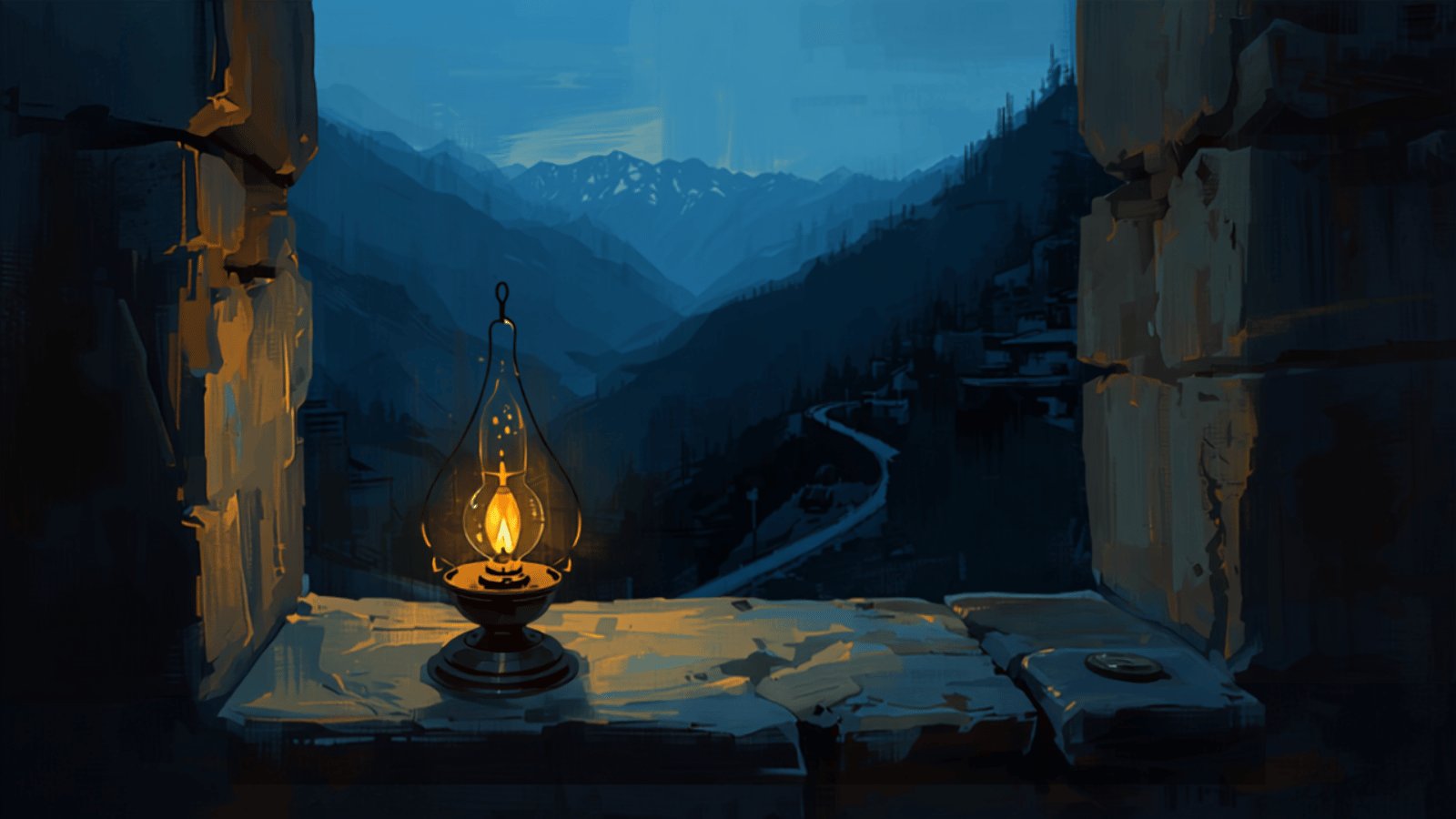
For as long as she could remember, Rosa had helped her grandmother light the lamp. It was a small brass lamp, old and gentle, with a soft yellow flame. Every evening, when the sun went down behind the mountain, her grandmother — everyone in the village called her Nena — took the lamp down from the shelf. She cleaned the glass. She poured a little oil into it. She lit the flame. Then she carried the lamp to the window that looked out on the north road, and she put it there.
Rosa was fifteen years old. She had lived with Nena in the little stone house at the crossroads all her life. The crossroads was a quiet place where two roads met. One road went down to the village, warm and safe. The other road went up into the mountains — north, into the cold country. It was a long, lonely road. Travellers came that way sometimes, but not often. Most weeks, the road stayed empty from morning until night.
“Nena, why do we always light it?” Rosa had asked, many times, when she was little.
And Nena had always given the same answer. “Because we promised.”
Rosa loved her grandmother. She loved the little stone house. She loved the smell of the lamp oil, and the warm yellow light on the wooden floor at night. But now that she was older, she began to think about things differently.
Oil was not free. It cost money. And in that mountain village, money was not easy to find. Every week, Rosa walked down to the village shop and bought a small bottle of lamp oil. Every week, she counted the coins in her hand, and she thought that maybe there were better things to buy — bread, or wool, or medicine for Nena’s cough.
“Nena,” she said one evening. “We use so much oil. And nobody sees the light. The road is empty.”
Nena was sitting by the fire. She was old — nearly eighty. Her hair was as white as the mountain snow. She smiled, but she did not answer at once.
“Sit down, my heart,” she said. “Sit down and listen.”
Rosa sat.
“This lamp,” Nena said quietly, “has burned every single night for one hundred years. Not just in my time. In my mother’s time. In my grandmother’s time. And in her grandmother’s time before that. It is a promise our family have kept for four generations.”
“A promise to who?” Rosa asked.
Nena’s eyes were kind. “To anyone on the road,” she said. “To anyone who is lost.”
Rosa looked at the small flame. It did not look very strong. Outside, the wind was rising in the trees.
“But nobody comes,” she said quietly.
Nena took Rosa’s hand. Her fingers were thin, but they were warm. “Someone came once,” she said. “And that is enough.”
2 · The shopkeeper’s warning
That winter was hard. The snow came early. It fell heavily on the mountains, and it fell heavily on the crossroads. The wind grew colder every night. Rosa often heard it crying around the little stone house long after she had gone to bed.
Nena’s health was not good. She coughed a lot. She sat by the fire and slept, and Rosa did most of the work now. Rosa cooked. Rosa cleaned. Rosa walked to the village for food and for oil. And she also lit the lamp each evening, because Nena’s old hands had begun to shake too much.
One cold morning at the village shop, the shopkeeper looked at her with worried eyes.
“Rosa,” he said. “You buy a lot of oil these days. In this cold winter, oil has become expensive. Are you sure you need so much?”
“It is for the lamp,” Rosa said. “The one in our window.”
The shopkeeper nodded slowly. “Ah. The old lamp.” He was quiet for a moment. Then he said, “Your grandmother is a good woman. But some old customs cost more than they give. If you cannot pay for oil this week, do not worry. Come back when you can.”
Rosa walked home in the cold. The small bottle of oil felt heavy in her bag. She kept thinking about what the shopkeeper had said. Some old customs cost more than they give.
She thought about the lamp. She thought about the empty road, week after week. She thought about her grandmother, coughing and tired by the fire.
Maybe the shopkeeper was right. Maybe the lamp was a beautiful old idea, but only an idea. Maybe nobody had ever really needed it. Maybe her ancestors — the people in her family who had lived long ago — had lit it because they were kind, but not because it did anything real for anyone.
That evening, Nena was very tired. She fell asleep in her chair before dinner.
Rosa looked at the lamp on the shelf. She looked at the small bottle of oil in her bag.
“Just one night,” she whispered to herself. “One night without the lamp. Nena will not know. And I will save a little oil for a very cold day.”
She did not light it. She ate her supper alone in the quiet kitchen. Then she helped Nena to bed and sat by the fire for a while, listening to the wind.
Outside, the window was dark. Very dark.
But nothing happened. No traveller came. The road stayed empty, as always. Rosa went to bed, and she felt strange — a little proud, and also a little ashamed.
To be ashamed is to feel bad because you have done something wrong. Rosa did not really understand why she felt like that. She had done nothing wrong, had she? The lamp was only an old promise. And a promise to no one, surely, was not really a promise at all.
She fell asleep, and she did not dream.
The next night, the window was dark again. And the night after that. Three nights in a row, no lamp burned in the window at the crossroads.
3 · The night of the great storm
On the fourth day, the storm came.
It began in the afternoon. Grey clouds rolled down from the mountains. The wind roared through the trees. Then the snow started — heavy, fast, silent snow. By evening, the world outside was white. Rosa could not see the road. She could not see the village down in the valley. She could not even see the fence at the end of the garden.
Nena was very ill that day. Her cough was worse than before. She had a fever, and her breathing was slow and small. Rosa had run down to the village that morning and brought back some medicine. Now she sat beside her grandmother’s bed, holding her hand.
“Sleep, Nena,” she whispered. “Sleep. I am here.”
Nena’s eyes opened for just a moment. “The lamp, Rosa,” she said quietly. “Have you lit the lamp?”
Rosa froze. Her heart went cold. Outside, the storm was louder than she had ever heard it. Wind. Snow. Darkness. And she had not lit the lamp for three nights now.
“Yes, Nena,” she said. It was a small lie. “Yes, of course. Sleep now.”
Nena closed her eyes and slept.
Rosa sat very still. The lie sat inside her, heavy as a stone.
She stood up quietly. She walked to the shelf. She took the little brass lamp down. Her hands were shaking. She poured the oil carefully. She struck the match. The flame jumped, then stood tall — a bright, warm, dancing flame in the middle of all that darkness. Rosa carried the lamp to the north-road window and put it down on the sill.
The little flame burned. It threw yellow light on the snow outside. And then, for a moment, Rosa thought she saw something moving in the white — a small dark shape, very far away, on the road.
But when she looked again, there was nothing. Only snow. Only wind. Only the long, empty, freezing road.
She stood at the window for a long time. She watched the flame. She watched the storm. Then she went back and sat beside her sleeping grandmother.
The night passed slowly. The wind screamed at the walls. Sometimes Rosa slept a little in her chair, then woke again with a jump. Every time she woke, she looked across the room at the window. The lamp was still burning. The little flame did not go out.
If the lamp went out tonight, Rosa thought, and if somebody was really out there in the snow, they would be lost. They would freeze. Nobody would ever know.
She got up twice in the night and put more oil in the lamp. She was careful not to wake her grandmother. She was very quiet, and her hands were very steady now.
By morning, the storm had stopped. The wind was gone. The whole world was white and silent, and the sun came up slowly over the mountains. The snow shone like broken glass.
Rosa was so tired. She sat by the window with her hands around a cup of tea, and she looked out at the empty, white road.
Then she heard a soft knock at the door.
4 · The traveller at the door
Rosa opened the door slowly.
A woman stood there. She was young, but her face was as white as the snow behind her. Her coat was soaked. There was ice in her hair. And she was holding something inside her coat, close to her heart — a small child, a baby wrapped in a thick grey blanket.
“Please,” the woman whispered. “Please, may we come in?”
Rosa opened the door wide. She took the woman’s arm and helped her into the warm kitchen. She put a chair by the fire. She wrapped a dry blanket around the woman’s shoulders. She brought a bowl of hot soup, and a small cup of warm milk for the baby.
The woman was shaking. She could not speak for a long time. She held her baby close and watched the fire. Slowly, the colour came back into her face.
“Thank you,” she said at last. Her voice was small and rough. “Thank you. I really thought — I thought we would die out there.”
“Where did you come from?” Rosa asked gently.
“From the north,” the woman said. “From a village beyond the mountains. My name is Ines. This is my son, Tomás. His father is dead. There is no work for us in the north country any more, so I am walking down to my aunt’s home, three days south of here. She is our only family.”
Rosa listened, and she did not know what to say.
“Yesterday afternoon, the storm found us on the road,” Ines said. “I have walked for so many hours in the snow. It was so dark that I could not see my own feet. I did not know if we were still on the road, or if we had walked into the trees, or if we would fall down the side of the mountain. And then, very far away, I saw a light. A small yellow light. So small, it was almost nothing. But I walked toward it. It was the only thing I could see. I do not know how long I walked. But your light did not go away, and so I did not stop. And now, here we are.”
Rosa felt something break inside her.
She looked at the little brass lamp in the window. The flame was still burning quietly, small and steady in the morning sun.
“You saw the light?” she whispered.
“Yes,” Ines said. “Your lamp saved us. I do not know your name yet, or the name of this house. But when my Tomás is older, I will tell him this story. I will tell him that a small light in a window in the mountains saved his life, in the year he was born.”
Rosa could not speak. She was ashamed.
She thought about the three nights when there had been no lamp at all — nights just like this one, in the same cold winter, on the same lonely road. She thought about all the other travellers, over one hundred long years, who might have looked out into the darkness for that same light. She thought about her ancestors, who had lit the lamp every night, in every storm, without asking for anything back, and without ever knowing whether they had helped a single person.
She looked at Ines and her small sleeping baby. And then she looked, across the room, at her own sleeping grandmother.
Nena had been right. She had always been right, all along.
“There is something you should know,” Rosa said quietly. And she began to tell Ines the true story of the lamp.
5 · A chain of light
Ines stayed with Rosa and Nena for two days.
The snow was too deep to travel, and the baby needed rest. Rosa cooked for them all. She heated water for baths. She made a small warm bed for Tomás beside the fire, and she washed his wet blankets. Nena’s fever went down on the second day, and she smiled at the young woman and her baby.
“Welcome,” Nena said. “Welcome to our house.”
Ines told them about her long walk from the north. Nena told Ines about the lamp, and the promise, and the four generations. Rosa listened to them both, and said little.
That evening, when the sun was going down, Ines said something surprising.
“I have something to tell you,” she said. “I did not want to say it before, because I was worried you would think I was making it up. But when I was a little girl, my own grandmother told me a story too. She said that many years ago — before I was born, before my mother was born — she was travelling in these mountains with her little sister. A great storm came, just like the one last night. They were lost. They thought they would surely die. And then, very far away, they saw a small yellow light in the window of a house at a crossroads. They walked toward it, all night, and it saved them.”
Rosa’s mouth fell open. Nena, in her chair, sat up straight.
“That was our house,” Rosa whispered.
“I think it was,” Ines said quietly. “My grandmother’s name was Elena. She lived to be ninety years old. She had four children, and eleven grandchildren, and I am one of them. So — because a light was burning in a small window that night, all those years ago, I am here now. My son Tomás is here. That is a very long chain of light, is it not?”
A chain, Rosa thought — a line of things joined one to the next. Or, in this case, a line of people. Elena. Ines. Tomás. And, one day soon, Tomás’s own children too.
Rosa looked at her grandmother. Nena’s eyes were closed, but there were tears on her old face. She was smiling.
That night, Rosa lit the lamp herself. She cleaned the glass very carefully. She poured the oil slowly, so that not a single drop was lost. She lit the flame, and she carried the lamp to the window that looked out on the north road. The flame stood up bright and strong.
Ines stood beside her. Together, they watched the small yellow light on the snow.
“When Tomás is old enough,” Ines said, “I will tell him this story. And when he has his own house, one day, maybe he will keep a light in his window too. And his children will do the same. And so on. The chain will grow.”
Rosa nodded. She could not speak. She thought about the promise that her family had kept for one hundred years — a promise, she now understood, that had never really been to a stranger on the road. It had been to the future itself.
Ines and Tomás left three days later. They walked south, down the valley, in the fresh clean snow. Rosa and Nena stood at the door and waved for a long time, until the two small shapes disappeared behind the trees.
That evening, Rosa lit the lamp as usual. She placed it in the north-road window. Then she stopped. Something on the far side of the valley caught her eye.
Across the valley, on the other mountain, in a small stone house she had never really noticed before, there was a new light in a window. A small, soft, yellow light — just like her own.
Someone over there had lit their own lamp.
Rosa smiled. She wondered who it was. She wondered how long they would keep it burning, and what story they were telling their children about the night of the great storm.
And she wondered which traveller, somewhere out there in the dark mountains, was walking toward it right now.
Check your understanding
Read each question. Think about your answer. Then click “Show answer” to check.
Words to remember
Here are the ten key words again, in fresh sentences. Read each one out loud, and try to make your own sentence with the word.
- lamp — There was an old lamp on the table, and it gave a warm yellow light.
- oil — She poured a little oil into the lamp before she lit it.
- crossroads — At the crossroads, one road goes to the sea and the other goes into the hills.
- traveller — A tired traveller knocked on our door and asked for a cup of water.
- flame — The flame of the candle moved gently in the wind.
- promise — He made a promise to his mother that he would always call every Sunday.
- ashamed — I was ashamed when I saw how much rubbish I had left on the beach.
- ancestor — My great-great-grandfather is an ancestor I never met, but I know his name.
- storm — During the storm, we could not go outside for two days.
- chain — Every small act of kindness is one link in a long chain of good.
Grammar in this story: the present perfect
Most of this story uses the past simple, because folk-tales tell you what happened. But look closely and you will find the present perfect at the moments when a character talks about a long tradition — something that started in the past and is still true now.
“This lamp has burned every single night for one hundred years.”
“It is a promise our family have kept for four generations.”
“I have walked for so many hours in the snow.”
We form it with have or has + the past participle: burn → has burned, keep → have kept, walk → have walked. We often use it with for (a length of time) or since (a starting point): for one hundred years, since last winter.
👉 Learn the full rule here: The Present Perfect Tense (B1).
Talk about it · Write about it
Talk about it: Is there a small tradition in your family — something you have done for a long time, even if you do not fully know why? What is it? Who started it? Do you think you will pass it on to the next generation?
Write about it: Write a short paragraph (about 100 words) about one small act of kindness that someone once did for you, or that you did for someone else. Try to use the present perfect at least twice — for example, “She has helped me many times” or “I have never forgotten that day”.
🎉 Well done — you have read a full B1 story of nearly 2,800 words in English. That is a real achievement. And notice how much easier all ten key words feel now that you have met them inside a story.
But who lit that far-off lamp across the valley? Is there another family, on the other side of the mountain, with a story of its own — perhaps a story that started on the same terrible night? Write your own ending, using details from the story to explain your choice.
Nadia feels alone in the city. Read about the rooftop garden and trace how a shared space changes her daily life. Next story: The Rooftop Garden (B1 Reading Story)
About this story: This is an original B1 graded reader (~2,780 words) built on the Oxford Bookworms method. Vocabulary is controlled to roughly 1,000 headwords, with any harder word glossed up front and reused inside the story so learners can understand about 98% of the running words. Grammar highlights the present perfect against a past-simple narrative frame.

I’m Khamis Maiouf. I’m studying Health and Social Care and have completed Functional Skills Level 2 in English and Level 3 Hairdressing. I have taught ESOL in my community and helped students with GCSE English. I run English Teacher Site to help people learn and practise English.