
The Light in the Bay (B1 Reading Story)

B1 · INTERMEDIATE Reading practice · ~3,100 words · 16-min read
This is an original story for intermediate learners. It is about a small fishing village, a strange light in the sea, and a young woman who refuses to believe the easy answer. First, read the ten key words. Then read the story. At the end, there is a quiz to check what you understand.
Before you read — 10 key words
- glow — to shine with a soft, steady light, like a candle or a screen in the dark.
- plankton — very small living things that float in the sea; fish eat them.
- microscope — a scientific instrument that makes very small things look big.
- sample — a small amount of something that you take in order to study it.
- tide — the regular movement of the sea up and down the beach, twice a day.
- pollution — dirty or dangerous substances that damage water, air, or land.
- harbour — a protected area of water where boats can stay safely.
- evidence — facts or objects that show what is really true.
- disturb — to move or touch something and change its quiet, still state.
- creature — any living animal, especially one that is strange or unknown.
The story
1 · The night the sea turned blue
Mira Deniz had lived in Saltrock Bay all her life, and she thought she knew everything about it. She knew the narrow streets that climbed up from the water. She knew the smell of salt and engine oil on the harbour wall. She knew which fishermen sang while they worked and which ones never said a word before ten o’clock. Most of all, she knew the sea — its colours, its moods, and the sound it made against the stones on a quiet night.
Mira was twenty-four. Since she had finished school, she had worked with her uncle Tomas on his small fishing boat, the Grey Gull. It was hard work, and the money was never good, but she loved the early mornings when the water was flat and pink. Her friends had moved to the city one by one. Mira had stayed. “Somebody has to stay,” she always said, “and it might as well be somebody who loves the place.”
One warm evening in late August, Mira walked home along the beach after fixing the nets. The tide was low, and the wet sand shone in the last light of the day. She stopped to pick up a plastic bottle that someone had dropped, because she hated rubbish on her beach. When she stood up, she saw something that made her forget the bottle completely.
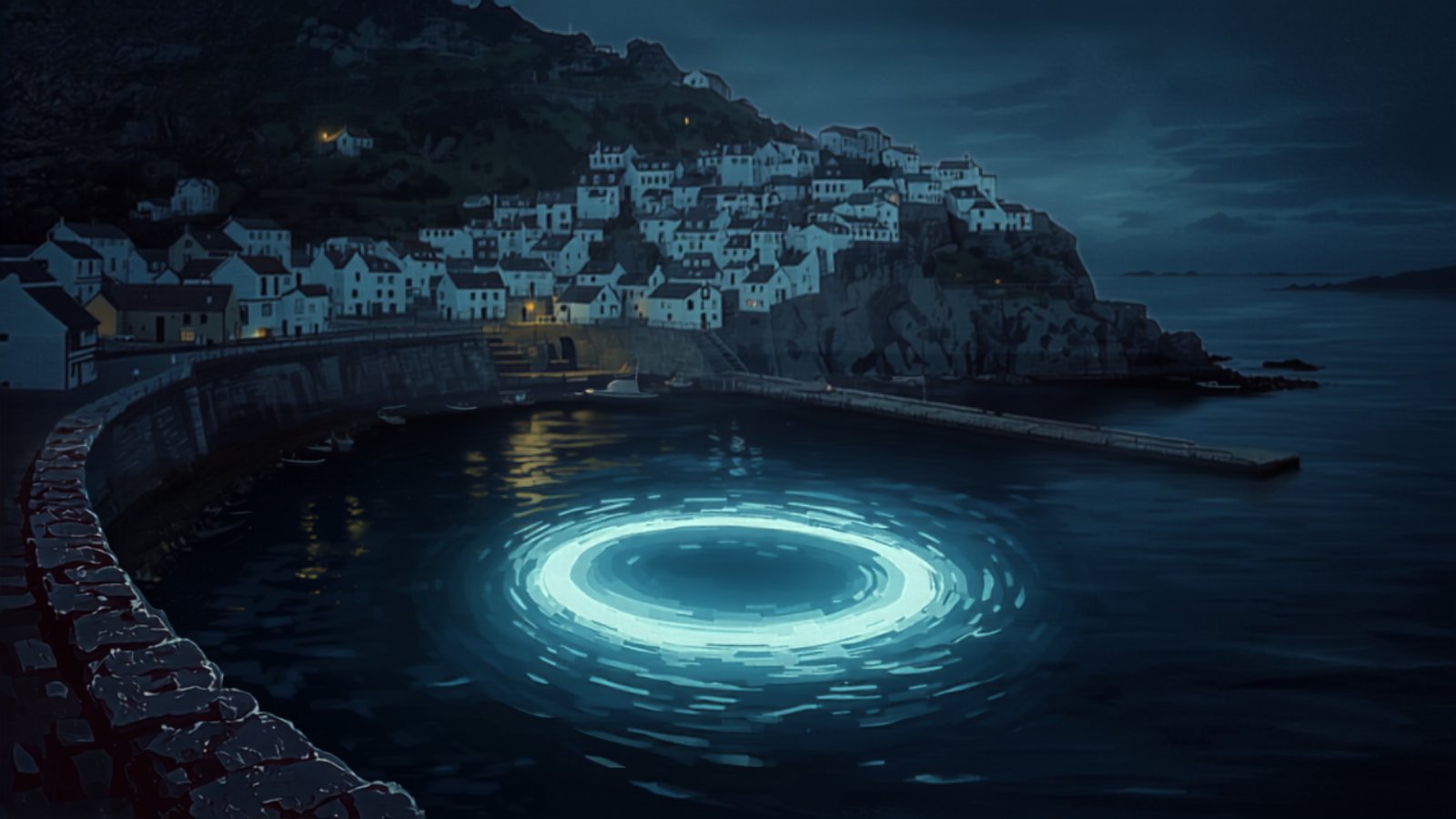
The edge of the sea was glowing.
Every small wave that touched the sand lit up with a soft blue light, like electric fire. The light appeared, danced for a second, and disappeared. Then the next wave came, and it happened again. Mira stood very still. She had seen the sea in a storm, under the moon, and in thick fog — but in twenty-four years she had never seen anything like this.
She walked closer and put her hand into the shallow water. The moment her fingers disturbed the surface, blue light exploded around them, as if she had put her hand into a sky full of tiny stars. She pulled her hand out. The light died. She moved her hand through the water again — and again the light followed every movement.
“It only glows when something disturbs it,” she said quietly to herself. “It’s answering me.”
She took out her phone and made a video. Then she ran up the beach road to her uncle’s house, her wet shoes slapping the stones, her heart beating like an engine. She didn’t know it yet, but that short video was going to change everything for Saltrock Bay.
2 · Rumours in the village
By the next morning, half the village had seen Mira’s video, and by lunchtime the other half had heard about it. In a place as small as Saltrock Bay, news travels faster than the wind.
The problem was that everyone had a different explanation, and most of the explanations were frightening.
“It’s chemicals,” said Mrs Petrov, who ran the bakery. “My cousin worked at a factory once, and he told me that chemicals glow in the dark. Something has leaked into our water.”
“It’s pollution from the big ships,” said old Henrik, who had fished the bay for fifty years. “The sea has never done this before. If the water were clean, it would look normal. Water that glows is water that’s sick.”
Uncle Tomas said nothing at all, which was worse. He sat at the kitchen table, turning his coffee cup in his hands. Finally he spoke. “Mira, the restaurant in town has cancelled today’s order. The manager saw your video. He says he can’t sell fish from glowing water. People will think it’s dangerous.”
Mira felt her stomach drop. “But we don’t even know what it is yet!”
“People don’t wait to know,” her uncle said quietly. “They just decide.”
That afternoon, a large silver car drove down the harbour road, and a man in an expensive jacket got out. His name was Mr Callan, and everyone in the village had heard of him. His company had been trying to buy the old harbour for two years. They wanted to knock down the fishing sheds and build a marina — a modern harbour full of white yachts for rich visitors from the city.
Mr Callan stood on the harbour wall and looked at the water with a sad, careful face, like a doctor looking at a very ill patient.
“This is exactly what I’ve been afraid of,” he told the small crowd that had gathered. “This bay is old and dirty. The water is clearly polluted. If you sell me the harbour, my company will clean everything, and this village will finally have a future. If you wait, the fish will die, and the tourists will never come.”
He announced that there would be a village meeting on Friday evening, where everyone could vote on his offer. Then he got back into his silver car and drove away.
Mira watched the car disappear up the hill. Something about Mr Callan’s speech bothered her. He had called the glowing water “pollution” — but he hadn’t tested it, hadn’t touched it, hadn’t even asked a single question about it. He had simply given the village an answer that was good for his company.
“He might be right,” she thought. “But if he’s wrong, we’re about to sell our home because of a light in the water that nobody understands.”
She decided, standing right there on the harbour wall, that she would find the truth before Friday.
3 · The man with the microscope
There was only one person in Saltrock Bay who might know what to do, and he lived in the last cottage on the cliff road, behind a garden full of strange plants with small paper labels.
Mr Abiodun Okafor had been the science teacher at the village school for thirty years before he retired. He was the kind of teacher that students remember forever — the kind who once brought a sheep’s heart to class in a plastic box, and who answered every question with another question. Mira had been one of his best students, although she had almost forgotten that.
When she knocked on his door that evening, he opened it, looked at her over his glasses, and smiled.
“Mira Deniz,” he said. “I’ve been expecting you since this morning. You’re the only person in this village who would rather ask a question than repeat a rumour. Come in.”
His front room looked more like a laboratory than a living room. There were shelves of books, jars of dried leaves, a human skeleton wearing a woolly hat, and, on the desk by the window, an old but beautiful microscope made of black metal and brass.
“You’ve seen the video, then,” Mira said.
“Seven times,” said Mr Okafor. “And I have a theory. But a theory without evidence is just a story that a scientist tells himself. If we want the truth, we need a sample of that water. Tonight, before the tide changes.”
“Tonight? It’s nearly dark.”
“My dear girl,” he said, picking up his coat and three empty glass jars, “dark is exactly what we need. You can’t study a light in the daytime.”
So that night, while the village slept and worried, an old teacher and a young fisherwoman walked down to the beach together. The moon was hidden behind thin clouds, and the beach was completely black — which made what they saw even more wonderful. The glow was still there, fainter than the night before, but alive. Every wave drew a thin blue line on the black water, and when a night bird landed on the surface far out in the bay, a circle of pale light spread around it like a ring on a pond.
Mr Okafor showed Mira how to take a proper sample. They filled the three jars in three different places: one near the rocks, one by the harbour steps, and one out where the fresh stream ran into the sea. When Mira lifted the first jar, she shook it gently. The water inside flashed blue, and hundreds of tiny points of light appeared and vanished, like a photograph of a city at night.
“It’s beautiful,” she whispered.
“It is,” said Mr Okafor. “And here is your first lesson of the evening: pollution is many things, but it is almost never beautiful. Now let’s go and meet whatever is living in these jars.”
4 · A thousand tiny lights
Back in the cottage, Mr Okafor put a single drop of the sample onto a small piece of glass and slid it under the microscope. He looked for a long time without speaking. Then he laughed — a short, happy laugh, like a boy who has found money in an old coat.
“Come and look,” he said. “Come and meet your monster.”
Mira put her eye to the microscope. At first she saw only grey water. Then Mr Okafor turned a small wheel, and suddenly the drop of water became a world. It was full of tiny round creatures, almost transparent, drifting slowly like balloons in a gentle wind. Each one was smaller than a grain of flour. There were dozens of them in that single drop — which meant there were billions of them in the bay.
“What are they?” she asked.
“Plankton,” said Mr Okafor. “To be exact, a very special kind of plankton that scientists call dinoflagellates — but ‘sea sparkle’ is easier to remember, and it’s the name I prefer. They are tiny living creatures that float wherever the water carries them. Fish eat them. Whales eat them. Half the ocean depends on them. And this particular kind has a talent: when something disturbs the water around them — a wave, a boat, a curious hand — they produce light. It’s a chemical reaction inside their bodies, the same kind of chemistry that makes fireflies glow.”
“But why do they do it?”
“Ah — the correct question at last!” He held up one finger. “The best theory is that it’s a burglar alarm. When a small fish comes to eat the plankton, the sudden movement makes them flash. The flash lights up the small fish — and shows it to the bigger fish that hunt it. So the little thief runs away, because nobody wants to be seen by the police. A creature too small to run or fight has learned to defend itself with light. Isn’t that a better story than anything on television?”
Mira sat back. Her head was full of questions, and she chose the most important one. “If they’ve always been in the sea, why has the bay never glowed before?”
“It has glowed before,” said Mr Okafor. “I saw it once, in 1989, for a single night. But you need perfect conditions: a long spell of warm weather, calm water, and the right food arriving on the right current. This August has been the warmest that I have ever recorded in forty years of keeping notes. The sea sparkle has bloomed — that means its numbers have grown enormously, very fast. It’s rare. It’s natural. And it is completely, absolutely harmless.”
“Can you prove that? Mr Callan has told everyone it’s pollution. If we say ‘plankton’ and he says ‘poison’, people will believe the man in the expensive jacket.”
Mr Okafor took off his glasses and cleaned them slowly, which Mira remembered was what he always did before saying something serious.
“Then we won’t ask them to believe,” he said. “Belief is for rumours. We’ll bring evidence, and we’ll let them see it with their own eyes. If a picture is worth a thousand words, a microscope is worth a thousand speeches. We have until Friday. Let’s get to work.”
For the next three days, they worked like scientists. They tested samples from seven parts of the bay. They measured the water temperature every morning and evening. They wrote everything down in a notebook with the date and the time, because, as Mr Okafor said, “evidence that isn’t written down is just a memory.” They photographed the plankton through the microscope. They even sent one sample by post to a marine laboratory in the city, where a former student of Mr Okafor’s now worked. On Thursday night, her answer arrived by email, and when Mira read it, she smiled for the first time all week.
5 · The meeting in the hall
On Friday evening, the village hall was fuller than it had been for twenty years. Fishermen stood at the back with their arms crossed. Mrs Petrov had brought bread rolls, because in Saltrock Bay no serious event happened without food. At the front, Mr Callan stood beside a large screen that showed pictures of white yachts and smiling tourists.
His speech was smooth and professional. He talked about jobs, about money, about the future. Then his voice became soft and worried. “Friends, you have all seen the light in the water. I have consulted my experts, and I must be honest with you: water does not behave like this unless something is seriously wrong. My company will clean this bay — but only if we act now, before the story reaches the newspapers and destroys the value of every house in this village. I need your vote tonight.”
People nodded. Fear moved through the room like cold air.
Then Mira stood up. Her hands were shaking, so she held the notebook tightly.
“Mr Callan,” she said, “which experts have you consulted? Because the water has been tested this week — seven samples, three days, and a marine laboratory in the city. I have the results here. Would you like to see them?”
The room went quiet. Mr Callan’s smile stayed on his mouth but left his eyes. “Young lady, with respect, this is a complicated scientific matter—”
“You’re right, it is,” said Mira. “That’s why I brought a scientist.”
Mr Okafor walked to the front carrying the black-and-brass microscope, a glass jar of sea water, and the projector that he had borrowed from the school where he had taught half the people in the room. He connected a small camera to the microscope, and suddenly the big screen showed not yachts, but the drifting, transparent creatures of the bay, moving gently like snow that had decided not to fall.
“Ladies and gentlemen,” he said, “meet your monster. This is plankton — sea sparkle. It has lived in our bay for longer than our village has existed. The laboratory report, which anyone may read, confirms it: the water is clean. The glow is a natural bloom that happens in rare, warm summers. It is not pollution. It has never been pollution. And it is already fading — in two or three weeks, it will be gone.”
Then he turned off the lights, held up the jar, and shook it once.
Blue fire filled the glass. The whole hall gasped like one person. In the darkness, lit by the soft glow of a billion tiny creatures, the village of Saltrock Bay fell in love with its own sea all over again.
Old Henrik spoke first. “Fifty years I’ve fished that water,” he said slowly, “and I called it sick without asking one question. I’m ashamed of myself.” He turned to Mr Callan. “The bay’s not for sale.”
The vote was not even close. Mr Callan packed up his screen full of yachts and left before the bread rolls were finished.
6 · The brightest night of the year
Something unexpected happened after that Friday. Mira’s video, which had frightened the village, escaped onto the wider internet — and the world was not frightened at all. The world thought it was magical.
Visitors began to arrive: photographers, families, a science club from the city with matching yellow T-shirts. They filled Mrs Petrov’s bakery. They ate fish at the restaurant that had cancelled Uncle Tomas’s order — the manager had apologised, and had put a new dish on the menu called “Catch of the Glowing Bay”, which cost, Uncle Tomas noted with a smile, three times the old price.
It was Mira’s idea to take people out in the Grey Gull after dark. Every evening for the rest of the bloom, she guided small groups across the black water. She showed them how every pull of the oars painted blue light in the sea, and she told them about the tiny creatures that had saved the harbour without knowing it. She sounded, Mr Okafor told her, exactly like a teacher.
“There’s a course at the city university,” he said one evening, as they watched the tide come in. “Marine biology. Part-time, so you could still work the boat. If you apply, I’ll write you a letter that will open the door.”
“And if I fail?”
“If you failed, you would still know more about this bay than any man with a silver car. But you won’t fail. I’ve been teaching for thirty years. I know a scientist when I argue with one.”
Even the village school joined in. The head teacher asked Mr Okafor to give one special lesson about the sea sparkle, and for the first time in years, not a single child looked out of the window. Afterwards, three of them told their parents that they wanted to become scientists. “That,” said Mr Okafor, “is worth more to me than any marina.”
Two weeks later, exactly as he had predicted, the glow faded. The sea sparkle sank back into the ordinary darkness of the sea, waiting for another perfect summer. The village almost felt sad — but the visitors had promised to return, and the bay had kept its fishing boats, its crooked streets, and its name.
On the last night of the bloom, Mira brought Mr Okafor one final jar of glowing water, as a souvenir. He thanked her, put one drop under the microscope for old times’ sake, and looked into it.
Then he went very quiet.
“Mira,” he said slowly, “come and look at this. There’s something else in the water. A creature I haven’t seen in forty years of samples — and it shouldn’t be here until spring.”
Mira looked. Among the familiar round shapes of the sea sparkle, something long and silver was moving. Not drifting — swimming.
“What is it?” she asked.
Mr Okafor took off his glasses and began, very slowly, to clean them.
“If it is what I think it is,” he said, “then the glow was only the beginning.”
Check your understanding
Read each question. Think about your answer. Then click “Show answer” to check.
Words to remember
Here are the key words again, in new sentences. Try to make one more sentence of your own for each word.
- glow — The city lights glow orange under the night clouds.
- plankton — Even the biggest whales in the ocean feed on tiny plankton.
- microscope — Under the microscope, a drop of pond water becomes a whole world.
- sample — The doctor took a blood sample and sent it to the laboratory.
- tide — Check the tide times before you walk out to the island.
- pollution — The new law is designed to reduce pollution from old cars.
- harbour — The fishing boats returned to the harbour before the storm arrived.
- evidence — Don’t just tell me it works — show me the evidence.
- disturb — Please don’t disturb the birds while they are nesting.
- creature — Scientists discover new creatures in the deep sea every year.
Grammar in this story: the present perfect
The characters often use the present perfect (have/has + past participle) to connect the past to now — for life experience and for recent events that matter in the present. Look:
“In twenty-four years she had never seen anything like this.” · “Something has leaked into our water.” · “The sea has never done this before.” · “This August has been the warmest that I have ever recorded.” · “Fifty years I‘ve fished that water.”
Notice the pattern: the exact time is not important — what matters is the result or the experience now. That is the heart of the present perfect.
👉 Learn the full rule here: Understanding the Present Perfect Tense.
Talk about it · Write about it
Talk about it: Mira checked the facts instead of believing the rumour. Have you ever believed something that later turned out to be false? What convinced you of the truth? And what natural event — a storm, an eclipse, glowing water — has amazed you most in your life?
Write about it: Write a short paragraph (6–8 sentences) about a place in nature that is special to you. What have you seen or done there? What would happen to the people nearby if it disappeared? Try to use the present perfect at least three times.
🎉 Well done — you have just read a story of more than 3,000 words in English. That is real intermediate reading. And along the way, you have learned how a creature smaller than a grain of flour defends itself with light.
But wait — what is the long, silver creature swimming in Mr Okafor’s last sample? Why has it arrived months too early? And why did he say the glow was “only the beginning”? Write your own ending, using details from the story to explain your choice.
Read the fictional life of Elena Voss, an island mapmaker. Notice how her work changes what other people can see. Next story: The Mapmaker of Aster Island (B1 Reading Story)
About this story: This is an original B1 graded reader (~3,100 words), written with controlled intermediate vocabulary so that learners can understand about 98% of the words. The grammar focuses on past narrative, the present perfect, relative clauses, and first and second conditionals. Any harder word is explained before the story and used again inside it.

I’m Khamis Maiouf. I’m studying Health and Social Care and have completed Functional Skills Level 2 in English and Level 3 Hairdressing. I have taught ESOL in my community and helped students with GCSE English. I run English Teacher Site to help people learn and practise English.