
The Feast of the Returning Tide (C1 Reading Story)

C1 · ADVANCED Reading practice · ~3,250 words · 16-min read
This is an original story for advanced learners, written in the style of a graded reader. Before you begin, look through the ten key words below — they carry the weight of the story, and you will meet each of them more than once. At the end, there are comprehension questions, a grammar focus, and prompts for speaking and writing.
Before you read — 10 key words
- custodian — a person entrusted with protecting or looking after something valuable.
- procession — a line of people moving slowly and formally as part of a ceremony.
- commemorate — to honour and keep alive the memory of a person or event.
- dwindle — to become gradually smaller, weaker, or fewer.
- intricate — very detailed, made of many small parts fitted carefully together.
- estrangement — a state in which people, often family members, no longer speak to each other.
- ephemeral — lasting only a very short time; designed to disappear.
- provenance — the documented history of an object: where it came from and who owned it.
- slack tide — the brief pause when the sea stops moving, just before the tide turns.
- resentment — a lasting, quiet anger about something felt to be unfair.
The story
1 · The house above the harbour
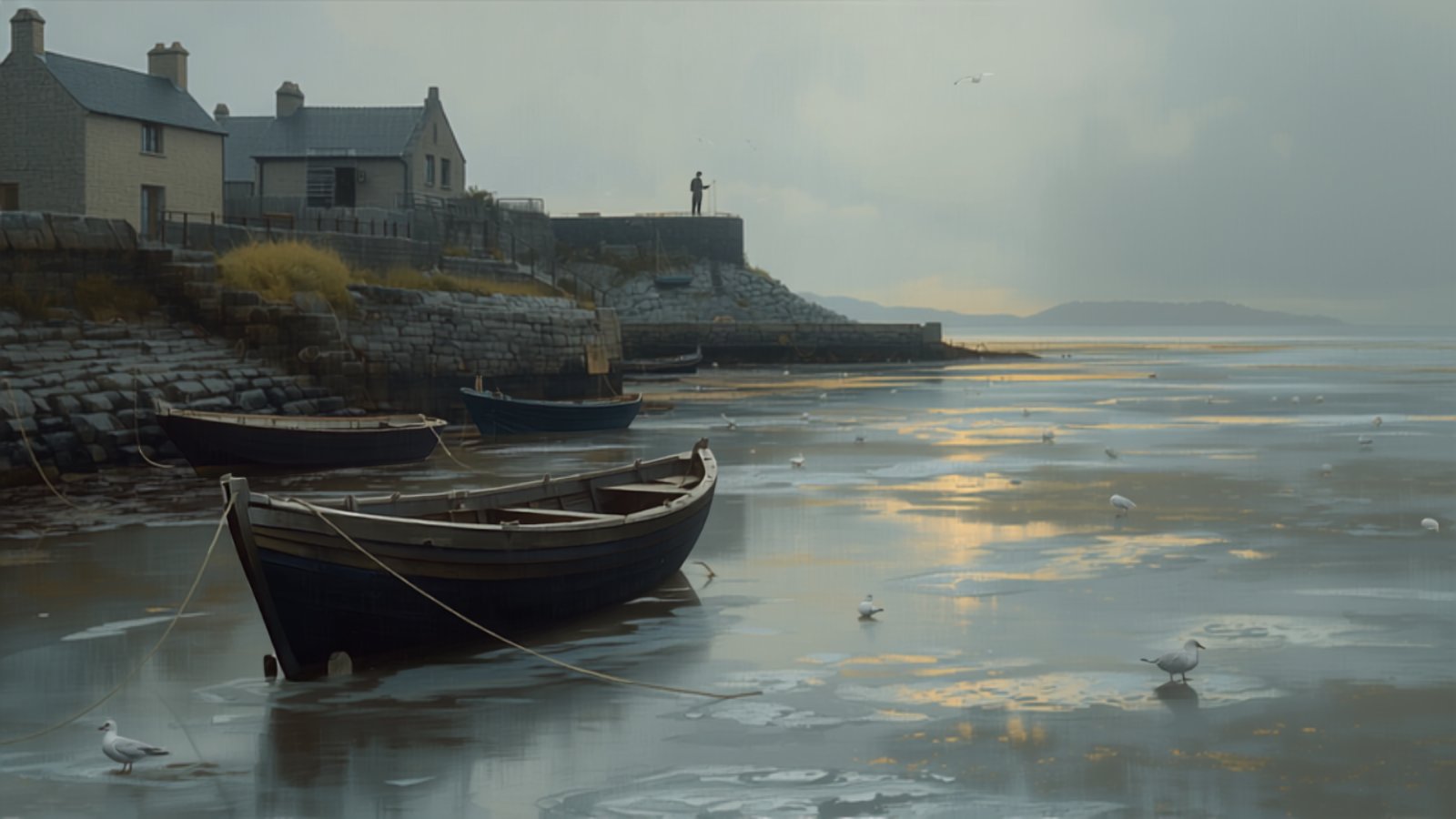
The funeral had been on a Tuesday, and by Friday everyone had gone home except Nell. She stood in the kitchen of her grandmother’s house, listening to the particular silence that houses acquire when their owners die — not an absence of sound exactly, but a kind of waiting. Below the window, the harbour of Aldermouth curved like a grey arm around the fishing boats, and beyond the sea wall the tide was going out, dragging its long silver hem across the mud.
Nell Harrower was thirty-four, and she designed exhibitions for a museum in London — cases of Roman coins, carefully lit manuscripts, the belongings of the dead arranged to tell a story. She was, she sometimes joked, a professional at other people’s memories. It had not prepared her in the slightest for her own.
Her grandmother, Edie Harrower, had lived in this house for sixty-one years. She had raised Nell’s father in it, and then, after his early death, she had half-raised Nell in it too, every summer from July to September. Edie had been a small, sharp, endlessly practical woman who mended nets, kept bees, and never once in Nell’s hearing said the words I love you, preferring to express the sentiment through fried mackerel and merciless card games.
Having put it off for three days, Nell finally opened the door to the back room — the one Edie had always called, with no explanation, the workroom.
She had expected clutter. What she found was an archive.
Shelves lined three walls, and on the shelves, arranged by year, stood shallow wooden trays of folded paper boats. Hundreds of them. Some were plain white, creased with an accuracy that looked almost printed; others were intricate beyond belief — hulls folded from single uncut sheets, with paper sails, paper rigging, tiny paper lanterns no bigger than a thumbnail. Each tray was labelled in Edie’s upright handwriting: 1974, teaching models. 1988, storm year, launch cancelled. 2003, the new fold.
On the workbench, alone in the lamplight, lay one unfinished boat. Its hull was complete, its sail half-formed, as if the maker had stood up meaning to come back in a minute. Written faintly in pencil along the inside of the hull — in the place, Nell would later learn, where the message always went — were two words:
For F.
Nell stood there for a long time, holding the little boat in both hands like something that might still be warm. In all her thirty-four years, she had never heard of anyone in the family whose name began with F.
2 · What the tide brings back
It was Gwen Tredinnick, the retired harbourmaster, who explained — over tea so strong it could have held up a spoon — what the workroom actually was.
“You do know what your grandmother was to this town, don’t you?” Gwen said, watching Nell’s face and evidently finding the answer there. “No. Of course you don’t. She’d never have told you herself.”
Every year, on the first spring tide of September, Aldermouth held the Feast of the Returning Tide. Nell knew that much; as a child she had watched it from this very window, a river of small lights moving down to the water. What she had never understood was its machinery — the quiet system of custom underneath the spectacle.
The feast worked like this. In the week before, anyone in the town who had lost someone — to death, to distance, to silence — folded a paper boat. Inside the hull, hidden in the final fold, they wrote a single sentence to that person: a message no one else would ever read. On the night itself, the whole town walked in procession from the church steps to the harbour, each person carrying their boat with a stub of candle burning in it. And at slack tide — that brief, held breath when the sea stops moving before it turns — they set the boats on the water together. The turning tide carried the lights out past the sea wall, and the town stood and watched until the last one vanished.
“The whole point is that it goes,” Gwen said. “You say the thing you never managed to say, and the sea takes it. Nothing is kept. Nothing is photographed — that was always the rule, though good luck enforcing it now. It’s ephemeral on purpose, see. Grief needs somewhere to go, that’s what the feast is. Somewhere for it to go.”
And the boats themselves — the folding of them, the teaching of the folds, the twelve traditional patterns from the plain child’s hull to the full-rigged mourning ship — all of that had one custodian in each generation. For the last fifty years, the custodian had been Edie Harrower.
“Every February she’d start the classes in the church hall,” Gwen said. “Taught every child in Aldermouth their first fold. Taught their parents before them. When old Mrs Vane’s arthritis got too bad, Edie folded her boat for her every year for a decade — Edie’s hands, Ivy Vane’s sentence. That’s a kind of trust you can’t buy.” She paused. “The feast commemorates everyone we’ve lost, all at once, with no names read out and no plaques. Your gran used to say plaques were for people who didn’t trust the sea.”
Nell thought of the trays. Fifty years of teaching models, dated and kept — the one archive of a festival whose entire philosophy was to keep nothing.
“Who takes over?” she asked. “The folding. The classes. Who’s the custodian now?”
Gwen looked at her steadily over the rim of her cup. “Well,” she said. “That would rather depend on who’s asking.”
3 · The proposal
The council meeting was held the following Thursday in the church hall, under strip lighting that flattered no one. Nell went because Gwen more or less ordered her to, and because the agenda, photocopied and pinned to the noticeboard, contained an item that had made her stomach tighten: Item 4 — Future of the Feast of the Returning Tide: partnership proposal, Brightwater Experiences Ltd.
The truth, laid out by the council chair with apologetic slides, was that the feast was dying. Attendance had dwindled for fifteen years straight. The young left Aldermouth for work and rarely came back; the faithful old were becoming, in the nature of things, fewer. Last September, only a hundred and twelve boats had gone out on the tide — a third of what the feast had drawn in Edie’s prime. Insurance costs rose; volunteer numbers dwindled with everything else. Meanwhile the town’s economy, one bad winter from real trouble, needed visitors.
Then the man from Brightwater stood up. He was pleasant, well prepared, entirely sincere, and every word he said made Nell feel colder.
Brightwater proposed rebranding the feast as the Aldermouth Sea of Lights. Ticketed viewing platforms on the sea wall. A drone display “echoing the heritage of the boat ceremony”. Biodegradable LED lanterns, available pre-folded — “removing the barrier to entry”, he said, “of the difficult traditional folding”. A projected eleven thousand visitors, a festival food quarter, national press. The ceremony itself would be professionally choreographed and, naturally, filmed: “Content is how tradition survives now,” he said, smiling. “If it isn’t shared, it didn’t happen.”
Having spent her whole career putting precious things in glass cases, Nell recognised exactly what was being proposed. It was taxidermy. The animal keeps its shape, its colours, even its expression — everything except the one thing that made it matter.
The room, to her surprise, did not erupt. It murmured, divided. The publican was for it; his takings said what his heart couldn’t. Two young councillors spoke, carefully, about jobs. An old fisherman said the feast wasn’t a show and sat down again, shaking. And Nell — who had opinions, credentials, an entire professional vocabulary for precisely this situation — said nothing at all. She was, she told herself, an outsider now, a Londoner, a summer child. She had not folded a boat since she was nine. What standing did she have?
The vote was deferred to the last Thursday in August. Fifteen days before the feast itself.
Walking home along the harbour afterwards, Nell was stopped by Gwen, who fell into step beside her without preamble.
“Your grandmother saw all this coming, you know,” Gwen said. “Years ago. I asked her once what would kill the feast — the money men or the empty pews. And she said neither.” Gwen stopped walking. “She said: Feasts don’t die of enemies. They die of estrangement. The day the folding stops being passed down hand to hand, it’s finished — everything after that is just lighting.“
“Then why didn’t she train a successor?” Nell said, more sharply than she intended. “Fifty years, and no custodian after her? That’s not like her. She planned everything.”
Gwen was quiet for a moment. “She did train one,” she said at last. “Long before my time on the harbour, mind. It went wrong. If you want to know how the feast really works, Nell, you’d best find out how it broke.” And she nodded towards the dark house on the hill, where the workroom lamp still burned because Nell could not bring herself to switch it off. “Start with the boat she never finished.”
4 · Provenance
Provenance, Nell’s first museum director used to say, is just gossip with receipts. Every object has two histories: what it is, and whose it was — and the second is where the truth hides. So Nell did what she had been trained to do. She treated the workroom as a collection, and she catalogued it.
It took her four days. The teaching models told her one story — an unbroken line of Februaries, half a century of patient hands. But provenance is about gaps as much as objects, and the gaps told her another. There was no tray at all for 1971. The 1972 tray held only nine boats, folded — she could see it even as an amateur — badly, the creases hesitant, several abandoned mid-pattern. Whatever had happened to Edie Harrower had happened in 1971, and it had nearly stopped her hands.
She found the rest at the bottom of the linen chest, beneath the good tablecloths: a biscuit tin, tied shut with string, labelled in pencil — F. Returned unopened.
Inside were letters. Twenty-six of them, one a year, each addressed in Edie’s handwriting to Miss Florence Harrower at a series of addresses — Cardiff, then Bristol, then a village in the Welsh borders — and each stamped, posted, and sent back unopened. The last was dated 1997. After that, nothing: either Edie had stopped writing, or she had stopped being able to find her.
Florence. For F.
Her grandmother had a sister. Had, or has — the tin did not say. Nobody had ever said. In sixty years of Sunday dinners and summer holidays and funerals, not one person had so much as spoken the name, and that silence, Nell now understood, was not forgetfulness. It was policy. This was what estrangement meant in a family like hers: not a wound but a border, patrolled for so long that everyone forgot there had ever been a country on the other side.
One letter had been opened — the first, from October 1971. Opened, read, and returned all the same, which struck Nell as the cruellest possible order of events. She read it standing up, by the workroom lamp.
Flo. You will not answer my calls so I am writing. I said things on the feast night that I had no right to say, grief or no grief. Mother’s boat was yours to fold. She chose you, she taught you the mourning ship for a reason, and I could not bear it, and I let you sail for Cardiff believing I meant what I said. I did not mean it. Come home and fold the boats. The feast needs its custodian and it was never meant to be me. — E.
Nell sat down slowly among the trays of boats. Fifty years of resentment — except it wasn’t even resentment, she thought; resentment at least talks. This was worse: two proud women, each folding paper alone in a different town, each waiting for the other to turn first, like two tides that never met. Edie had not failed to train a successor. She had trained one perfectly, driven her away in a single evening, and then spent half a century being the custodian of her sister’s inheritance — keeping the seat warm, one February at a time, for someone who never came.
The last address was twenty-six years old. It was, as provenance went, extremely thin. Nell booked the train anyway.
5 · Florence
It took eleven days, two archives, a parish newsletter, and the unstoppable telephone network of retired harbourmasters — Gwen, it turned out, knew somebody in every port from Fishguard to Whitby — but on the last Thursday in August, while the council of Aldermouth sat down to vote on the future of its feast, Nell Harrower stood outside a terraced house in a Welsh border town, watching a light move behind the curtain.
The woman who opened the door was small and upright, with Edie’s exact way of tilting her head, and eyes that went to the biscuit tin under Nell’s arm before they went to her face. For a long moment nobody spoke.
“You’ll be Nell,” said Florence Harrower. “You have her hands.” And then, seeing everything in Nell’s expression at once, she gripped the door frame. “When?”
“Three weeks ago. I’m so sorry.”
Florence stood absolutely still. “Three weeks,” she repeated. “I always thought there’d be a right year to go back. I had fifty of them, and I was waiting for the right one.” She stepped aside. “You’d better come in.”
The front room stopped Nell on the threshold. Shelves lined three walls, and on the shelves, in shallow trays arranged by year, stood hundreds of folded paper boats.
“Every September,” Florence said, not needing to be asked. “First spring tide. There’s no sea here, so they never sailed — but I never missed a year of the folding. You don’t stop being what you are just because you’ve left the place that made you.” She picked one up, a full-rigged mourning ship so intricate it seemed impossible that fingers had made it, and turned it in the lamplight. “She taught me my first fold when I was six. Our mother taught us both, but Edie — Edie was the one who made me practise.”
They talked until two in the morning. The quarrel, when Florence finally described it, was almost unbearably small: a funeral, a question of who should fold their mother’s last boat, and grief doing what grief does, which is to pick up the nearest heavy thing and swing it. Edie, the elder, had said the unforgivable sentence; Florence, the prouder, had done the unforgivable thing, which was to leave on the morning tide without a word and return every letter unopened, year after year, long past the point where she could remember what the returning was supposed to prove.
“The first one I opened,” Florence admitted. “October of ’71. She took the blame — all of it, and it wasn’t all hers to take, believe me. And I found I couldn’t bear being forgiven. Resentment is a boat too, you know. You climb in, and it carries you, and one morning you look back and you can’t even see the coast you sailed from.” She set the mourning ship down. “So. You’ve come all this way. Tell me what you came to ask.”
Nell took out the unfinished boat, hull complete, sail half-formed, For F. pencilled inside. She set it on the table between them.
“The feast is in fifteen days,” she said. “It needs a custodian. It was only ever meant to be you.”
6 · The returning tide
The council, as it happened, had not sold the feast. They had voted — by two votes, Gwen reported with grim satisfaction — to defer the Brightwater decision by a year, largely because a retired harbourmaster had stood up at the back and asked whether the councillors intended to put their own grief on a ticketed viewing platform, and if so, at what price per seat. A year was not a rescue. A year was a stay of execution, and everyone in the hall knew what would make the difference: not this September’s feast, but whether anyone was left to teach the folding next February.
Which is why what happened on the first spring tide of September mattered so much, and why half the town claimed afterwards to have seen it with their own eyes.
They came down from the church steps in the old procession, a hundred and forty candles this year, the lights swaying with the walkers’ steps, and at the front — where the custodian had always walked, in the space left empty out of respect for Edie Harrower — walked a small, upright stranger with Edie’s tilt to her head, carrying two boats.
Florence had finished the sail on the crossing back to Aldermouth, her hands steady on the swaying train, completing her sister’s folds so exactly that no one, Nell thought, would ever be able to say where one woman’s work ended and the other’s began. Inside the hull, beneath Edie’s pencilled For F., she had written her single sentence. She did not show it to anyone. That was the whole point of the feast, after all: some things are said only once, to the sea.
At the harbour wall the town gathered, and the water went still. Slack tide is a strange, suspended moment — the sea neither coming nor going, as if the world were holding its breath to listen — and into that stillness, a hundred and forty boats went down onto the black water, and Florence Harrower knelt, fifty-five years late, and launched her sister’s boat with her own.
The tide turned. The lights moved out, slowly at first, then with the long, certain pull of deep water, past the sea wall and into the dark. Nobody filmed it. Nell stood between Gwen and her great-aunt and understood, at last, what it was to commemorate something properly: not to preserve it behind glass, but to let it go in company. The feast was ephemeral by design, and it was the design that endured — that was the trick of it, the thing no events company would ever be able to buy, because it could only be given away.
“February,” Florence said quietly, watching the last light dwindle to a spark on the water. “The classes start in February. I’ll need the church hall. And an assistant with young hands.” She looked sideways at Nell. “Someone told me you design exhibitions. Tell me — can you fold?”
Nell laughed, and it turned into something else halfway, and she let it. “Badly,” she said. “I was nine.”
“Then we start with the child’s hull,” said the custodian of Aldermouth, “like everyone else.”
It was Gwen who saw it first, the next morning, on the early ebb: a single paper boat, riding high and dry-hulled on the returning tide, coming back in through the harbour mouth against all sense and current. The paper was yellowed, the folds old-fashioned — a pattern, Florence said when they brought it to her, that nobody had taught in Aldermouth for fifty years. There was a sentence written inside the hull. Florence read it, went very still, and closed her hand around the boat.
“Whose is it?” Nell asked. “What does it say?”
Florence looked out at the water for a long moment. “That,” she said, “is a story for another tide.”
Check your understanding
Read each question. Think about your answer. Then click “Show answer” to check.
Words to remember
Here are the key words again, in new sentences. Try writing one sentence of your own for each.
- custodian — After the head librarian retired, no one was quite sure who the custodian of the rare-book room should be.
- procession — The graduation procession wound slowly across the courtyard, gowns billowing in the wind.
- commemorate — The city planted a thousand trees to commemorate those who died in the flood.
- dwindle — Membership of the chess club had dwindled from forty to a loyal half-dozen.
- intricate — The watchmaker bent over the intricate mechanism, tweezers in hand.
- estrangement — Their estrangement lasted so long that neither could remember exactly how it had begun.
- ephemeral — Sand mandalas are deliberately ephemeral: monks spend days making them, then sweep them away.
- provenance — The auction house refused to sell the painting until its provenance could be established.
- slack tide — The divers entered the water at slack tide, when the current briefly died away.
- resentment — He smiled at the meeting, but years of quiet resentment were audible in every word.
Grammar in this story: participle clauses
This story leans heavily on participle clauses — a hallmark of sophisticated written English. They let a writer attach an extra action or reason to a sentence without a new subject or conjunction. Look:
Having put it off for three days, Nell finally opened the door to the back room.
Gwen fell into step beside her, watching Nell’s face.
Having spent her whole career putting precious things in glass cases, Nell recognised exactly what was being proposed.
The -ing form (watching) shows an action happening at the same time; the perfect form (having put, having spent) shows an earlier action that explains the main one. Notice that the implied subject of the participle must match the subject of the main clause — otherwise you produce a “dangling” participle, one of the most common advanced-level errors.
👉 Master the full rule here: Participle Clauses in English: Shorten Sentences Like a Native Writer.
Talk about it · Write about it
Talk about it: Is there a festival or custom in your culture that has changed — or is under pressure to change — because of tourism, money, or social media? What has been gained, and what has been lost? Where would you personally draw the line between keeping a tradition alive and selling it?
Write about it: Write 200–250 words on this question: “If it isn’t shared, it didn’t happen.” Do you agree? Use at least three of the key words from this story, and try to include two participle clauses (one with -ing, one with having + past participle).
🎉 Well done — you have just read more than 3,200 words of authentic narrative English, including ten C1 words you now own. That is exactly how advanced readers are built: one whole story at a time.
But one question is still riding the tide: whose yellowed boat came back through the harbour mouth, folded in a pattern no one has taught for fifty years — and what was the sentence that made Florence go so still? Some stories, like some boats, insist on returning…
Read the fictional life of Inês Barroca, who maps places threatened by change. Notice how description preserves what a map alone cannot. Next story: The Cartographer of Missing Places: The Life of Inês Barroca (C1 Reading Story)
About this story: This is an original C1 graded reader (~3,250 words), written using the graded-reader method: vocabulary is controlled to an advanced headword level, the full range of English grammar appears naturally (participle clauses, inversion, complex discourse markers), and every above-level key word is glossed before the story and reused at least twice inside it, so you meet it in context. The plot is entirely original.

I’m Khamis Maiouf. I’m studying Health and Social Care and have completed Functional Skills Level 2 in English and Level 3 Hairdressing. I have taught ESOL in my community and helped students with GCSE English. I run English Teacher Site to help people learn and practise English.