
Showed or Shown? Past Tense and Past Participle of Show

Quick Answer
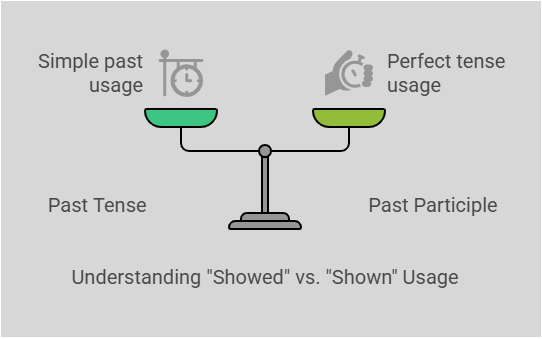
The past tense of show is showed. With “have,” “has,” or “had,” use shown.
Every day: I show my work to the class.
Yesterday: I showed my work to the class.
Many times: I have shown my work to the class before.
Show, Showed, Shown — See the Pattern
Read these sentences. Look at how the verb changes:
- I show photos to my friends every day. (now — it happens often)
- She showed me the way to the station. (past — it is finished)
- He has shown great progress this year. (past with “has”)
Did you see the pattern? There are three forms:
| When? | Form | Example |
|---|---|---|
| Now / every day | show | I show my ID at the door. |
| In the past | showed | She showed me the photo. |
| With have / has / had | shown | They have shown us the plan. |
When to Use Showed and When to Use Shown
This is the part that confuses many learners. Here is the simple rule:
Use “showed” when you talk about the past — something that is finished:
- He showed us the new classroom yesterday.
- The teacher showed a video during the lesson.
Use “shown” when there is a helping word before it — have, has, or had:
- She has shown me her new flat. (with “has”)
- We have shown the visitors around the building. (with “have”)
- He had shown his ticket before they let him in. (with “had”)
You also use shown after “was” or “were” — when something was done to you:
- The film was shown at the cinema last week.
- We were shown to our seats by a waiter.
Easy way to remember: If you see have, has, had, was, or were before it, use shown. If not, use showed.
The Rule in One Line: have/has/had/was/were → shown. No helping word → showed.
How to Use Show, Showed, and Shown in Everyday English
Here are examples you might use every day:
- My friend showed me a funny video on her phone. (past — it is finished)
- The map showed us the fastest way home. (past — it is finished)
- He has shown that he can do it by himself. (with “has” — use shown)
- I have already shown you how to do this. (with “have” — use shown)
- Can you show me where the bus stop is? (now — use show)
You are doing great. Now let’s look at the mistakes many learners make.
Three Mistakes to Avoid With Show
Even advanced learners mix up “showed” and “shown” sometimes — so if you get confused, you are not alone. Even native speakers make this mistake in everyday conversation.
Mistake 1: Using “showed” with have/has/had
✗ She has showed me the letter.
✓ She has shown me the letter.
Mistake 2: Using “shown” without a helping word
✗ He shown me the way to the shop.
✓ He showed me the way to the shop.
Mistake 3: Adding “-ed” to make “showned”
✗ I have showned him the email.
✓ I have shown him the email.
How to remember: Think of know, knew, known. It follows a similar pattern — the past form with a helping word ends in -own: shown, known, grown.
Other verbs like this: grow → grew → grown, know → knew → known, throw → threw → thrown, blow → blew → blown.
Test Yourself: Showed or Shown?
Choose an answer to see your feedback immediately. Your first answer counts towards your score.
1. She _______ me her holiday photos last night.
2. He has _______ us the way to the park many times.
3. The teacher _______ a film in class yesterday.
4. We were _______ to our table by the waiter.
5. I had already _______ him the email before the meeting started.
Keep Going — You Are Building Something
You just learned show, showed, shown. That is one more irregular verb you will never get wrong again.
Use the examples above to practise this pattern. When you are ready, choose your next topic below.
Choose Your Next Topic
This path ends here. Choose another B1 lesson from the collection when you are ready for a new topic.
Related Lesson for Review: Know, Knew, or Known — Which One Do You Use?
Source
Harper, Douglas. “Etymology of show.” Online Etymology Dictionary

I’m Khamis Maiouf. I’m studying Health and Social Care and have completed Functional Skills Level 2 in English and Level 3 Hairdressing. I have taught ESOL in my community and helped students with GCSE English. I run English Teacher Site to help people learn and practise English.