
The Night of the Golden Bird (A2 Reading Story)

A2 · ELEMENTARY Reading practice · ~1,600 words · 11-min read
This is an original story for A2 learners. It uses the past simple tense and easy connectors like and, but, so, and because. First, read the ten key words. Then read the story. At the end, there is a quiz to check what you understand.
Before you read — 10 key words
- festival — a special day when many people celebrate together, with music and food.
- lantern — a light inside a paper or glass box. You can carry it.
- tradition — something people do every year, for many years.
- wish — something you want very much. You hope it comes true.
- lonely — sad because you are alone and you have no friends near you.
- prepare — to make something ready before you need it.
- decorate — to make something beautiful with colours, paint, or paper.
- glue — a wet thing that sticks paper together. It dries hard.
- crowd — a big group of people in one place.
- proud — happy because you (or someone you love) did something well.
The story
1 · The new town
Amira moved to the small town of Milbrook in September. She came with her mother and father from a big city far away. Her father found a new job there, so the family packed everything and drove for two days.
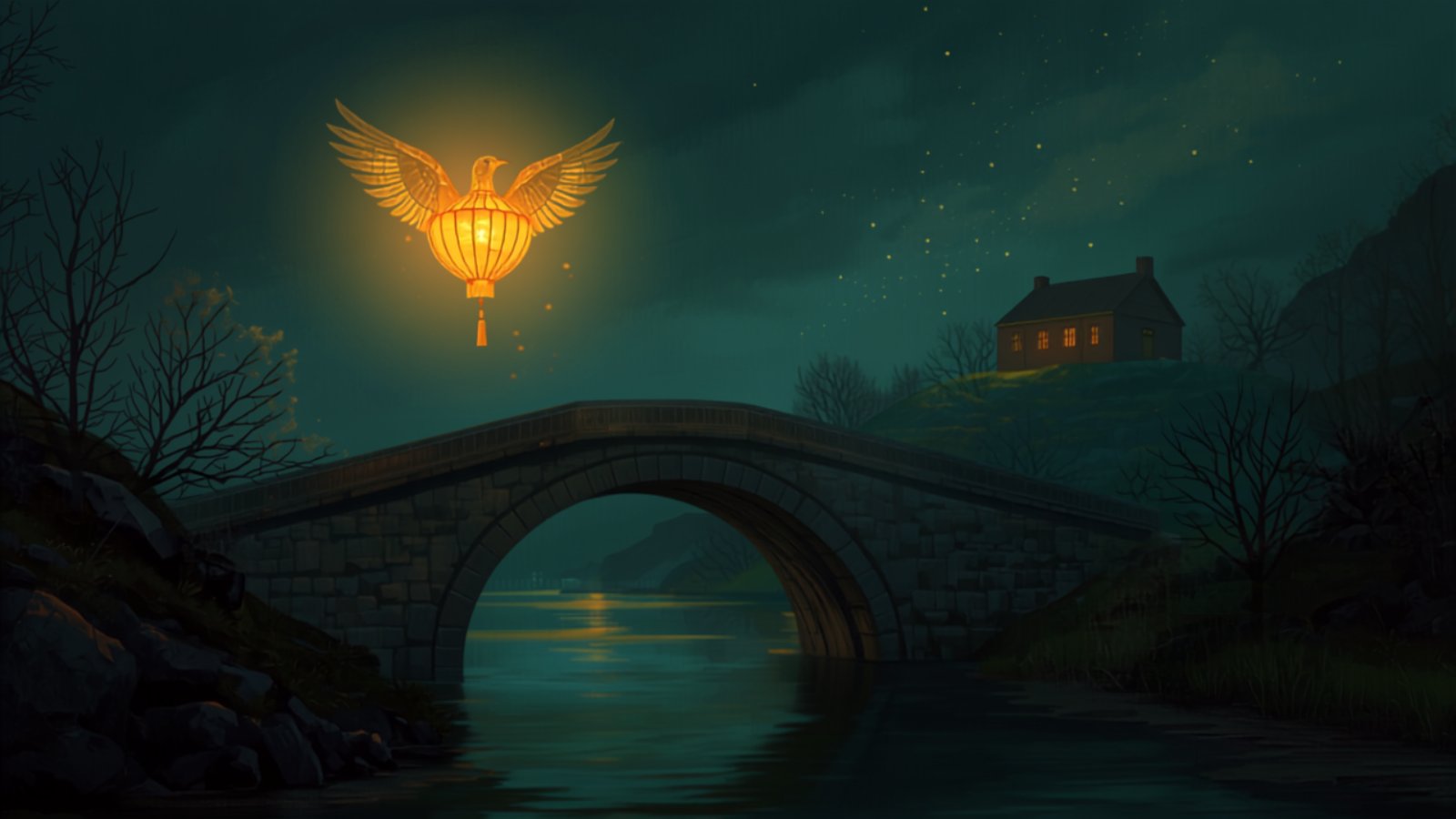
The town was pretty. There was a slow green river, a stone bridge, and a little school on a hill. But Amira was not happy. She did not know anybody. At school, the other children talked and laughed together, but Amira sat alone. She understood the language, but she was shy, so she did not speak much.
“I am lonely here,” she wrote in her notebook one night. “In my old city, I had three good friends. Here I have nobody.”
Next to Amira’s house, there was an old white house with a big garden. An old woman lived there. Her name was Mrs Chen. Every afternoon, Mrs Chen worked in her garage with the door open. Amira walked past the garage every day after school, and every day she looked inside.
One Friday, Amira stopped. On the garage table, she saw something beautiful: a big paper lantern, round like the moon, with a red fish painted on the side.
Mrs Chen looked up and smiled. “Hello,” she said. “Do you like it?”
“It’s beautiful,” Amira said quietly. “What is it for?”
“For the festival, of course!” said Mrs Chen. Then she saw Amira’s face. “Oh — you are new here. You don’t know about our festival.”
Mrs Chen put down her paintbrush and told her. Every year, on the first Saturday of October, the town celebrated the Lantern Festival. It was an old tradition. It started more than a hundred years ago, when the first families came to the town after a long, hard journey. They put lights in the windows to say: we are here, and we are safe.
“Now everybody makes a paper lantern,” Mrs Chen said. “You write a wish on the paper — a secret wish. At night, the whole town walks to the river with the lanterns. There is music, there is food, and the bridge shines with hundreds of lights. It is the best night of the year.”
“A wish?” Amira asked.
“Yes. Something you want very much.” Mrs Chen smiled again. “The festival is in two weeks. Would you like to make a lantern? I can teach you.”
Amira thought about her empty afternoons and her quiet notebook. “Yes, please,” she said.
2 · Paper and glue
They started the next day. There was a lot to prepare. Mrs Chen showed Amira the thin wooden sticks, the white paper, and the pot of glue.
“First, we make the body of the lantern with the sticks,” she said. “Then we cover it with paper and glue. The glue must dry for one day. After that, we decorate it.”
It was not easy. Amira’s first lantern was terrible. The sticks broke, the paper tore, and the glue went everywhere — on the table, on her hands, and even in her hair. But Mrs Chen laughed kindly and said, “Good. My first lantern was worse. Try again.”
So Amira tried again. She went to the garage every afternoon after school. Slowly, her hands learned the work. She made the round body. She covered it with paper, smooth and tight. While the glue dried, Mrs Chen made tea, and they talked.
Mrs Chen told her about her husband, Wei. He died five years ago. “Wei made the best lanterns in the town,” she said. “He won the festival prize nine times. Every year, I make one lantern for me and one for him. It is my little tradition inside the big tradition.”
Amira told Mrs Chen about her old city, her old school, and her three friends far away. It was strange — she was shy at school, but in the garage, the words came easily.
On Wednesday, it was time to decorate. Amira thought for a long time. Then she painted a bird with long golden wings — a bird from the stories of her grandmother’s country. Under the bird, she painted small white stars.
Mrs Chen looked at it for a long moment. “In sixty years,” she said slowly, “I never saw a lantern like this one. Wei would love it.”
Amira felt proud. It was a new feeling in this town, and it was warm.
That night, at home, she wrote her secret wish on a small piece of paper. She folded it three times and stuck it inside the lantern. Nobody saw the words. The wish was short — only six words.
3 · The wind
On Friday — one day before the festival — the weather changed. In the morning, the sky was grey. In the afternoon, a strong wind came from the hills. It pulled the leaves from the trees and pushed the rain against the windows.
Amira ran home from school through the storm. When she came to her street, her heart stopped. The door of Mrs Chen’s garage was open. The wind was inside.
She ran into the garage. Mrs Chen stood by the table with a white face. On the floor lay Amira’s lantern. The wind threw it down, and a garden chair fell on it. One side was broken. The paper was torn, and the golden bird had a long, ugly hole through its wings.
“Oh no,” Amira whispered. She picked it up carefully. Two weeks of work. Her beautiful bird. She wanted to cry, and then she did cry.
Mrs Chen put a hand on her shoulder. “Listen to me,” she said. “It is bad, but it is only paper and sticks. We can repair it. But the festival is tomorrow, and my old hands are slow. We are going to need help.”
“Help? From who?” Amira asked. “I don’t know anybody.”
Mrs Chen smiled a small, clever smile. “But I know everybody,” she said. She went to the telephone.
One hour later, the garage was full. Mr Rossi from the bakery came with hot bread. His son Leo came too — Leo was in Amira’s class at school, the tall boy who always drew pictures in his books. Two girls from the next street came with their mother. Everybody brought paper, sticks, or glue.
“Right,” said Mrs Chen, like a general. “Leo, you are good at drawing — you help Amira with the bird. Everybody else, we prepare the new side.”
They worked all evening. Outside, the storm slowly died. Inside, the garage was warm and loud. Leo mixed the gold paint and passed the brushes. “Your bird is really cool,” he said. “What kind of bird is it?”
“It comes from my grandmother’s stories,” Amira said. “It flies at night and carries lost things home.”
“Then it is the right bird for a lantern,” Leo said, and Amira laughed for the first time in Milbrook.
At ten o’clock, the lantern was ready again. The new wing was not the same as the old wing — the gold was a little brighter, and one star sat in a new place. But Mrs Chen said, “Repaired things have two stories. That makes them better, not worse.”
4 · The night of the lanterns
Saturday evening was clear and cool. The storm was gone, and the stars were out. At seven o’clock, Amira and her parents walked with Mrs Chen to the town square.
Amira never saw the town like this. There was a crowd in every street — hundreds of people, all with lanterns in their hands. There was music from the school band. There were tables with hot soup, sweet cakes, and apple tea. Children ran between the legs of the adults, and every child carried a small light.
At eight o’clock, the church bell rang, and the crowd began to walk to the river. It was a slow, happy river of lights. Amira carried her lantern high. The golden bird shone in the dark, and people turned to look at it.
“Look at that one!” someone said. “The bird! Who made the bird?”
“She did,” said Leo loudly, and he pointed at Amira. “She’s in my class.”
On the stone bridge, the mayor gave the festival prize. It went to Mr Rossi’s giant bread-shaped lantern, and everybody laughed and clapped. Amira did not win. But she was surprised, because she did not feel sad at all.
Because then something better happened. The two girls from the next street came to her. “We are going to start our lanterns early next year,” one said. “Can you teach us your bird? Please?”
“And me,” said Leo. “I want to learn it too. You can sit with us at lunch on Monday, and we can plan it.”
Amira looked at the lights on the water. She thought about the small folded paper inside her lantern, and her secret six-word wish: I want one friend in Milbrook.
The wish came true — but not one friend. Four.
Late that night, when they walked home, Mrs Chen stopped at her gate. She gave Amira a small wooden box, old and smooth. “This was Wei’s,” she said. “Don’t open it now. Open it at home, alone. And then come and see me tomorrow — because next year, you and I are going to make something much bigger than a lantern.”
Amira held the little box all the way home. It was light, but something inside moved softly, like paper wings. What was in the box? And what did Mrs Chen want to build?
Check your understanding
Read each question. Think about your answer. Then click “Show answer” to check.
Words to remember
Here are the key words again, in new sentences. Say each one out loud.
- festival — Our town has a music festival every summer.
- lantern — We put a paper lantern in the garden last night.
- tradition — In my family, Sunday lunch together is a tradition.
- wish — I made a wish before I blew out the candles.
- lonely — He felt lonely in his first week at the new job.
- prepare — We prepared the food one day before the party.
- decorate — They decorated the room with flowers and lights.
- glue — I stuck the photo in my notebook with glue.
- crowd — A big crowd waited outside the stadium.
- proud — She was proud of her first cake — it looked great.
Grammar in this story: the past simple
This story happened in the past, so it uses the past simple tense. Look:
Amira moved to Milbrook. She painted a golden bird. The wind came from the hills, and the lantern broke.
Regular verbs add -ed: move → moved, paint → painted. But many important verbs are irregular and change completely: come → came, break → broke, go → went.
👉 Learn one tricky irregular verb here: Went or Gone — What’s the Past Tense of Go?
Talk about it · Write about it
Talk about it: What is the biggest festival in your town or country? What do people eat, wear, and do? Do you have a favourite tradition?
Write about it: Write 6–8 sentences about a festival you went to. Use the past simple: Where did you go? Who was with you? What did you see and eat? How did you feel?
🎉 Well done — you finished a whole A2 story in English! You also met ten useful words and a lot of past simple verbs.
But two questions stay open… What is inside Wei’s wooden box? And what does Mrs Chen want to build next year — something “much bigger than a lantern”? Maybe you will find out one day.
Amir has moved to a town by the sea. Follow the white-bird kite through a festival day. Next story: The White Bird Kite (A2 Reading Story)
About this story: This is an original A2 graded reader (~1,600 words). It uses controlled elementary vocabulary, the past simple tense, and basic connectors, so A2 learners can understand about 98% of the words. Any harder word is explained before the story and used again inside it.

I’m Khamis Maiouf. I’m studying Health and Social Care and have completed Functional Skills Level 2 in English and Level 3 Hairdressing. I have taught ESOL in my community and helped students with GCSE English. I run English Teacher Site to help people learn and practise English.