
The White Bird Kite (A2 Reading Story)

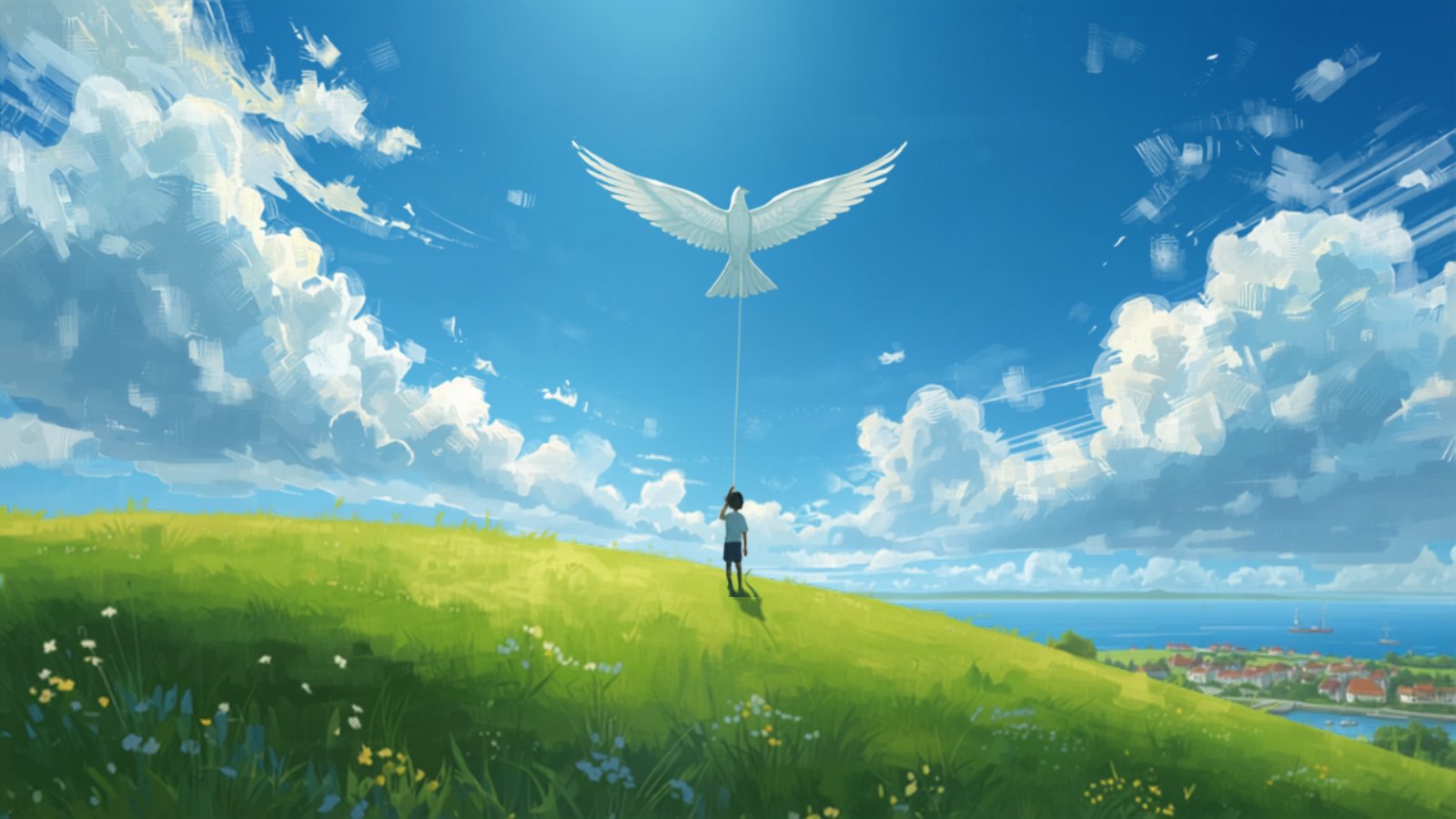
A2 · ELEMENTARY Reading practice · ~1,700 words · 11-min read
This is an original story for elementary learners. It uses the past simple tense and easy, everyday words. First, read the ten key words. Then read the story. At the end, there is a small quiz to check what you understand.
Before you read — 10 key words
- festival — a special day when many people meet to celebrate together, with music and food.
- kite — a light toy made of paper or cloth; it flies in the sky on a long string.
- string — a long, thin line; you hold it in your hand to control a kite.
- competition — a game or event where people try to win.
- prize — the thing you win in a competition.
- workshop — a room where a person makes or repairs things.
- glue — a wet material that sticks two things together.
- proud — happy because you (or someone you love) did something well.
- tradition — something people in a place do the same way every year, for many years.
- harbour — a safe place by the sea where ships and boats stop.
The story
1 · The new boy
Amir was twelve years old. In March, his family moved to Portanova, a small town by the sea. His father got a job at the harbour, so they left the big city and drove south for six hours. Their new flat was small, but from the kitchen window Amir could see the boats and the water.
The town was pretty, but Amir was not happy. He did not know anybody. At school, the other children already had their friends. At lunch, Amir sat alone and looked out of the window.
One day in April, his teacher put a yellow poster on the classroom wall. It said: “The Wind Festival — Sunday 3rd May, Green Hill. Kite competition at 2 p.m. A prize for the most beautiful kite!”
“What is the Wind Festival?” Amir asked the boy next to him. The boy’s name was Marco.
“You don’t know?” Marco laughed. “It’s the biggest day of the year here. It’s a tradition. Every year, on the first Sunday of May, the whole town goes up Green Hill and flies kites. There’s music, there’s food, and there’s the competition. My father won it three years ago. This year I’m going to win it. My parents bought me a new kite from a shop in the city. It cost sixty euros.”
Amir looked at the poster for a long time. He wanted to go to the festival. He wanted to stand on the hill with everybody and fly a kite. Maybe then he wasn’t going to be “the new boy” anymore.
That evening, at dinner, his mother asked, “How was school today?” Amir said, “Fine.” But it was not fine. In the city, he had three best friends. Here, nobody waited for him after class, and nobody called his name in the playground. He looked out of the kitchen window at the boats in the harbour and felt very small.
But there was a problem. Amir did not have a kite, and he did not have sixty euros. He walked home slowly and said nothing to his parents.
2 · The house with the blue door
Next to Amir’s building there was an old house with a blue door. An old woman lived there alone. Her name was Rosa. Every morning she walked to the market with a heavy bag, and every morning she stopped three times to rest.
That Friday, the wind was strong and it started to rain. Amir saw Rosa in the street. Her bag was full of oranges, and the wind pulled at her coat.
“Can I carry your bag?” Amir asked.
Rosa looked at him. “You are the new family, yes? From the city?” She smiled. “Thank you, young man. My arms are old today.”
Amir carried the bag to the blue door. Rosa invited him in for a glass of orange juice. Her kitchen was warm and full of photos. Amir looked at the photos — and stopped.
In every photo, there were kites. Red kites, gold kites, kites like birds, kites like fish. In one photo, a tall man held a huge blue kite and laughed at the camera.
“Who is that?” Amir asked.
“That was Tono. My husband,” Rosa said quietly. “He made kites for fifty years. Everybody in Portanova knew him. He won the festival competition nine times. Nine!” She touched the photo. “He died two years ago. Now his workshop is closed, and I don’t go to the festival anymore.”
Amir didn’t plan to say it, but the words came out: “I want to fly a kite at the festival. But I don’t have one, and I can’t buy one.”
Rosa was quiet for a long moment. She looked at the photo of Tono, and then she looked at Amir. Then she stood up and took an old key from a drawer.
“Come with me,” she said. “I’m going to show you something.”
3 · The workshop
Behind the house there was a small wooden building. Rosa opened the door with the old key. Inside, everything was grey with dust, but Amir’s eyes grew big.
There were long sticks of light wood on the wall. There were rolls of paper in every colour. There were pots of glue, boxes of string, scissors, and paint. It was a kite workshop — a whole room only for making kites.
“Tono made every kite here, with his hands,” Rosa said. “He always said: a kite from a shop has a price. A kite from your hands has a story.” She picked up a stick of wood. “I watched him for fifty years. I know how he did it. So — do you want to learn?”
“Yes!” said Amir. “Yes, please!”
So they started. Every day after school, Amir knocked on the blue door, and they worked in the workshop together. It was not easy. The first frame broke because Amir cut the wood too thin. The second frame was too heavy. “A kite must be strong but light,” Rosa said. “Like a bird. Try again.”
Amir tried again. He learned to bend the wood slowly. He learned to use only a little glue, because too much glue makes a kite heavy. He learned to tie the string in the right place, not the easy place. His fingers hurt, but he loved every minute.
While they worked, Rosa told him stories about the old festivals. One year, the wind was so strong that a kite pulled a small boy across the hill, and Tono caught him by the coat. Another year, there was no wind at all, so five hundred people sat on the grass and ate cake and waited. “The festival is not really about kites,” Rosa said. “It is about the town, together, looking up at the same sky.” Amir liked that idea very much.
They covered the frame with sea-blue paper. Amir painted a gold sun in the middle. Then Rosa took a small brush and painted a little white bird in the corner.
“What is that?” Amir asked.
“Tono painted a white bird on every kite he made. It was his sign. When people saw the white bird in the sky, they said: that is a Tono kite.” She smiled, but her eyes were wet. “This kite came from his workshop. So it gets his bird.”
On the last Saturday of April, they tested the kite on the beach near the harbour. The wind came in from the sea. Amir ran, the string went tight, and the blue kite jumped into the sky. It flew! It danced left and right, high over the water. Amir shouted and laughed. Rosa watched it for a long time and said nothing. She looked proud, and also a little sad.
“Will you come to the festival tomorrow?” Amir asked.
Rosa shook her head. “No, Amir. The festival was our day, Tono’s and mine. It is too heavy for my heart. But you will go, and your kite will fly. That is enough for me.”
4 · The first Sunday of May
The festival day was loud and bright. Hundreds of people walked up Green Hill with baskets of food. There was a band with drums. There were tables with sweet cakes and lemonade. And over the hill, the sky was full of kites — red, green, yellow, orange.
Amir carried his blue kite carefully up the hill. Something surprising happened on the way: people looked at it. A woman with a food basket stopped and said, “What a lovely kite! Did you make it?” Two small children walked next to him just to look at the gold sun. For the first time in Portanova, people talked to Amir — and he was not “the new boy”. He was “the boy with the beautiful kite”.
Amir stood in the line for the competition. Marco was there too, with his sixty-euro kite from the city. It was silver and shiny, like a small plane.
“You made that?” Marco said. “Yourself? With paper?” He laughed, but not in a kind way.
At two o’clock, the competition began. Twenty kites went up into the wind. Amir let out his string slowly, like Rosa taught him. The blue kite with the gold sun rose higher and higher.
Then, suddenly, the wind grew very strong. It came fast from the sea, and the kites pulled hard on their strings. People shouted. One kite fell. Then another. Marco’s silver kite turned in a circle, made a loud crack, and broke into two pieces. The pieces dropped into the grass.
But the blue kite did not break. Rosa’s words were true: strong but light, like a bird. It stood high in the wild wind, and the little white bird in its corner seemed to fly.
An old judge with white hair walked along the line of kites. He stopped in front of Amir and looked up for a long time. Then he saw the white bird, and his mouth opened.
“Boy,” he said slowly, “where did this kite come from? I know that bird. Everybody my age knows that bird.”
“It came from Tono’s workshop,” Amir said. “Rosa taught me. We made it together, with our hands.”
The judge turned to the crowd and lifted his arms. “The white bird is back!” he shouted. And the people on the hill — people who remembered fifty years of Tono’s kites — began to clap.
Amir won the prize for the most beautiful kite: a small gold cup. But he did not stay to celebrate. He ran all the way down the hill, through the town, to the house with the blue door. He knocked hard.
Rosa opened the door — and Amir saw that she already knew. Her window looked up at Green Hill, and from her kitchen she watched the blue kite the whole afternoon. There were tears on her face, but she was smiling.
“This is yours,” Amir said, and he put the gold cup in her hands. “The judge said the white bird is back.”
Rosa held the cup for a long moment. Then she said something that Amir did not expect.
“Come inside, Amir. There is something in the workshop that I want to show you. Before Tono died, he started one last kite — his biggest one, his special one. He never finished it.” She looked at Amir’s hands. “Maybe, together, we can.”
Check your understanding
Read each question. Think about your answer. Then click “Show answer” to check.
Words to remember
Here are the key words again, in new sentences. Say each one out loud.
- festival — Our town had a music festival last summer, and we danced all day.
- kite — We took a kite to the park because the wind was perfect.
- string — Hold the string tightly, or the kite will fly away!
- competition — My sister entered a photo competition at school.
- prize — She won first prize: a book and a small cup.
- workshop — My uncle repairs old chairs in his workshop behind the house.
- glue — I used glue to stick the photo into my notebook.
- proud — My parents were proud of me when I passed the exam.
- tradition — Eating fish on Fridays is an old tradition in our family.
- harbour — The boats came back to the harbour before the storm.
Grammar in this story: the past simple
This story happened in the past, so it uses the past simple tense. Regular verbs add -ed, but many common verbs are irregular — they change in a special way. Look:
Amir’s family moved to Portanova (move → moved). Rosa opened the workshop (open → opened). But: Amir ran down the hill (run → ran), the kite flew high (fly → flew), and Marco’s kite broke (break → broke).
👉 Learn the two verb families here: What Are Regular and Irregular Verbs.
Talk about it · Write about it
Talk about it: Is there a festival or tradition in your town or country? What do people do on that day? Did you go last year?
Write about it: Write 6–8 sentences about a festival you remember. Use the past simple: Where did you go? What did you see? What did you eat? Who was with you?
🎉 Well done — you read a whole A2 story in English! And you now know ten new words, from festival to harbour.
But wait — Tono’s last kite is still in the workshop, big and unfinished. Will Rosa and Amir finish it? And will it fly at next year’s festival? What happens next? Write your own ending in five short sentences.
Marco is new in a mountain village. Read about its sugar-bird festival and tell the events in order. Next story: The Sugar Bird Festival (A2 Reading Story)
About this story: This is an original A2 graded reader (~1,700 words). It uses controlled A2 vocabulary and the past simple tense, so elementary learners can understand about 98% of the words. Any harder word is explained before the story and reused inside it. The story is 100% original and written for englishteachersite.com.

I’m Khamis Maiouf. I’m studying Health and Social Care and have completed Functional Skills Level 2 in English and Level 3 Hairdressing. I have taught ESOL in my community and helped students with GCSE English. I run English Teacher Site to help people learn and practise English.