
The Last Postcard (B1 Reading Story)

B1 · INTERMEDIATE Reading practice · ~3,300 words · 16-min read
This is an original story for intermediate learners. A young woman finds a box of old postcards in her grandmother’s flat — and a mystery she cannot leave alone. First, read the ten key words. Then read the story in six short chapters. At the end, there are questions to check what you understand.
Before you read — 10 key words
- inherit — to receive money, a house, or a thing from a person after they die.
- stranger — a person you do not know.
- signature — the special way a person writes their name at the end of a letter or a card.
- envelope — the paper cover that you put a letter or a card inside before you send it.
- suitcase — a large bag with a handle, for your clothes when you travel.
- cobblestone — a small, round, hard stone; old streets are made of many of them.
- tram — a small train that runs on rails through the streets of a city.
- tradition — something people do the same way, again and again, over many years.
- memory — a picture in your mind of something that happened in the past.
- grief — the deep sadness you feel when someone you love has died.
The story
1 · A wooden box
Sofia’s grandmother died in February, on a cold Tuesday morning. She died quietly, in her small flat in Manchester, with a book open on her lap. She was eighty-four years old. She had lived a quiet life. She had worked at the same library for thirty years, and then she had retired. She had never married again after Sofia’s grandfather died. She had one daughter — Sofia’s mother — and one granddaughter, Sofia herself.
At the funeral, the church was small but full. Sofia sat next to her mother, holding her hand. She cried more than she thought she would. Her grandmother had been part of her life every week for twenty-six years. Sunday phone calls. Birthday cards. Little envelopes at Christmas with a five-pound note inside.
Two weeks later, Sofia and her mother went to clean out the flat. The building was old, with a slow lift and green carpets. Everything inside the flat smelled of tea and old books. Her grandmother’s reading chair was still by the window. Her cup was still on the small table beside it.
“I don’t know where to start,” said Sofia’s mother, standing in the middle of the sitting room.
“One room at a time,” said Sofia. “We don’t have to do it all today.”
They started with the kitchen, because it was the easiest. They put plates and pots into cardboard boxes. They gave the food to the neighbour across the hall. Then they moved into the bedroom.
Sofia had inherited very little from her grandmother — just a small silver ring, a set of blue tea cups, and now this quiet job of tidying a life into boxes. To inherit means to receive things from a person after they die. It felt strange to fold her grandmother’s soft cardigans, knowing she would never wear them again.
The wardrobe was tall and heavy and full of neat clothes on wooden hangers. Sofia stood on a chair to reach the top shelf. Between an old winter hat and a pile of soft yellow blankets, her hand touched something hard.
It was a wooden box, about the size of a shoebox. It was dark brown, with small silver corners, and it was locked.
“Mum, look,” said Sofia, climbing down. “What’s this?”
Her mother took the box in her hands. She turned it slowly. “I have never seen this before,” she said.
“Never?”
“No. Not once, in fifty years of coming to this flat.”
They looked for a key. They searched drawers, cups on the shelf, and the pockets of the coats in the wardrobe. In the end, Sofia found the key in a small china bowl on the bedside table, under two old buttons. It fitted the lock. The box opened with a soft click.
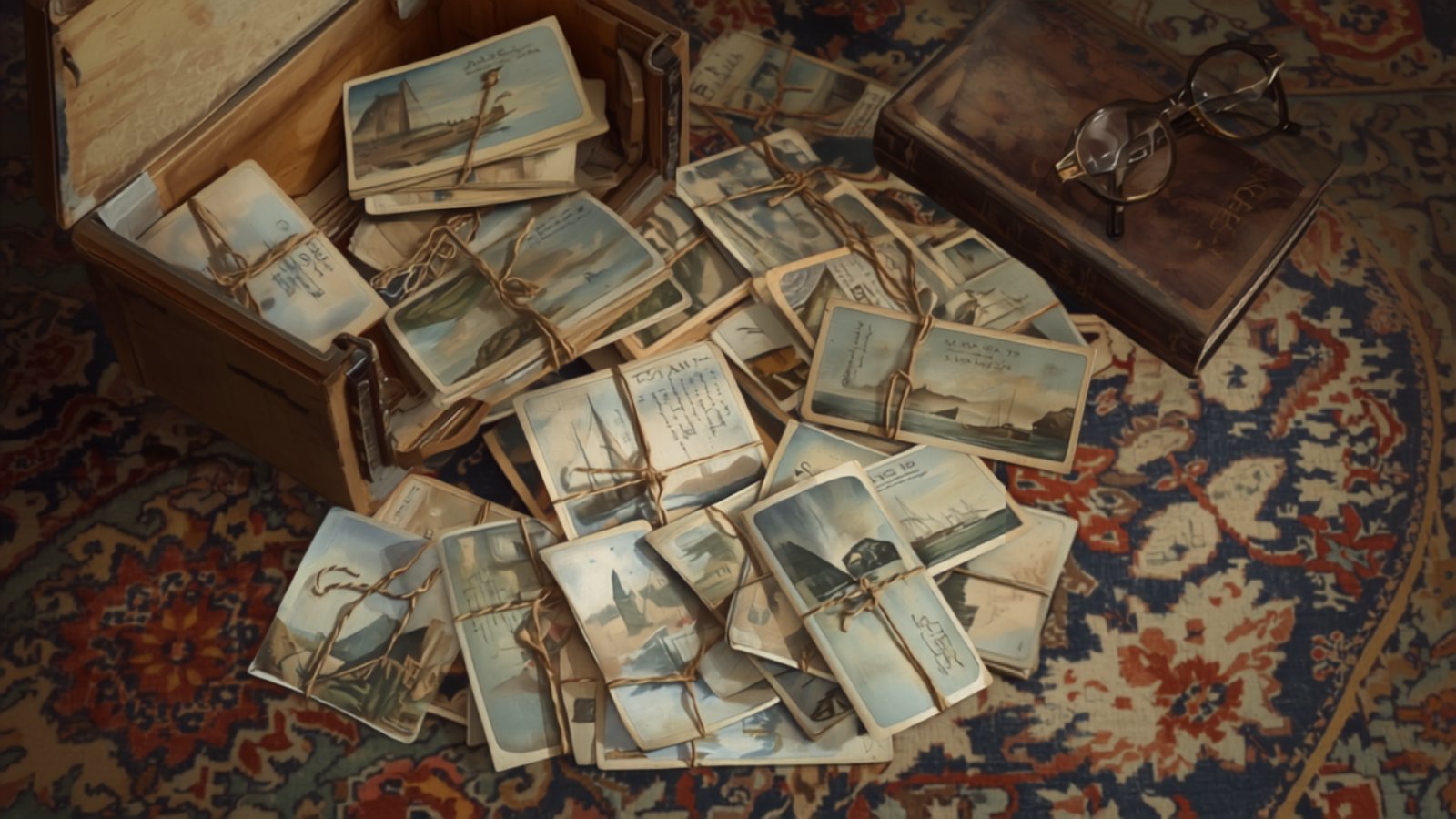
Inside, there were no letters, no jewellery, no photographs. There was only one thing: a neat pile of postcards, tied together with a thin blue ribbon.
Sofia lifted them out. Her mother looked over her shoulder. The top card showed the Eiffel Tower at night. On the back, in blue ink, there was a short message — just three lines. And at the end, instead of a name, there was one careful letter: M.
That was all. No full name. No address. Only that single letter, like a small secret written on the back of a card.
2 · Five cities, one signature
Sofia sat on the edge of her grandmother’s bed. Her mother sat down next to her. Together, they untied the blue ribbon.
There were seven postcards in total, sent from five different cities. Sofia laid them out on the blanket, in the order of the dates on the stamps.
The first card was from Paris, July 1972. The picture showed a small café with red chairs. The message said: “The city is loud, but the mornings are quiet. I sit at your favourite café and think of you. Come next year, if you can. — M.”
The second was from Rome, July 1974. The picture was of the river at sunset. “You would love the light here. The waiters shout. The pasta is better than they promised. I saved a table for you, but only in my head this time. — M.”
Then Prague in July 1978. Vienna in July 1981. And two cards from Lisbon — one from July 1984, and the last one from July 1985.
Every card was written to the same person: Sofia’s grandmother. Every card was sent in July. And every card had the same signature at the end — a single, careful letter M. A signature is the special way a person writes their name at the end of a letter or a card, and this signature was strange, because it was not really a name at all.
“I don’t understand,” said Sofia. “Who was M?”
Her mother shook her head. She read one of the cards a second time, slowly. “I have no idea. Your grandmother never told me she had a friend called M. She never told me she went to Europe.”
“Did she go?”
“I don’t think so. When I was little, we never went further than the seaside. My father worked too much for holidays. And after he died — no, she stayed here. She said the flat was enough. She said she was too old to travel.”
“But she has kept these cards for fifty years,” said Sofia. “That means something.”
They read every card. The messages were short, but they were warm. They were the words of someone who had known Sofia’s grandmother very well. Someone who had missed her. Someone who had been waiting for her.
The last card was different. It was from Lisbon, July 1985. It had a picture of an old street in the sunshine — narrow, with a yellow tram climbing a hill. On the back, the writing was slower and more careful than on the other cards, as if the writer had wanted every word to matter.
“The café is still here. The old owner is still here. Our table by the window is still here. I have kept our tradition for you again this year. Maybe one day, you will come and sit with me. And if you never do — then someone from your family will. Yours always, M.”
“‘Someone from your family will,'” Sofia read out loud. She looked at her mother.
Her mother said nothing.
Sofia turned the card over in her hands. She looked at the yellow tram on the front. She looked at the address of the café, printed at the bottom in small letters. She read it twice. She did not know it yet, but she had already made a decision.
3 · The decision
That night, Sofia went home to her own small flat in Manchester. She sat at the kitchen table with a cup of tea. She did not eat dinner. She read the last postcard again.
She had never travelled alone before. She had gone to Spain once with two friends, and to Ireland once with her mother. That was all. She was twenty-six years old, and the biggest journey of her life had been three hours on a plane, with somebody else buying the tickets.
For a week, she went to work. She sat at her desk at the bank. She answered emails. She made coffee. She talked to customers. But her mind was always in a small café in Lisbon, at a table by the window.
She looked up the flights. She looked up small guest houses near the café. She read about the trams, the streets, the food. Every evening, she opened her laptop and closed it again without buying anything.
Then, one Friday evening, her mother phoned her.
“How are you, love?” her mother said.
“I keep thinking about the postcards,” Sofia said. “I can’t stop.”
Her mother was quiet for a moment. Then she said something that surprised Sofia.
“You should go, you know.”
“Where?”
“Lisbon. If you want to go, go. It might help you with the grief.”
Grief. It was a word Sofia had not said out loud, not once since February. Grief is the deep sadness you feel when someone you love has died. It had been sitting in her chest for weeks, but she had not given it a name. She swallowed hard.
“What if there is nothing there?” she said. “What if the café is closed? What if the man who owned it has died? What if M has died too? I might go all that way for nothing.”
“You might,” said her mother. “But you might not. And even if you find nothing about M — you will still have gone. Your grandmother never did. Maybe you should.”
That was Friday. On Saturday morning, before she could change her mind, Sofia booked a flight. She booked a small guest house in Lisbon for eight nights. She asked her boss for two weeks off. He said yes.
She took her suitcase down from the top of her wardrobe. A suitcase is a large bag with a handle, and hers was old and covered in dust. She had not used it since Spain. She put in some light clothes, a pair of good walking shoes, a notebook, and one small book about Lisbon that she had bought at the station.
At the very bottom of the suitcase, wrapped in a soft cloth, she placed the last postcard — the one from July 1985, with the picture of the narrow street and the yellow tram.
That night, she could not sleep. She lay in bed and looked at the ceiling and thought about her grandmother’s small, kind hands. She thought about a stranger called M — because a stranger is a person you do not know, and to Sofia, M was still exactly that. She thought about a café she had never seen, in a city she had never visited.
For the first time in months, she felt something like hope.
4 · Alone in Lisbon
Sofia arrived in Lisbon on a warm July afternoon. The airport was busy, and she felt small in the crowd. She took a taxi to her guest house. Her Portuguese was three words long: obrigada, sim, and bom dia.
The guest house was in a quiet street called Rua da Rosa. The owner was a kind woman called Marta, who spoke slow, careful English. She gave Sofia a small room with a window that opened onto a narrow balcony. From the balcony, Sofia could see the tops of trees, the roof of a church, and a thin blue line — the river Tagus, far below.
“Your first time in Lisbon?” Marta asked, as she poured Sofia a glass of cold water.
“Yes. My first time.”
“Alone?”
“Yes. Alone.”
Marta smiled. “Then walk. Do not take the bus. Do not take the taxi. Walk everywhere. Lisbon is a city that you must feel with your feet.”
That evening, Sofia did as she was told. She walked out of the guest house and along the small streets. She had never seen streets like these before. They were narrow and old, made of small square cobblestones that shone in the low sun. Cobblestones are the small, round, hard stones that make old streets — the ones her grandmother had never walked on.
The trams were slow and yellow and full of tired people. She watched one climb a steep hill, ringing its bell. She read the sign — Elétrico 28 — and she smiled. Her grandmother would have liked this, she thought. Her grandmother would have liked all of it.
She ate dinner alone at a small restaurant near the river. She had grilled fish and boiled potatoes and one glass of white wine. The waiter was patient with her broken words. At the next table, a family was laughing, and a little girl waved at her over her father’s shoulder.
Sofia waved back. She did not feel as lonely as she had thought she would.
She spent the next two days walking. She climbed the steep streets to a viewpoint high above the city. She looked down at the red roofs, the wide river, the huge white ships coming in from the sea. She sat on a bench and cried a little, because her grandmother would never see this, and because there was no one in the world she could send a postcard to who would truly understand.
On the second evening, she opened her notebook and wrote a short list.
Things I have done alone this week:
– taken a plane
– bought a coffee in another language
– asked a stranger for directions
– cried in front of a beautiful view
– walked home in the dark
She read the list twice. She had never made such a list before.
On the morning of her third day, she washed her face, brushed her hair neat, and put on a clean shirt. She put the last postcard into her small bag. She checked the address of the café on her phone: Rua Garrett, in a busy square in the centre.
She took a deep breath. She walked out into the sunlight. It was time. She was going to find the café.
5 · The old café
The café was called Café Rosa. It sat on the corner of a busy street, with big glass windows and small tables outside. Waiters in white shirts carried silver trays between the tables. Tourists took photographs. Locals stood at the long marble counter, drinking small strong coffees.
For a moment, Sofia was afraid. What if it was the wrong café? What if her grandmother’s name meant nothing here? What if the old owner from the postcard had died years ago, and nobody remembered anything?
She held the door open for a woman with a small dog, and then she went inside.
Inside, the café was cooler and darker. The ceiling was high. Old photographs covered the walls — writers and painters from a hundred years ago, all in black and white. In the far corner, next to the tall window, there was a small round table with two green chairs.
Sofia’s heart moved. She had never seen the table before, but she felt as if she had.
She sat down.
A young waitress came over. She had a friendly face and short black hair. She wore a green apron with the name Rosa on the front.
“Boa tarde,” the waitress said. “What can I get you?”
“A coffee, please,” said Sofia. Then she added, more quietly, “And — I have a question.”
The waitress waited.
Sofia took out the postcard. She placed it carefully on the table, in front of her. “This card was sent from this café,” she said. “A long time ago. In 1985. My grandmother received it. She has died, and — I found it in a wooden box in her flat. I know it is strange. But I wanted to see the place, and — I hoped somebody might remember.”
The waitress picked up the card. She read the message. She turned the card over and looked at the picture. Her face changed.
“Wait here, please,” she said.
She walked quickly to the back of the café. She spoke to an older man at the counter — a man in his sixties, with grey hair, a green apron the same colour as hers, and kind, quiet eyes. He looked over at Sofia’s table. He looked at her face. He put down his cloth. He came over slowly.
“I am Rui,” he said. “This is my café now. My father, João, started it in 1962. May I see the card again?”
Sofia gave him the postcard. He held it in both hands, the way people hold something small and important. He read the message.
For a long moment, he did not speak. Then he sat down at the table, in the green chair opposite Sofia, and he smiled. There were tears in the corners of his eyes.
“I remember your grandmother,” he said. “Her name was Elizabeth.”
Sofia could not speak. She could only nod.
“And I remember Marion, too,” Rui said. “They came together, every summer, for many years. My father had a good memory for the regular customers — a memory is a picture in your mind of something that happened in the past, and my father kept his memories carefully, like this café. He used to say those two English women were like sisters. Two young ladies, always at this table, always laughing. They wrote each other postcards all year, and then they met here in July. That was their tradition — a tradition they kept for more than twenty years. My father used to save this table for them every July, without them even needing to ask.”
6 · What was left behind
Sofia sat very still. Outside, a tram passed the window with its bell ringing, but she did not hear it. Rui watched her kindly.
“Marion,” Sofia said, at last. “M was Marion.”
“Marion Whitfield,” said Rui. “That was her full name. Your grandmother was Elizabeth Hall. My father knew both of them by name after the very first summer. He said they were like sisters — not sisters by family, but sisters by choice.”
“When did they stop coming?” Sofia asked.
“Your grandmother came for the last time in 1984. In 1985, Marion came alone. My father asked her, ‘Where is Elizabeth?’ and Marion said, ‘She cannot travel any more. Her husband is very sick.’ That was the summer she sent the last postcard. After that, she still came every year, alone, for many years. Then she got older, and she came less. The last time I saw her was five, maybe six years ago. She has died now. I heard the news two years ago, from her nephew.”
“She kept coming,” Sofia whispered. “Every summer. Alone.”
“Yes,” said Rui. “And every year, she asked us to save this table.”
He stood up slowly. He walked to a small cupboard behind the counter. When he came back, he had an envelope in his hand — an old brown envelope, soft at the corners, with a name written on the front in careful blue ink: For Elizabeth’s family.
“She left this with my father on her last visit,” Rui said. “She said, ‘One day, someone will come. Give this to them.’ I have kept it for two years, and I have thought many times that no one would ever come. And then, today, you walked in.”
He placed the envelope on the table in front of Sofia. His hand was gentle.
Sofia’s fingers were shaking a little. She opened the envelope carefully. Inside was one thing — a small, square photograph.
The photograph was old. The colours were soft and warm. In the picture, two young women sat at this same table, in these same green chairs. They were both laughing. One had short brown hair and a red scarf — that was her grandmother, Elizabeth. The other had long dark hair, and she was holding up her coffee cup as if she was making a toast.
That was Marion. That was M.
Sofia turned the photograph over. On the back, in her grandmother’s handwriting — her grandmother’s handwriting, which she would have known anywhere — there was one line.
“Sofia, if you ever find this — take the train to Sintra. Go to Number 4, Rua das Flores. There is a small yellow door. Someone is waiting for you.”
Sofia read it once. She read it again. She looked up.
Rui was smiling gently. “Sintra is one hour from here by train,” he said. “Yellow door, Rua das Flores. Do you want another coffee first?”
Sofia laughed, and then, softly, she began to cry. Because her grandmother had known, all those years ago. She had known that one day, someone from the family would come — and she had left a door open.
And now Sofia was standing in front of it.
Check your understanding
Read each question. Think about your answer. Then click “Show answer” to check.
Words to remember
Here are the ten key words again, in fresh sentences. Read each one out loud.
- inherit — When my uncle died, I inherited his old guitar and all his music books.
- stranger — I do not usually talk to strangers, but the woman on the train was very friendly.
- signature — The bank asked me to put my signature at the bottom of the form.
- envelope — She put the birthday card into a small red envelope and posted it.
- suitcase — My suitcase is too heavy. I need to take some clothes out.
- cobblestone — The old part of the town is beautiful, but the cobblestones are hard to walk on in high shoes.
- tram — In Amsterdam, many people take the tram to work instead of a car.
- tradition — In our family, it is a tradition to eat fish on the last day of the year.
- memory — I have a strong memory of my first day at school — the smell of pencils and the sound of the bell.
- grief — After his dog died, he felt a deep grief for many months.
Grammar in this story: the present perfect
This story uses the present perfect tense a lot. We form it with have or has + a past participle (like been, seen, done, kept). We use it to link the past to now — for life experiences, and for actions that started in the past and are still important today.
Look at these examples from the story:
“I have never seen this before.” (a life experience — up to now)
“She has kept these cards for fifty years.” (started in the past, still true)
“I have kept it for two years.” (started in the past, still true)
“I have never travelled alone before.” (a life experience — up to now)
Notice how the present perfect is different from the past simple. If you say “I saw Lisbon”, it sounds like a finished moment. If you say “I have seen Lisbon”, it means it is part of your life — you can still remember it now.
👉 Learn the full rule here: Present Perfect Simple.
Talk about it · Write about it
Talk about it: Is there a person in your family whose life you do not know very well? What questions would you like to ask them? If they are still alive, could you ask them this week?
Write about it: Write 8–10 sentences about a place you would love to travel to alone. Where is it? Why that place? What would you do on your first day? Use the present perfect at least twice (for example: “I have always wanted to see…” or “I have never been to…”).
🎉 Well done — you have just read a full B1 story in English, more than 3,000 words. That is real reading practice. And along the way, you have met ten new words and seen the present perfect at work in a real story.
But wait — what is behind the yellow door in Sintra? Who has been waiting there for Sofia? And what did her grandmother arrange, all those years ago, that she never told anyone about? Sofia is about to find out. Write your own ending, using details from the story to explain your choice.
Maya is tired from working two jobs. Follow the envelopes and use details from the story to explain her choices. Next story: The Last Envelope (B1 Reading Story)
About this story: This is an original B1 graded reader (~3,300 words). It is written with a controlled B1 vocabulary and grammar (past simple, past perfect, and the present perfect featured above). Any harder word is explained before the story and reused inside it, so an intermediate learner can understand about 98% of the running words. Read it once for the story, then read it a second time and notice the tenses.

I’m Khamis Maiouf. I’m studying Health and Social Care and have completed Functional Skills Level 2 in English and Level 3 Hairdressing. I have taught ESOL in my community and helped students with GCSE English. I run English Teacher Site to help people learn and practise English.