
Amina and the Moon (A1 Reading Story)

A1 · BEGINNER Reading practice · ~1,300 words · 10-min read
This is a short, easy story for beginners. The sentences are simple. First, read the eight key words. Then read the story about a girl, her notebook, and the moon. At the end, there is a small quiz to check what you understand.
Before you read — 8 key words
- moon — the big white light in the sky at night.
- sky — the big space over our heads.
- shape — the form of a thing (round, thin, or square).
- notebook — a small book with empty pages, for writing and drawing.
- draw — to make a picture with a pencil or pen.
- change — to become different (small to big, thin to round).
- month — a piece of time; one year has 12 months.
- clever — good at learning, asking, and thinking.
The story
1 · A gift from Dad
Amina is nine years old. She lives in a small house with her mum and her dad. Amina likes to look at things. She looks at the flowers in the garden. She looks at the birds in the tree. And most of all, she looks at the sky.
The sky is the big space over our heads. In the day, the sky is blue. At night, the sky is dark. But at night, there is a big white light in the sky. The name of that light is the moon. Amina loves the moon.
One evening, her dad comes home with a small red bag. “This is for you, Amina,” he says. Amina opens the bag. Inside, there is a small book. The book has no words. All the pages are empty and white.
“Dad, the book is empty,” Amina says.
“Yes,” her dad says with a smile. “It is a notebook. A notebook is a small book with empty pages. You can write in it. You can draw in it. To draw means to make a picture with a pencil.”
“But what do I draw?” Amina asks.
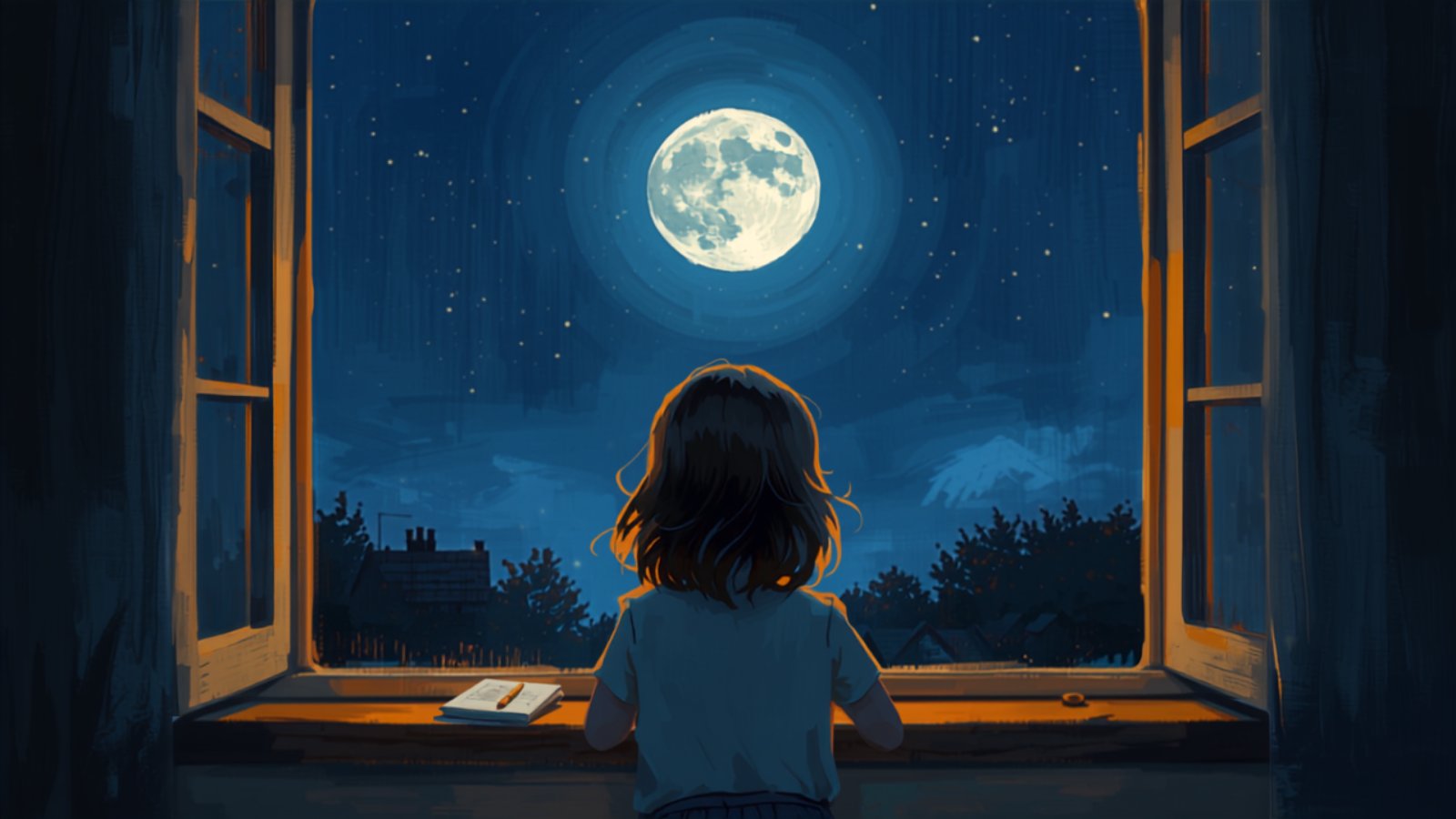
Her dad looks out of the window. It is night. The moon is high in the dark sky. “Look, Amina,” he says. “The moon is beautiful tonight. Why don’t you draw the moon?”
Amina looks at the moon. Tonight, the moon is not a big round circle. It is thin, like a small smile. That is the shape of the moon tonight. A shape is the form of a thing — round, thin, or square.
Amina takes her pencil. She sits at the table. She draws the shape of the moon in her new notebook.
“That is a good picture,” her dad says. “Now, I have an idea for you. Draw the moon every night for one month. A month is a piece of time — 30 or 31 days. One year has 12 months. Draw the moon every night, and see what happens.”
Amina smiles. “Okay, Dad. I can do that.”
2 · The moon changes
The next night, Amina looks out of her window. She sees the moon. She takes her pencil and her notebook. She draws the moon.
Tonight, the moon has a different shape. It is a little bigger than yesterday. Amina looks at the two pictures in her notebook. “That is strange,” she thinks.
The next night, Amina draws the moon again. Now the moon is bigger. It is like half of a big ball.
The next night, the moon is bigger still. Amina writes a small word next to her picture: “bigger”.
Night after night, Amina draws the moon. Some nights are cold. Some nights are warm. One night, the sky has a lot of clouds. Amina cannot see the moon. She waits. After some time, the clouds move away. The moon comes back. Amina draws it fast, before the clouds come again.
After two weeks, the moon is very big. Now it is a full circle. It is like a big white plate in the sky. Amina thinks it is the most beautiful moon in the world. She draws it big and round.
But the next night — something strange happens! The moon is not a full circle now. It is a little smaller. There is a small dark part on one side.
“Oh no,” Amina says. “Is my moon sick?”
She is a little sad. She goes to her dad. “Dad,” she says, “look at my notebook. The moon changes! It gets bigger, and then it gets smaller. What is happening?”
3 · A question for Dad
Amina’s dad sits down. He looks at all her pictures. He looks at every page.
“Amina,” he says. “This is very good work. You are a clever girl. Clever means you are good at learning, asking, and thinking.”
“But why does the moon change?” Amina asks.
Her dad thinks for a minute. Then he takes a small ball from the table. He takes a small lamp too. He turns on the lamp. Then he turns off the big light in the room.
“Now, look,” he says. “The lamp is like the sun — the big light in the day. The ball is like the moon. And you and I — we are the Earth.”
He puts the ball in front of the lamp. “Look at the ball,” he says.
The side of the ball near the lamp is light. The side far from the lamp is dark. Amina can only see a small part of the light side. It looks like a smile — like the moon in her first picture!
“Now watch,” her dad says. He moves the ball slowly around. He moves it in a big circle. Now Amina sees more and more of the light side. In one place, she sees all of the light side. It is a full circle. It looks like her big round moon in the notebook.
“Oh!” Amina says. “The moon is not really changing! It is the same ball all the time. But we see it in a different way — because it moves!”
Her dad smiles a big smile. “Yes, Amina. That is right. The moon moves around us. Every month, it goes around one time. Sometimes we see all of the light side. Sometimes we see only a small part. But the moon is always the same moon.”
Amina’s eyes are big. “So the moon is not sick,” she says.
“No,” her dad says. “The moon is not sick. The moon is fine. And you — you are a clever girl. Tonight, you learn something important.”
Amina looks at her notebook. She looks at all her pictures — the small smile, the half ball, the big circle. Now she understands. She is very happy.
4 · A full circle
The next day at school, Amina takes her notebook to class. She shows it to her teacher, Miss Sara.
“Miss Sara, look,” Amina says. “I draw the moon every night. It changes its shape — but it is not really changing. It only looks different, because it moves around us.”
Miss Sara looks at every page. Then she looks at Amina. “Amina, this is wonderful,” she says. “You are a little scientist! A scientist is a person who looks, asks, and learns.”
Miss Sara shows Amina’s notebook to all the class. The other children look at the pictures. They ask a lot of questions.
“Do you see the moon every night?” one boy asks.
“Yes, most nights,” Amina says. “Some nights, there are clouds. But I wait.”
“Does the moon go around fast?” a girl asks.
“No, slowly,” Amina says. “One time in a month.”
That evening at home, Amina wants to teach one more person. She takes her mum’s hand. She takes a ball from the toy box. She takes the small lamp. She does everything her dad does the day before.
“Look, Mum,” she says. “The ball is the moon. The lamp is the sun. Now watch.” She moves the ball slowly in a big circle.
Her mum looks. Her mum’s eyes get big too. “Amina! I am forty years old, and I never really understand this before. Thank you, my clever girl.” She gives Amina a big, warm hug.
That night, Amina looks out of her window again. The moon is a thin smile shape now — like the first moon in her notebook. One month is finished. She draws the moon one more time.
Then she has a new idea. She turns to a new page in her notebook. At the top, she writes two words: “The stars.”
The stars are the small white lights around the moon. There are a lot of stars in the sky tonight. Amina looks up. She smiles. The moon has a lot of stories. But the sky has more.
Check your understanding
Read each question. Think about your answer. Then click “Show answer” to check.
Words to remember
Here are the key words again, in new sentences. Say each one out loud.
- moon — The moon is big and white tonight.
- sky — There are a lot of birds in the sky today.
- shape — A ball has a round shape. A book has a square shape.
- notebook — I write my new English words in my notebook.
- draw — My little brother likes to draw pictures of cars.
- change — The weather can change fast. Now it is sunny, but soon it is cold.
- month — January is the first month of the year.
- clever — My friend is very clever. She reads a new book every week.
Grammar in this story: there is / there are
This story uses there is and there are. We use them to say that something exists in a place. Look:
There is a big white light in the sky. There is a small dark part on one side. There are clouds tonight. There are a lot of stars in the sky.
The rule is simple. Use there is for one thing (a light, a book, a moon). Use there are for two or more things (clouds, stars, birds).
👉 Learn the full rule here: There Is and There Are for Beginners.
Talk about it · Write about it
Talk about it: Do you like the moon or the sun more? Why? What do you see in the sky where you live?
Write about it: Write 5 simple sentences about the sky at night in your city. Use there is and there are. For example: “There is a big moon tonight. There are three stars near the moon.”
🎉 Well done — you read a whole story about the moon in English! That is a big step. And now you know eight new words too.
But wait — Amina writes “The stars” at the top of a new page. What does she learn next? What is her new question? What happens next? Write your own ending in five short sentences.
Mina is getting ready for a town festival. Read about the lanterns and the people who make the day special. Next story: The Lantern Festival (A1 Reading Story)
About this story: This is an original A1 graded reader (~1,300 words). It uses simple, controlled vocabulary and short sentences, so beginners can understand about 98% of the words. Any harder word — like notebook, shape, or scientist — is explained before or inside the story, and used again so you can remember it.

I’m Khamis Maiouf. I’m studying Health and Social Care and have completed Functional Skills Level 2 in English and Level 3 Hairdressing. I have taught ESOL in my community and helped students with GCSE English. I run English Teacher Site to help people learn and practise English.