
Omar’s Bicycle Fund (A1 Reading Story)

A1 · BEGINNER Reading practice · Read one numbered part at a time
Read about Omar’s plan to buy a bicycle. First, read the eight key words. Read one numbered part at a time, and follow the amounts he saves. At the end, check both the story details and the money total.
Before you read — 8 key words
- market — a place with many small shops outside, where people buy food and other things.
- stall — one big table in a market. People sell things from a stall.
- pay — the money you get for your work.
- save — to keep your money and not spend it now.
- jar — a glass pot. You can keep coins in a jar.
- count — to say numbers to know “how many” — one, two, three…
- wallet — a small case for your money and cards.
- honest — truthful; an honest person tells the truth and does not steal.
The story
1 · Omar and the market
Omar is nineteen years old. He lives in a small town with his mother and his little sister, Nadia. Their flat is small, but it is warm and happy.
Every morning, Omar walks to the big market. The market is a place with many small shops outside. The walk is long — one hour. There is a bus, but the bus costs money. Omar does not take the bus. He wants to save his money. To save means to keep your money and not spend it now.
The market opens at seven o’clock. There are many stalls. A stall is one big table, and people sell things from it. There is a fish stall. There is a bread stall. There is a flower stall with red and yellow flowers. And there is a fruit and vegetable stall. That is where Omar works.
Omar’s boss is Mr Bell. Mr Bell is old. He has white hair and a big laugh. He is kind to Omar. He knows every person in the market, and every person knows him.
Omar likes the market in the morning. It is full of colours and sounds. The fish man shouts, “Fresh fish! Fresh fish!” The bread stall smells warm and sweet. Music plays from a small radio. For Omar, the market is like a second home.
Omar works hard. He carries heavy boxes. He puts the apples in a long line. He puts the oranges in a big pyramid. He talks to the customers. “Good morning! The bananas are very good today!”
Omar is good at one more thing: he can count fast. To count means to say numbers — one, two, three. A customer buys three apples, two lemons, and one melon, and Omar knows the price in one second. Mr Bell always says, “Omar, your head is a calculator!”
Every Friday is pay day. Pay is the money you get for your work. Mr Bell gives Omar a small envelope. “Your pay, Omar. Thank you for your good work.” It is not a lot of money. But it is Omar’s money, and he is happy.
2 · The money jar
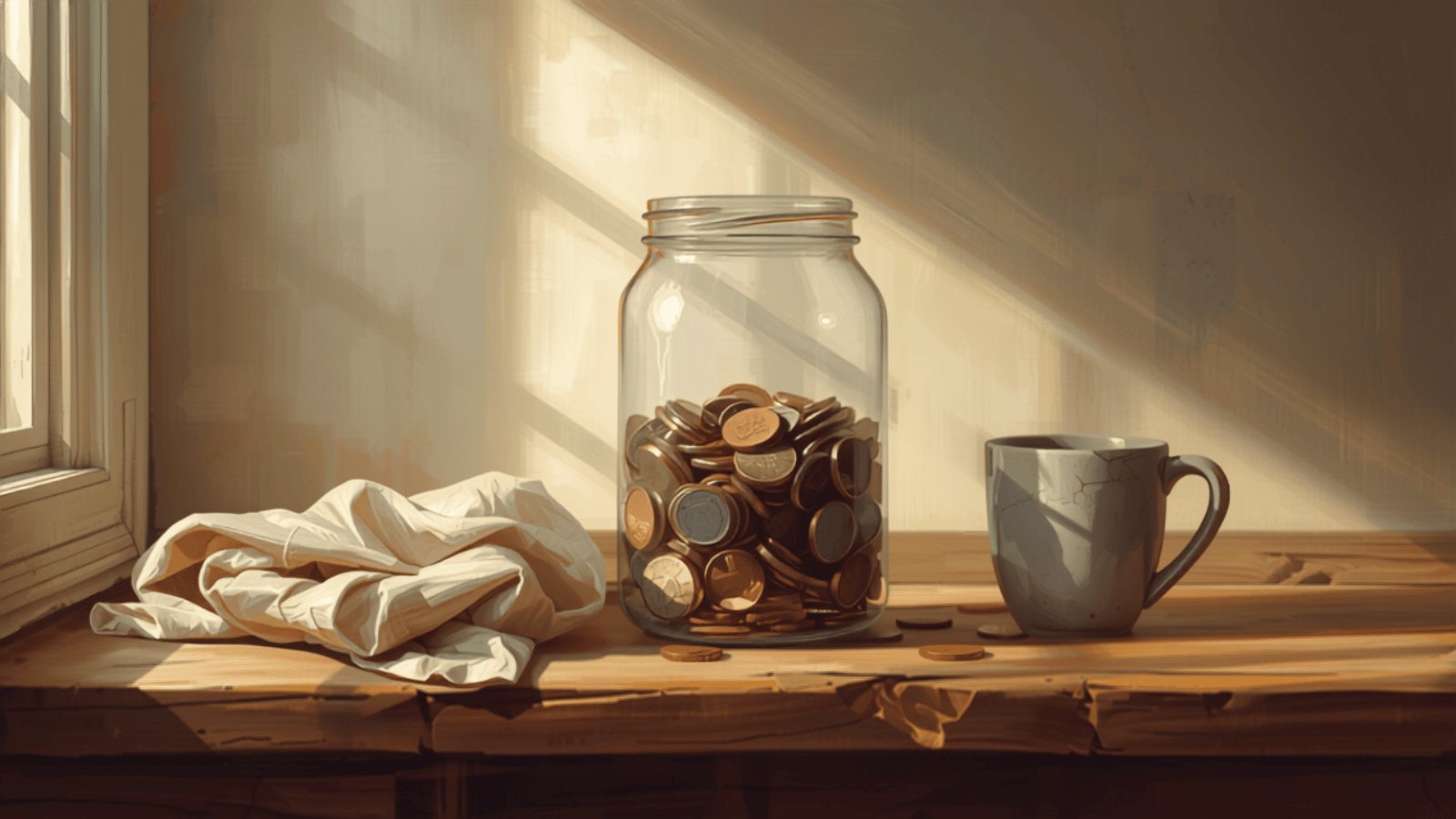
At home, on a shelf in the kitchen, there is a big glass jar. This jar is very important to Omar.
Every Friday, Omar opens his envelope. He gives some money to his mother, for food and for the flat. Then he puts four pounds in the jar. Coin by coin. Note by note.
Why? Because Omar has a dream. In the town, there is a small shop with bicycles. In the window, there is a beautiful blue bicycle. It costs ninety pounds.
Saving money is not easy. Omar’s friends go to the cinema on Saturday. Omar does not go. His friends buy new trainers. Omar does not. He looks at his old shoes and thinks, “They are fine. The jar comes first.”
“With a bicycle,” Omar tells Nadia, “I do not walk one hour to the market. I ride fifteen minutes. I can sleep more. I can come home early and help Mum.”
Every Sunday evening, Omar and Nadia count the money in the jar. Nadia loves this job. She makes little towers with the coins.
This Sunday, they count everything. “Seventy-four pounds!” says Nadia.
“Seventy-four,” says Omar with a big smile. “Only sixteen more. Four more Fridays, and the blue bicycle is mine.”
3 · The wallet
On Tuesday, the market is very busy. It is cold, and everybody wants hot soup, so everybody buys vegetables. Omar works fast all morning. Apples, potatoes, onions, carrots.
In the afternoon, the market is quiet. Omar takes a brush and cleans under the stall. And there, on the ground, under a box, he sees something small and brown.
It is a wallet. A wallet is a small case for money and cards.
Omar picks it up. He opens it. His eyes go big. There is a lot of money inside — maybe two hundred pounds! There is also a small photo of an old woman with a kind face.
Omar’s heart beats fast. He thinks: “Two hundred pounds. With this money, I can buy the blue bicycle today. Today! And nobody sees me.”
He looks at the wallet for a long moment. Then he hears his mother’s voice in his head. His mother always says: “Omar, be honest. An honest person does not steal. Money comes and goes. A good name stays.”
Omar closes the wallet. He walks to Mr Bell. “Mr Bell, look. There is a wallet under our stall. There is a lot of money in it. And there is this photo.”
Mr Bell looks at the photo and smiles. “I know this face! This is Mrs Rose. She has the flower stall. She has worked here for thirty years.”
They go to the flower stall, but it is closed. Mrs Rose is not there.
“She is at home now,” says Mr Bell. “Come early tomorrow, Omar. And keep the wallet safe tonight. I trust you.”
That night, at home, Omar puts the wallet on the kitchen shelf, next to the money jar. He tells his mother everything. His mother listens. Then she puts her hand on his face and says, “You are a good son, Omar. Tomorrow, that poor woman is going to be very happy.”
Omar looks at the wallet and the jar, side by side, for a long time. One is his money. One is not. Then he goes to bed.
4 · A surprise
The next morning, Omar is at the market at half past six. Mrs Rose is at her flower stall. Her eyes are red. She looks very tired and very sad.
“Mrs Rose?” says Omar. “Is this your wallet?”
Mrs Rose looks at the wallet. Then she starts to cry — but she is smiling too. “My wallet! Oh, thank you, thank you! This money is for my flower stall. I pay for my new flowers this week. Without this money, I have a very big problem.”
She opens the wallet and takes out twenty pounds. “This is for you, young man.”
“No, thank you,” says Omar. “It is your money.”
“Please,” says Mrs Rose. “You are honest. In this world, that is not a small thing. Please take it.”
Omar takes the twenty pounds. His face is red, but his heart is warm.
On Sunday evening, Omar and Nadia count the jar again. Seventy-four pounds, plus four pounds from Friday, plus twenty pounds from Mrs Rose. “Ninety-eight pounds!” shouts Nadia. “More than ninety! Omar, the bicycle!”
On Monday, Omar and Nadia go to the bicycle shop. Omar gives the man ninety pounds from the jar. The man gives Omar the beautiful blue bicycle. Nadia rings the little bell all the way home.
On Tuesday morning, Omar rides to work. Fifteen minutes! The wind is cold, and the sun is coming up, and Omar laughs out loud on the road.
At the market, Mrs Rose gives him a red flower. “For your mother,” she says.
Then Mr Bell calls him. “Omar, come here. Listen. You work hard. You count fast. And now everybody in the market knows you are honest.” He puts his hand on Omar’s shoulder. “I am old now, and my stall needs a young man. I have a big question for you.”
Omar waits. What is Mr Bell’s big question?
Check your understanding
Read each question and say or write your answer. Then click the question to open the suggested answer. Check it against the story.
Words to remember
Here are the key words again, in new sentences. Say each one out loud.
- market — On Saturday, we buy fruit and fish at the market.
- stall — The flower stall has red roses today.
- pay — I get my pay every Friday.
- save — I save ten pounds every week for my holiday.
- jar — There are many coins in the glass jar.
- count — Please count the apples. How many are there?
- wallet — My money and my bus card are in my wallet.
- honest — She is honest. She always tells the truth.
Grammar in this story: there is / there are
This story uses there is and there are many times. We use them to say that something exists in a place. Look:
There is a fish stall. There is a lot of money inside. There are many stalls.
There is goes with one countable thing, such as a wallet, or an uncountable noun, such as money. There are goes with two or more things: There are many stalls.
👉 Learn the full rule here: There Is or There Are.
To check Omar’s savings, review English numbers from 1 to 100. Then return to the story and say the amounts aloud.
Talk about it · Write about it
Talk about it: Do you save money? What do you want to buy? Imagine you find a wallet with a lot of money. What do you do?
Write about it: Write five sentences about Omar’s savings. Include the amounts before the reward, after Friday’s saving and after buying the bicycle. You can start: There are seventy-four pounds in the jar.
Well done for working through the story. Cover the word list and see which words you can explain. Review any you are still learning.
But wait — Mr Bell has a big question for Omar. What does the old man want to ask? What happens next? Write your own ending in five short sentences.
Anna works hard at a hotel. Read about her little blue jar and follow what she chooses to save. Next story: Anna's Little Blue Jar (A1 Reading Story)
About this story: This story is in our A1 reading collection. It mainly uses the present simple, with other forms where the meaning needs them. Read one numbered part at a time. Use the key words and pause to check unfamiliar vocabulary. Difficulty varies between readers and stories.

I’m Khamis Maiouf. I’m studying Health and Social Care and have completed Functional Skills Level 2 in English and Level 3 Hairdressing. I have taught ESOL in my community and helped students with GCSE English. I run English Teacher Site to help people learn and practise English.