
The Lantern Festival (A1 Reading Story)

A1 · BEGINNER Reading practice · ~1,300 words · 9-min read
This is a short, easy story for beginners. The sentences are simple. First, read the eight key words. Then read the story. At the end, there is a small quiz to check what you understand.
Before you read — 8 key words
- festival — a big, happy day. Many people come together with music, food, and lights.
- lantern — a light inside paper or glass. You can carry it in your hand.
- candle — a small stick with a little fire on top. It makes soft light.
- glue — a wet thing. It makes paper stick together.
- prize — a thing you win when you are the best.
- crowd — many, many people together in one place.
- proud — happy because you or your family do something very well.
- village — a very small town in the country.
The story
1 · Grandma’s lanterns
Mina lives in a small town near a river. She is ten years old. She lives with her mother, her father, and her grandmother. Everybody calls her grandmother “Grandma Roza”.
Every year, in autumn, the town has a big festival. A festival is a happy day for everybody. There is music in the streets. There is hot food on little tables. And there are lights everywhere — hundreds of paper lanterns.
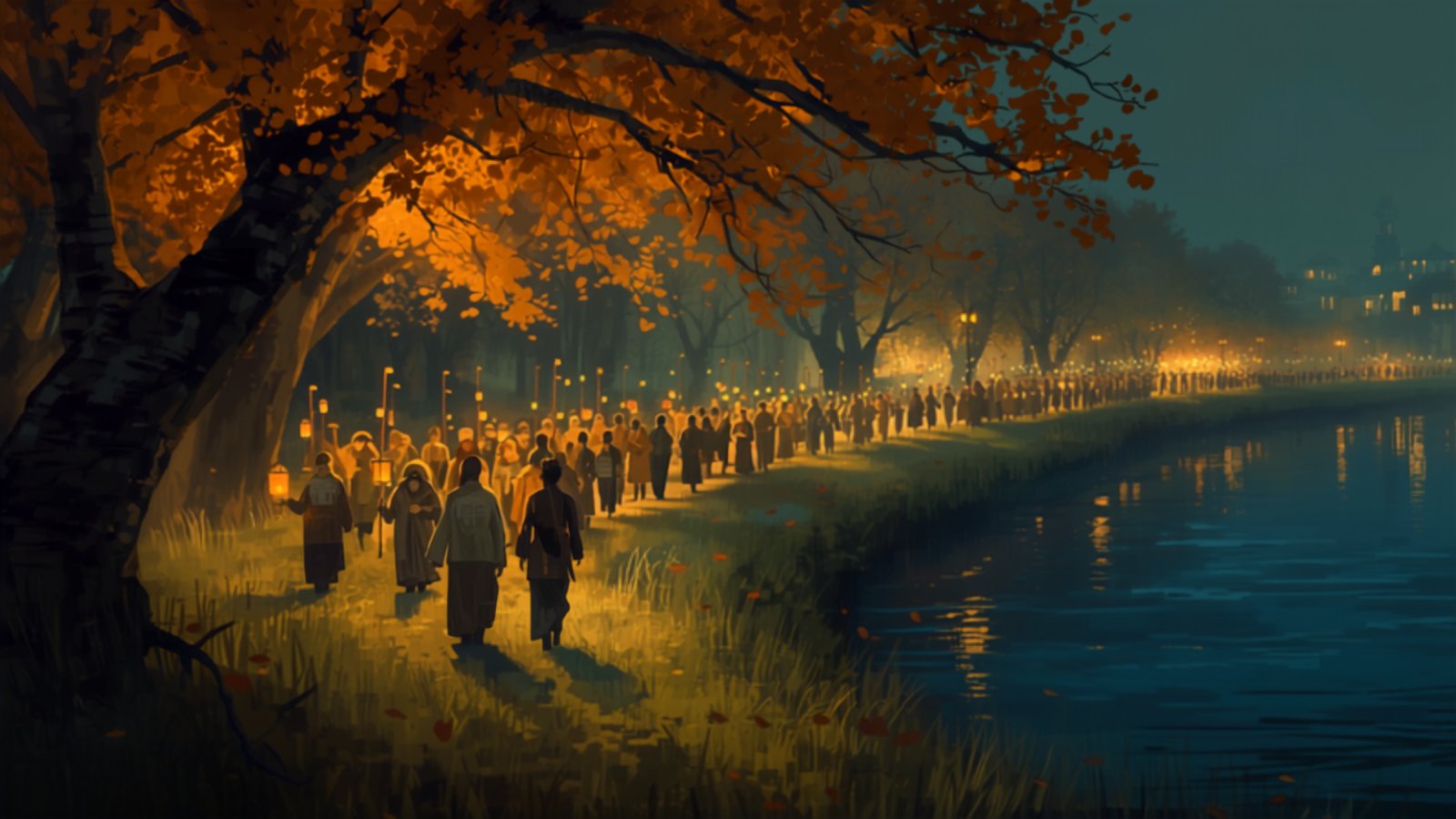
A lantern is a light inside paper. You put a small candle in it, and the paper shines like the moon. On the night of the festival, every family carries a lantern to the river. The crowd walks together, slowly, with all the little lights. It is the most beautiful night of the year.
Mina loves the festival. She loves the smell of hot bread and sweet apples. She loves the music. Children run in the streets with small lanterns on sticks. Old people sit in front of their houses and watch the lights. On this night, nobody stays at home. On this night, the town is one big family.
There is also a competition. The town gives a prize for the most beautiful lantern. And who wins the prize every year? Grandma Roza.
Grandma Roza makes wonderful lanterns. She cuts red and gold paper. She uses glue and thin wood. She works slowly, with a small smile. Her lanterns are not just lights. They tell stories. One year, her lantern shows a garden. One year, it shows the river with little boats. People come from other towns to see her lanterns.
“Grandma, why do you make a lantern every year?” Mina asks.
“Because my mother makes lanterns,” Grandma says. “And her mother too. In my old village, far from here, every child learns it. When I carry my lantern, I remember them all.”
Mina loves this answer. She feels proud of her family. Proud means happy because your family does something very well.
Every year, Mina sits next to Grandma and watches her work. She gives her the scissors. She holds the paper. But she never makes a lantern with her own hands. “Next year,” she always thinks. “Next year I learn.”
2 · This year is different
One morning in October, Mina comes home from school. Grandma Roza sits by the window. The red and gold paper is on the table. But Grandma is not working.
“Grandma? The festival is in ten days,” Mina says. “Where is your lantern?”
Grandma Roza looks at her hands. “My hands hurt this year, little one,” she says. “They are old hands. They cannot cut the paper now. This year, there is no lantern from our family.”
Mina looks at the paper. She looks at Grandma’s sad face. Then she says something big.
“I can make it. Teach me with words. Your eyes and my hands — together we are one lantern-maker.”
Grandma laughs. Then she stops laughing, because Mina’s face is serious. “All right,” Grandma says softly. “We start today.”
It is not easy. Oh, it is not easy at all! The first day, Mina cuts the paper wrong. The second day, there is glue on the table, glue on her hands, and glue in her hair. The thin wood breaks two times. Mina wants to cry.
“I am bad at this,” she says.
“No,” says Grandma. “You are new at this. Bad and new are not the same thing. Try again.”
So Mina tries again. Every day after school, she works at the table. Grandma sits next to her and speaks: “Cut slowly. Fold here. Not too much glue — a little is enough.” Day by day, Mina’s hands learn.
Mina’s mother comes into the room one evening. She sees paper on the floor and glue on the chairs. She opens her mouth to say something. Then she sees Mina’s face — quiet, serious, happy. She closes her mouth, smiles, and brings two cups of warm milk instead.
On the seventh day, something changes. The paper does not fight with Mina now. The scissors go where she wants. The little wooden frame stands straight and strong. Grandma picks it up and turns it in the light.
“Now,” she says, “you are ready for the picture.”
“What picture do we put on it?” Mina asks one evening.
Grandma is quiet for a moment. “My old village,” she says. “The little houses. The big tree. The mountain behind them. I want to see it one more time — in the light.”
3 · The night of the festival
The night of the festival comes. The town is full of people. There is music on every street. There are lanterns in every hand — blue ones, green ones, big ones, small ones. The crowd moves slowly to the river, like a river of light.
Mina carries her lantern with two careful hands. Inside, a small candle burns. On the paper, there is a village: little houses, a big tree, and a mountain behind them. It is not perfect. One house is a little crooked. But in the warm light, it looks alive.
Grandma Roza walks next to her. She does not carry anything. But she stands very tall tonight.
People stop and look. “Is that a new lantern-maker?” a man asks. “Look at the little village!” says a woman with a green lantern. Mina hears them, and her face goes warm and red. She walks a little taller, just like Grandma.
Then the wind comes. It is a strong autumn wind, cold and fast. It pulls at the paper. The candle dances. “No, no, no!” says Mina. The lantern shakes in her hands.
Suddenly, there are people around her. Mina’s father stands on one side. Her mother stands on the other side. Two neighbours come too. They all stand close, like a wall. The wind cannot touch the lantern now. Inside the little wall of people, the candle grows calm again.
“You see?” says Grandma. “This is why we make lanterns. Not for the light. For this.”
At the river, everybody stops. The water is black and quiet, and all the lanterns shine in it. There are two festivals now — one on the street and one in the water. Mina thinks it is the most beautiful thing in the world.
Then the judges come. They look at every lantern. There are so many beautiful ones this year — a fish, a star, a golden bird. Then the oldest judge stops in front of Mina. He looks at the little village for a long time. He does not speak. The crowd goes quiet.
“Who is the maker of this lantern?” he asks.
“Two people,” says Mina. “My grandma’s eyes and my hands.”
The judge smiles. “Then the prize is for two people,” he says, and he gives Mina the little gold cup.
The crowd claps. Grandma Roza’s eyes shine. Mina holds the prize with one hand and Grandma’s hand with the other. She is so proud. This is her family’s story now, too.
4 · The woman in the crowd
But the night has one more surprise.
An old woman comes out of the crowd. She walks slowly to Mina’s lantern. She looks at the little houses, the big tree, the mountain. Her eyes open wide.
“Excuse me,” she says quietly. “This village… I know this village. The house with the blue door — I am born in that house.”
Grandma Roza turns. She looks at the woman’s face for a long, long moment.
“Roza?” the woman whispers.
“…Vera?” says Grandma.
Mina looks from one old face to the other. Who is this woman? How does she know Grandma’s village — and Grandma’s name?
Check your understanding
Read each question. Think about your answer. Then click “Show answer” to check.
Words to remember
Here are the key words again, in new sentences. Say each one out loud.
- festival — Our town has a music festival every summer.
- lantern — At night, we carry a paper lantern in the garden.
- candle — There is one candle on the birthday cake.
- glue — I stick the photo in my book with glue.
- prize — She runs fast and wins the first prize.
- crowd — There is a big crowd at the football match.
- proud — My son can read now. I am very proud of him.
- village — My grandfather lives in a small village near the mountains.
Grammar in this story: there is / there are
This story uses there is and there are many times. We use them to say that something exists in a place. Look:
There is music in the streets. There is a competition. There are lights everywhere. There are lanterns in every hand.
The rule is simple: there is + one thing (music, a competition), there are + many things (lights, lanterns).
👉 Learn the full rule here: There Is or There Are.
Talk about it · Write about it
Talk about it: Is there a festival in your town or country? What is its name? What do people do — is there music, food, or dancing?
Write about it: Write 5 simple sentences about a festival you know. What is there in the streets? Who do you go with? Use there is and there are.
🎉 Well done — you read a whole story in English! That is a big step. And did you notice? You now know the eight new words too.
But wait — who is Vera? How does she know Grandma Roza’s old village? Their story starts many years ago, far away… and you will hear it in another story.
Maya feels lonely in a new city. Follow her Saturday visit to the chess table in the park. Next story: The Chess Table in the Park (A1 Reading Story)
About this story: This is an original A1 graded reader (~1,300 words). It uses simple, controlled vocabulary and mostly the present simple tense, so beginners can understand about 98% of the words. Any harder word is explained before the story and used again inside it.

I’m Khamis Maiouf. I’m studying Health and Social Care and have completed Functional Skills Level 2 in English and Level 3 Hairdressing. I have taught ESOL in my community and helped students with GCSE English. I run English Teacher Site to help people learn and practise English.