
The Long Way Round (C1 Reading Story)

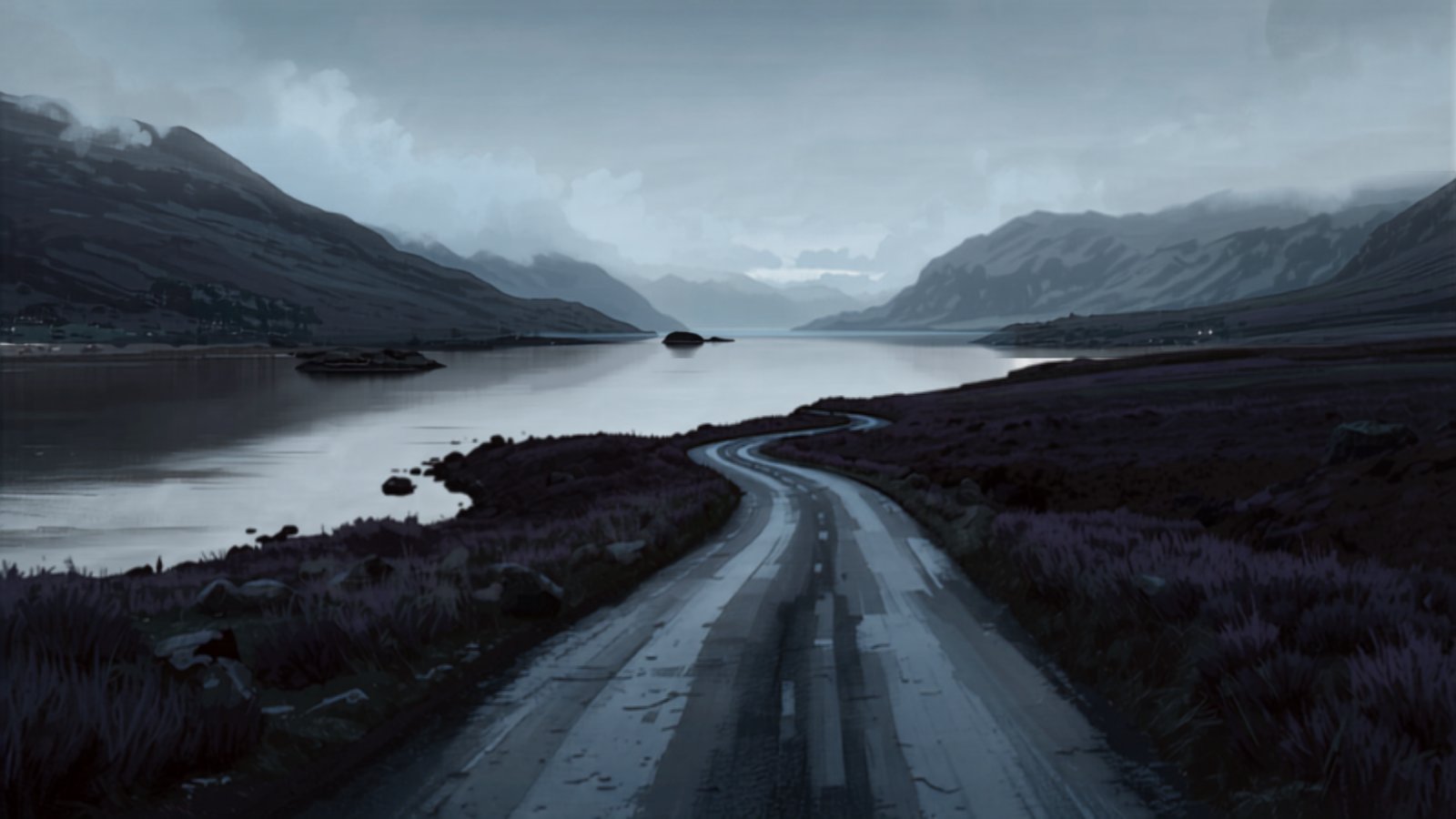
C1 · ADVANCED Reading practice · ~3,100 words · 16-min read
This is an original story for advanced learners. The language is rich but controlled: before you begin, glance at the ten key words below — each one reappears at least twice inside the story, so you will meet it again in a natural context. At the end you will find comprehension questions, the vocabulary in fresh sentences, and one C1 grammar point that is worth borrowing for your own writing.
Before you read — 10 key words
- estrangement — the state of no longer being close to someone you were once close to.
- reticence — the habit of holding back your thoughts and feelings; a reluctance to speak openly.
- penance — a small self-imposed punishment you accept in order to make up for something you did wrong.
- attrition — the process by which something is worn down gradually by many small pressures rather than a single blow.
- gruelling — extremely tiring and demanding, over a long stretch of time.
- wistful — thoughtfully sad, in a way that suggests longing for something lost or missed.
- cairn — a heap of stones piled up as a walker’s path marker or a small memorial.
- reconcile — to restore friendly relations after a long disagreement (noun form: reconciliation).
- drenched — completely soaked, usually by rain.
- threshold — a point of beginning that you deliberately cross; also, the strip of floor under a doorway.
The story
1 · The message she almost didn’t open
The message arrived at eleven minutes past ten on a Wednesday evening, while Iona MacRae was standing at her kitchen sink washing the same wine glass for the third time and pretending, as she had pretended for most of her adult life, that she was not waiting for anything in particular.
It came from a number she had deleted from her phone in 2011, reinstalled in 2014, and deleted again in 2017 during a period she preferred not to revisit. Her phone, more sentimental than she was, had kept the association. The name at the top of the screen still said, quietly, Cath.
She read it once, put the glass down carefully in the drying rack, and read it again.
I’m walking the West Highland Way next Saturday, one stage — Rowardennan to Inverarnan. If you want to walk it with me, be at Rowardennan pier by 8 a.m. If you don’t, I understand. Longer than a text can carry. — C.
Fifteen years of estrangement, and this was the reopening: fifty-eight words and a full stop. It was very like Cath. Cath had always understood that some things do not need the covering fire of a preamble.
Iona placed the phone face down on the drainer, which was as close as she could get to putting it face down inside a locked drawer without appearing to overreact. She poured the wine she had not yet drunk down the sink, because it seemed the wrong drink for the evening. Then she stood at the window looking out over the tenement gardens of Marchmont and — for the first time in a decade and a half — allowed herself to picture Cath Mackay’s face without flinching.
They had met in the same week of the same October at the same overcrowded Edinburgh corridor, both of them lost, both looking for the same tutor’s room. Cath had asked, without ceremony, whether Iona also thought the building had been designed by someone with a personal grudge, and Iona had laughed for the first time since arriving in the city, and that had been that: seven years of the kind of friendship that fills the whole horizon, in which every joke is inside, every wound is aired, and every plan for the future assumes the presence of the other. They had shared a flat, a coat, a job in a second-hand bookshop, a summer in Portugal, and — briefly — one poor boyfriend, whom they subsequently agreed to describe as “a learning experience.”
Then, at Cath’s wedding, Iona had said something.
She had been drunk on the honesty for which she was not, on reflection, famous. She had said it in the corridor between the reception and the toilets, and she had said it with the terrible, righteous clarity of somebody who is convinced she is doing a favour. The words had been are you sure, and then several more words which she could no longer, even after fifteen years of rehearsing them in the shower, remember exactly. Cath had walked her outside quite calmly, handed her her coat quite calmly, and closed the hotel door.
The estrangement had begun there — in a corridor, in a coat, and in the click of a door — and had continued, in the way estrangements do, by attrition. Not by decisions but by the accumulation of small non-decisions. A birthday not marked. A change of address not requested. A mutual friend’s news relayed only in the third person. Attrition wears the loudest friendships thinnest, and by the time Iona thought seriously of writing, the writing had come to feel absurd, like sending a postcard to a country that had renamed itself.
She looked up the forecast for Loch Lomond on Saturday. It said heavy rain, high winds, midges likely. It was, she thought, the exact conditions in which no sane person would attempt a reconciliation, and therefore, presumably, the exact conditions Cath had selected on purpose. Never before had she agreed to a plan whose entire premise was discomfort. She booked the train.
2 · Rowardennan, eight a.m.
The pier was drenched before she reached it. So was Iona. It had rained, in the biblical mode, from Balloch onwards, and the borrowed waterproof she had assumed would be sufficient was now performing the role of a wet flannel around her shoulders.
Cath was already there, in a red jacket that looked as though it had survived several campaigns, in boots that were somehow already dirty at eight in the morning, and with a small pack she was retying with the practised, irritated care of someone who had done this before. She was thinner than Iona remembered, and — this was the discovery that undid her — greyer at the temples. Not old, but not the twenty-four-year-old bookshop girl she had somehow, secretly, been carrying around. Fifteen years had happened to Cath in exactly the way they had happened to Iona: only, until this moment, one had been imaginary and the other only visible in the mirror.
“You came,” said Cath.
“I came.”
There was a pause in which several sentences arrived simultaneously in Iona’s mouth and cancelled one another out. It was Cath, mercifully, who moved first.
“There’s tea in the flask. I made too much. I always make too much. We should walk before we lose the light — twenty-two kilometres if we stay on the low path, twenty-four if we’re stupid.” A small, dry look. “I’ve become the sort of person who worries about that sort of thing.”
They walked. For the first hour they did not talk about anything at all, which was — Iona realised, slogging through the puddled path in Cath’s efficient wake — its own particular kindness. Only the necessary things: watch that stone; midges bad through here, keep moving; do you want a mint? The rain thinned to a fine grey mist that was, if anything, worse. Loch Lomond glowered on their left, wide and cold and unimpressed by them.
At the second cairn she stopped to catch her breath. Cath, who had gone on ahead, doubled back and stood beside her without comment. In several stretches of the West Highland Way, walkers add a stone to the cairns as they pass — a small votive act, a private note left for the mountain. Cath bent, picked up a flat piece of slate, and placed it at the top of the cairn with a care that struck Iona as almost ceremonial.
“For Rhona,” Cath said, into the wind, and walked on.
Rhona. Cath’s older sister. Six years older, patient, funny, the one who had made the two of them cups of tea at three in the morning in that terrible flat off Nicolson Street, and had listened to them argue about Foucault without ever once pretending to have read him. Iona had not seen Rhona in fifteen years either. She had heard, at some sanitised remove from the fact, that Rhona had died.
She placed her own stone on the cairn without asking permission. It looked, next to Cath’s, entirely inadequate.
“When?” she said.
“February,” said Cath. “Fast, in the end. She’d wanted a walk. This walk. So.” A small shrug. “I’m doing the walk. I did think about doing it alone. Then I thought about doing it with someone she would have wanted here, and there was — no one else on that list. So.”
So. Iona had forgotten how much of Cath’s speech ran on the word so. Anglo-Scottish shorthand for a great deal of feeling that she was not, this morning or possibly ever, going to translate into more. It was the same reticence Iona remembered from twenty, from twenty-two, from twenty-five: a private policy of leaving important things unfinished in the air, on the trust that the right listener would complete them.
They walked another six kilometres in a silence that had begun to hurt in the way only certain silences can hurt — a slowly gruelling silence, the silence of a bell that has not yet been struck, but is expected to be.
3 · The broken strap
It was somewhere after Inversnaid that Cath’s ankle turned. She had been picking her way down a rain-slicked slab of granite when the strap of her boot, softened by hours of water, chose that moment to snap. She went down hard, sat, said a single word Iona had not heard her say in fifteen years, and looked at the strap in her hand with the private fury of a person for whom things breaking is a personal affront.
“Sit,” said Iona, kneeling in front of her before she had thought about it. “Let me look.”
“It’s fine.”
“Cath. Let me look.”
The ankle was already puffing. The strap was unmendable. In Iona’s own pack, blessedly, were a spare set of laces, a length of gaffer tape, and — because she was still, at heart, the sort of person who over-prepares for events she does not want to attend — a compression bandage.
She improvised. She threaded, taped, and wrapped, and Cath — whose reticence had been a byword in the flat off Nicolson Street — let her. It was the first physical contact of fifteen years and it was, of all things, taping a boot back onto an ankle in horizontal rain outside Inversnaid.
“There,” said Iona, sitting back on her heels. “It won’t win prizes. It’ll get you to Inverarnan.”
Cath tested it, winced, and did not stand up. She looked out across the loch, which was the colour of old iron, and did not look at Iona.
“You said something to me,” she said, “in a corridor. At the Roman Camp. In September of 2011.”
Iona sat down on the wet slab. She noticed, distantly, that the rain had stopped.
“I know.”
“I’ve been walking with it for fifteen years.”
“I know.”
“I want to know what you meant. Not the words. I remember the words. I want to know what you meant.” Cath’s voice was level, which was worse than if it had been raised. “And I want to know it now, because I don’t have another fifteen years of not knowing it in me. Neither do you.”
Iona took a breath so long that her ribs hurt. It occurred to her, with a jolt, that the pain in her ribs was the same pain she had felt for fifteen years and had catalogued, incorrectly, as guilt. It was not guilt. What it had always been was the pressure of an unsaid thing.
“I meant,” she said, “that you were choosing him instead of us. Not instead of me — I want to be honest — instead of us, the whole enormous shared life we’d built. I watched him ordering you a drink you’d never drunk and I thought, he doesn’t know her, and she’s going to become the person he thinks she is, and I’ll lose her. And I panicked. And instead of saying it kindly, six months earlier, in a kitchen, I said it as a headline in a corridor on your wedding day. Which was —” she looked for the right word “— the least honest way I could possibly have said the most honest thing.”
Cath was quiet for a very long time.
“He turned out to be exactly the man you said he was,” she said at last. “I stayed with him for three years. He never once asked me what I thought about anything that mattered. Rhona used to come round, and afterwards I’d catch her in the hallway looking as though she wanted to break something.”
“I’m sorry.”
“I’m not saying it because I want an apology, Iona. I’m saying it because I owe you the acknowledgement.” A small, hard smile. “I’ve been carrying that debt around too, you know. Only mine has been quieter, because being right at somebody’s wedding is easier to remember than being wrong.”
They sat there, drenched, on the wet slab. The mist over the loch lifted, briefly, and Iona could see the water lit thinly at its far edge. A pair of walkers coming the other way glowered at them for blocking the path, then, noticing the ankle, softened, and passed. Cath laughed for the first time — one short, tired laugh.
“For a fortnight after the wedding,” she said, “I thought if I ever saw you again I’d hit you.”
“That would have been fair.”
“After a year, I thought I’d cut you dead in the street. After five, I thought I’d nod. After ten, I’d rehearse what I’d say if we ever bumped into each other in an airport, and it always came out wrong. After fifteen —” she shrugged “— I sent you a text about a walk.”
Iona swallowed. “I sent you a card,” she said. “Every year. For your birthday. To the address you no longer lived at. Unstamped. I never posted it — I dropped it in the wastepaper bin at the end of the day, always. It was my private penance, I think. I wanted to be someone who had sent it, without ever risking being someone who had actually sent it. Which, when you spell it out, is quite a distinguished form of cowardice.”
“Fifteen cards?”
“Fifteen cards. Roughly. One year I forgot until October and made two, as a form of accounting penance.”
Cath looked at her for a long moment. Then she did something Iona had not seen her do in fifteen years: she began, quietly, to laugh. Not kindly, not unkindly — the way one laughs at a piece of news so ridiculous that only laughter fits the shape of it.
“You absolute idiot,” she said, wiping her eyes. “You could have just posted one.”
“I know.”
“You could have posted the first one.”
“I know.”
“Come on,” Cath said, standing carefully on the taped ankle. “It’s still six kilometres to Inverarnan. If you help me up the last stile, I promise not to make you talk about anything else all afternoon.”
4 · Inverarnan
The last six kilometres were, by any honest measurement, gruelling. The path climbed and dropped and climbed again through wet bracken and rowan wood; the taped ankle held; the rain returned twice and gave up twice; and they talked, at last, in the way old friends talk when the thing they have been avoiding has been placed on the table between them and been found, on inspection, not to bite.
They talked about Rhona. Cath told her about the last week — about the hospice window, about the playlist Rhona had made for her own funeral, about the letter she had written to Cath and left in the bedside drawer, and the smaller envelope inside the letter with a name on it that was not Cath’s. They talked about the intervening years, in outline: Iona’s move to Glasgow and back, her almost-marriage, her decision, quietly, three years ago, to stop dating men who would have benefited from a manual; Cath’s second, better marriage; the twins; the small independent bookshop she now ran off Byres Road, and yes, of course she’d known Iona was still in Edinburgh, and no, she hadn’t looked her up, and Iona was not, thank you, allowed to ask why.
Somewhere on the rise before Inverarnan, in the wistful blue hour after the rain has stopped and the light has gone plum-coloured over the hills, Iona realised she had misunderstood — for the whole of this walk and for most of her adult life — what a reconciliation actually looked like. She had assumed it involved a scene: a speech, a wide gesture, a formal restoration to the position they had occupied before. This was not that. To reconcile, she was learning with each stony step, was less like unlocking a door and more like crossing a threshold: an edge you can only cross by agreeing, very quietly, to cross it. There was no ceremony to it, no bright line drawn on the ground to say which side of the threshold you were now on. There was only Cath’s taped ankle on her arm, the mist coming off her jacket, and the low sound of two women who had once known each other very well beginning, again, to know each other.
Not once during the descent did either of them mention next week, or next month, or the possibility of a further stage of the Way. Only when Inverarnan itself came into view, its warm hostel lights glowing through the last drizzle, did Cath say, without turning her head, “There’s another stage after this one, you know. Bridge of Orchy to Kingshouse. Late September. Weather’ll be worse.” Iona took a moment to answer, and then said, with the wistful half-smile that Cath had once been able to read at fifty paces, “I know.”
At Inverarnan the walker’s hostel was already lit and steamy. Cath sat down heavily on the porch bench and eased her boot off. Iona brought two teas, over-milked in the Scottish manner, and they drank them in a silence that was not, this time, the silence of an unstruck bell. It was closer to the silence of two people who had heard music and were letting it stop of its own accord.
Cath fished in the top pocket of her pack and brought out a small brown envelope, worn at the corners.
“This is Rhona’s,” she said. “The one she left, with your name on it. She made me promise I’d give it to you in person or not at all. If you hadn’t come this morning, I’d have taken it home and put it in a drawer and I would have —” she thought about it “— eventually forgiven her, I think.”
Iona took the envelope. It was heavier than a letter. Something soft, folded inside paper.
“Not here,” Cath said. “Read it on the train. I don’t want to be watching your face when you open it. It’s yours, and it’s private, and I don’t think it’s meant for me to see.”
She reached across the bench and squeezed Iona’s wrist briefly. It was — Iona thought, walking to the platform in the last of the light with the envelope in her inside pocket and her boots making an unfamiliar competent sound on the wet stones — the first easy touch in fifteen years.
On the unlit platform at Ardlui the train came in one minute early. Iona sat by the window, put her wet pack under the seat, and drew the envelope out.
At the top, in Rhona’s careful, slanting hand — the hand that had made tea at three in the morning in a terrible flat, that had listened to her argue about Foucault without ever once pretending to have read him — was a single line.
Iona — open only when you’ve walked at least one stage with her. R x
She turned the envelope over. The train shuddered north. She slid her thumb under the flap.
Check your understanding
Read each question. Think about your answer — some ask you to read between the lines. Then click “Show answer” to check.
Words to remember
Here are the key words again, in new sentences. Try writing one sentence of your own for each.
- estrangement — After ten years of estrangement, the brothers met again at their mother’s funeral and neither knew what to say.
- reticence — His reticence in meetings is often mistaken for indifference, when in fact he is listening more carefully than anyone.
- penance — Cleaning the whole flat before her housemate returned felt like a small penance for having lost her keys.
- attrition — The project was not cancelled outright; it died by attrition, one missed deadline at a time.
- gruelling — The final week of the trial was gruelling — twelve-hour days and no obvious progress.
- wistful — She spoke about her old neighbourhood in a wistful tone, as if it belonged to a person she used to be.
- cairn — At the summit, walkers had built a small cairn and left messages weighted down with stones.
- reconcile — It took a serious illness to reconcile the two colleagues, who had not spoken since the merger.
- drenched — By the time we reached the shelter we were drenched to the skin and laughing about it.
- threshold — Every important change in her life had felt less like an event and more like a threshold she was choosing, quietly, to step across.
Grammar in this story: cleft sentences (it-clefts and wh-clefts)
This story leans on cleft sentences — a stylish C1 tool for taking a normal sentence and reshaping it so one specific part carries all the emphasis. Advanced writers use them when they want you to hear the important word, not just read it. Look at these three examples from the story:
· It was Cath, mercifully, who moved first. (Not just “Cath moved first” — the it-cleft puts the spotlight on Cath.)
· It was somewhere after Inversnaid that Cath’s ankle turned. (Foregrounds the place — the accident is anchored in a specific stretch of the walk.)
· What it had always been was the pressure of an unsaid thing. (A wh-cleft — Iona rejects the earlier explanation and reframes the real one.)
The pattern is simple. It-cleft: It + be + [emphasised part] + that/who/where + rest of sentence. Wh-cleft: What + [background clause] + be + [emphasised part]. The rule of thumb: reach for a cleft when the neutral word order would let the reader skate straight past the word you want them to pause on.
👉 Master the full pattern here: Cleft Sentences in English: How to Emphasise Like a Native Writer.
Talk about it · Write about it
Talk about it: Iona describes fifteen years of unposted birthday cards as “a distinguished form of cowardice.” Is she being too hard on herself — or is there a real difference between wanting to reach out and actually doing it? Have you ever kept up a friendship secretly, in your head, without the other person knowing?
Write about it: Write 150–200 words about a friendship you have neglected, or one you have deliberately reopened. Use at least two cleft sentences (e.g. It was only after her call that I realised… / What surprised me most was…) and at least three words from the key vocabulary above.
🎉 Well done — that was a full C1 graded reader, about 3,100 words, and much of the meaning was tucked between the lines. Notice how much of it you followed without translating: that is what reading at the right level does.
But Iona’s thumb is still under the flap. What has Rhona left her, and why did it have to wait until she’d walked at least one stage with Cath? Write your own ending, using details from the story to explain your choice.
Nell remains in her grandmother’s house after the funeral. Notice how place and tradition shape what happens next. Next story: The Feast of the Returning Tide (C1 Reading Story)
About this story: This is an original C1 graded reader (~3,100 words), written using the graded-reader method: vocabulary is controlled to an advanced (C1) level, and each of the ten harder words above is glossed before the story and reused at least twice inside it, so you meet it in a natural context. The grammar uses the full C1 range — cleft sentences, participle clauses, perfect forms, and understated discourse markers — while keeping roughly 98% of the running words within reach for a C1 reader.

I’m Khamis Maiouf. I’m studying Health and Social Care and have completed Functional Skills Level 2 in English and Level 3 Hairdressing. I have taught ESOL in my community and helped students with GCSE English. I run English Teacher Site to help people learn and practise English.