
The Kite Maker’s Promise (B1 Reading Story)

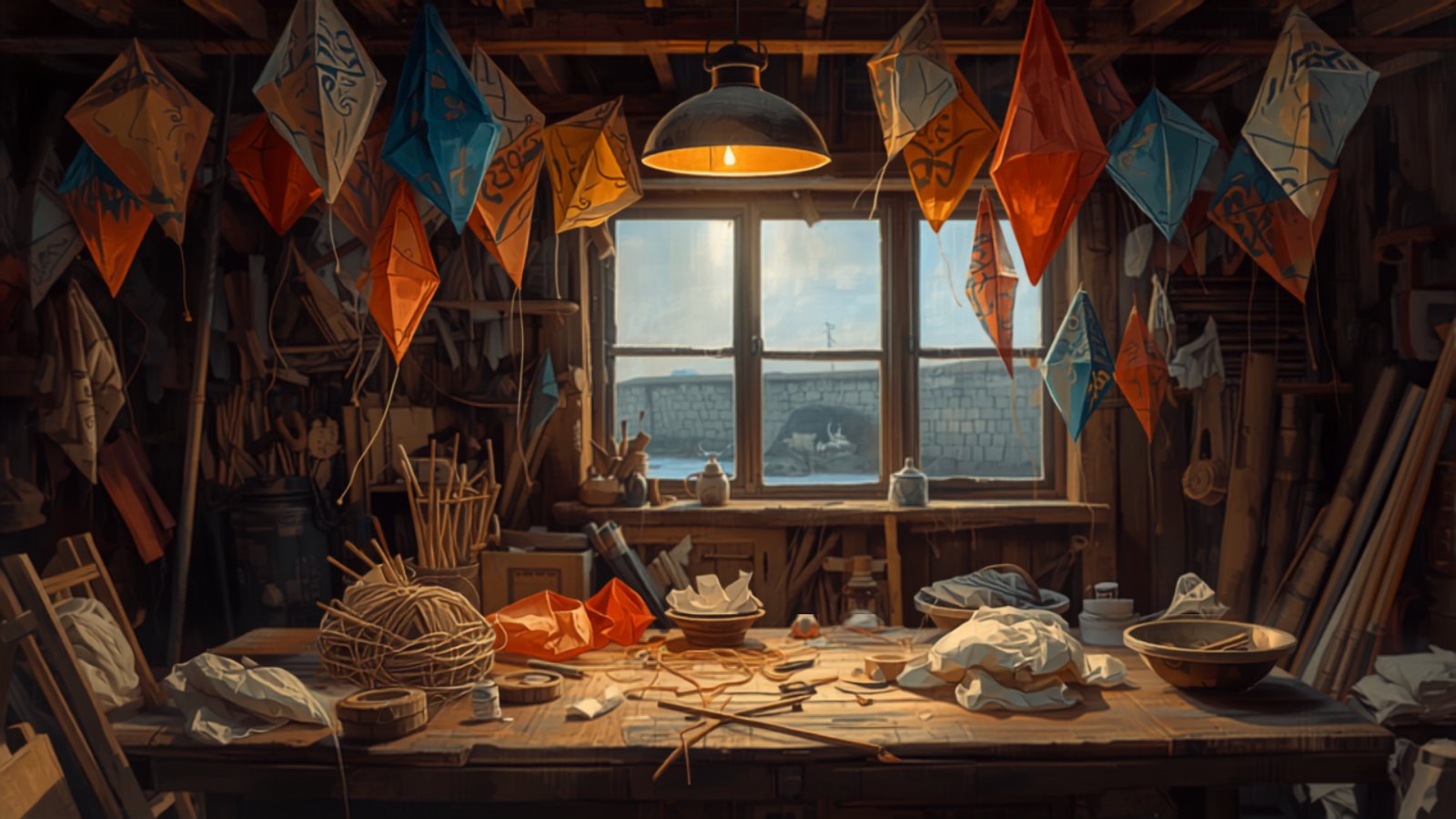
B1 · INTERMEDIATE Reading practice · ~3,000 words · 15-min read
This is an original story for intermediate (B1) learners. It is about a young woman, a small English town, and a festival that is 150 years old. First, read the ten key words. Then read the story — it is in five short chapters. At the end, there are questions to check what you understand.
Before you read — 10 key words
- kite — a light object made of paper or cloth on a frame, which flies in the wind on a long string.
- frame — the thin sticks inside a kite that give it its shape.
- bamboo — a light, strong plant with hard stems, often used for making things.
- breeze — a light, gentle wind.
- tradition — something special that people in a place have done in the same way for many years.
- festival — a special day when a town or a group of people celebrates something together.
- cancel — to decide that a planned event will not happen.
- workshop — a meeting where people learn to make something with their hands.
- harbour — a safe place on the coast where boats stay.
- proud — feeling pleased about something good that you, or people close to you, have done.
The story
1 · A new town by the sea
Sofia has lived in Westcliff for six months, but she still feels like a visitor.
Westcliff is a small town on the east coast of England. It has a grey stone harbour, a street of little shops, and a long, windy beach. In summer, tourists come for the sea. In winter, the town belongs to the wind. The wind here never really stops. It pushes the clouds across the sky, it shakes the shop signs, and it throws salt water against the harbour wall.
Sofia works at the Harbour Hotel, a small hotel which looks out over the boats. She cleans rooms in the morning and works at the front desk in the afternoon. The job is fine. The people are polite. But polite is not the same as friendly, and at the end of each day, Sofia walks home alone.
She came to England for work, like many people from her country. Her mother cried at the airport. Her little brother asked her to send photos of red buses. And her grandfather, Nadim, gave her a long wooden box.
“Open it when you arrive,” he said.
Her grandfather is a kite maker — the best kite maker in their city, people say. He has made kites for more than fifty years. In his small workshop behind the house, the walls are covered with kites: birds, fish, dragons, moons. Every spring, at the Festival of the Wind, hundreds of his kites fill the sky above the river, and everyone in the city looks up.
When Sofia was a child, she spent every Saturday in that workshop. She learned to cut bamboo into thin sticks. She learned to tie a frame so that it was strong but light. She learned to choose paper, to mix glue, to test the wind with one wet finger. “A kite is a simple thing,” her grandfather always said. “Sticks, paper, string. But when it flies, people forget their problems. Remember that, Sofia. A person who can make a kite can make people look up.”
On her first night in England, in a cold rented room, Sofia opened the wooden box. Inside there was a kite — but it was not finished. The bamboo frame was perfect, tied with red string. The paper, white as snow, was attached on one side only. Under the kite there was a short note in her grandfather’s careful writing:
“Every kite maker must finish one kite alone. This one is yours. Finish it, and fly it when you have found your sky. — Grandfather”
That was six months ago. The box is still under her bed. Sofia has not touched it since that night. She has told herself that she is too busy, that the weather is too wet, that the room is too small for glue and paper. But the true reason is different, and she knows it. Finishing the kite means accepting that she really lives here now — far from the workshop, far from the festival, far from home. And she is not ready to accept that. Not yet.
2 · The poster in the window
One Tuesday in April, Sofia walks home past the bakery, and a yellow poster in the window catches her eye.
WESTCLIFF KITE DAY — 150 YEARS OF FLYING.
Sofia stops in the middle of the pavement. A kite festival? Here? She reads the poster twice. Every year, on the first Saturday of June, the people of Westcliff fly kites on the cliff top above the beach. The tradition started 150 years ago, when the fishermen’s children flew kites to welcome the boats home. The poster shows an old black-and-white photo: the sky above the harbour, full of small paper diamonds.
Then she sees the second piece of paper, taped under the first one. It is smaller, and the message is written by hand:
“CANCELLED? Sadly, this year’s Kite Day may not happen. If you can help, please come to the community hall on Thursday at 6 p.m.”
Sofia has never been inside the community hall. But on Thursday at six o’clock, she is there, sitting on a plastic chair at the back. Only seven other people have come, and most of them have grey hair. At the front stands a small, straight-backed woman of about seventy, with bright eyes and a walking stick. Her name is Mrs Pearce, and she has organised Kite Day for thirty years.
“I’ll be honest with you,” Mrs Pearce says. “The festival is in trouble. You all remember the storm in February. The sea came over the harbour wall and flooded our storeroom. Every kite the club owned was destroyed — forty kites, some of them older than me. We have no kites, we have no money to buy new ones, and — let’s be honest — we have no young people. If we can’t find a way to fill the sky by June, we’ll have to cancel. And if we cancel once, after a hundred and fifty years…” She stops. “Well. Traditions are like kites. When they come down, it’s very hard to get them up again.”
There is a long, uncomfortable silence. An old man suggests buying cheap plastic kites from the internet. Mrs Pearce looks at him the way a teacher looks at a boy who has given a very wrong answer. “Plastic kites from a factory,” she says, “for our one hundred and fiftieth year.”
Sofia’s heart is beating fast. She has not planned to speak. But she hears her grandfather’s voice in her head — a person who can make a kite can make people look up — and suddenly she is standing.
“Excuse me,” she says. Everyone turns. “My name is Sofia. I work at the Harbour Hotel. In my country, my grandfather is a kite maker. He has made kites all his life, and he has taught me everything — the frame, the paper, the string, all of it. I have made kites since I was seven years old.” She takes a breath. “You don’t need to buy kites. If you give me a room and some materials, I will teach this town to make its own.”
Nobody speaks. Then Mrs Pearce smiles, and her bright eyes shine.
“Young lady,” she says, “sit here at the front. You and I have a festival to save.”
3 · The workshop
The first workshop is on a rainy Tuesday evening, and it is nearly a disaster.
Sofia has prepared everything carefully. She has found bamboo garden sticks at the hardware shop. She has bought paper, string and glue with the club’s last thirty pounds. She has cut examples of every shape and written simple instructions on big cards. She has borrowed six tables and covered them with newspaper.
Exactly four people come. Two are from the Thursday meeting. One is Mrs Pearce. The fourth is a boy of about ten, who has been sent by his mother because, he says, “she wants the living room to herself.”
“Right,” says Sofia, and swallows her disappointment. “Four kite makers are better than none. Let’s begin.”
She shows them how to cut the bamboo and how to tie the two sticks into a cross. She shows them the secret her grandfather taught her: bend each stick gently against your knee first, and listen. Good bamboo makes a soft sound; bad bamboo cracks. “Your frame is the heart of your kite,” she tells them. “If the frame is weak, the most beautiful paper in the world will not save it. But if the frame is strong, the kite will fly in almost any wind — and it will come back to you again and again.”
The boy, whose name is Charlie, learns fastest of all. His first frame is terrible. His second is worse. But his third is so good that Sofia holds it up to show the others. Charlie tries hard to look bored. He fails completely. He looks proud, and he is.
And that, strangely, is how everything changes — because Charlie goes to school.
On Wednesday, Charlie shows his kite frame to his class and tells them about “the kite lady from the hotel”. On Thursday, five children come to the workshop, with two mothers and one grandfather. The next Tuesday, there are twelve people. The Tuesday after that, there are twenty-five, and Mrs Pearce has to bring more chairs from the church.
The hall fills with the smell of glue and the sound of laughing. The baker donates paper. The fishermen’s club donates string — “the best string on this coast,” they say, and it is true. A reporter from the local newspaper takes a photo of thirty half-made kites hanging from the ceiling like strange white birds. The headline says: NEWCOMER TEACHES WESTCLIFF TO FLY AGAIN.
One evening, an old fisherman called Mr Hobbs stays behind after the workshop. He turns his half-finished frame in his hands and tells Sofia why the tradition matters so much. “My grandfather fished from this harbour,” he says. “In those days, the boats had no radios. When the men were coming home after a bad storm, the children ran up to the cliff and flew their kites, so the boats could see from far out at sea that everything was all right. A sky full of kites meant welcome home — we have waited for you.” He looks at the white shapes hanging above them. “People think a festival is just a nice day out. It isn’t. It’s a town remembering who it is.” Sofia thinks about that all the way home. She has been part of this tradition for only a few weeks, and already she understands: she is not just making kites. She is helping a town send its oldest message.
Sofia cuts, ties, glues, explains, repairs and encourages, four evenings a week. She has never talked to so many people in her life. She knows the names of children, parents, dog-walkers, the postman. When she walks down the high street now, people wave at her through shop windows. One evening she realises, with surprise, that she has not felt lonely for three weeks.
Only Mrs Pearce notices the one thing that is missing.
“Sixty-one kites,” she says one evening, counting the finished ones. “You have helped this town make sixty-one kites, Sofia. But I haven’t seen yours.”
Sofia looks down at the table. “Mine isn’t finished,” she says quietly.
“Then finish it,” says Mrs Pearce, in the voice of a woman who has organised things for thirty years. “A festival needs every kite. Especially that one.”
4 · The night before
On the Friday evening before Kite Day, two bad things happen at the same time.
The first is the weather forecast. Sofia watches it on her phone in her small room, and her heart sinks. A storm is coming up the coast. Heavy rain all Friday night. And then, on Saturday — the forecast shows a grey, dead symbol that every kite maker hates: no wind. Calm. Nothing. You cannot fly a kite in a storm, but you also cannot fly a kite in still air. Sixty-one kites, three hundred people, a hundred and fifty years of tradition — and perhaps no wind at all.
The second bad thing is quieter. Sofia pulls the wooden box from under her bed, opens it, and looks at the unfinished kite. And she finds that her hands will not move.
She has repaired forty kites this month. She could finish this one in an hour. It is not a question of skill. It is the note. Fly it when you have found your sky. If she finishes this kite, she is saying: my sky is here now. This cold, windy, grey-stone town is my sky. And some part of her still feels that this is a betrayal — of the workshop, of the Festival of the Wind, of the old man with careful hands who taught her everything.
So she does what she has wanted to do for weeks. She video-calls her grandfather.
His face fills the screen, brown and lined like old paper. Behind him she can see the workshop wall, the birds and fish and dragons. She starts to tell him everything — but he already knows. Her mother has translated the newspaper article for him. He has looked at the photos of the hall, of the hanging kites, of Charlie’s proud face.
“Sixty-one kites,” he says. “From garden sticks and shop paper. I have never been so proud in my life.”
“But mine isn’t finished, Grandfather. You asked me to finish it, and I couldn’t. I felt that…” She looks for the words. “I felt that if I finished it, I would lose home. That home would become just a place I’m from.”
Her grandfather is silent for a moment. Then he leans closer to the camera.
“Sofia. When you were seven, you asked me why we give kites so much string. Do you remember what I told you? A kite is not free because it has no string. A kite can only fly because it is tied to something. The string is not a prison, child. The string is home. It doesn’t stop the kite flying — it is the reason the kite can fly at all. You have not cut your string by living there. You have simply flown further than the others.” He smiles. “Now finish your kite. That is an order from your teacher.”
Sofia laughs and wipes her eyes. “And if there is no wind tomorrow?”
“If there is no wind,” he says, “the town will stand together on a cliff, holding beautiful things they made with their own hands, and talking to their neighbours. Tell me, is that a failure?” He shakes his head slowly. “The wind always comes back, Sofia. That is the oldest tradition of all.”
That night, while the storm throws rain against her window, Sofia finishes her kite. She works slowly, the way she was taught: stretch the paper, feel the frame, trust the string. When she attaches the last corner of paper, something feels different — the paper is slightly heavier on one side, as if the sheet is double there — but it is two o’clock in the morning, the glue is drying, and she is too tired to wonder about it.
She sleeps with the finished kite standing against the wall, white as snow, red string wound in a neat circle beside it.
5 · Kite Day
Saturday morning is bright, washed clean by the storm — and completely still.
By ten o’clock, the cliff top above the beach is full of people. Sofia has never seen the town like this. Families with picnic blankets. The baker with a table of bread. The fishermen’s club in matching blue jumpers. Charlie and his friends, each holding a home-made kite, checking the sky every thirty seconds. Sixty-one kites, red and yellow and white, lie flat on the grass like sleeping birds. And the air does not move at all.
“We’ve had still mornings before,” Mrs Pearce says calmly, but her hand is tight on her walking stick. “In 1987 we waited until two o’clock.” She does not say what happened in 1987 if the wind never came, and Sofia does not ask.
Eleven o’clock. Nothing. The flags on the harbour hang straight down. Someone’s radio plays quietly. The children have stopped running and sit in a row along the cliff edge, watching the flat, silver sea.
Sofia stands a little apart from the crowd, her grandfather’s kite — no, her kite — in her hands. She closes her eyes and does the oldest thing she knows: she licks one finger and holds it up, the way she did when she was seven, standing on a river bank a thousand miles away.
And she feels it. The smallest coldness on one side of her finger. A breath off the sea.
“Charlie!” she calls. “Face the sea! Everybody — face the sea and get ready!”
The breeze arrives like a guest who is late but very welcome. It comes up the face of the cliff, soft and steady, smelling of salt. It lifts the flags on the harbour. It turns the pages of the baker’s newspaper. And then, with a sound like a hundred birds taking off at once, it lifts the kites of Westcliff into the air.
Charlie’s kite goes first — of course it does — climbing in quick, confident jumps. Then the sky fills: diamonds and birds and one slightly crooked dragon, red and yellow and white against the blue, higher and higher, while three hundred people shout and laugh and point. The old man who wanted to buy plastic kites is dancing. Mrs Pearce is not crying, because she has organised things for thirty years and organisers do not cry; but she is holding her walking stick very, very tightly.
Sofia lets out her string, and her white kite rises above all of them, steady as a star. The red string runs from the sky straight down into her two hands. She thinks: this is what he meant. Tied, and flying. Both at once. She has found her sky, and it did not cost her the old one. The sky, her grandfather always says, is the one country with no borders.
“Miss Sofia!” Charlie is beside her, staring up. “There’s writing on your kite! When the sun comes through it — look! There are words inside the paper!”
Sofia looks up. Charlie is right. The sun is shining through the white paper, and she can see them clearly now: lines and lines of small, careful handwriting, hidden between the two layers — written by her grandfather, folded inside the kite, waiting all these months under her bed. The heavier side. The double paper. A whole letter, sealed inside the one thing he knew she would finish.
Her heart beating, Sofia begins to pull the kite down, hand over hand, towards the words her grandfather has hidden in the sky.
Check your understanding
Read each question. Think about your answer. Then click “Show answer” to check.
Words to remember
Here are the key words again, in new sentences. Say each one out loud.
- kite — We flew a kite on the beach until the sun went down.
- frame — The frame broke when the kite hit the tree, so we made a new one.
- bamboo — This basket is made of bamboo, so it’s very light.
- breeze — There was a warm breeze coming off the sea last night.
- tradition — Eating together on Sunday is an old tradition in our family.
- festival — Thousands of people have come to the music festival this year.
- cancel — They had to cancel the match because of the rain.
- workshop — I’ve joined a pottery workshop at the community centre.
- harbour — The fishing boats returned to the harbour before the storm.
- proud — She felt proud when her son read his first book alone.
Grammar in this story: the present perfect
This story uses the present perfect tense (have/has + past participle). We use it to connect the past to now — for experiences, and for situations that started in the past and are still true. Look:
Sofia has lived in Westcliff for six months. Her grandfather has made kites all his life. “I haven’t seen yours,” says Mrs Pearce. “You have not cut your string by living there.”
Notice the difference: She has lived here for six months (she still lives here now) vs She lived there as a child (finished, past only). The present perfect keeps one foot in the present.
👉 Learn the full rule here: Understanding the Present Perfect Tense.
Talk about it · Write about it
Talk about it: Is there a festival or tradition in your town or country that you love? What happens on that day? Has the tradition changed since you were a child? Do you think old traditions need young people to survive?
Write about it: Sofia’s grandfather says, “The string is not a prison. The string is home.” Write a short paragraph (6–8 sentences) about something that connects you to home — a person, a place, an object, or a tradition. Try to use the present perfect at least twice (for example: I have kept… , It has always been…).
🎉 Well done — you have just read a 3,000-word story in English. That is real intermediate reading, and you did it. Did you notice how often the ten key words came back? That is how new words become your words.
But one question is still hanging in the air, like a kite on a string: what has Sofia’s grandfather written in the letter hidden inside the paper? Why did he seal it there, months ago, before she even left home? You will find out in a future story…
A river divides the village of Two Banks. Read the bridge folk tale and explain how the villagers respond to one another. Next story: The Bridge of a Thousand Stories (B1 Reading Story)
About this story: This is an original B1 graded reader (~3,000 words), written with controlled intermediate vocabulary so you can understand about 98% of the words. The grammar focuses on past narrative with the present perfect, relative clauses and first/second conditionals — all B1 territory. Any harder word is explained before the story and reused inside it.

I’m Khamis Maiouf. I’m studying Health and Social Care and have completed Functional Skills Level 2 in English and Level 3 Hairdressing. I have taught ESOL in my community and helped students with GCSE English. I run English Teacher Site to help people learn and practise English.