
The Hundred Steps (B2 Reading Story)

B2 · UPPER-INTERMEDIATE Reading practice · ~3,100 words · 16-min read
This is an original story for upper-intermediate learners. It is about a city, a staircase, and a young reporter who asks one question too many. Before you start, read the ten key words below — they all appear in the story more than once. At the end, there is a quiz, a grammar focus, and ideas for speaking and writing.
Before you read — 10 key words
- demolition — the act of knocking down a building or structure on purpose.
- developer — a company that buys land and builds new buildings on it to make money.
- covenant — a formal written promise in a legal document, which must be kept.
- deed — the official legal document that shows who owns a piece of land.
- archive — a place where old documents, newspapers, and records are kept.
- petition — a written request signed by many people, asking those in power to do something.
- survey — an official inspection of a building or structure to check its condition.
- heritage — old buildings, places, and traditions that a community wants to protect.
- plaque — a flat piece of metal or stone fixed to a wall, with writing that records something important.
- funicular — a small railway that carries people up and down a steep hill.
The story
1 · A small notice
Amara Silva had been a junior reporter at the Valmora Courier for exactly two years, and in that time she had written about lost dogs, broken traffic lights, a man who grew a two-metre sunflower, and the opening of three coffee shops. What she wanted, more than anything, was a real story — the kind that gets printed on the front page and talked about on buses.
On a wet Tuesday morning in October, her editor, Marcus, dropped a single sheet of paper onto her desk without slowing down.
“Council notice,” he said over his shoulder. “Four hundred words by Friday. Don’t make it poetic.”
Amara picked it up. It was Public Notice 4471, printed in the smallest font the city council could legally use. It announced that the Vega Steps — the long stone staircase that connected the harbour district of Lowmarket to the upper town — had been declared unsafe and would be closed at the end of November. The structure would then be demolished. The land had been sold to a company called Meridian Property Group, which planned to build “Vega Heights”: fourteen floors of luxury apartments with a private lift to the top of the hill.
She read it twice. A staircase. Marcus had given the port strike to Daniel, who had been at the paper for six months less than she had, and she had been given a staircase.
“Demolition of some old steps,” she said to the empty desk beside her. “Front page, here I come.”
If she had known where that thin piece of paper would lead, she would not have complained. But nobody ever knows that at the beginning. That is how the best stories work: they arrive looking like nothing at all.
She decided to do the minimum. She would walk to the steps in her lunch break, take one photograph, collect one quote from a passer-by, and write her four hundred words. The whole job, she estimated, would take ninety minutes.
It ended up taking six weeks.
2 · The people of the steps
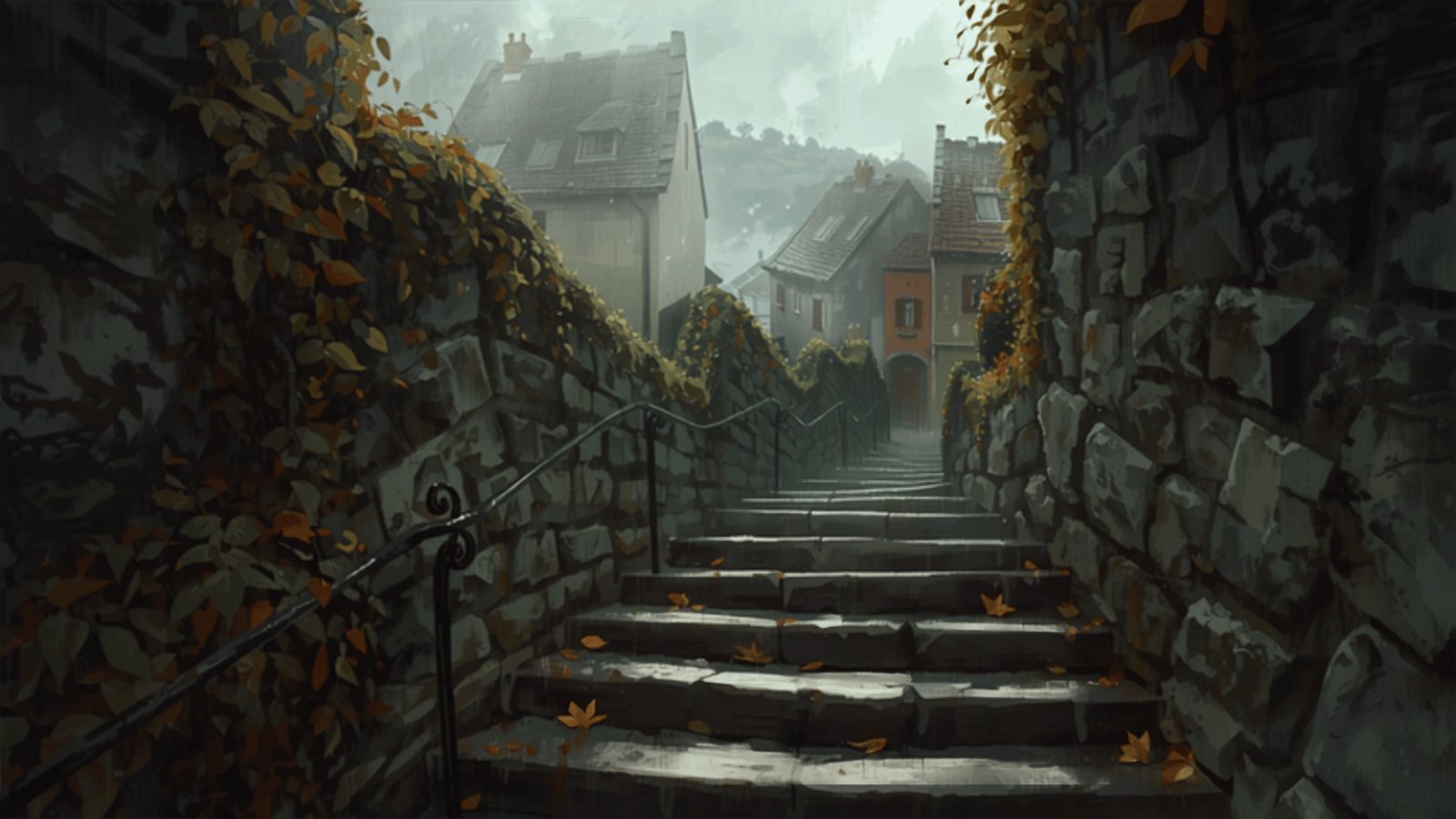
The Vega Steps began at the bottom of Anchor Lane, between a fish restaurant and a shop that repaired bicycles. From there, one hundred wide stone steps climbed the hill in five straight sections, with a small terrace at the end of each section where people could stop and catch their breath. Halfway up, on the third terrace, stood a green wooden kiosk that sold newspapers, bus tickets, cold drinks, and — according to the hand-painted sign — “the best view in Valmora, free with every coffee”.
Climbing them for the first time, Amara understood at once that the steps were not simply a way of getting somewhere. They were a street that happened to go uphill. Washing lines crossed overhead between the houses on either side. A cat slept on the warm stone of the second terrace. A delivery man carried boxes of vegetables up towards a restaurant, two steps at a time, greeting people by name as he passed. Somewhere above her, someone was practising the trumpet, badly. The city did not just use the steps; it lived on them.
When Amara arrived at the halfway terrace, slightly out of breath, the kiosk was busy. A nurse in a blue uniform was buying water. Two schoolboys were arguing about football. An old man with paint on his fingers was drinking coffee on the bench and watching the harbour as if it belonged to him.
The woman behind the counter was called Rosa. She was sixty-one years old, and she had run the kiosk for nearly forty years — first with her husband, Tomas, and then, after his death, alone.
“You’re the third journalist this year,” Rosa said when Amara introduced herself. “The other two took a photo of the view and never came back. Sit down. If you’re going to write about my steps, you should at least know what they are.”
So Amara sat down, and Rosa talked.
She told Amara that around two thousand people used the steps every day. She told her that the nurse, whose name was Grace, climbed them twice a day to reach the hospital in the upper town, because the bus went the long way around the hill — almost two kilometres — and only came every forty minutes. She told her that the funicular, the little railway that had once carried people up the steepest part of the hill, had been closed for fifteen years, so the steps were now the only direct way up. She told her that Tomas had proposed to her on step fifty, on a windy evening in 1987, and that he had been so nervous he had dropped the ring, and it had bounced down four steps before a stranger caught it.
The nurse, Grace, stopped on her way out. “I heard what you’re writing about,” she said. “Put this in your article: if the steps close, I will spend three extra hours a week on a bus. That is three hours I could spend with my patients, or with my son. The people who signed that decision have never had to choose between the two.”
“If they close the steps,” Rosa added, “they don’t just close a shortcut. They cut the city in half. The lift in the new building will be private — residents only. Everyone else can walk around the hill and be grateful.”
The old man with paint on his fingers turned around. His name was Teo, and he had been a sign-painter all his life; half the shop signs in Lowmarket had been painted by his hand.
“Ask them about the plaque,” he said.
“What plaque?” Amara asked.
“There was a bronze plaque at the bottom of the steps when I was a boy. It was taken down in the sixties, when the council widened the road, and it was never put back. My father used to read it to me.” Teo closed his eyes to remember. “It said the steps were built in 1911, and it said who paid for them. Not the city. Not a rich family. Everybody.”
“What do you mean, everybody?”
“A thousand families, one coin each. The fishermen wanted their children to reach the school in the upper town without walking two kilometres in the rain. So the neighbourhood paid, and the neighbourhood built.” He opened his eyes. “You’re a journalist. Go and check. Old things get forgotten, but they get written down first.”
Amara walked back down the hundred steps with three pages of notes and a strange feeling in her chest. Her ninety-minute job was already ruined, and she was glad.
3 · Paper and dust
The city archive occupied the basement of the old post office: a long, cool room that smelled of dust and cardboard, where the history of Valmora was kept in grey boxes on metal shelves. It was managed, unofficially, by Mr Benedek, a retired teacher who volunteered there four days a week because, as he put it, “someone has to know where the twentieth century is”.
When Amara explained what she was looking for, his eyes brightened in a way she would later recognise as dangerous. It was the look of a man who had been waiting years for somebody to ask the right question.
“The Vega Steps,” he said. “Completed in April 1911. Paid for by public subscription — which means ordinary people gave the money. Sit down, drink nothing near the documents, and give me twenty minutes.”
He came back with a box of photographs and a bound volume of the Valmora Herald, the newspaper that had existed before the Courier. The paper was brown at the edges and the print was tiny, but the story was all there. In 1910, a fishermen’s association had collected money from more than a thousand families in Lowmarket. The landowner, a shipping merchant named Aurelio Vega, had been so moved by the campaign that he had given the land for a symbolic price of one coin.
The photographs told the story before the words did. In one, taken in the winter of 1910, a line of men and women stood in the rain outside a church hall, waiting to hand over their coins; a boy at the front held up a small flag. In another, taken at the opening in April 1911, hundreds of people filled the finished staircase from bottom to top, dressed in their best clothes, while a priest blessed the stone and a band played on the first terrace. At the bottom of the steps, clearly visible, was the bronze plaque that Teo remembered.
And then Amara found the sentence that changed everything. The Herald of 14 April 1911 reported the opening ceremony, and quoted the words that had been written into the deed of transfer — the legal document by which Vega gave up the land:
“This land is given to the people of Valmora, freely and forever, on the condition that it shall remain a public way. Should it ever cease to be so, it shall be returned to the families who built it.”
Amara read it three times. “Mr Benedek,” she said slowly, “is that what I think it is?”
“It’s a covenant,” he said. “A condition attached to the gift. If the words in the newspaper match the words in the deed, then the land cannot legally be sold to a private developer at all. It doesn’t fully belong to the city. It belongs, in a sense, to a thousand families.”
“Then show me the deed.”
Mr Benedek’s face changed. He led her to a shelf, took down a grey box labelled Vega — land transfers, 1905–1920, and opened it. Inside there was a folder. Inside the folder there was nothing except a small paper slip, dated 1984, on which somebody had written: Removed for administrative review.
“Removed by whom?” Amara asked.
“It doesn’t say. And in forty years, it has never come back.” He put the empty folder down gently, the way you might handle something that had died. “A newspaper report is evidence of what the deed said. But it is not the deed. If this goes to a courtroom, or to a council vote, they will ask for the original document. Without it, Meridian’s lawyers will say the covenant is a legend.”
“Then I’ll find it,” Amara said, with more confidence than she felt.
4 · The question of safety
While Amara was digging through the past, the present was moving quickly. Meridian Property Group had started a polite, well-funded campaign of its own. Glossy leaflets appeared in Lowmarket letterboxes. A smiling spokesperson appeared on local radio. The message was always the same: this was not about profit, it was about safety. The steps, it was said, were crumbling. The structure, it was claimed, could collapse. A professional survey had found the staircase to be beyond economic repair.
Amara requested a copy of that survey from the council, as any citizen had the right to do. It took eleven days and three reminder emails to arrive, and when it did, she read all sixty pages at her kitchen table with a pot of tea and a growing sense of disbelief.
The survey did describe real problems: cracked steps, tired handrails, poor drainage on two of the terraces. But the word “collapse” appeared nowhere. And on the final page, in small print, she found the detail that mattered most: the survey had been commissioned and paid for by Meridian Property Group itself. The company that wanted the steps declared unsafe had hired the inspectors who declared them unsafe.
She also tried the official routes. She rang the council’s press office and asked, politely, who had removed the deed from the archive in 1984, and why the covenant had not been mentioned in the sale documents. A spokesperson told her that the council did not comment on individual records. When she asked whether the council had seen the survey before approving the sale, she was told that all correct procedures had been followed. When she asked what those procedures actually were, she was told that someone would call her back. Nobody ever did.
She telephoned an independent structural engineer, a brisk woman named Dr Okafor, and asked her to walk the steps and give an honest professional opinion. The Courier could not pay much, Amara warned. Dr Okafor laughed and said that some jobs were worth doing for the story alone.
Two days later, Dr Okafor called back with her verdict. The steps needed repair, she said — that part was true. But they were more than a century old and structurally honest, built by people who expected them to last forever. Full repair would cost around two hundred thousand. Demolition alone would cost three times that, before a single apartment was built.
“So it was never about safety,” Amara said.
“In my experience,” said Dr Okafor, “when a developer talks about safety, it is wise to ask who measured the danger.”
That evening Amara went to see Marcus. She put her notes, the survey, the engineer’s numbers, and a photocopy of the 1911 newspaper page on his desk, and she talked for ten minutes without stopping. Marcus listened with his arms crossed. When she finished, he was quiet for a long moment.
“You were asked to write four hundred words,” he said.
“I know.”
“Write two thousand. Front page, Saturday.” He almost smiled. “And Amara — if you are going to accuse a property company of bending the truth, be right. If we get one fact wrong, their lawyers will eat us alive.”
5 · What the city keeps
The article was published on Saturday under the headline “Who Owns a Staircase?” It told the story of the thousand families, the coin, the covenant in the deed, the missing document, and the survey that had been paid for by the very company that profited from its conclusions. Every fact had been checked twice.
Valmora woke up. By Sunday evening, the article had been shared thousands of times. By Wednesday, a petition demanding the repair — not the demolition — of the Vega Steps had been signed by nine thousand people, and Rosa’s kiosk had become its unofficial headquarters, with the signature sheets kept under the counter next to the bus tickets. Teo painted a banner that was hung across the bottom of the steps: BUILT BY A THOUSAND FAMILIES. NOT FOR SALE.
Meridian’s spokesperson announced that the company was “disappointed by the emotional tone of the coverage”. The council, caught between an angry public and a signed contract, did what councils do: it scheduled a special meeting.
In the days before the meeting, the steps themselves became the campaign. Students from the art school chalked the number of each step onto the stone — one to one hundred — and next to every tenth number they wrote the name of one of the original families, copied from Mr Benedek’s records. Grace organised the nurses, and the nurses organised everyone else. On the Sunday, the completed petition was carried from the kiosk to the town hall by a procession that took twenty minutes to pass, and Teo, who said he was too old to march, stood on the third terrace and painted the whole scene instead.
The meeting was held on a cold Thursday night in the town hall, and so many people came that loudspeakers had to be set up outside. Amara sat in the press seats with her notebook. Meridian’s lawyer, a calm man in a beautiful grey suit, spoke first. He said that his client sympathised with local feeling. He said that the sale had been conducted lawfully. And then he said the sentence that Amara had been expecting for weeks.
“Much has been made of a so-called covenant. Yet no such document has been produced. A line in a newspaper from 1911 is not a legal deed. If this covenant exists, where is it?”
Silence. Amara’s stomach dropped. Six weeks of searching — the archive, the land registry, two law offices, a museum — and the original deed had never been found.
Then, near the back of the hall, a chair scraped. Rosa stood up. She was holding an old biscuit tin.
“My husband’s grandfather was Tomas Herrera,” she said, and her voice shook only a little. “He was the treasurer of the fishermen’s association. He collected the coins in 1910, house by house. When the land was transferred, three copies of the deed were signed. One went to the city — you seem to have lost it. One went to the Vega family. And one was kept by the association.” She opened the tin. “My husband kept everything. He always said that paper is the only thing a poor family can leave behind.”
She lifted out a document, brown with age, folded in quarters, and held it up. “It has been in my kiosk, halfway up those steps, for forty years. If it had been kept anywhere else, perhaps it would have gone missing too.”
The hall erupted. The document was passed to the council’s own legal officer, who read it under the lights while eight hundred people held their breath, and who then confirmed, in careful legal language, that the covenant was genuine, that the condition had been broken by the sale, and that the contract with Meridian could not stand.
The vote was not even close. The sale was cancelled, the steps were declared a protected heritage structure, and the repair programme — guided, at the council’s request, by Dr Okafor — was approved before Christmas.
In the spring, a new bronze plaque was fixed at the bottom of the Vega Steps, in the exact place where the old one had been taken down sixty years earlier. Teo painted the letters for the unveiling banner himself. The plaque repeated the words of 1911, and below them, in smaller letters, it added a new line: Defended by the people of Valmora, 2026.
Amara stood at the unveiling with Rosa on one side and Mr Benedek on the other, and she thought that “the best view in Valmora” had never looked better.
On Monday morning, back at her desk, she found a single sheet of paper waiting for her. Marcus walked past without slowing down.
“Council notice,” he said over his shoulder. “The old harbour clock tower is being sold. Probably nothing.”
Amara picked it up and smiled. Probably nothing. That was exactly what they had said about the staircase.
Check your understanding
Read each question. Think about your answer. Then click “Show answer” to check.
Words to remember
Here are the key words again, in new sentences. Try to use each one in a sentence of your own.
- demolition — The demolition of the old cinema was stopped after local protests.
- developer — A developer has bought the empty factory and plans to build offices there.
- covenant — The garden is protected by a covenant, so it can never be built on.
- deed — Keep the deed to your house in a safe place — it proves you own it.
- archive — I found my grandfather’s photograph in the newspaper’s archive.
- petition — More than five thousand people signed a petition to save the library.
- survey — The survey showed that the bridge needed urgent repairs.
- heritage — The old town centre is part of our heritage and must be protected.
- plaque — There is a small plaque on the wall where the poet was born.
- funicular — We took the funicular up the hill instead of climbing the steps.
Grammar in this story: the passive voice
This story is full of the passive voice, because official city language loves it. The passive lets a speaker hide who did the action — which is exactly what officials and companies often want. Look:
The steps had been declared unsafe. The land had been sold. The plaque was taken down in the sixties and was never put back. The survey was commissioned and paid for by Meridian itself.
Notice the pattern: be + past participle (was sold, had been declared, was taken down). In each sentence, the person or company who acted is either hidden or pushed to the end with by. When Amara asks “Removed by whom?”, she is really fighting against the passive voice — she wants to know who is responsible.
👉 Learn the full rule here: Active vs Passive Voice Explained.
Talk about it · Write about it
Talk about it: Is there a place in your city — a market, a park, a staircase, an old building — that people would fight to save? Who uses it, and what would be lost if it disappeared? Have you ever signed a petition, and did it work?
Write about it: Imagine your favourite public place is about to be sold to a developer. Write a short letter (120–180 words) to your local newspaper arguing against the plan. Use at least three passive forms (for example: it was built by…, it has been used for…, it must not be demolished).
🎉 Well done — that was a full-length B2 story of more than three thousand words. You followed an investigation, a legal mystery, and a whole neighbourhood’s fight, all in English.
But one thread is still hanging: there is a new notice on Amara’s desk, and the harbour clock tower is “probably nothing”. You already know what that means in Valmora…
Choose Your Next Story
This is the last story in the money and responsibility group. Choose another B2 story from the reading collection when you are ready.
Other Story in This Group: The Extra Zero (B2 Reading Story)
About this story: This is an original B2 graded reader (~3,100 words). The vocabulary is controlled to upper-intermediate level, with richer grammar — passives, reported speech, and conditionals — used naturally in context. The ten harder words that the story needs are explained before you read and repeated inside the story, so you should understand about 98% of the words you meet.

I’m Khamis Maiouf. I’m studying Health and Social Care and have completed Functional Skills Level 2 in English and Level 3 Hairdressing. I have taught ESOL in my community and helped students with GCSE English. I run English Teacher Site to help people learn and practise English.